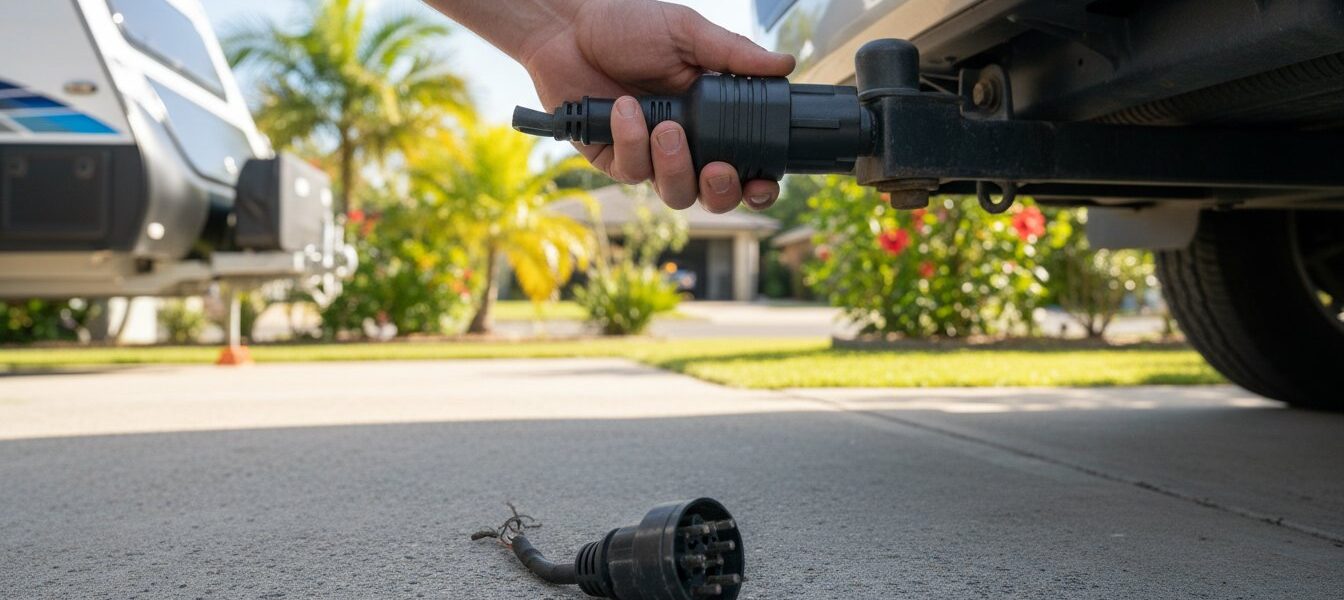
A melted trailer plug is often the first sign that your 7 pin connector is working way beyond its engineered limits. When you’re pulling 30 amps through a circuit designed for basic lighting, the heat buildup is inevitable and dangerous. Most caravan owners realize too late that their batteries didn’t charge during an eight hour haul because the voltage drop was too high. Upgrading to a 12 pin trailer plug is the most effective way to provide dedicated high-current paths for your fridge and power systems without compromising your safety or your equipment.
We know you need a setup that works every time you hit the road. You’ll learn the technical differences between standard and heavy-duty connections and why the 12 pin solution is essential for modern Australian towing. This overview compares pin configurations and explains how to achieve a reliable power connection that meets national standards.
Key Takeaways
- Understand why modern caravans require more than basic 7-pin lighting circuits to power complex internal accessories.
- Compare the physical size and current-carrying capacity of a 12 pin trailer plug against traditional 7-pin options.
- Identify standardized Australian wiring layouts and color codes for both lighting and heavy-duty auxiliary power pins.
- Determine if a 12-pin system or an Anderson plug is the right choice for your fridge and battery charging needs.
- Learn why ADR compliance and heavy-duty components are critical for maintaining electrical reliability in harsh Australian conditions.
The Role of 12 Pin Trailer Plugs in Modern Towing
Trailer wiring used to be simple. You needed power for indicators, brake lights, and tail lights. Modern towing demands far more from a vehicle’s electrical system. Today’s caravans and heavy-duty trailers carry onboard batteries, electronic stability control, and large fridges. A standard 7-pin setup often reaches its physical limit quickly. This evolution has made the 12 pin trailer plug the industry standard for serious Australian tourers who need reliable power on the move.
The Australian Standard AS4177.5 defines the requirements for these connectors. This standard ensures that the plug can withstand the mechanical stress of towing while maintaining a constant electrical connection. For a broader trailer connector overview, it’s clear that moving beyond basic lighting requires a more robust interface. The flat-style 12-pin configuration is now the common choice across Australia. It maintains compatibility with 7-pin flat plugs while adding high-current capacity for heavy-duty applications.
Solving the Power Delivery Problem
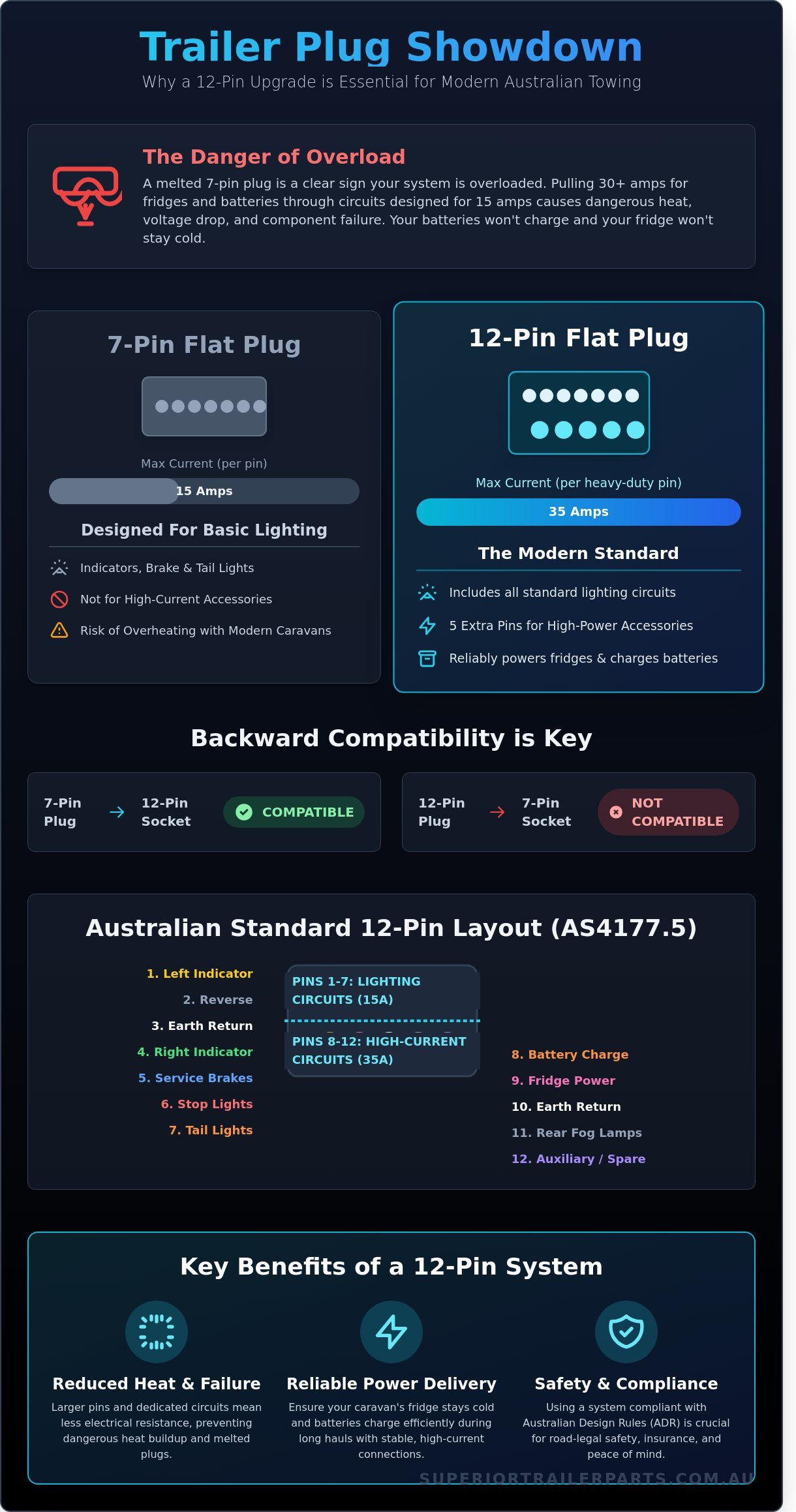
Standard 7-pin circuits use small terminals rated for approximately 15 amps. When you try to run a 12V fridge and charge a caravan battery through these tiny pins, they struggle. High resistance leads to heat. It’s common to see 7-pin plugs with melted plastic around the pins because of this overload. You’ve outgrown your wiring when your fridge isn’t staying cold or your trailer batteries aren’t charging during transit. A 12 pin trailer plug solves this by providing five additional large pins.
- Dedicated Circuits: These plugs provide separate paths for high-draw accessories like fridges and battery chargers.
- Higher Amperage: The additional pins are typically rated for 35 amps, offering a stable path for heavy current.
- Reduced Heat: Larger contact areas mean less resistance and a lower risk of circuit failure.
Australian Towing Requirements
Compliance with the Australian Design Rules (ADR) is essential for safety and insurance purposes. Your electrical setup must meet specific criteria to remain road legal. Using genuine components is vital for long-term reliability. Cheap, non-compliant plugs often fail when exposed to the vibration and dust of corrugated roads. If you’re planning a DIY upgrade, sourcing high-quality trailer parts ensures your connection stays secure. Superior components are built to handle 40-degree heat and the harsh conditions found across the country. Stick to gear that meets the AS4177.5 benchmark to keep your setup safe and functional.
7 Pin vs 12 Pin Trailer Plugs: A Functional Comparison
The physical difference between these two components is immediate. A standard 7 pin flat socket measures approximately 70mm in width, while a 12 pin trailer plug socket is slightly wider at roughly 75mm. While the mounting screw patterns often align, the 12 pin housing requires more depth behind the bumper to accommodate the additional heavy-gauge wiring. Choosing the larger format provides a future-proof setup for any towing requirement.
Pin Capacity and Current Limits
Electrical performance is where the 12 pin trailer plug excels. Standard pins 1 through 7 are designed for essential lighting circuits like indicators and brake lights; these typically carry a 15 Amp limit. The bottom row of a 12 pin configuration contains five heavy-duty pins. These are rated for up to 35 Amps in high-quality units. This extra capacity is a game-changer for caravan owners who need to power internal fridges or charge house batteries while on the move. All wiring must adhere to the Australian Vehicle Standards Bulletin 1 to ensure safety and legal compliance on public roads.
Backward Compatibility and Practicality
One of the most practical features of the 12 pin flat socket is its backward compatibility. A standard 7 pin flat plug fits perfectly into the top row of a 12 pin socket. This versatility means you can tow a basic box trailer one day and a complex caravan the next without using adapters. A 12 pin plug won’t fit into a 7 pin socket because the bottom row of pins is physically blocked. Using a 7 pin plug in a 12 pin environment also means you lose access to those high-draw auxiliary circuits.
Upgrading your vehicle to a 12 pin system is a cost-effective move. High-quality sockets range from A$35 to A$65, with professional installation usually taking under two hours. If you’re currently maintaining or building a heavy duty single axle box trailer, sticking with a 7 pin is sufficient. For anything involving a battery system, the 12 pin is the industry standard for reliability. You can find a wide range of reliable caravan parts and electrical components to suit your specific towing weight and electrical load.
Australian Wiring Standards and Pin Layouts
Australian trailers must adhere to the AS 4177.5-2004 standard. This regulation ensures that every tow vehicle and trailer remains compatible across the country. A 12 pin trailer plug integrates standard lighting signals with high-current power circuits into a single housing. This setup is the industry standard for modern caravans equipped with internal batteries, electric brakes, and 12V fridges.
The Standard 7-Pin Layout (Pins 1-7)
The top row of a 12-pin socket mirrors the traditional 7-pin flat layout. These pins handle essential safety lighting and braking signals. You must ensure these connections match standard caravan parts configurations to maintain road legality. For a detailed visual reference, refer to the Narva trailer plug wiring guide which outlines the terminal positions precisely.
- Pin 1: Yellow (Left Turn)
- Pin 2: Blue (Service Brakes)
- Pin 3: White (Earth)
- Pin 4: Green (Right Turn)
- Pin 5: Brown (Tail, Clearance, and Side Markers)
- Pin 6: Red (Stop Lamp)
- Pin 7: Black (Reverse Lamp)
The Auxiliary 5-Pin Layout (Pins 8-12)
The bottom row provides the expanded functionality that defines a 12 pin trailer plug. These five pins are physically larger than the top row. This design allows them to carry up to 35 amps of current safely. Using the correct wire gauge is vital here. We recommend at least 6mm automotive cable for pins 8, 9, and 10 to prevent voltage drop over long distances.
- Pin 8: Orange (Battery Charger or Winch)
- Pin 9: Pink (Auxiliary/Battery Feed)
- Pin 10: White (Earth Return)
- Pin 11: Grey (Rear Fog Light)
- Pin 12: Purple (Spare/Auxiliary)
Pin 10 plays a critical role as the dedicated earth return for high-power circuits. Don’t make the mistake of grounding your auxiliary power through the small pin 3 earth. The pin 3 wire is usually only 1.5mm to 2.5mm thick. It can’t handle the return current from a 30-amp DC-DC charger. Overloading that small wire leads to melted plugs and potential electrical fires.
Common DIY mistakes often involve poor terminal crimping or using undersized “ribbon” cable for power-hungry accessories. If your fridge isn’t staying cold during transit, check the voltage at pins 8 and 9. Most issues stem from high resistance caused by corrosion or thin wiring. Always use heat-shrink tubing on your joins to keep moisture out of the copper strands. This simple step prevents the “green rot” corrosion that plagues trailers in coastal environments.
Practical Considerations for Upgrading to a 12 Pin System
Moving to a 12 pin trailer plug involves more than just swapping a plastic housing. You’re changing how your vehicle manages power delivery to your caravan or trailer. You must account for increased current draw and the physical toll of Australian road conditions. Before you start, check your vehicle’s alternator capacity. Most modern 4WD alternators produce between 80 and 140 amps. Adding a 3-way fridge and a battery charging circuit can strain these systems if not managed correctly.
Component quality is the difference between a reliable connection and a roadside failure. Always choose plugs with nickel-plated brass terminals. These offer superior corrosion resistance compared to standard brass. This is vital for coastal towing where salt air quickly oxidises unprotected metal. You’ll need the right tools for a professional-grade installation:
- Heavy-duty wire strippers for thick gauge cable
- A quality ratchet crimping tool
- Adhesive-lined heat shrink for weatherproofing
- A digital multimeter to verify circuit continuity
The 12-Pin vs Anderson Plug Debate
A 12 pin trailer plug provides a convenient single-point connection for all your lighting and low-to-medium power needs. The five larger pins are generally rated for 30 amps. This is usually sufficient for running a fridge while driving. However, an Anderson plug is still the standard for ultra-high current applications. If your DC-DC charger pulls 50 amps or more, a dedicated Anderson plug is required. Many owners run a hybrid system. They use the 12 pin for signals and the fridge, while a separate Anderson plug handles heavy battery charging.
Durability in Australian Environments
Australian conditions are notoriously harsh on electrical components. High UV levels make cheap plastics brittle within months. Vibration from corrugated tracks can shake loose poorly seated terminals. Ensure your plug features a high-impact, UV-stabilised housing with a robust weather seal. This prevents dust and water ingress, which are the primary causes of short circuits in the bush. If you’re unsure about the specific wiring requirements for your rig, contacting experts is the best way to avoid costly electrical errors.
Upgrade your towing setup with heavy-duty caravan parts designed for Australian roads.
Sourcing Heavy-Duty Electrical Components for Your Trailer
Reliability starts with the hardware. A standard 12 pin trailer plug must handle 35 amps on its larger auxiliary pins to function correctly. Cheap imports often fail because they use low-grade plastics that melt at temperatures as low as 80 degrees Celsius. Superior Trailer Parts stocks components tested for harsh Australian conditions. We prioritize ADR compliance to ensure your setup meets legal safety standards. We offer Australia-wide shipping on all electrical components to keep your fleet moving.
Quality Indicators for Trailer Plugs
Look for heavy-duty nylon or reinforced metal casings. These materials resist impact and UV degradation during long hauls. Quality 12 pin trailer plug units feature internal rubber seals. These gaskets prevent moisture from corroding copper terminals. Corroded terminals increase electrical resistance. This leads to heat buildup and eventual circuit failure. Avoid unbranded plugs that lack integrated cable grips. A secure grip prevents wires from pulling out during tight turns or heavy vibrations.
Complete Your Trailer Setup
Your plug is just one part of the electrical system. Ensure your caravan parts and lighting are fully compatible. Modern LED submersible lights require clean signals to prevent flickering or ghosting. Check your electric braking system compatibility before finishing the install. A 12-pin configuration often powers fridge circuits and battery charging simultaneously. If your wiring gauge is too thin, you’ll lose voltage over the length of the trailer. We take a practical approach to maintenance. Get the right trailer parts the first time to avoid costly roadside repairs.
Final Pre-Departure Checklist:
- Check pin alignment for all 12 connection points to prevent bent terminals.
- Test the auxiliary power pins with a multimeter to ensure minimal voltage drop.
- Verify the weather seal is seated correctly in the socket housing.
- Inspect the cable gland for a tight, waterproof fit on the harness.
- Confirm the locking flap on the socket engages the plug securely.
Superior Trailer Parts is Australian Owned and Operated. We provide the expert advice needed to tackle complex electrical upgrades. Our team understands that durability is non-negotiable for professional haulers. We focus on providing genuine parts at competitive pricing. Order your heavy-duty electrical gear today and experience the difference that quality engineering makes on the road.
Upgrade Your Towing Capability
Modern towing demands more than basic lighting signals. While a 7 pin setup handles essentials like indicators and brake lights, it lacks the circuits needed for high-current accessories. Switching to a 12 pin trailer plug adds five dedicated pins rated for 35 amps each. These extra connections power electric brakes, internal fridges, and battery charging systems without overloading your wiring. Adhering to Australian Standard AS 2513 ensures your vehicle and trailer communicate safely across every kilometer of track. Superior Trailer Parts is a 100% Australian Owned and Operated business. We stock heavy-duty electrical components designed to withstand intense heat and vibration. Our team provides expert technical advice to help you select the right parts for your specific rig. We offer fast nationwide shipping Australia wide so you can complete your upgrade and get back on the road. Don’t settle for a basic connection when your equipment requires reliable power. Invest in quality components that keep your caravan or camper fully functional during your next trip.
Shop Heavy-Duty 12 Pin Trailer Plugs at Superior Trailer Parts
Frequently Asked Questions
Can I plug a 7 pin trailer plug into a 12 pin socket?
Yes, you can plug a standard 7-pin flat plug directly into a 12-pin socket. The top row of a 12-pin socket is designed to be 100% compatible with the standard Australian 7-pin flat configuration. This allows you to tow different trailers without needing a bulky adapter. It’s a practical solution for owners who switch between a basic box trailer and a heavy-duty caravan.
What is the main advantage of a 12 pin trailer plug over a 7 pin?
The primary advantage is the extra five high-current pins located on the bottom row. While a 7-pin plug only handles basic road lights, a 12 pin trailer plug provides dedicated circuits for power-hungry accessories. Each of these five additional pins is rated for 35 amps. This allows you to run internal caravan lights or maintain battery charge while you’re on the move across Australia.
Do I need a 12 pin plug to run a fridge in my caravan?
You definitely need a 12 pin trailer plug if you intend to run a 3-way fridge on 12V power while driving. A standard 7-pin plug isn’t built to handle the 15 to 25 amp draw required by these appliances. Using the larger 35-amp pins on a 12-pin setup prevents dangerous heat buildup and ensures your fridge stays at 4 degrees Celsius during long hauls.
What wire gauge should I use for the heavy-duty pins on a 12 pin plug?
Use 6mm automotive cable for the five heavy-duty pins to ensure maximum performance and safety. This specific gauge is necessary to support the 35-amp rating of the larger terminals without causing a voltage drop. For the standard lighting pins on the top row, 2.5mm or 3mm cable is sufficient. Always select high-quality tinned copper wire to resist corrosion in harsh coastal environments.
Is a 12 pin plug the same as an Anderson plug?
No, they’re different components with different jobs. A 12-pin plug combines your road lights and medium-power circuits into a single housing. An Anderson plug is a dedicated high-current connector often rated at 50 amps or more. While a 12-pin plug is great for fridges, an Anderson plug is the industry standard for heavy-duty battery charging and powering electronic stability control systems.
Why does my 12 pin plug get hot when I am towing?
Heat is a sign of high electrical resistance. This usually happens because the pins are dirty, the terminals are loose, or you’re pulling more than 35 amps through a single circuit. Check your wire gauge and ensure the female sockets haven’t spread open over time. A 10% increase in resistance can cause enough heat to melt the plastic housing during an 8-hour drive.
Can I wire a 12 pin plug myself or do I need an auto electrician?
You can wire it yourself if you’re confident with 12V systems and have the right crimping tools. However, hiring an auto electrician ensures the 35-amp circuits are fused correctly and integrated safely with your vehicle’s CAN bus system. For professional installation, you can visit Armour Corporation. This investment, typically costing between A$150 and A$300 in Australia, protects your vehicle’s warranty and ensures your trailer lights work every time.
Are 12 pin plugs waterproof for boat trailer use?
Most 12-pin plugs carry an IP54 rating, which means they’re splash-proof but not submersible. Saltwater is highly conductive and will cause rapid corrosion if it gets inside the housing. If you use a 12-pin setup for a boat trailer, we recommend mounting the socket high on the winch post. This keeps the terminals dry and functional, preventing the common A$50 replacement cost for a corroded plug.