Most imported box trailers sold in Australia aren’t worth the steel they’re made from. They look the part online, but often show up with a flimsy chassis, questionable welds, and a coat of paint hiding low-grade materials ready to rust after the first downpour.
It’s a frustrating reality when you just need a reliable workhorse for tip runs, moving gear, or weekend projects. You don’t have time for a trailer that fails when you need it most, and decoding technical jargon like GVM versus ATM can feel like a guessing game.
This article provides a no-nonsense breakdown of the classic 6×4 trailer. We’ll equip you with the essential knowledge to assess a trailer’s true dimensions, understand its load capacity, and identify the heavy-duty components that define a quality Australian build. You’ll learn exactly what to look for in axles, springs, and chassis construction, so you can choose a trailer that meets legal standards and is tough enough for the job.
Key Takeaways
- Learn why a Rectangular Hollow Section (RHS) chassis and hot-dipped galvanisation are critical for durability in Australian conditions.
- Understand the key differences in capacity and towing visibility between a 6×4 and 7×4 trailer to select the right size for your needs.
- Establish a routine inspection schedule to protect your single axle trailer from high-wear and coastal corrosion.
- Identify the manufacturing standards that define a heavy-duty trailer and the benefits of using Australian-owned hardware.
Understanding the 6×4 Trailer Standard in Australia
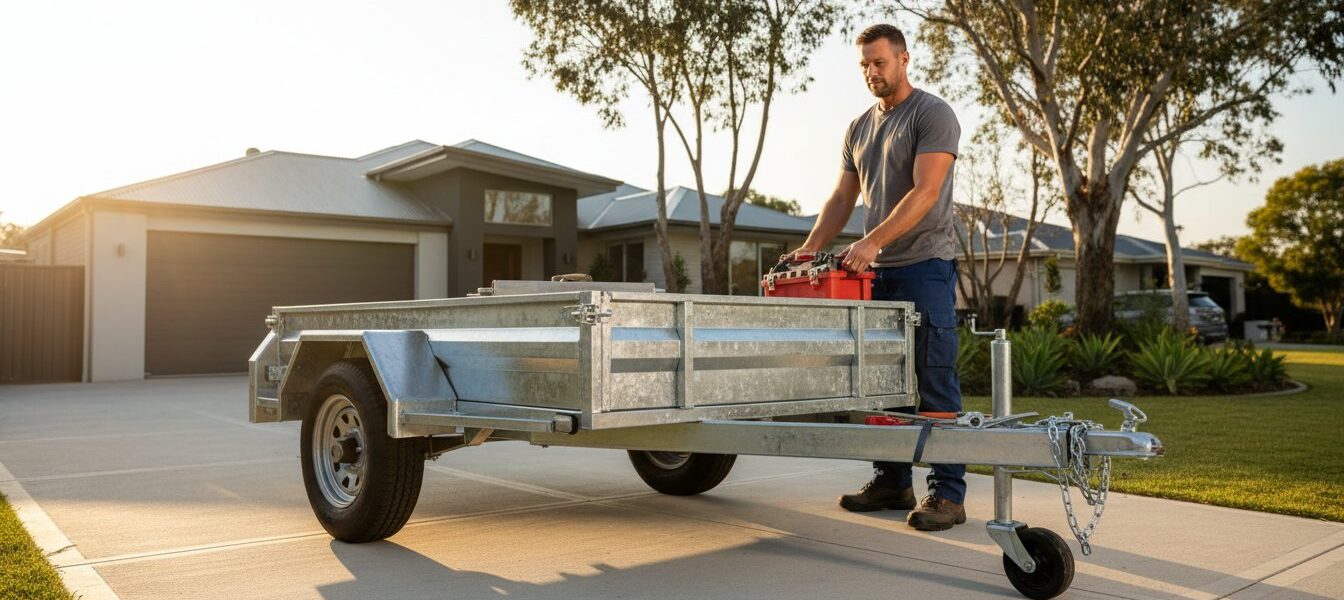
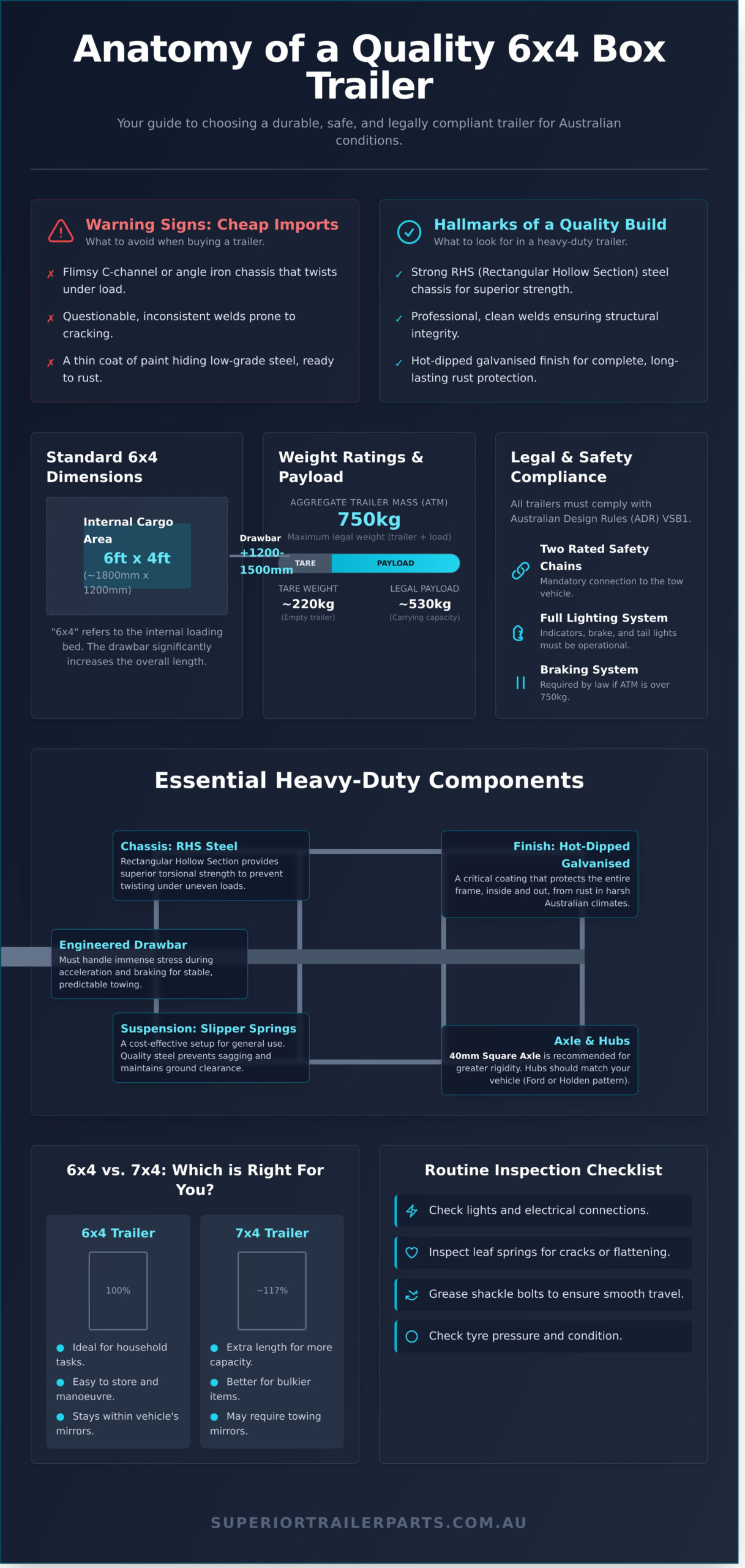
The 6×4 box trailer is a cornerstone of Australian utility. The name defines its core function: an internal loading bed measuring 6 feet long (approximately 1800mm) and 4 feet wide (approximately 1200mm). This simple, effective design makes it the default choice for residential tasks and light commercial work across the country. It’s the go-to solution for weekend tip runs, transporting garden supplies, or carrying a tradesperson’s basic tools.
Its widespread popularity is built on a practical, no-fuss foundation. Most models feature a durable single-axle configuration, which keeps costs down and maintenance simple. This setup is perfectly matched to the standard unbraked Aggregate Trailer Mass (ATM) of 750kg. This specific rating allows it to be towed by most passenger cars without needing a separate braking system, making it one of the most accessible trailer types available. It hits the sweet spot between capability and convenience.
Internal vs External Dimensions
The “6×4” designation refers strictly to the internal cargo area. The trailer’s overall footprint is significantly larger. The drawbar, which connects the trailer to the tow vehicle, typically adds another 1200mm to 1500mm to the total length. This is a critical measurement for anyone planning to store their trailer in a standard garage. Side wall heights also vary, with 300mm being a common standard and 600mm high-side options available for bulkier loads.
Weight Ratings and Legal Requirements
Understanding trailer mass is essential for safe and legal towing in Australia. Every trailer has a compliance plate detailing its weight specifications, which you must not exceed.
- Tare Weight: The weight of the empty trailer. A typical steel 6×4 trailer has a Tare Weight between 200kg and 250kg.
- Aggregate Trailer Mass (ATM): The maximum legal weight of the trailer fully loaded. For a standard unbraked 6×4, this is 750kg.
- Payload: Your legal carrying capacity. It’s calculated by subtracting the Tare Weight from the ATM. A trailer with a 220kg tare has a payload of 530kg (750kg – 220kg).
All trailers must comply with Australian Design Rules (ADR), as outlined in Vehicle Standards Bulletin 1 (VSB1). This includes mandatory, non-negotiable safety features like two rated safety chains and fully operational lighting systems for indicators, brakes, and tail lights. If a 6×4 trailer is built to carry more than 750kg ATM, it must be fitted with an effective braking system by law.
Essential Components of a Reliable 6×4 Box Trailer
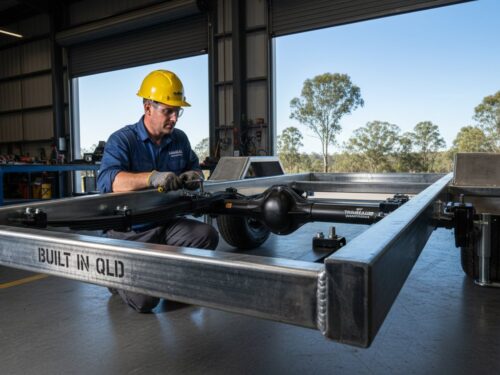
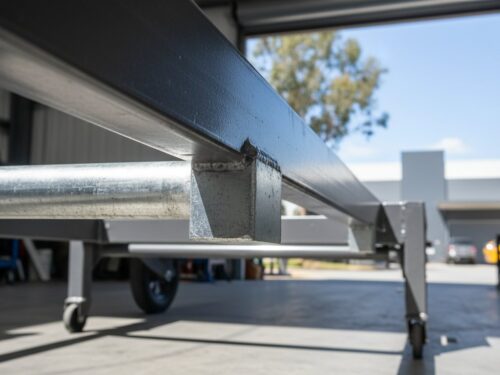
A trailer’s true value lies beneath its painted surface. The structural integrity of a 6×4 box trailer depends entirely on the quality of its core components. The chassis is the backbone, and for dependable strength, we recommend builds using RHS (Rectangular Hollow Section) steel. Its design provides superior torsional strength compared to lighter-duty angle or C-channel frames, preventing twisting under uneven loads.
In the harsh Australian climate, corrosion is a constant threat. A hot-dipped galvanised finish isn’t an optional extra; it’s a necessity for long-term durability. This process coats the entire frame, inside and out, providing a robust barrier against rust that far outlasts a simple paint job. The drawbar, which connects the trailer to your vehicle, must also be built to handle immense stress during acceleration and braking. A well-engineered drawbar ensures stable, predictable towing. Over time, even the best components wear. Sourcing quality replacement trailer parts is key to maintaining performance and safety.
Axle and Hub Selection
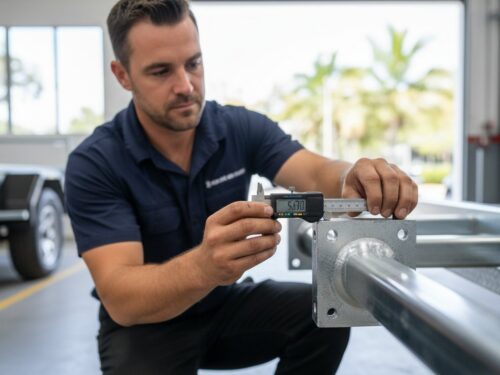
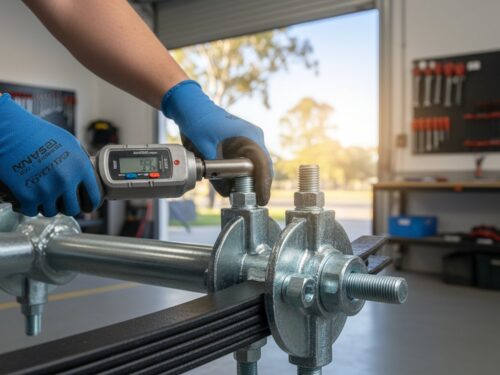
For a standard 750kg Aggregate Trailer Mass (ATM) build, the choice often comes down to a 39mm round axle or a 40mm square axle. While both are suitable, the 40mm square axle offers greater rigidity and resistance to bending. Hub pattern is critical for wheel compatibility. Most Australian trailers use either a Ford (PCD 5×114.3mm) or Holden (PCD 5x120mm) stud pattern. Matching this to your tow vehicle’s spare can be a practical, time-saving choice. Always select axles with a load rating that meets or exceeds your trailer’s ATM.
Suspension and Springs
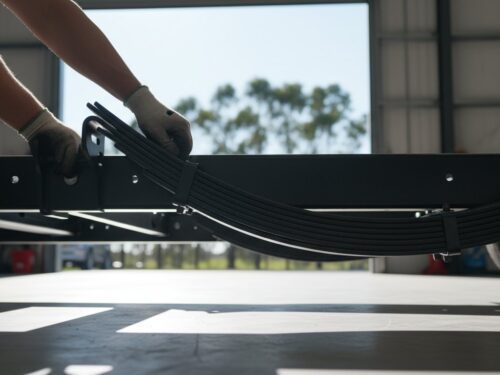
Most utility box trailers use a 4-leaf slipper spring setup. This configuration is cost-effective and provides adequate suspension for general-purpose loads like garden waste, tools, or camping gear. The quality of the steel and the spring’s camber (its upward arc) directly impact ride height and stability. Poor quality springs can sag quickly under load, reducing ground clearance and leading to an unstable tow. Regularly inspect your leaf springs for cracks or flattening, and keep shackle bolts greased to prevent seizure and ensure smooth travel.
Building a trailer from scratch or upgrading an existing one requires careful component selection. If you need help matching the right parts to your project, our team provides expert advice to ensure you get a reliable, long-lasting result.
6×4 vs 7×4: Selecting the Right Dimensions
The primary difference between these trailers is one foot of length. This single dimension impacts load capacity, towing dynamics, and storage. Selecting the right size means matching the trailer’s utility to your specific jobs. You shouldn’t pay for space you won’t use, but you also need a trailer that gets the job done in one trip.
A 7×4 trailer offers approximately 17% more cubic capacity than a 6×4 model, assuming standard 300mm side heights. That extra volume is useful for loose materials like mulch or soil. Both trailers, however, share a 4-foot (1.22m) width. This dimension is critical. It’s narrower than the body of most Australian utes and SUVs, ensuring your side mirrors provide a clear, unobstructed view. This makes towing less stressful on busy roads and simplifies lane changes.
Expect to pay A$200 to A$400 more for a 7×4 trailer over a comparable 6×4. The decision comes down to value. If your typical tasks consistently push the limits of a smaller trailer, that extra investment pays for itself by eliminating second trips. For the occasional user, the added cost may not deliver a practical return. You can directly compare the specifications and pricing of various heavy-duty single axle box trailers to assess the price-to-utility ratio for your needs.
Storage and Maneuverability
A standard Australian carport is around 5.4 metres long. The compact footprint of a 6×4 trailer allows it to be stored easily without obstructing vehicle access. Its shorter drawbar-to-axle length makes it highly responsive when reversing into tight suburban driveways. While any single axle trailer has a sharper turning circle than a tandem, the shorter overall length gives it a distinct advantage in confined residential spaces.
Payload Efficiency
For over 90% of common household jobs, a 6×4 is the right tool. It handles weekend tip runs with green waste, hauling camping gear, or moving a single large appliance with total efficiency. You should only upgrade to a 7×4 or an 8×5 when your loads become consistently bulky or long. This includes transporting multiple sheets of building material, carrying trade tools daily, or moving awkward furniture that demands extra length to secure safely.
Speaking of hauling camping gear, once you have your trailer sorted, the next step is planning the adventure itself. For enthusiasts of remote travel and outdoor exploration, the digital community at Adventurerz is an excellent resource for inspiration and advice.
For those planning a different kind of memorable outdoor gathering, you can explore 3-Day Weekend Wedding options for a truly unique celebration.
Maintenance Requirements for Single Axle Trailers
A trailer’s reliability is a direct result of its maintenance schedule. Whether you own a compact 6×4 trailer for tip runs or a larger 7×4 for trade work, a single axle design requires consistent attention to high-wear components. Don’t wait for a failure on the road. A simple routine inspection prevents costly repairs and ensures your trailer is safe and ready for any job.
For operators in coastal regions like Queensland, the corrosive salt air is a major factor. Salt accelerates rust on steel frames, suspension parts, and electrical contacts. A galvanised finish offers superior protection, but even these trailers benefit from regular freshwater rinses to wash away salt deposits and prolong their service life.
Your pre-tow checklist should always include these critical points:
- Tyre Condition: Check pressure before every trip. The correct PSI is listed on the tyre sidewall. Under-inflation causes excessive wear and heat buildup. Ensure tread depth is above the legal minimum of 1.5mm across the entire tyre surface.
- Coupling and Safety Chains: Inspect the coupling for cracks or damage and ensure it latches securely. Check safety chains and D-shackles for wear and proper connection.
- Springs and U-Bolts: Visually inspect leaf springs for cracks or sagging. U-bolts connect the axle to the suspension and are a critical safety component. Check them for tightness and signs of corrosion. Damaged or stretched bolts must be replaced immediately with high-quality U-bolts kits to prevent axle slippage.
Wheel Bearing Service
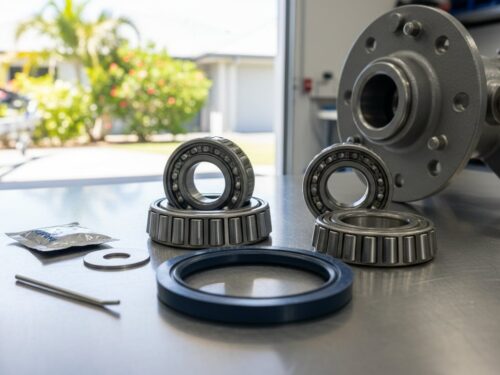
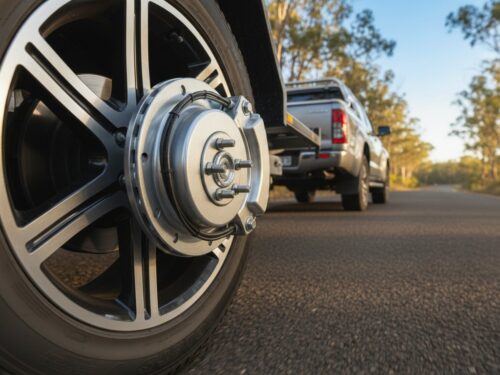
Worn wheel bearings are a common point of failure. You can identify a problem by listening for a rumbling or grinding sound while towing. Another method is to check the hub temperature by hand after a short drive; it should be warm, not excessively hot. Regular greasing every 10,000 km or 12 months is essential. For trailers stored outdoors, fitting bearing protectors provides a constant supply of grease and keeps water out, significantly extending bearing life.
Electrical and Lighting Systems
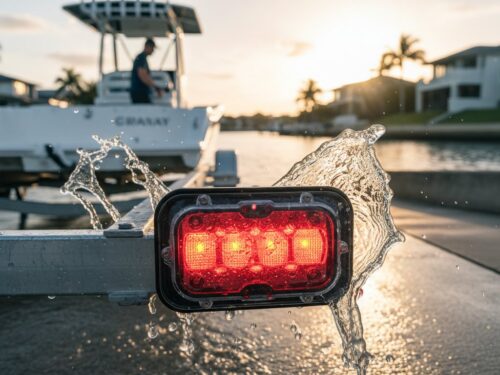
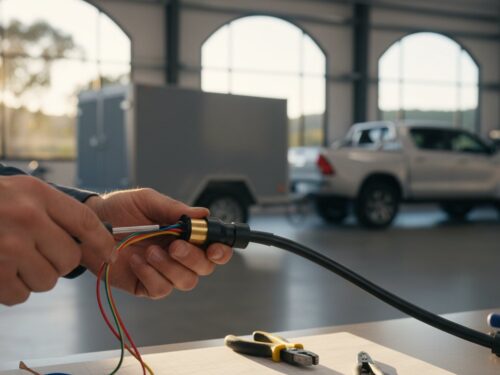
Faulty trailer lights are a safety hazard. Upgrading from old incandescent bulbs to sealed, submersible LED lights offers far greater reliability and longevity, especially for boat trailers. Most lighting issues stem from the 7-pin plug or a poor earth connection. Check plug pins for corrosion and ensure wires are secure. A solid earth connection, bolted directly to a clean spot on the trailer’s steel frame, is necessary for all lights to function correctly.
Proactive maintenance is the best way to get maximum performance and safety from your trailer. Taking 15 minutes for a thorough inspection before you hit the road protects your investment and ensures every trip is a safe one. For genuine, heavy-duty parts to keep your 6×4 or 7×4 trailer in top condition, get expert advice and browse our full range of trailer parts.
Heavy-Duty 6×4 Solutions from Superior Trailer Parts
Choosing the right trailer means investing in hardware that works as hard as you do. At Superior Trailer Parts, our trailers are engineered to meet demanding Australian standards. As an Australian-owned and operated business, we build equipment that withstands harsh local conditions, from corrosive coastal air to rough outback tracks. We don’t just sell trailers; we provide reliable work tools built for longevity.
A standard 6×4 trailer is a solid foundation, but its real value comes from customisation. We offer a range of heavy-duty accessories to match your specific job requirements. These aren’t generic add-ons; they are functional upgrades designed for performance.
- 900mm Galvanised Cages: Instantly increase your trailer’s volume for transporting bulky items like green waste, furniture, or scrap metal. The cage’s rear gate provides easy access for loading and unloading.
- Waterproof Covers: Protect your cargo from rain, dust, and debris. Our durable, fitted covers secure your load and keep your tools and materials in top condition.
- Ladder Racks: Essential for tradies, our sturdy ladder racks provide a secure and accessible transport solution for ladders, pipes, and long lengths of timber, freeing up valuable space in the trailer bed.
Galvanised vs Painted Finishes
For a work trailer, the finish is not just cosmetic; it’s a critical layer of defence. While a painted finish may lower the initial purchase price, it is susceptible to chipping and scratching, which exposes the steel to moisture and accelerates rust. Hot-dipped galvanising is the industry benchmark for a reason. The process involves immersing the entire trailer frame in molten zinc, creating a metallurgical bond that offers superior abrasion and corrosion resistance. This protective layer is measured to last for decades, making it a smarter long-term investment that eliminates the need for costly rust repairs and maintains a higher resale value.
Sourcing Quality Replacement Parts
A trailer is only as strong as its weakest component. We provide access to a complete inventory of genuine replacement parts with fast, reliable shipping Australia Wide. Finding the correct part is straightforward. To identify an axle, you’ll need its profile (e.g., 40mm square) and bearing type (e.g., Holden or Ford). For leaf springs, measure the length from eye to eye and count the leaves. If you’re unsure, our experts can help. Choosing between a standard 750kg spring set and a heavy-duty 1,000kg alternative requires technical knowledge. We provide that expertise to ensure your trailer is safe, compliant, and fit for purpose.
Don’t guess when it comes to safety and performance. For expert technical advice on building or maintaining your trailer, contact us today. Our team is ready to help you find the right parts for the job.
Secure Your Heavy-Duty Hauling Solution
Choosing the right box trailer means focusing on the fundamentals. A durable trailer is built from quality components, including a fully galvanised chassis and reliable couplings. Your specific load requirements and towing capacity are what determine if a versatile 6×4 trailer or a larger model is the right tool for the job. Regular maintenance isn’t optional; it’s essential for safety and performance.
At Superior Trailer Parts, we provide the heavy-duty components and expert advice to get your build right. As a proudly Australian Owned and Operated business, we offer nationwide shipping to get you what you need, fast. Our team is here to ensure you have the technical support for any project.
Ready to get started? View our range of heavy-duty 6×4 trailers and parts and find your perfect hauling solution today. Build it right. Build it to last.
Frequently Asked Questions
What is the standard internal size of a 6×4 trailer?
The standard internal size of a 6×4 trailer is approximately 1800mm long by 1200mm wide. This measurement refers to the usable load space inside the trailer box. The overall external dimensions will be larger due to the drawbar, wheel guards, and frame construction. Always confirm the exact internal measurements with the manufacturer, as slight variations can occur depending on the build and material thickness. This size is well-suited for carrying standard 1200mm wide building sheets.
How much weight can a standard 6×4 box trailer carry?
A standard unbraked 6×4 box trailer in Australia has a Gross Trailer Mass (GTM) limit of 750kg. The GTM is the total weight of the trailer and its payload. Given that the trailer itself (Tare weight) typically weighs 200-250kg, your maximum payload capacity is around 500-550kg. It’s illegal and unsafe to exceed the GTM listed on your trailer’s compliance plate. Always weigh your load if you are unsure.
Do I need a braked axle for a 6×4 trailer in Australia?
No, you don’t need a braked axle for a 6×4 trailer if its Gross Trailer Mass (GTM) is 750kg or less. Australian regulations mandate that trailers with a GTM over 750kg must be fitted with an effective braking system. Since most standard 6×4 trailers are designed with a 750kg GTM, they are legally compliant with a single unbraked axle. Always check the compliance plate to confirm your trailer’s GTM rating and ensure it meets road rules.
What is the difference between ATM and Tare weight on a 6×4?
Tare weight is the empty weight of your 6×4 trailer when it’s completely unloaded. Aggregate Trailer Mass (ATM) is the maximum legal weight of the trailer when it is fully loaded and coupled to a vehicle. Your legal payload capacity is calculated by subtracting the Tare weight from the ATM. For example, if your trailer has a 750kg ATM and a 220kg Tare weight, you can carry a 530kg load. Both figures are legally required to be on the compliance plate.
Can I tow a 6×4 trailer with a small passenger car?
Yes, most small passenger cars can safely tow a standard 6×4 trailer. Check your vehicle’s owner’s manual for its official towing capacity, which is typically listed as braked and unbraked. Many small cars have an unbraked towing capacity of 750kg, making them a perfect match for a standard 6×4. Ensure your towbar is correctly rated and you don’t exceed your vehicle’s towing limit or the trailer’s ATM.
How do I maintain the wheel bearings on my 6×4 trailer?
You should inspect and re-grease your trailer’s wheel bearings every 12 months or 10,000 kilometres. To inspect, jack the wheel off the ground and check for excessive side-to-side wobble or a rumbling sound when you spin it. If you find either, the bearings likely need replacement. Using a high-quality, marine-grade grease provides superior protection against water intrusion, which is crucial for extending bearing life in tough Australian conditions.
Are 6×4 trailers better than 7×4 trailers for home use?
A 6×4 trailer is often the better choice for general home use. Its smaller footprint makes it much easier to manoeuvre in tight driveways and store in a standard garage. It’s perfectly sized for tip runs, collecting firewood, or moving small furniture. A 7×4 offers extra length for carrying longer items like timber or kayaks, but this comes at the cost of being heavier and harder to park. The best choice depends on your specific needs and storage space.
What should I look for when buying a used 6×4 box trailer?
When buying a used 6×4 box trailer, check the chassis and drawbar for rust or cracks, paying close attention to welds and spring hangers. Inspect the axle to ensure it’s not bent and check the suspension for worn bushes or broken leaf springs. Spin the wheels to listen for noisy bearings and examine the tyres for cracks and sufficient tread. Finally, confirm all lights are functional and the trailer has a legible compliance plate with a VIN.