That cheap trailer you’re eyeing online might not survive its first wet season. It’s a common problem for buyers. You need a reliable workhorse for tough jobs, not a rust bucket that fails when you need it most. Many trailers simply aren’t built for harsh Australian conditions, despite what the seller claims.
This guide cuts through the sales talk. We provide the essential technical facts you need to properly assess any 7×4 box trailer for sale australia. You’ll learn how to identify a genuine, heavy-duty build, understand critical specifications like Aggregate Trailer Mass (ATM), and confirm your trailer meets all Australian Design Rules. We’ll cover everything from hot-dip galvanising and axle ratings to the legal requirements for braking systems, ensuring your purchase is a long-term asset, not a short-term liability.
Key Takeaways
- Assess trailer durability by comparing hot-dipped galvanised finishes to painted ones. A fully welded chassis offers superior strength for demanding Australian conditions.
- Ensure your trailer is road-legal by understanding Australian Design Rules (ADR). This guide covers essential compliance for load ratings (ATM/GTM), lighting, and safety chains.
- Discover why the 7×4 size offers the ideal balance of capacity and maneuverability when looking for a 7×4 box trailer for sale australia.
- Customise your hauler for specific tasks by evaluating add-ons. Learn how cage heights and toolbox integration can maximise your trailer’s utility and security.
Understanding the 7×4 Box Trailer: Australia’s Versatile Workhorse
The 7×4 box trailer is a staple on Australian roads for good reason. It represents a practical balance of size, capacity, and maneuverability. Defined by its internal dimensions of approximately 2100mm long by 1200mm wide, this trailer offers a significant advantage over smaller models without the bulk of larger commercial units. While there are many different types of trailers available, the 7×4 box trailer consistently proves its worth for homeowners, campers, and light-duty tradies across the country. It’s the reliable tool for weekend tip runs, moving furniture, or hauling gear to a job site.
Its widespread adoption comes down to pure utility. It’s large enough to be genuinely useful for common tasks yet remains compact enough for easy storage and towing. A quality trailer must also be built for our demanding environment. From coastal salt spray to the red dust of the outback, a trailer constructed with heavy-duty, galvanised components is not a luxury; it’s a necessity for long-term performance and reliability.
Size and Capacity: Why 7×4 Hits the Sweet Spot
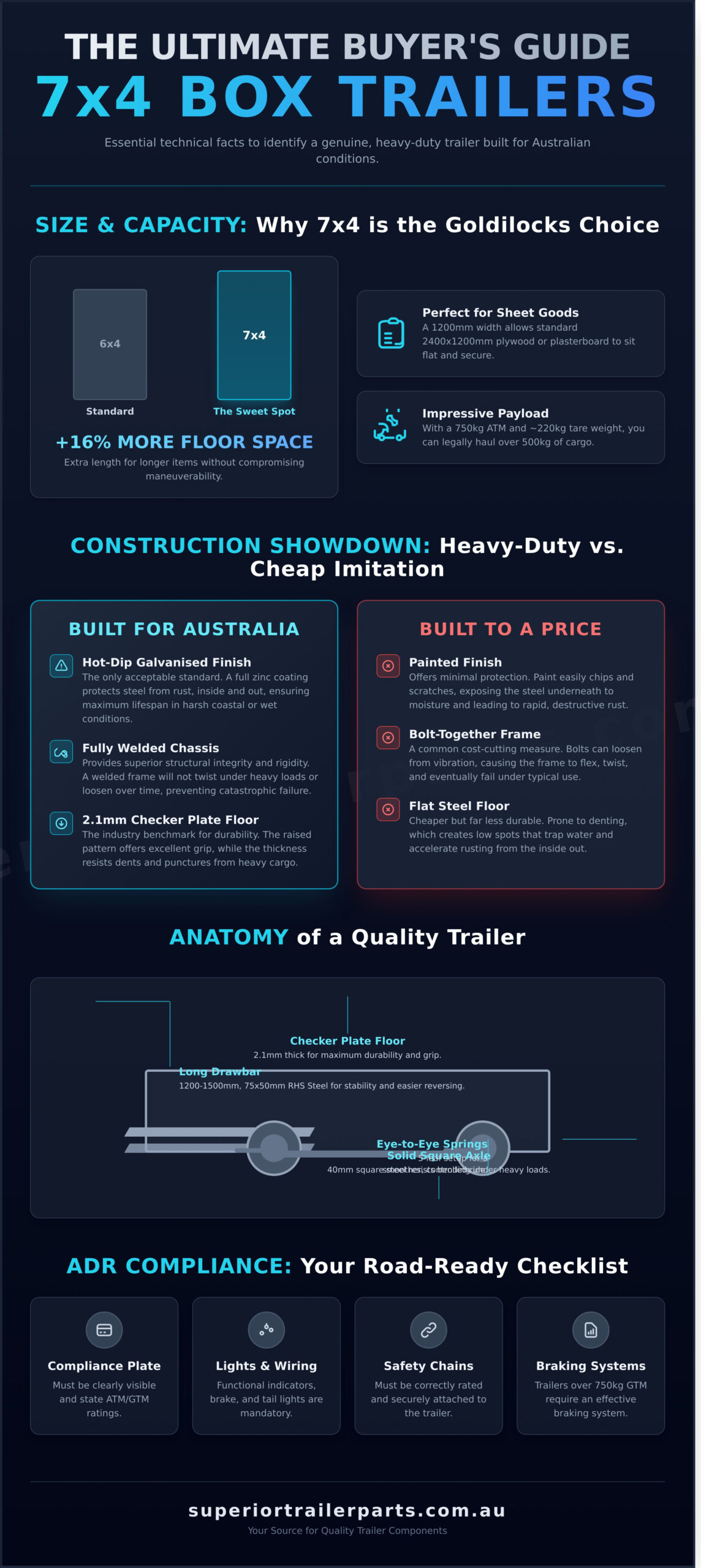
Compared to a standard 6×4 trailer, the 7×4 provides over 16% more floor space. This extra 300mm of length makes a substantial difference when transporting long items or simply fitting in that last pile of green waste. Despite this increased capacity, it remains easy to tow and reverse for most drivers using a standard SUV or ute. For unbraked models with a 750kg Aggregate Trailer Mass (ATM), the payload is impressive. With a typical tare weight of around 220kg, you can legally carry over 500kg of cargo. This is ideal for most domestic and light commercial jobs.
The “Goldilocks” Factor for Home and Trade
The 7×4 is perfectly sized for common Australian materials. Its 1200mm width allows a standard 2400mm x 1200mm sheet of plywood or plasterboard to sit flat and secure. When it comes to storage, its footprint fits neatly into a standard single-car garage without consuming all the available space. This practicality directly impacts its resale value. The constant demand for this size means a well-maintained 7×4 trailer holds its price exceptionally well in the used market, making it a sound investment. When you search for a 7×4 box trailer for sale australia, you are looking at a product with proven long-term value and unmatched versatility.
Technical Specifications: What Makes a Quality 7×4 Trailer?
A trailer’s price tag doesn’t tell the whole story. The real value is in its construction. When you’re looking for a 7×4 box trailer for sale australia, the materials and engineering determine its lifespan, safety, and performance under load. A cheap trailer often means cut corners on the most critical components. Understanding these technical details ensures you invest in a tool that lasts.
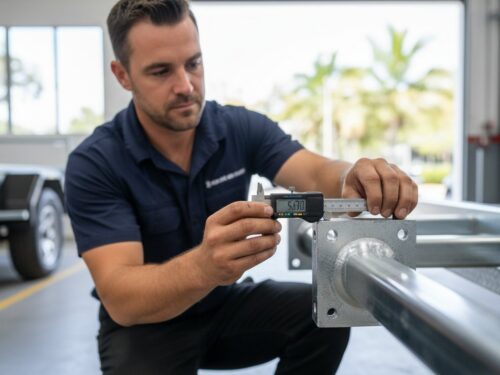
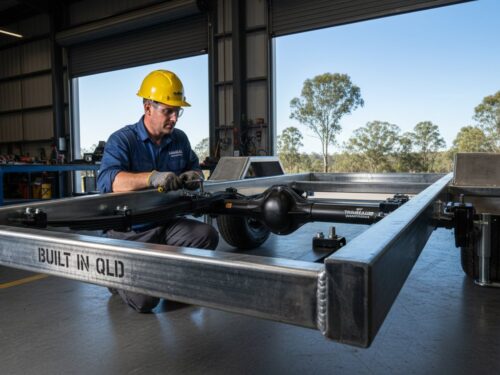
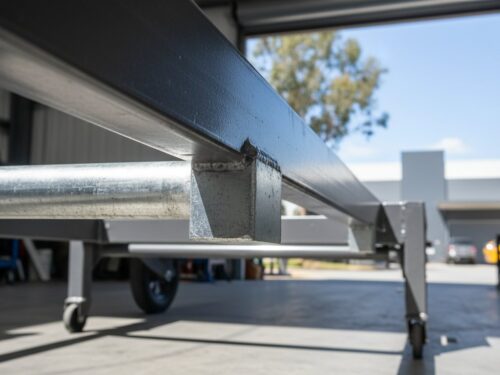
The foundation of any good trailer is its chassis. A fully welded frame provides superior strength and rigidity compared to a bolt-together kit. Welded construction prevents the chassis from twisting under heavy loads, a common failure point for bolted frames which can loosen over time. Look for a drawbar constructed from at least 75x50mm Rectangular Hollow Section (RHS) steel. A longer drawbar, typically 1200mm to 1500mm, makes reversing significantly easier and improves towing stability at highway speeds. All trailer construction must adhere to minimum standards outlined in the Australian government’s National Code of Practice for Building Small Trailers, which specifies requirements for these crucial structural elements.
For the floor, 2.1mm checker plate steel is the industry benchmark for durability. Its raised pattern provides excellent grip for cargo and foot traffic, while its thickness resists dents and punctures from tools, gravel, or equipment. Flat steel floors are cheaper but damage far more easily, leading to premature rust and structural weakness.
The Undercarriage: Axles and Suspension
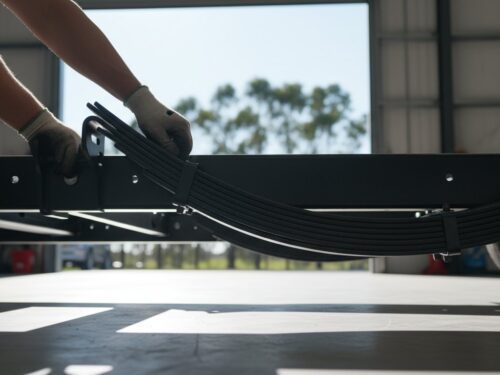
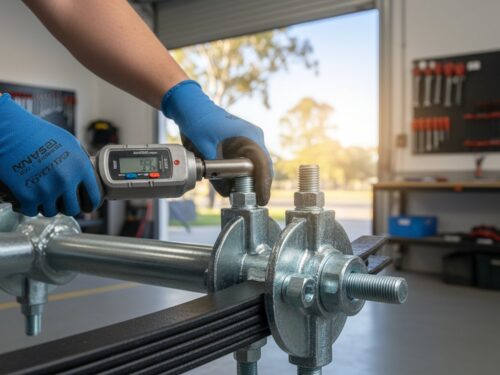
The undercarriage takes the most punishment. Standard axles for a 750kg Aggregate Trailer Mass (ATM) trailer are either 39mm round or 40mm square solid steel. The 40mm square axle offers greater resistance to bending under load. This is typically paired with 5-leaf eye-to-eye springs for a smoother, more controlled ride. Slipper springs are a simpler alternative but provide a harsher ride. Standard 13-inch or 14-inch Sunraysia rims with light truck tyres complete the package, offering proven reliability on Australian roads. Ensuring these components are high quality is key; you can find reliable trailer suspension kits to match these specifications.
Galvanisation and Corrosion Resistance
In Australia, rust is the enemy. A painted finish offers minimal protection and is easily chipped, exposing the steel to moisture. Hot-dipped galvanisation is the only acceptable standard for long-term corrosion resistance. This process involves submerging the entire fabricated trailer frame in a bath of molten zinc at around 450°C. This creates a metallurgical bond, coating the steel inside and out. It’s vital that welds are cleaned and treated after fabrication, as the intense heat of welding can burn away protective coatings, creating a weak point for rust to start. For anyone living in coastal regions, marine-grade protection isn’t a luxury; it’s a necessity to fight saltwater corrosion.
Customisation and Add-ons: Tailoring Your Hauler
A standard 7×4 trailer gets the job done. The right customisations make it work harder for you. Whether you’re a tradesperson, a keen gardener, or a weekend adventurer, tailoring your trailer unlocks its true potential. These practical upgrades add utility, security, and durability to your investment, ensuring it’s fit for purpose across Australian conditions.
From cages that increase your carrying capacity to toolboxes that secure your gear, every add-on is designed to solve a problem. Investing in these features from the outset ensures your trailer is ready for any task, from a simple tip run to a cross-country haul.
Securing the Load: Cages and Racks
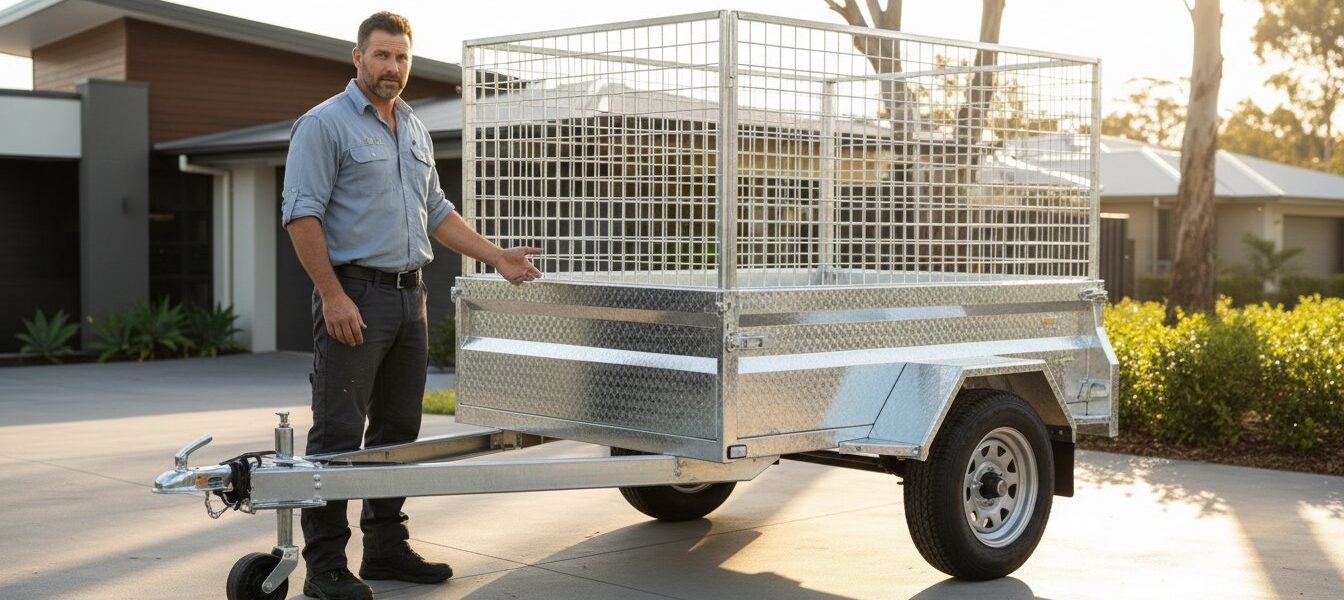
A removable cage is one of the most versatile upgrades for a box trailer. A 600mm high cage is perfect for containing green waste or camping gear. For moving bulky items like furniture or appliances, a 900mm cage can double your trailer’s cubic volume. For tradespeople, forward-mounted ladder racks are essential for safely transporting long lengths of timber or pipe. Always check for heavy-duty, fully welded tie-down rails along the side panels; they are critical for securing any load properly with ropes or straps.
This added capacity is also invaluable for small businesses or serious BBQ enthusiasts stocking up on fuel from a wholesale charcoal supplier Australia for events or the season ahead.
Utility Upgrades: Toolboxes and Spare Mounts
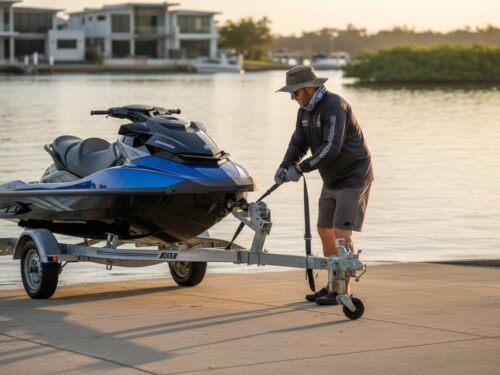
Secure your equipment with a drawbar-mounted toolbox. A quality 2.5mm aluminium checker plate model, like our heavy-duty toolboxes, provides weatherproof storage for straps, tools, and safety gear. Don’t leave home without a spare wheel. A vertical spare wheel carrier mounted on the drawbar is a simple addition that can save hours of downtime. Finally, upgrade your jockey wheel. A heavy-duty, 8-inch solid rubber swing-up model makes manoeuvring a loaded trailer on site far easier than a standard fixed wheel.
Your choice of tailgate directly impacts usability. While a standard drop-down gate is simple and effective, a reinforced ramp gate is a necessity for loading machinery. A heavy-duty mesh ramp, often rated for 300kg to 500kg, allows you to easily load equipment like ride-on mowers, quad bikes, or wheelbarrows without heavy lifting.
To protect your cargo from the elements, a canvas cover is a smart investment. A high-quality, 600gsm waterproof PVC tonneau cover keeps your gear dry and secure. It shields everything from road grime and dust on outback tracks to rain in the city. When you’re browsing any listing for a 7×4 box trailer for sale australia, check if these options are included or can be added. They are practical additions that pay for themselves in convenience and load protection.
Beyond functional upgrades, many tradespeople and businesses turn their trailers and vehicles into mobile billboards. This is a cost-effective way to advertise your services wherever you go. For ideas and examples on how to brand your setup, you can explore Commercial Vehicle Wraps.
Properly managing the financial side of such an asset is just as important for a business. For tradespeople treating a trailer as a business expense, understanding tax deductions and depreciation is key. Consulting with an experienced accounting team, such as Brown Hamilton Partners, can help ensure these purchases are handled correctly from a financial standpoint.
Legal Requirements and Towing Safety in Australia
Owning a box trailer is about utility. But that utility depends entirely on its legality and roadworthiness. Understanding Australian towing regulations isn’t just about avoiding fines; it’s about ensuring the safety of yourself and others on the road. Before you commit to any 7×4 box trailer for sale australia, you must be familiar with the rules that govern its use.
The core of trailer compliance revolves around its weight rating. Two key terms you need to know are:
- Aggregate Trailer Mass (ATM): The total weight of the trailer and its maximum payload when unhitched from a vehicle.
- Gross Trailer Mass (GTM): The weight of the fully loaded trailer imposed on the trailer’s axle when it is coupled to the tow vehicle.
GTM is the critical figure for determining braking requirements. A standard 7×4 box trailer is typically rated with a GTM of 750kg. Under Australian law, any trailer with a GTM of 750kg or less does not require its own braking system. However, if you opt for a heavy-duty model with an upgraded axle and a GTM between 751kg and 2,000kg, it must be fitted with brakes on at least one axle. This can be a simple mechanical override system or a more advanced electric brake setup.
All new trailers must comply with the Australian Design Rules (ADRs). This ensures components like couplings, lights, and chassis construction meet national standards. Registering your trailer is mandatory in all states and territories. The process generally involves obtaining a Vehicle Identification Number (VIN), getting a weighbridge certificate, and undergoing an inspection at your local transport authority, such as VicRoads or Transport for NSW.
Safety Chains and Lighting Standards
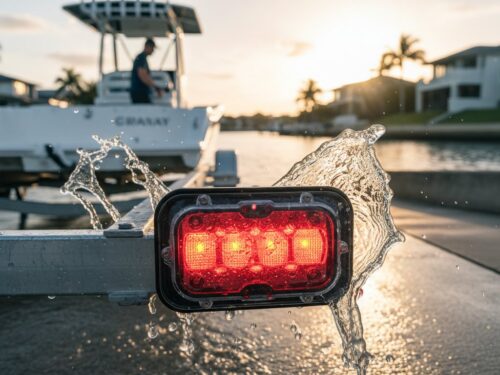
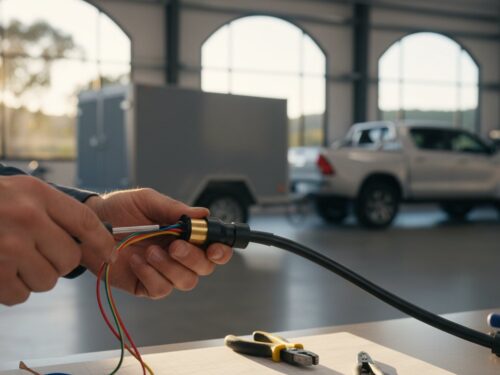
For a trailer with a 750kg GTM, you must have at least one safety chain that meets Australian Standard AS 4177.4. The chain must be stamped with its rating and permanently attached to the trailer’s drawbar. It’s your final line of defence if a coupling fails. Modern trailers use LED lights for a reason. They are fully sealed, submersible, and far more resistant to vibration than old incandescent bulbs, ensuring your indicators and brake lights work every time. Most vehicles in Australia use a 7-pin flat plug, so ensure your trailer’s wiring matches your car’s socket.
Proactive Maintenance for Longevity
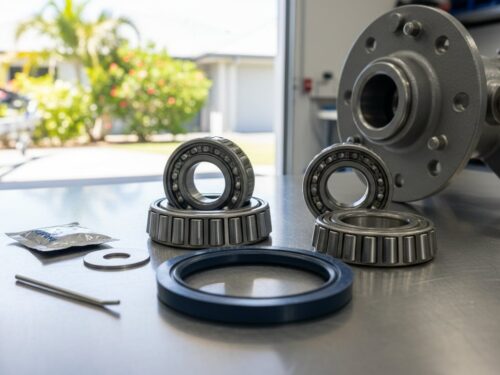
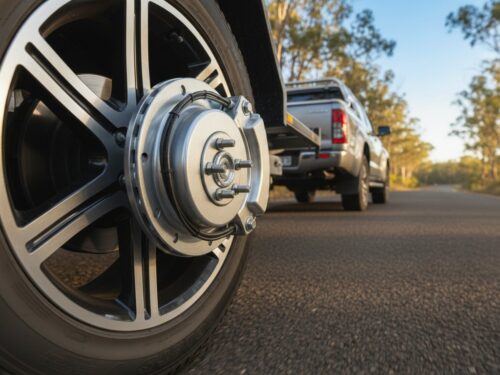
A trailer’s running gear works hard. Wheel bearings should be inspected and repacked with grease every 12 months or 10,000 kilometres to prevent catastrophic failure on the highway. Regularly check your suspension components. Ensure spring U-bolts remain tight and that rubber bushes haven’t perished or cracked. Proper tyre pressure is also vital; run pressures at the higher end of the recommended range when loaded to reduce heat and wear, and slightly lower when empty for a smoother ride. If your trailer parts show signs of wear, don’t wait for them to fail. Keep your trailer roadworthy with our extensive range of ADR-approved components.
Choosing Superior Trailer Parts for Your 7×4 Solution
Your trailer is a critical tool for your work or recreation. As an Australian Owned and Operated business, we understand the harsh conditions our products face. Local expertise isn’t a marketing slogan; it’s the foundation of our engineering. We design and build trailers and parts that withstand the realities of Australian roads, from corrugated tracks in the outback to demanding job sites in major cities. When you search for a 7×4 box trailer for sale australia, you’re not just buying a frame and wheels. You’re investing in a solution that needs to be reliable, day in and day out.
Buying direct from a manufacturer and parts specialist gives you a distinct advantage. You bypass the retail markup, ensuring you get competitive pricing on genuine, high-quality components. More importantly, you get direct access to expert advice. We help you match the right trailer configuration to your vehicle’s towing capacity and your specific job requirements. We don’t just sell parts; we provide durable, long-term solutions.
High-Quality Components and Complete Units
A trailer is only as strong as its weakest component. That’s why we stock a comprehensive range of heavy-duty trailer parts and accessories. From galvanised axles and hubs to marine-grade lighting and robust couplings, every item is selected for performance and longevity. Our direct-to-customer model means you get access to these premium parts without the inflated price tag found at general hardware or automotive stores. We build the trailers, so we know precisely which parts work best.
We stand behind every weld and axle. Our products come with a straightforward warranty and the full support of our technical team. When you buy from us, you’re buying a commitment to quality. If an issue arises, you talk directly to the people who understand the product inside and out, ensuring a fast and effective resolution.
Nationwide Delivery and Support
Getting your equipment where you need it is part of the job. Our established logistics network ships large trailer components and complete units to every corner of the country. Whether you’re in Perth, Hobart, or regional Queensland, we have a proven system for getting your order to you safely and efficiently. This makes us a direct source for anyone looking for a 7×4 box trailer for sale in Australia, regardless of location.
For custom requirements or technical questions, our Queensland-based team is ready to assist. Contact us for expert advice on load ratings, brake systems, or any specific modifications you need. Before you hit the road with your new 7×4, run through this final checklist to ensure a safe journey.
- Tyre Pressure: Check that all tyres, including the spare, are inflated to the manufacturer’s recommended PSI.
- Coupling and Chains: Ensure the trailer coupling is securely locked onto the tow ball and that safety chains are correctly crossed and attached.
- Lights and Electrics: Connect the trailer plug and test all lights with a helper: brake lights, indicators, and tail lights.
- Load Security: Confirm your load is evenly distributed over the axles and securely fastened with rated straps or ropes.
Find the Right 7×4 Trailer for the Job
Choosing the right trailer means looking beyond the price tag. It’s about understanding the core specifications, from the hot-dip galvanised chassis to the axle’s load rating. Ensuring your setup meets all Australian towing regulations is essential for safety and compliance on every job. When you’re searching for a durable 7×4 box trailer for sale australia, this knowledge ensures you invest in a workhorse that won’t let you down.
At Superior Trailer Parts, we provide the heavy-duty equipment you need. As an Australian Owned and Operated business, we offer expert technical advice to help you select the right trailer and components for your specific requirements. With nationwide shipping available, we deliver reliable solutions right where you need them. Don’t settle for less than the best for your hauling needs.
View our range of heavy-duty 7×4 trailers and parts and get your project moving with confidence.
Frequently Asked Questions
Do I need a special license to tow a 7×4 box trailer in Australia?
No, you don’t need a special license for a standard 7×4 box trailer. A regular car license is sufficient for towing any trailer with a Gross Trailer Mass (GTM) of up to 750kg. Since most unbraked 7×4 trailers fall well below this limit, your current license is all that’s required. Always confirm your vehicle’s maximum towing capacity before you hook up and hit the road.
What is the maximum load I can carry in an unbraked 7×4 trailer?
The maximum legal capacity is determined by its 750kg Gross Trailer Mass (GTM) limit. GTM is the combined weight of the trailer itself plus your cargo. For example, if your trailer has a Tare Mass (empty weight) of 250kg, you can legally carry a 500kg load. Exceeding the 750kg GTM requires the trailer to be fitted with its own independent braking system.
Is a 7×4 trailer better than a 6×4 for general home use?
A 7×4 trailer is often a more versatile choice for general use. That extra foot of length provides crucial space for longer items like standard sheet materials, furniture, or a small motorbike. While a 6×4 is perfectly capable for tip runs and garden waste, the 7×4’s greater utility makes it a more practical investment for handling a wider range of jobs around the home or for light trade work.
How do I prevent my 7×4 box trailer from rusting?
The best defence against rust is to purchase a hot-dip galvanised trailer. This process coats the entire steel frame in a protective layer of zinc. To maintain it, regularly wash the trailer to remove corrosive materials like mud, dirt, and salt. Inspect the trailer for any deep scratches or chips and treat exposed steel immediately with a cold galvanising spray to maintain the protective barrier and ensure its long-term durability.
What is the difference between a single axle and tandem axle 7×4 trailer?
A 7×4 box trailer is a single axle trailer by design. Tandem axles, which feature two axles and four wheels, are used on larger trailers to manage loads exceeding 750kg GTM. The single axle configuration on a 7×4 is ideal for its intended capacity, keeping the trailer lightweight, easy to manoeuvre by hand, and more affordable. It provides all the stability and strength needed for its load rating.
Are all 7×4 trailers for sale in Australia ADR compliant?
All new trailers sold by reputable dealers must comply with Australian Design Rules (ADR). When inspecting any 7×4 box trailer for sale in Australia, look for the compliance plate, which is typically located on the drawbar. This plate certifies that the trailer meets national safety standards for its chassis, lighting, and components. Purchasing a non-compliant trailer can lead to registration problems and safety risks.
Can I add a cage to my 7×4 box trailer later?
Yes, adding a cage is a common and straightforward upgrade. Most well-built trailers are designed with cage installation in mind, featuring pre-drilled mounting points along the top rail of the trailer box. This makes fitting a cage a simple bolt-on job that you can do yourself. A cage is a practical addition for securely transporting bulky items like green waste, camping gear, or furniture.
How often should I service the bearings on my 7×4 trailer?
You should service your trailer wheel bearings at least every 12 months or 10,000 kilometres, whichever comes first. This essential maintenance involves cleaning, inspecting, and repacking the bearings with high-temperature wheel bearing grease. If you frequently tow in very wet or dusty environments, more frequent checks are recommended. Proper bearing maintenance is critical for preventing a costly and dangerous roadside failure.