Choosing the right boat winch for your trailer shouldn’t be guesswork. Yet, too many Aussie boaties find themselves stuck, wrestling with capacity calculations and the manual versus electric debate. The harsh saltwater environment adds another challenge-no one wants a winch that seizes up or rusts out after just a few launches. Getting this critical piece of gear wrong means frustration at the boat ramp and potential damage to your vessel, costing you time and money.
This guide cuts through the confusion. We deliver the expert, no-nonsense advice you need to get the job done right. You will learn how to accurately calculate pulling capacity, weigh the real-world pros and cons of different winch types, and identify the marine-grade materials essential for Australian conditions. We cover everything from straightforward installation to the essential maintenance that keeps your gear reliable, season after season. Stop guessing and start hauling with confidence.
Key Takeaways
- Calculate the correct winch capacity using our no-guesswork formula to prevent dangerous and costly equipment failure.
- Understand the key differences between manual and electric winches to make the right choice for your boat size and budget.
- Determine whether a webbing strap or steel cable is the most durable choice for your boat winch in harsh Australian marine conditions.
- Follow a simple maintenance checklist to ensure your winch operates safely and reliably for years to come.
Manual vs. Electric Boat Winches: Understanding the Core Types
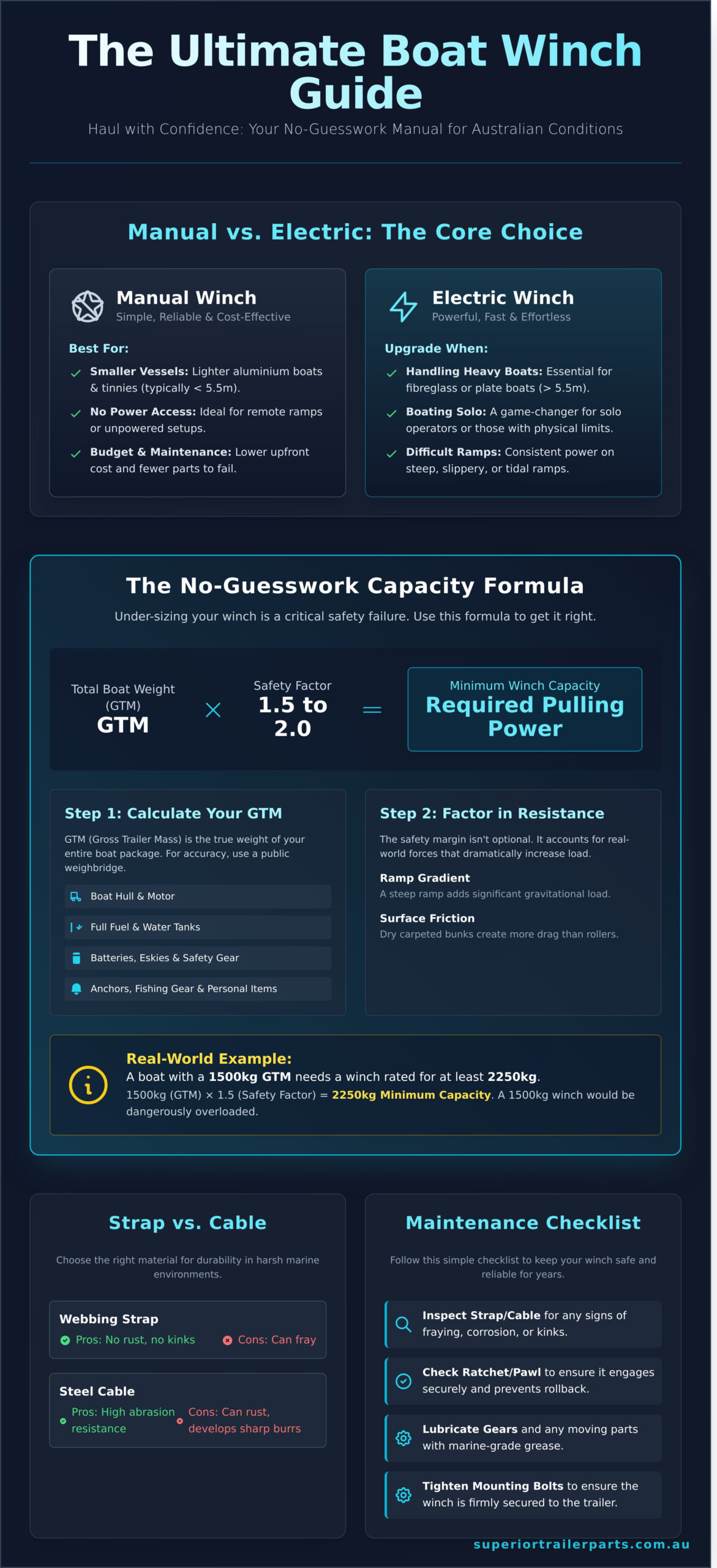
Choosing the right boat winch starts with one key decision: manual or electric. A manual winch relies on your physical effort, while a 12V electric winch uses your vehicle’s battery to do the heavy lifting. Each type is engineered for different boats, ramps, and boaters. Understanding these core differences ensures you get the job done safely and efficiently.
A manual winch is a simple, reliable machine. It uses a hand crank and internal gears to give you the mechanical advantage needed to pull your boat onto the trailer. For a detailed explanation of the core principles, see this guide on What is a Winch?. Single-speed winches offer a consistent gear ratio for light boats on flat ramps. Multi-speed models provide a lower gear for easier cranking under heavy load, giving you more control.
An electric winch automates retrieval. It connects directly to your car or 4WD’s 12V battery, using a powerful motor to wind the strap or cable. This eliminates physical strain, making it the superior choice for heavy vessels or difficult launch conditions.
Key Components of Any Boat Winch
Regardless of type, every winch shares core components designed for strength and safety:
- The Drum: The cylinder that holds the winch strap or steel cable.
- Gears: The internal mechanism providing mechanical advantage. The gear ratio dictates pulling power.
- Handle or Motor: The power source. Manual winches use a crank handle; electric winches use a 12V motor.
- Ratchet/Pawl: A crucial safety feature that engages the gears to prevent the boat from sliding backwards.
When to Choose Manual
A manual winch is the practical choice in several situations:
- Smaller Vessels: Perfect for lighter aluminium boats and tinnies, typically under 5.5 metres.
- No Power Access: Ideal if you launch at remote ramps without easy vehicle access for power.
- Budget and Maintenance: A cost-effective and low-maintenance option with fewer parts to fail.
When to Upgrade to Electric
An electric winch is a necessary upgrade for safety and convenience when:
- Handling Heavy Boats: Essential for heavier fibreglass or plate aluminium boats over 5.5 metres.
- Boating Solo: A game-changer for solo operators or those with physical limitations.
- Difficult Ramps: Provides consistent, controlled power on steep, slippery, or tidal boat ramps.
Calculating Your Boat Winch Capacity: The No-Guesswork Formula
The single biggest mistake in choosing a boat winch is under-sizing it. An undersized winch is not just inefficient; it’s a serious safety hazard. It puts immense strain on gears, cables, and mounting points, leading to catastrophic failure. You don’t want your pride and joy rolling back down the ramp.
The rule of thumb is simple and effective: your winch capacity should be at least 1.5 to 2 times the total weight of your boat package. This safety margin accounts for real-world variables that increase the load far beyond the boat’s sticker weight.
Your winch capacity should be based on the combined weight of your boat, motor, and gear, not just the boat’s hull weight.
Step 1: Determine Your Gross Trailer Mass (GTM)
First, you need the true weight of your rig. This is your Gross Trailer Mass (GTM), and it includes everything you’ll be pulling up the ramp:
- Boat hull and motor
- Full fuel and water tanks
- Batteries, safety equipment, and anchors
- Eskies, fishing gear, and personal items
Check your manufacturer’s specifications for a starting point, but for an accurate figure, take your fully-loaded trailer to a public weighbridge. This is the only way to know your true working weight.
Step 2: Factor in Ramp Gradient and Friction
A boat’s weight on a flat surface is one thing. Pulling it up an incline is another. A steep boat ramp dramatically increases the required pulling force due to gravity. On top of that, you have friction from the trailer’s bunks or rollers. Carpeted bunks, especially when dry, can add significant resistance. Understanding these forces is critical, and for a technical overview, many manufacturers offer a detailed Winch Selection Guide that explains the physics involved.
Putting It Together: A Real-World Example
Let’s say your GTM is 1500kg. Using our formula, you calculate the minimum required winch capacity:
1500kg (GTM) x 1.5 (Safety Factor) = 2250kg (Minimum Winch Capacity)
In this scenario, a winch rated for only 1500kg would be operating at its absolute limit before even accounting for ramp angle or friction. It would be hard to crank, wear out quickly, and be dangerously prone to failure. Always invest in a winch that is comfortably overpowered for the job. It’s a small price for safety and reliability.
Strap vs. Cable & Material Choice: What Lasts in Australian Conditions?
The connection between your boat winch and your vessel is a critical safety link. In Australia, that link is constantly attacked by saltwater, intense UV radiation, and heat. Choosing the right material is not about looks; it is about safety, reliability, and long-term performance. Here is a direct comparison to help you make a practical, get-the-job-done choice.
Webbing Straps: The Modern Standard
Most modern winches for recreational boats use a heavy-duty webbing strap, typically made from polyester or advanced materials like Dyneema. This has become the standard for good reason.
- Pros: Straps are flexible and do not kink or develop sharp, metal burrs that can injure your hands. They are lightweight, easy to handle, and kinder to your boat’s gelcoat.
- Cons: Constant exposure to the harsh Australian sun will degrade the material over time. They can also fray if dragged over sharp trailer edges. Regular inspection is essential.
For the vast majority of trailer boat owners, a quality webbing strap is the superior and safer choice for day-to-day use.
Steel Cable: The Traditional Choice
Steel wire cable was the original standard and still has its place, particularly in demanding commercial or heavy-duty applications.
- Pros: Highly resistant to abrasion and cutting. If properly maintained and lubricated, it can offer a very long service life.
- Cons: Prone to rust if the galvanised coating is compromised. It can kink permanently, creating a dangerous weak spot. Over time, individual wire strands can break, creating needle-sharp burrs.
Handling a frayed steel cable is a serious safety risk. Understanding the function of Winch Safety Devices and always wearing heavy-duty gloves is non-negotiable. Cable is best reserved for commercial operators or where unavoidable abrasion is a constant issue.
Materials & Coatings: Galvanised vs. Stainless Steel
Corrosion resistance applies to the entire winch assembly, not just the strap or cable. The gears, handle, and frame must withstand constant exposure to moisture.
Galvanised Finish: This involves coating steel with a protective layer of zinc. It is a proven, cost-effective solution that provides excellent durability for most users. A galvanised winch will deliver years of reliable service, especially if rinsed with fresh water after saltwater use.
Stainless Steel: This is the premium option. Stainless steel offers maximum protection against rust and corrosion, making it the ultimate choice for boaties who frequently launch in harsh saltwater environments or want the longest possible lifespan from their equipment. It is a higher initial investment for superior, long-term peace of mind.
Boat Winch Installation & Maintenance Checklist
A reliable boat winch is essential for safe launching and retrieval. Proper installation is not a recommendation; it is a requirement. Once installed, consistent maintenance ensures your winch performs correctly every time, protecting both your boat and yourself. A well-maintained winch is a safe winch. Follow this checklist to get the job done right.
Pre-Installation Checks
Before you mount your new winch, inspect its foundation. A powerful winch is useless on a weak post. Getting these details right from the start prevents dangerous failures at the ramp.
- Check the Winch Post: Ensure the winch post on your trailer is structurally sound. Look for rust, cracks, or signs of metal fatigue. Reinforce or replace it if there is any doubt.
- Use Quality Hardware: Always use high-tensile, marine-grade bolts, nuts, and washers. Standard hardware will corrode quickly in a marine environment, compromising the entire setup.
- Confirm Alignment: The winch must be perfectly aligned with your boat’s bow eye. Misalignment causes the strap or cable to spool unevenly, leading to premature wear and potential failure.
Regular Maintenance Schedule
Routine checks extend the life of your equipment and are critical for safety. This simple schedule keeps your winch in top working order, ready for tough Australian conditions.
- After Every Trip: Rinse the entire winch assembly with fresh water. This is non-negotiable after saltwater use to prevent corrosion and salt buildup.
- Monthly Check: Fully extend the winch strap or cable. Inspect its entire length for fraying, cuts, broken strands, or burrs. Check the hook and safety latch for damage.
- Annual Service: Lubricate all gears, bushings, and moving parts with a high-quality marine-grade grease. This keeps the mechanism operating smoothly and prevents seizure.
This principle of preventing moisture damage extends to your entire vessel. The same damp conditions that attack your winch can cause persistent mould on seats, in the cabin, or on stored gear. While this is a separate challenge, it’s one many boat owners face. For a professional approach to this common problem, services like ABC Mould Cleaning Solutions offer comprehensive treatment options.
Safety is paramount. Never use a winch with a frayed or damaged strap or cable. A sudden snap under load can cause serious injury or damage to your vessel. Replace it immediately. If you need a replacement strap, heavy-duty components, or expert advice on your setup, our team has the genuine parts you need, delivered Australia wide.
Find Your Heavy-Duty Boat Winch at Superior Trailer Parts
Choosing the right winch is critical for safe and easy boat retrieval. At Superior Trailer Parts, we make the process simple. We stock a comprehensive range of reliable manual boat winches, each one specifically selected for its durability in harsh Australian marine environments. Every winch in our inventory is built from heavy-duty, marine-grade steel with high-quality galvanised or powder-coated finishes to resist saltwater corrosion and wear.
Based in Queensland, our team provides practical, expert advice to ensure you get the right component for the job. We ship Australia-wide, getting you the parts you need, fast.
Manual Winches for Every Application
Whether you’re launching a small tinny or retrieving a small cruiser, we have a manual winch to match your needs. Our range includes various capacity options to suit different boat sizes and weights. A single-speed winch is perfect for lighter aluminium boats, offering fast and straightforward retrieval. For heavier fibreglass hulls, a dual-speed or multi-gear boat winch provides the extra torque needed to make loading less of a physical strain. We also stock all the necessary hardware, including replacement straps, webbing, and winch handles, to keep your setup in top working order.
Why Choose Superior Trailer Parts?
Getting the right part the first time saves you time, money, and hassle. That’s our commitment. We are a trusted supplier for commercial operators and DIY enthusiasts across the country for good reason.
- Australian Owned and Operated: With decades of hands-on industry experience, we understand the demands of local conditions and stand behind the quality of our products.
- No-Nonsense Expert Advice: We cut through the jargon. Our team provides clear, straightforward guidance to help you select the correct component for your specific trailer and boat.
- Competitive Pricing on Quality Parts: We believe in fair value. You get access to high-quality, reliable trailer components that are built to last, without the premium price tag.
Stop searching and start hauling with confidence. For a winch that won’t let you down, browse our range of boat trailer winches online or contact our team for expert support.
Final Checklist for Your Boat Winch Purchase
Choosing the right winch is a critical task for any boat owner. It comes down to safety, efficiency, and protecting your investment. Remember the key takeaways: always calculate your required winch capacity using the correct formula, and select a strap or cable material that is proven to withstand harsh Australian marine environments. Getting these details right ensures reliable performance every time you launch and retrieve.
Don’t leave it to guesswork. As a proudly Australian Owned & Operated business, we provide the expert advice you need to select the right heavy-duty boat winch for your trailer. We stock a comprehensive selection of reliable, marine-grade winches and offer Australia-wide shipping to get you geared up faster.
Ready to upgrade? Shop our full range of heavy-duty boat winches. Get the right part for the job and make your next trip to the water a seamless one.
Frequently Asked Questions
Can a boat winch be too powerful for my boat?
Yes. A winch with excessive capacity can damage your boat’s hull or bow eye. The force can create structural stress, leading to costly repairs. Always match the winch capacity to your boat’s gross weight, including the motor, fuel, and gear. A winch rated for 1.5 to 2 times your boat’s total weight is a safe and effective choice. This provides enough power without risking damage to your vessel.
How often should I replace my boat winch strap or cable?
Inspect your winch strap or cable before every use. Look for signs of fraying, corrosion, or UV damage on straps, and check for broken strands or kinks in cables. Replace the component immediately if you find any damage. As a general guide, a well-maintained strap may last 2-3 years, while a galvanised cable can last longer. Regular visual inspection is your most reliable safety measure to prevent failure under load.
Are 12V electric boat winches waterproof?
Most 12V electric winches are water-resistant, not fully waterproof. They are built to withstand rain and splashing but must not be submerged. Key components like the motor and solenoid are sealed to an IP rating, but prolonged immersion will cause permanent damage. For boat trailers, ensure your electric winch is mounted high enough to stay clear of the water during launching and retrieval. Always check the manufacturer’s specifications.
What is a winch gear ratio and why does it matter?
The gear ratio tells you how many times you must turn the handle for the drum to make one full revolution. A higher first number, such as 5:1, provides more mechanical advantage. This means less effort is needed to crank, but the retrieval speed is slower. A lower ratio, like 3:1, is faster but requires more physical effort. For heavier boats, choose a higher gear ratio to make retrieval easier.
How do I secure the winch hook to my boat’s bow eye safely?
Always ensure the winch hook is correctly attached to the boat’s dedicated bow eye. The safety latch on the hook must be fully closed and functional. This latch prevents the hook from slipping off if the strap or cable goes slack. Never hook onto any other part of the boat. The bow eye is a reinforced point designed specifically for this high-stress task. Double-check your connection before you begin winching.
Can I use my boat winch to tie down the boat for transport?
No. A boat winch is designed for pulling, not for securing a load during transport. The ratchet mechanism can fail under the bouncing and jolting of road travel, allowing the boat to shift. You must use separate, rated tie-down straps to secure the bow and stern of your boat to the trailer. This is a critical safety step required by Australian road authorities to ensure safe towing on public roads.
What’s the difference between a winch and a hoist?
The key difference is their designed function. A winch is engineered for pulling a load horizontally across a surface. It uses a simple dynamic brake. A hoist is designed for lifting and suspending a load vertically. Hoists feature a more robust, load-holding mechanical brake system to prevent catastrophic failure. Never use a winch for lifting. Using the wrong equipment for the job is extremely dangerous and can lead to serious accidents.
Do I need a winch cover?
Yes, a winch cover is a smart, low-cost investment for Australian conditions. It protects your winch from harsh elements like sun, rain, and road grime. A cover prevents UV degradation of synthetic straps and protects the winch’s mechanical parts from dirt and moisture, which reduces corrosion. This simple step extends the service life of your winch and ensures it operates reliably when you need it most. It keeps your gear in top working order.