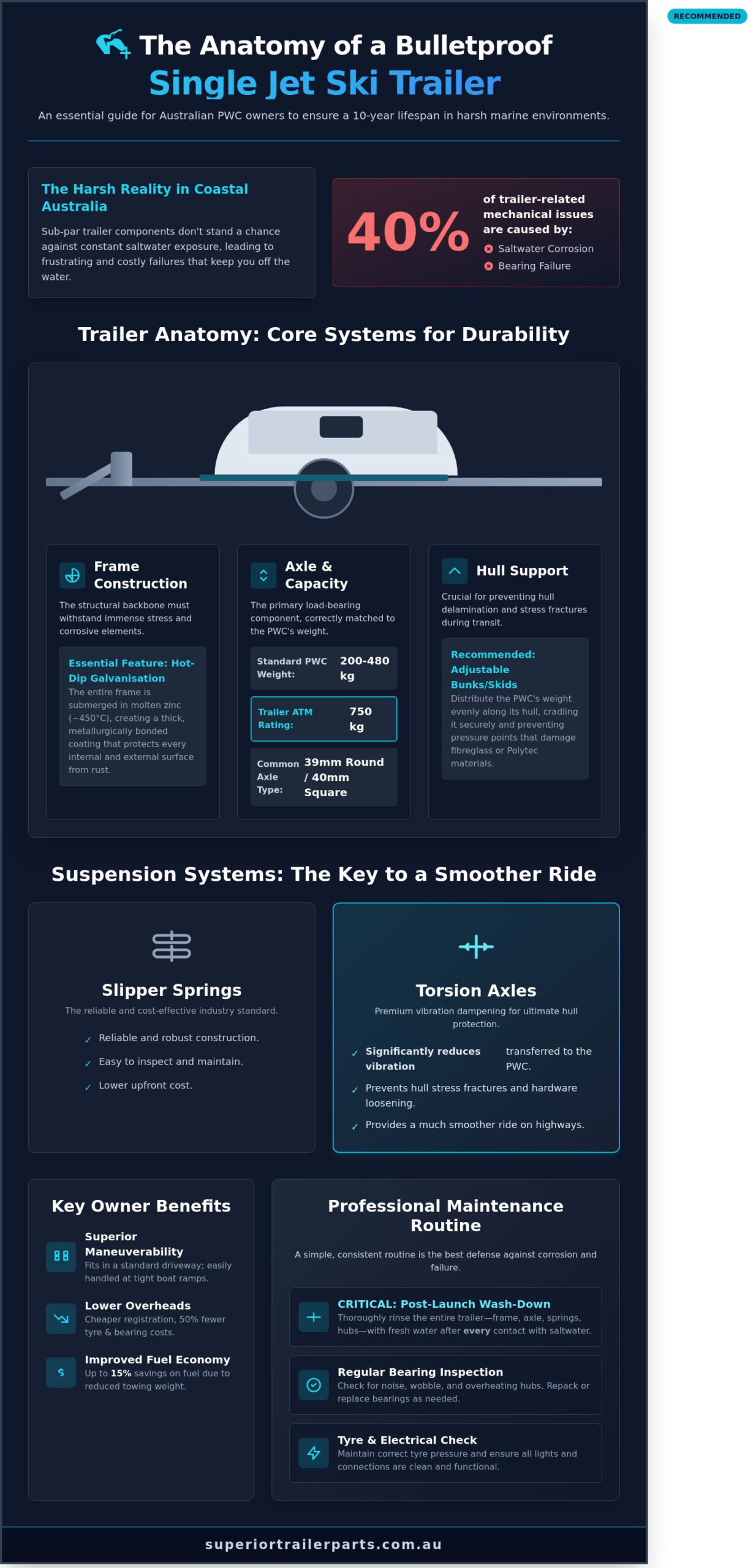
Did you know that saltwater corrosion and bearing failure account for approximately 40% of trailer-related mechanical issues in Australian coastal regions? It’s a harsh reality for PWC owners who don’t have the right gear. When you’re heading to the ramp, you need to know your equipment won’t let you down. Investing in high-quality single jet ski trailers is the only way to ensure your craft stays safe during transit and storage. You’ve likely felt the frustration of a seized bearing or a frame that looks ten years older than it is. We understand that your trailer needs to be as tough as the Australian sun.
You deserve a setup that makes solo launching a five-minute job rather than a struggle. This article explains how to select, configure, and maintain a trailer built for a 10-year lifespan in our demanding environment. We’ll examine marine-grade galvanising, essential ADR compliance, and the specific torsion systems that provide a smoother ride on our highways. Get the technical details you need to protect your investment and stay on the water longer.
Key Takeaways
- Select heavy-duty, marine-grade components designed to withstand harsh Australian saltwater conditions and protect your investment.
- Evaluate the performance differences between bunks and rollers to ensure optimal weight distribution and hull protection during transport.
- Use our technical checklist to match single jet ski trailers to your specific PWC model using Aggregate Trailer Mass (ATM) calculations.
- Master a professional maintenance routine, including the critical wash-down protocol, to prevent corrosion and ensure long-term hardware reliability.
- Identify the essential trailer anatomy required for durability, focusing on high-quality axles, suspension systems, and galvanised frames.
Understanding Single Jet Ski Trailers and PWC Transport
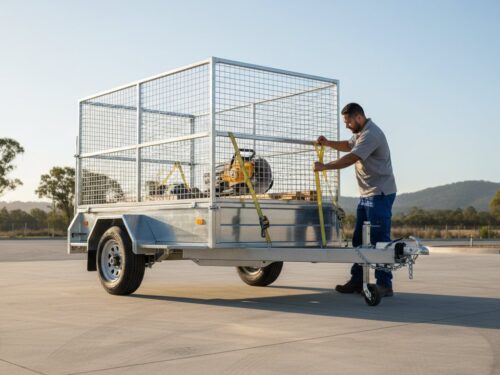
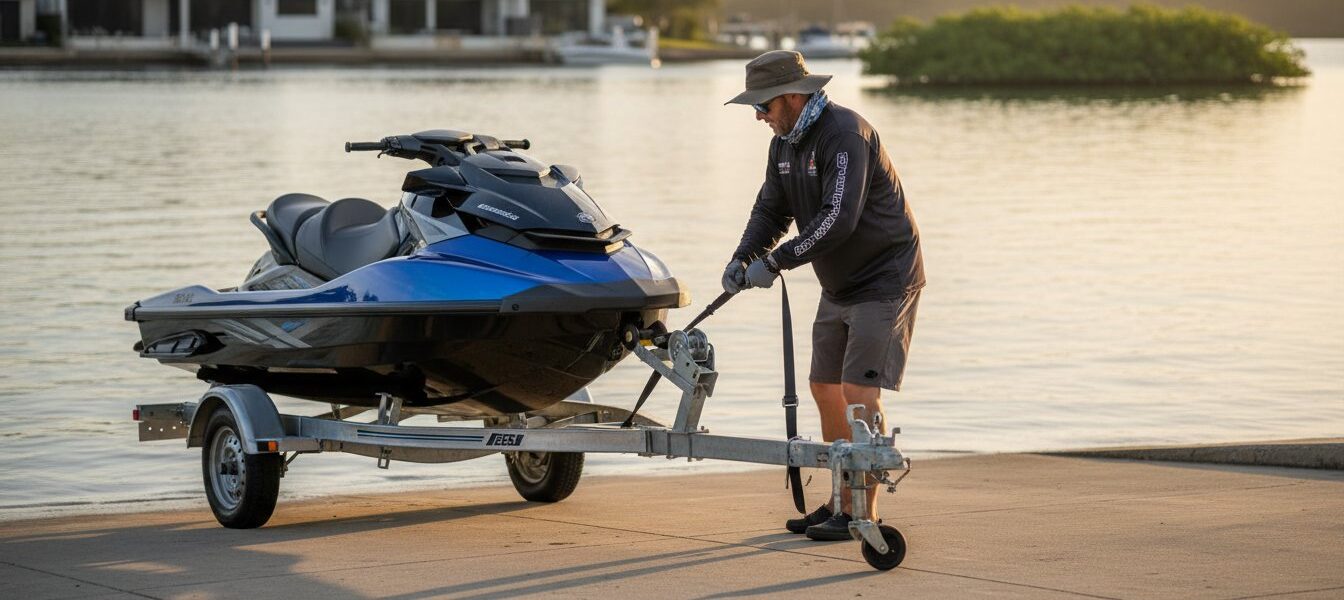
A single jet ski trailer is a purpose-built marine transport frame designed for a specific task. You cannot rely on generic flatbeds for PWC transport. These specialized units use heavy-duty galvanised steel to withstand harsh Australian salt water conditions. Proper weight distribution is critical for long-term durability. A standard PWC concentrates its entire mass on a small surface area. Specialized single jet ski trailers use adjustable bunks to cradle the hull. This prevents stress fractures in fiberglass or Polytec materials during transit on corrugated roads. Single-axle configurations remain the industry standard for these units. Most modern personal watercraft weigh between 200kg and 480kg. A single 750kg rated axle provides ample capacity while keeping the unit lightweight and easy to manage.
Expert advice suggests that matching the trailer to the specific hull shape is non-negotiable. Superior Trailer Parts provides components that ensure your craft sits low and secure. This engineering focus reduces the center of gravity; it makes towing at 100km/h on the highway much safer. Our jet ski trailers are built to handle the demanding environment of Australian boat ramps from Port Phillip Bay to the Gold Coast.
The Purpose of a Dedicated PWC Trailer
Dedicated trailers protect your investment from structural damage. Fiberglass hulls require continuous support along the strike lines to maintain integrity. Generic trailers often cause pressure points that lead to hull delamination. These units feature specific winch point alignments. This ensures the bow eye sits securely against the roller without shifting. The low-profile design is a functional requirement for shallow water. It allows for easier launches in tidal areas. You don’t need to submerge your tow vehicle’s exhaust to get the ski off the bunks.
Key Benefits of Single-Unit Trailers
Maneuverability is the primary advantage for most owners. You can park a single unit in a standard 6-meter driveway without hassle. It makes tight boat ramps manageable for solo operators who need to turn around quickly. Choosing a single-unit trailer also lowers your long-term overheads. Annual registration for a single-axle trailer in states like Queensland or NSW is significantly cheaper than dual-axle setups. You also face 50% fewer costs for tyre replacements and bearing maintenance. The reduced towing weight improves fuel economy by up to 15% on long coastal trips. This makes single jet ski trailers the most cost-effective choice for the average enthusiast.
Technical Specifications and Anatomy of a Reliable Trailer
A high performance trailer is more than just a steel frame on wheels. It’s a precision engineered tool built to protect your PWC during transit. The core anatomy of single jet ski trailers consists of three primary systems: the frame, the axle, and the suspension. Using genuine marine-grade hardware is mandatory because saltwater is relentless. Cheap components fail quickly, often leading to roadside breakdowns or hull damage. Your trailer’s safety starts with high quality axles, which serve as the structural backbone for the entire load. Choosing the right single jet ski trailers depends heavily on these technical foundations.
Frame Construction and Hot-Dip Galvanisation
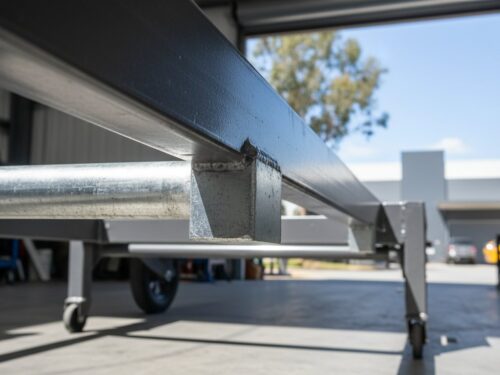
In Australian coastal conditions, raw steel won’t last a single season. Hot-dip galvanisation is the industry standard for a reason. This process involves submerging the entire steel frame into a bath of molten zinc at approximately 450 degrees Celsius. This creates a thick, corrosion-resistant coating that bonds metallurgically to the steel. It covers every internal and external surface, including the inside of hollow box sections. When inspecting a trailer, look for smooth, consistent welds. High quality welds are uniform and free of pinholes, whereas mass produced alternatives often show spatter or inconsistent penetration that invites rust.
Axle and Suspension Requirements
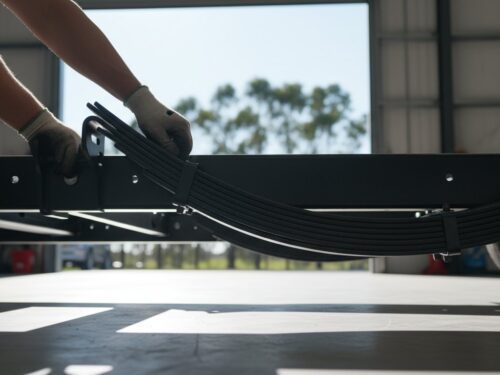
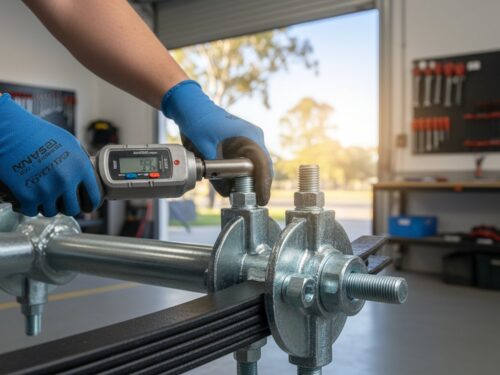
Most single jet ski trailers operate with a 750kg unbraked Gross Vehicle Mass (GVM). This setup typically utilizes a 39mm round or 40mm square axle. You have two main choices for suspension: slipper springs or torsion axles. Slipper springs are reliable and easy to maintain, making them a popular choice for many owners. Torsion axles use rubber cords to dampen road shock, which significantly reduces the vibration transferred to your jet ski’s fiberglass hull. Reducing this vibration prevents stress fractures and hardware loosening over long trips. If you need to upgrade your current setup, you can find durable components at Superior Trailer Parts to ensure your gear stays roadworthy.
- Axles: The primary load-bearing component.
- Slipper Springs: A simple, heavy-duty suspension option.
- Torsion Axles: Premium vibration dampening for hull protection.
- Galvanised Steel: Essential for saltwater corrosion resistance.
Bunks vs. Rollers: Which Support System Suits Your Watercraft?
The support system is the most critical interface between your PWC and the trailer frame. It determines how the hull handles road vibration. It also dictates how much effort you exert at the boat ramp. Choosing the right setup for single jet ski trailers depends on your launching conditions and travel distance. Improper support leads to hull de-lamination. It can also cause permanent structural stress over time. You must match the system to your specific hull material and total weight to ensure longevity.
Weight distribution varies between these two systems. Bunks provide a continuous contact point along the hull stringers. Rollers focus pressure on specific pivot points. Maintenance is a vital consideration for every owner. Bunks require regular carpet inspections for trapped sand and salt crystals. Rollers require you to check pins and internal bushes for salt corrosion. You can find replacement components for both systems in our range of boat trailer parts to keep your rig operational and safe on the highway.
The Case for Carpeted Bunks
Carpeted bunks offer maximum surface area contact. This design distributes the weight of a 450kg heavy-duty PWC across the entire rail length. It’s the best choice for long-distance towing on corrugated Australian roads. The simple mechanical design has zero moving parts. There’s less to fail when you’re 100km from the nearest workshop. Bunks also provide a stable platform for long-term storage. They prevent the hull from developing pressure spots during the winter months. Approximately 85% of fiberglass hull manufacturers recommend bunk trailers for their superior support characteristics.
When building or replacing these bunks, using high-quality, treated timber is essential to prevent rot from constant water exposure. For those sourcing durable materials for their trailer projects, you can discover Greenhill Timbers for a range of premium options.
Why Wobble Rollers Are Popular in Australia
Wobble rollers are frequently installed on single jet ski trailers used on steep or shallow ramps. They allow for effortless launching by reducing friction. These systems are self-aligning. They center the PWC automatically as you winch it toward the bow stop. This is a major advantage in crosswinds or heavy river currents. Always choose high-quality UV-stabilised poly rollers. Standard black rubber rollers often perish within 24 months in the harsh Australian sun. They also leave black skid marks on a clean hull. Polyurethane rollers offer better longevity and smoother rotation under load.
Matching Your Trailer to Your Jet Ski Model
Selecting the right single jet ski trailers requires more than just looking at the length of your hull. You must calculate the Aggregate Trailer Mass (ATM) to ensure your setup is legal and safe on Australian roads. An incorrect match leads to premature tyre wear, frame stress, and potential fines from transport authorities. Use this checklist to measure your PWC before purchasing: measure the total length from bow to stern, the width at the widest point of the hull, and the distance between the outer edges of the hull strakes. This data ensures your bunks or rollers support the weight where the hull is strongest.
For those building or modifying a setup, using high quality components is non-negotiable. Check our u-bolt kits to ensure your winch posts and axle hangers are mounted with marine-grade hardware that resists vibration and salt corrosion.
Calculating ATM and Payload Capacity
ATM is the total weight of the trailer plus its full load. You must sum the dry weight of the PWC, a full tank of fuel, all onboard gear, and the weight of the trailer itself. A modern 3-seater PWC like a Sea-Doo GTX often has a dry weight near 385kg. Once you add 70 litres of fuel (approx 52kg) and 30kg of safety gear, the total load exceeds 460kg. If your trailer weighs 180kg, your ATM is 640kg. Staying under the 750kg ATM threshold is vital because it avoids the legal requirement for mandatory braking systems in Australia. Overloading a light-duty trailer with a heavy 3-seater PWC risks axle failure and compromises your vehicle’s stopping distance.
ADR Compliance and Safety Standards
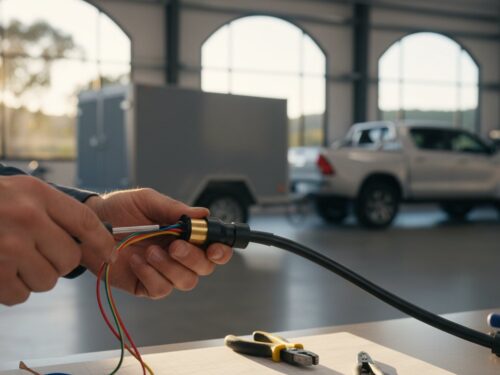
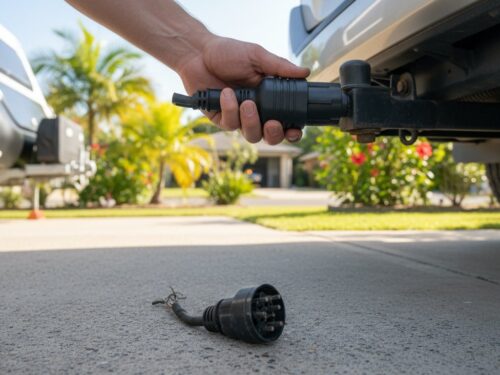
Every trailer on Australian roads must comply with the Motor Vehicle Standards Act. This includes fitting safety chains that meet Australian Standard AS 4177.4 and ensuring the coupling is rated for the trailer’s ATM. Submersible LED lighting is the standard for road legality; these units must be sealed to prevent water ingress during launch and recovery. Your trailer must also feature a clear VIN plate and a manufacturer compliance plate. These plates provide essential data for registration and roadside inspections. Without a visible VIN, your trailer is not road-legal and cannot be insured. Reliable single jet ski trailers always prioritise these safety markers to handle the harsh coastal conditions found across the country.
Ensure your watercraft is secure for your next trip. View our range of jet ski trailers for a reliable towing solution.
Long-Term Maintenance and Parts Replacement
Maintaining single jet ski trailers requires a disciplined routine to combat the harsh Australian environment. Saltwater is a relentless corrosive agent. It doesn’t just sit on the surface; it penetrates every crevice of your frame and mechanical components. Without a strict maintenance schedule, a reliable trailer can become a safety liability within a single season. You must treat trailer care as an extension of jet ski ownership to ensure your gear arrives at the ramp safely.
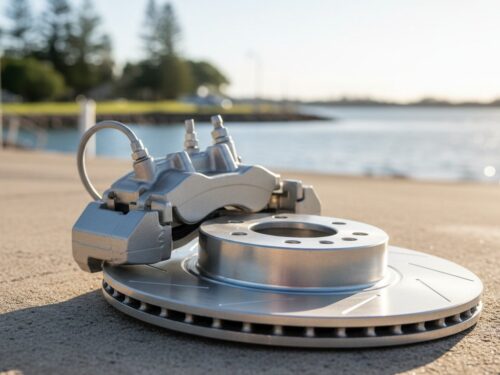
The “wash-down” protocol is your first line of defence. This must happen after every single saltwater launch. Don’t just spray the mudguards. Use high-pressure fresh water to flush the entire chassis. Focus on the axle, leaf springs, and brake assemblies where salt crystals accumulate. If salt remains on these surfaces for more than 48 hours, the oxidation process begins. Watch for early warning signs like orange staining on galvanised surfaces or “crunchy” sounds from the wheel bearings. These indicators suggest it’s time to visit a specialist for trailer parts before a minor issue turns into a highway breakdown.
Corrosion Prevention in Saltwater Environments
Galvanised steel provides a strong foundation, but it isn’t invincible. You need to clean the internal box sections of the trailer frame where water often pools. Insert a hose into the drainage holes to flush out trapped sand and salt. Apply lanolin-based sprays to all exposed nuts, bolts, and shackle pins every 90 days. These sprays create a durable, hydrophobic barrier that won’t wash off easily. Inspect the winch cable and strap for UV degradation. The Australian sun is brutal on synthetic fibres. If the strap feels stiff or looks frayed, replace it immediately. A snapped winch strap during recovery can cause significant damage or injury.
Essential Spares for Every Trip
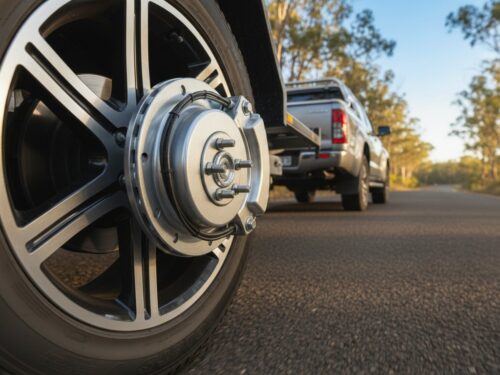
Being prepared for roadside repairs is part of responsible towing. You should always carry a spare hub and bearing kit pre-packed with marine-grade grease. Replacing a full hub assembly on the side of the road is significantly faster than trying to remove a seized bearing race in the dark. Check your tyre pressure and tread wear before every long haul. Small wheels on single jet ski trailers spin faster than car tyres, meaning they heat up quickly and wear down faster. Maintain a minimum tread depth of 3mm for optimal grip on slippery boat ramps. Finally, invest in a reliable jockey wheel. A heavy-duty, galvanised jockey wheel ensures easy hitching and prevents the trailer from sinking into soft ground during storage. Australian owned and operated, we understand that durability isn’t optional when you’re 100km from the nearest town.
This mindset of investing in durable, specialist equipment is common among outdoor enthusiasts, whether on water or on land. Cyclists, for instance, often seek out dedicated retailers like Bikeline to ensure their gear is just as reliable for long-distance rides.
Secure Your PWC for the Australian Coast
Selecting the right hardware keeps your watercraft safe between the garage and the boat ramp. Deciding between fixed bunks or a 12-roller support system depends on your launch frequency and hull material. Heavy-duty galvanised steel frames are the industry standard for resisting salt-water corrosion in local environments. We’ve seen that regular maintenance of marine-grade bearings can increase the lifespan of your assembly by 5 years or more. Proper weight distribution is essential; ensure your hitch weight sits between 5% and 10% of the total load for stable towing.
Superior Trailer Parts is 100% Australian Owned and Operated. We offer expert advice on all technical components and provide nationwide shipping to every state. Our single jet ski trailers are engineered to handle the toughest conditions from the Gold Coast to the Great Australian Bight. We focus on durability so you can focus on the water. Grab the gear you need to tow with confidence and get back out there.
View Our Range of Single Jet Ski Trailers
Frequently Asked Questions
Do I need brakes on a single jet ski trailer in Australia?
You don’t need brakes on single jet ski trailers if the Gross Trailer Mass (GTM) is under 750kg. Most modern three-seater PWCs weigh between 350kg and 480kg. When you add the trailer weight of 150kg and a full tank of fuel, the total remains well below the 750kg legal limit. Always check your specific vehicle’s unbraked towing capacity in the owner’s manual to ensure compliance.
Can I tow a jet ski trailer with a small passenger car?
Yes, you can tow a jet ski with a small car provided the single jet ski trailers and PWC combo stay within the vehicle’s unbraked towing limit. A typical small hatch like a Toyota Corolla has an unbraked towing capacity of 450kg to 600kg. Exceeding manufacturer limits voids your insurance and compromises braking distance on the road. We recommend weighing your fully loaded setup at a local weighbridge to be certain.
How often should I grease the wheel bearings on my PWC trailer?
Grease your wheel bearings every six months or after every 10 to 12 immersions in saltwater. Saltwater accelerates corrosion and breaks down lubricants quickly. Use a high-quality marine-grade grease to protect the internal components from rust. Inspect the seals for leaks during every trip to prevent roadside bearing failure. Proper maintenance extends the life of your hubs and prevents costly repairs during the peak season.
Is a galvanised trailer better than an aluminium one for saltwater?
Hot-dipped galvanised steel is the industry standard for durability in Australian saltwater conditions. While aluminium is lighter, galvanised steel offers superior structural rigidity for heavy-duty use. A high-quality galvanised coating provides a protective barrier that lasts 10 to 15 years in coastal environments. Aluminium trailers often cost 30% more and can suffer from stress cracking over time on rough boat ramps. Our expert advice is to choose galvanised for maximum resilience.
What is the average lifespan of a jet ski trailer?
A well-maintained jet ski trailer lasts between 10 and 15 years in Australian conditions. Exposure to salt and UV rays are the primary factors that determine longevity. Replacing wear items like rollers, LED lights, and winch straps every 3 to 5 years keeps the unit operational. Trailers stored in a garage or under cover typically see a 25% increase in lifespan compared to those left outdoors in the elements.
How do I know if my jet ski trailer is ADR compliant?
Check for a permanently fixed VIN plate to ensure your trailer is ADR compliant. This plate must list the manufacturer name, Gross Trailer Mass (GTM), and the Tare weight clearly. Australian Design Rules (ADR) 62/02 and 13/00 dictate the standards for mechanical connections and lighting. All trailers sold in Australia must meet these national standards to be legally registered for road use. As an Australian owned and operated specialist, we ensure all parts meet these requirements.
Can I use a boat trailer for a jet ski?
You can use a small boat trailer for a jet ski if the bunk or roller configuration supports the hull correctly. Jet skis require specific support points to prevent hull delamination or cracking. Most standard boat trailers are too wide or have long drawbars that make launching difficult in shallow water. Investing in a dedicated PWC trailer ensures the weight distribution is correct for safe towing and easy recovery at the ramp.