Your trailer’s biggest threat isn’t the heavy load on the tray, but the salt water and red dust that eat into the structural steel. A single trip to the boat ramp can start a corrosion process that ruins your suspension in less than six months. You’ve likely spent hours scrubbing rust off your leaf springs or wondering why your axle looks a decade older than it actually is. It’s an expensive frustration for Australian trailer owners who need gear that survives our harsh climate without constant maintenance.
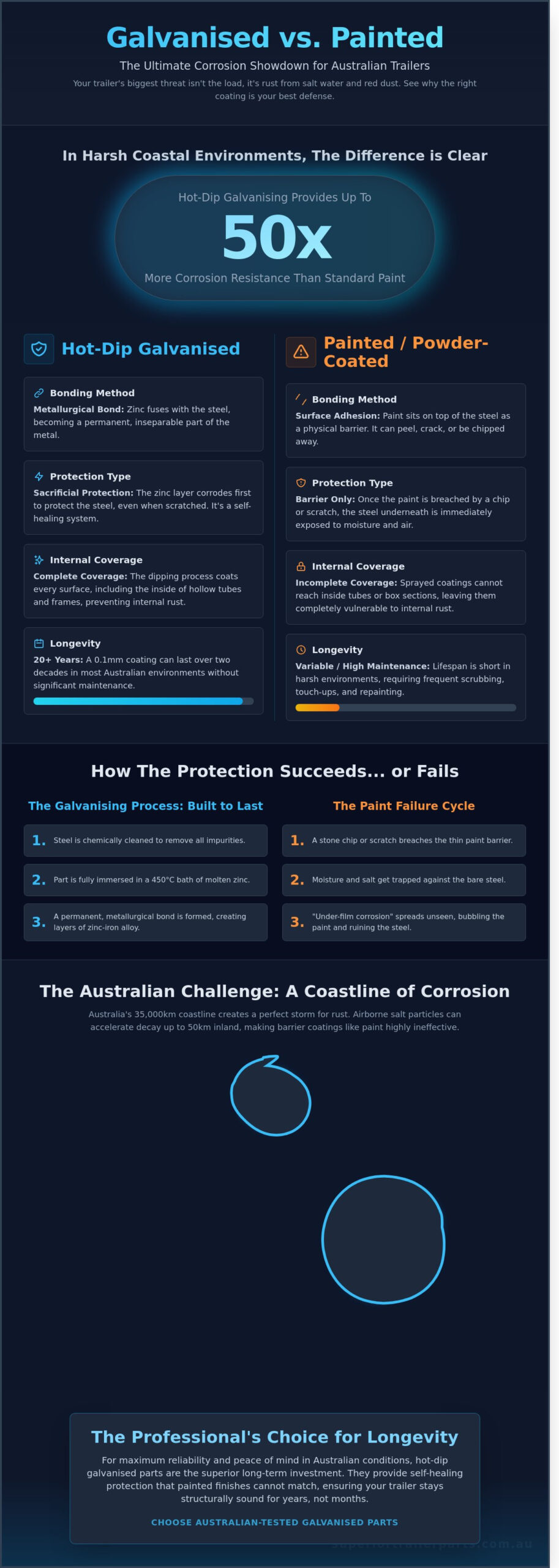
Deciding between galvanised trailer parts vs painted components is the most important choice you’ll make for your equipment’s longevity. Industry data indicates that hot-dip galvanising can provide up to 50 times the corrosion resistance of standard paint in coastal environments. We’ll show you exactly how these coatings perform in real-world conditions so you can avoid structural failure and high repair bills. This comparison covers the chemical resilience of galvanised steel versus the surface protection of industrial paint, ensuring your trailer stays on the road for years to come.
Key Takeaways
- Understand the metallurgical bond of hot-dip galvanisation and why it outperforms standard paint barriers.
- Learn how sacrificial protection prevents rust in harsh Australian salt air and high-humidity environments.
- Compare the long-term cost and maintenance requirements of galvanised trailer parts vs painted components.
- Identify which specific trailer parts must be galvanised to withstand heavy-duty use and marine conditions.
- See why industry professionals rely on Australian-tested galvanised parts for maximum equipment longevity.
Understanding the Core Differences Between Galvanised and Painted Finishes
Choosing between galvanised trailer parts vs painted options involves more than comparing price points. The decision impacts the long-term structural integrity of your equipment. The fundamental difference lies in how the protection attaches to the steel. Hot-dip galvanising creates a permanent metallurgical bond. The zinc actually becomes part of the steel substrate. In contrast, painted finishes function strictly as a physical barrier. They sit on the surface without changing the chemical makeup of the metal.
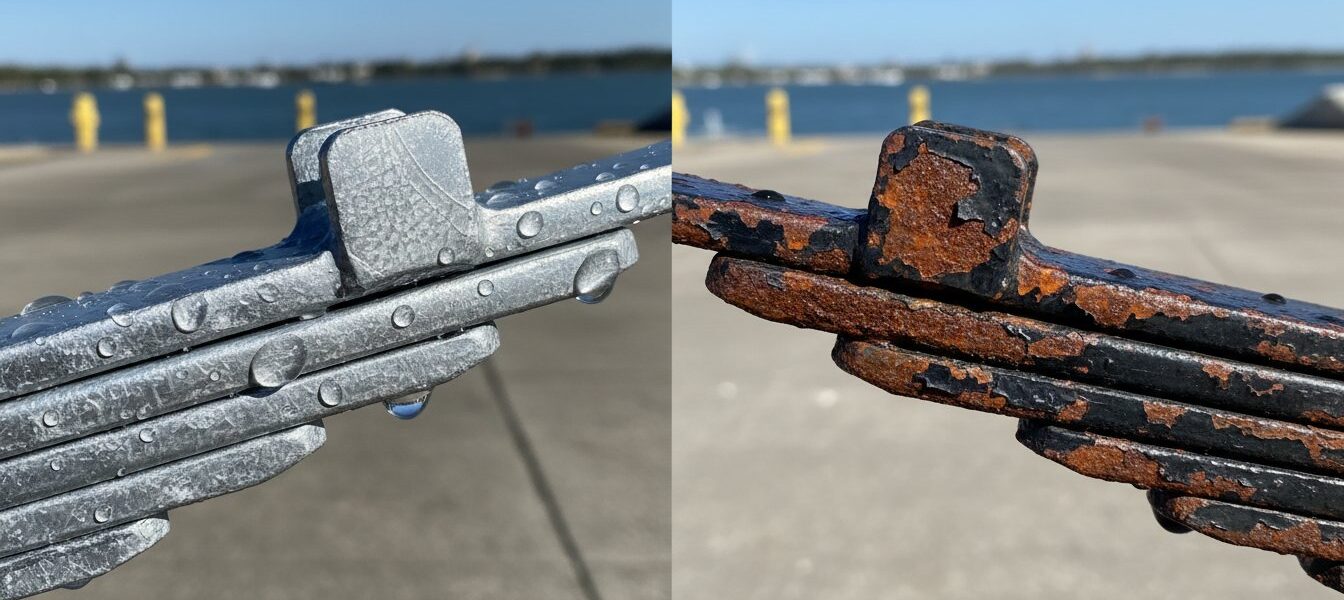
Visual changes over time reflect these different bonding methods. A galvanised finish starts bright but eventually weathers into a dull, matte grey patina. This change is a natural part of the oxidation process and doesn’t signal failure. Painted finishes offer a high-gloss look initially but are prone to peeling, cracking, and chalking. Once a stone chip or scratch breaches the paint, moisture traps against the steel. This leads to sub-film corrosion where rust spreads unseen beneath the coating.
Australian safety standards demand reliability. Using quality trailer parts that meet AS/NZS 4680 ensures the protective layer is thick enough for local conditions. This standard dictates the minimum coating mass required for different steel thicknesses, providing a baseline for durability that paint simply cannot match in high-stress environments.
What is Hot-Dip Galvanising?
The process starts with chemically cleaning the steel before immersing it in a bath of 450-degree molten zinc. This immersion ensures that the zinc-iron alloy layers form on every surface. Galvanization is unique because it protects the inside of hollow sections. Because the part is submerged, the molten zinc flows into tubes and box sections that spray paint or powder coating cannot reach. This prevents internal rust, which is a common cause of trailer frame failure in coastal regions.
The Role of Painted and Powder-Coated Finishes
Painted finishes usually involve industrial enamel or powder coating applications. These rely on surface adhesion rather than a chemical bond. If the steel surface has any contaminants during application, the finish will fail prematurely. Most users choose painted finishes for aesthetic reasons or custom branding. They work well for show trailers or equipment stored in climate-controlled sheds. However, for any trailer exposed to salt air, gravel roads, or constant weather, the reliance on a simple physical barrier often results in higher maintenance costs over time.
The Science of Corrosion Resistance in Australian Environments
Australia’s climate is brutal on steel. High humidity in the tropics and salt spray along the 35,000 kilometres of coastline create a perfect storm for oxidation. When comparing galvanised trailer parts vs painted, the difference lies in how they interact with the environment. Painted surfaces act as a simple barrier. If that barrier breaks, the steel underneath is vulnerable. Galvanised steel uses a metallurgical bond. It doesn’t just sit on top; it becomes part of the metal.
Road debris causes constant damage on Australian highways. A single stone chip on a painted trailer frame exposes raw steel. Moisture and oxygen enter this gap, starting a process called under-film corrosion. This often remains hidden until the paint bubbles and flakes off, revealing structural damage. Galvanised parts handle these impacts differently. The zinc coating is hard and abrasion-resistant. Even if a deep scratch occurs, the surrounding zinc continues to protect the exposed area. Choosing between galvanised trailer parts vs painted finishes depends on your tolerance for maintenance and your proximity to the ocean.
Sacrificial Protection: Why Zinc Wins
Zinc provides a unique advantage through a process called galvanic action. In this setup, the zinc layer acts as an anode. It corrodes intentionally to keep the steel cathode intact. A standard hot-dip galvanised coating of 0.1mm can last over 20 years in most Australian environments. Sacrificial protection is a chemical reaction where zinc gives itself up to save the steel. This means your heavy-duty trailer parts stay structurally sound even when the finish isn’t pristine. It’s a reliable, self-healing system that paint simply cannot replicate.
Coastal vs Inland Performance
Location determines how fast your gear degrades. In coastal regions, salt particles stay airborne for up to 50 kilometres inland. These salts accelerate the decay of painted parts by five times compared to dry environments. While painted finishes might survive in arid, inland areas, they still face risks. Fine red dust and mud trap moisture against the surface. This creates a micro-environment where rust thrives, even far from the sea.
Calling a painted part “rust-free” is a misnomer. Without meticulous maintenance and immediate touch-ups on every chip, paint will eventually fail. It is a passive system. Zinc is an active system. For those working in high-salt areas or hauling heavy loads across the country, the chemical bond of galvanisation offers a level of resilience that keeps trailers on the road longer. It’s about choosing the right tool for the job.
Comparing Performance: Durability, Maintenance, and Cost
Choosing between galvanised trailer parts vs painted finishes is a decision between immediate savings and long-term reliability. Australian conditions are notoriously harsh on equipment. Salt air, road debris, and high humidity accelerate corrosion on standard steel. While both finishes provide a barrier, their performance over a five-year period differs significantly. Practical owners look beyond the purchase price to see the true value of their investment.
Upfront Investment vs Total Cost of Ownership
Galvanised parts carry a higher initial price tag, often costing 15% to 25% more than painted equivalents. This premium covers the hot-dip process where steel is submerged in molten zinc. This creates a metallurgical bond that protects both the inside and outside of the component. Painted parts are cheaper to manufacture but require more frequent replacement. By year five, the cost of paint, sandpaper, and labor for repairs often exceeds the initial price gap. Investing in essential trailer parts with a galvanised finish reduces the frequency of component failure. This keeps your trailer on the road and out of the workshop.
Maintenance and Repair Realities
Maintenance for painted parts is a constant cycle. Stone chips from gravel roads expose raw steel, leading to immediate oxidation. Owners must sand, prime, and touch up these spots regularly to prevent rust from spreading under the paint. This “hidden rust” is a major risk, as it eats away at the structural integrity while remaining invisible under the surface. In contrast, galvanised parts are virtually maintenance-free. If the surface is scratched, the surrounding zinc acts as a sacrificial anode. It protects the exposed steel naturally. For minor mechanical repairs or welds, a simple application of “cold gal” spray restores the barrier. This direct approach saves hours of labor every year. To source high-quality industrial materials for your repair projects, visit Fosseway Tapes & Fixings Limited.
- Resale Value: Galvanised trailers consistently fetch 20% to 30% more on the used market. Buyers recognize the longevity of the frame and components and are willing to pay for that peace of mind.
- Structural Integrity: Painted hollow sections often rust from the inside out because the paint cannot reach internal surfaces. This hidden corrosion leads to sudden structural failure during transit. Galvanised parts are dipped, ensuring the metal stays thick and strong inside and out.
- Durability: Zinc coatings withstand the abrasive nature of Australian boat ramps and off-road tracks better than standard enamel paint. It’s a tougher finish for a tougher environment.
When you weigh the “galvanised trailer parts vs painted” debate, the evidence favors the zinc coating for any trailer seeing regular use. It is the professional choice for those who value safety and long-term performance over a slightly lower entry cost.
Selecting the Right Finish for Specific Trailer Components
Choosing between galvanised trailer parts vs painted finishes depends on where you drive and what you haul. Some parts face constant abuse from road grit and moisture. Standard paint works for a box trailer used once a month for inland tip runs. However, heavy-duty applications or coastal work require galvanised protection to prevent structural failure. Galvanised coatings offer a sacrificial layer of zinc that protects the steel even if the surface gets scratched. Paint lacks this chemical bond and allows rust to spread underneath the coating once the seal breaks.
Axles and Suspension Components
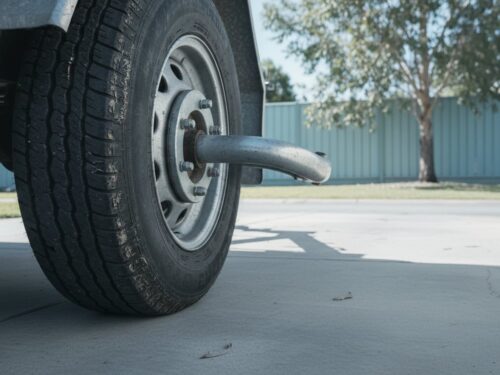
Axles sit in the splash zone. They catch every bit of road grime and moisture kicked up by the tow vehicle. While painted axles are common on budget trailers, they often show surface rust within 6 months of regular use. High-tensile leaf springs benefit from galvanisation because the zinc layer remains bonded as the metal flexes. Painted springs often flake during compression, exposing bare steel to the elements. Safety is the priority with u-bolts. These should always be galvanised. A rusted u-bolt can snap under heavy loads, leading to an axle shift at highway speeds.
Braking Systems and Marine Parts
Marine environments are the ultimate test for any metal. If you own a boat trailer or jet ski trailer, painted parts are a liability. Saltwater accelerates corrosion by 10 times compared to freshwater exposure. You need brakes and calipers with DACROMET or hot-dip galvanised finishes. These specific coatings prevent the pistons from seizing. When comparing galvanised trailer parts vs painted options for marine use, the galvanised choice is the only way to ensure the trailer remains roadworthy after multiple submersions.
Inspect your gear every 6 months to catch corrosion before it causes a breakdown. Use this checklist to evaluate your current components:
- Check for “spider-web” cracking or bubbling under the paint surface.
- Look for orange streaks running from bolt holes or weld points.
- Scrape away loose flakes to check the depth of metal pitting.
- Examine leaf spring eyes for thinning metal or loss of structural integrity.
- Test u-bolt nuts to ensure they haven’t fused to the thread due to oxidation.
Don’t risk a breakdown on the side of the highway. View our range of heavy-duty trailer parts to upgrade your rig with components built for Australian conditions.
Why Quality Galvanised Parts are the Professional Choice
Hot-dip galvanisation is the industry benchmark for Australian trailers. It withstands the corrosive salt air found along our 35,000 kilometres of coastline. Painted parts often show signs of structural fatigue or surface rust within 12 to 24 months in high-humidity regions. Galvanised components provide a metallurgical bond that becomes part of the steel. This sacrificial layer protects the metal even if the surface is chipped or scratched on gravel roads. For anyone weighing up galvanised trailer parts vs painted options, the long-term cost savings on maintenance make galvanisation the clear winner.
Australian-owned companies test these parts against local conditions. We see temperatures exceeding 40 degrees Celsius and extreme UV levels that degrade paint and powder coatings. Galvanised steel remains stable under these conditions; it doesn’t peel or flake like inferior finishes. This reliability ensures your trailer stays on the road instead of sitting in a workshop for rust repairs. Choosing high-quality galvanised hardware is an investment in safety and resale value.
Upgrading Your Current Trailer
You don’t need to buy a brand-new trailer to benefit from better protection. Upgrading a painted trailer with galvanised components is a practical way to extend its service life. Focus on the parts that sit closest to the road surface first. These items face constant bombardment from water and debris. Start with these critical areas:
- Suspension components: Replace rusted leaf springs and hangers with galvanised alternatives.
- Fasteners: Swap out standard U-bolts and nuts for galvanised versions to prevent seizing.
- Running gear: Install galvanised hubs and axles to protect critical mechanical points.
Galvanised parts are fully compatible with existing painted steel frames. You can bolt them directly onto your current setup without specialized tools. Ensure you source genuine components that comply with Australian design rules. This ensures your trailer remains roadworthy and safe under maximum load capacities. Replacing worn painted parts before they fail prevents expensive roadside breakdowns.
The Superior Trailer Parts Advantage
We stock a massive range of heavy-duty galvanised hardware built for the trade. Our inventory covers everything from marine-grade torsion axles to reinforced couplings. We focus on durability because we know how much a breakdown costs in lost time. Our team provides expert advice to help you select the right specifications for your build or repair project. We understand the technical requirements of different trailer types, from small box trailers to heavy plant haulers.
Don’t settle for low-grade imports that won’t survive a single season. Invest in hardware that lasts. Browse our full range of galvanised trailer parts for nationwide delivery and get your trailer back in peak condition.
Secure Your Trailer for Harsh Australian Conditions
Deciding between galvanised trailer parts vs painted finishes is a choice between short-term savings and long-term durability. Painted components offer a surface-level barrier, but they can’t match the sacrificial protection of hot-dip galvanising. In Australian coastal environments, salt spray causes unprotected steel to corrode at a rate of up to 80 microns per year. Galvanised parts bonded to AS/NZS 4680 standards provide a metallurgical shield that stops rust from taking hold. This reduces your maintenance schedule and prevents structural failure on the road.
Superior Trailer Parts is Australian Owned and Operated. We provide expert advice on heavy-duty components designed for local conditions. Our team understands that a trailer off the road costs you time and money. We offer nationwide shipping Australia wide to get your gear moving again with parts that last. Don’t compromise on safety or performance when you’re hauling heavy loads.
Shop Heavy-Duty Galvanised Trailer Parts Today
Get your trailer back in peak condition with parts you can trust.
Frequently Asked Questions
Is a galvanised trailer better than a painted one for off-road use?
Galvanised trailers are superior for off-road use due to their high abrasion resistance. The zinc coating creates a metallurgical bond that doesn’t flake or peel under stress. It protects the steel from constant stone pecking on corrugated dirt roads. Painted trailers often suffer from gravel rash, leading to rapid corrosion in hard-to-reach areas. This makes galvanisation the standard choice for heavy-duty outback travel.
Can I paint over a galvanised trailer part for a better look?
You can paint over galvanised parts, but you must use the correct preparation steps. Fresh zinc is naturally greasy and will repel standard paint. Clean the surface thoroughly and apply a high-quality etch primer to create a reliable bond. This allows you to match your vehicle’s colour while keeping the heavy-duty protection of the zinc underneath. It’s a common practice for custom builds and fleet branding.
How long do galvanised trailer parts typically last in Australia?
Hot-dip galvanised trailer parts typically last between 20 and 50 years in most Australian environments. In coastal regions with high salt spray, the lifespan may sit closer to 20 years. Inland areas with low humidity often see parts remain rust-free for over five decades. Regular rinsing with fresh water can extend this lifespan significantly, making it a reliable choice for long-term ownership across the country.
Why are painted trailers usually cheaper than galvanised models?
Painted trailers cost less because the manufacturing process is faster and requires fewer specialized resources. Applying enamel or acrylic paint is a simple surface treatment. Galvanisation requires a multi-stage acid bath and a 450 degree molten zinc dip. This extra labour and material cost makes galvanised parts a higher initial investment, but they offer much better long-term durability for Australian owners.
What is the difference between hot-dip and cold galvanising?
Hot-dip galvanising involves submerging steel in a 450 degree Celsius bath of molten zinc. This covers both the internal and external surfaces of hollow sections. Cold galvanising is a zinc-rich paint applied with a brush or spray can. It’s an excellent tool for touching up welds or scratches during maintenance. However, it’s not a substitute for the structural protection provided by the hot-dip process during manufacturing.
Do galvanised trailer parts ever rust or corrode?
Galvanised parts can rust once the sacrificial zinc coating is fully depleted. You might notice white rust first, which is actually the zinc protecting the steel. Red rust only appears if the steel itself is exposed to oxygen and moisture. Proper maintenance and washing after beach trips will prevent the zinc from wearing down prematurely. It’s important to inspect your trailer regularly for any deep gouges.
Is powder coating the same as painting for trailer protection?
Powder coating isn’t the same as traditional painting. It involves applying a dry polymer powder that is baked to form a hard skin. While it offers better impact resistance than paint, it doesn’t provide the sacrificial protection found in galvanised trailer parts vs painted steel. If the coating chips, moisture can crawl underneath and cause hidden structural damage. This makes it less effective than galvanisation in high-corrosion areas.
Which parts of a trailer should I prioritise for galvanisation?
Focus on the chassis, axles, and suspension components first. These parts are closest to the road and face the most moisture and debris. If you’re using a boat trailer, every structural component must be galvanised to survive salt water immersion. Protecting these core elements ensures your trailer remains safe and roadworthy for years. It’s the most cost-effective way to prevent major structural failures on Australian roads.