You’re at a crowded boat ramp with a queue of fifteen cars watching you attempt to reverse a five-metre trailer into a narrow lane. It’s a high-pressure scenario that makes even seasoned drivers sweat. Learning how to tow a trailer confidently for the first time is about understanding the physics of your rig, not just having a powerful 4×4. You understand that safety is the priority, but the complex reality of GVM, ATM, and GTM ratings often creates more confusion than clarity. National road safety data indicates that improper weight distribution contributes to a significant portion of towing-related incidents on Australian highways.
You’ll master the essential mechanics, weight calculations, and driving techniques required to tow any trailer safely across Australia. This article provides the expert advice needed to manage trailer sway and hitch up alone without the stress. We’ll explain how to handle your load in heavy traffic and ensure a safe arrival without mechanical failure.
Key Takeaways
- Identify your vehicle’s legal towing limits and master weight distribution to prevent dangerous trailer sway on Australian roads.
- Learn how to tow a trailer confidently for the first time by following a repeatable mechanical checklist for hitches, safety chains, and electrical connections.
- Understand the physics of heavy-load braking and adjust your driving style to safely manage increased vehicle length and weight.
- Simplify the reversing process with a systematic steering technique designed to avoid jackknifing and ensure precise maneuvering.
- Conduct a professional-grade final walk-around to verify load security and the mechanical integrity of your suspension and axle assembly.
The Foundation of Confidence: Understanding Your Towing Weights
Confidence on the road starts in your driveway, not on the highway. Learning how to tow a trailer confidently for the first time requires more than just a heavy-duty hitch; it requires a firm grasp of physics and legal limits. Every vehicle has a mechanical breaking point. Exceeding it risks structural failure or a total loss of control. Before you hook up any hardware, you must identify the physical capacities of both your tow tug and your trailer. Proper preparation prevents the “tail wagging the dog” scenario. Understanding Towing Basics ensures you aren’t guessing when you hit 100km/h on the highway. Establish your safety baseline by checking the compliance plates on your vehicle and trailer frame today.
Weight distribution is the most critical factor in preventing trailer sway. If you place too much weight at the rear of the trailer, a see-saw effect occurs that lifts your vehicle’s rear wheels. This shift causes instability and unpredictable handling. Keep your heaviest items low and centered over the axles. A balanced load keeps all four vehicle tyres firmly planted, which is essential for steering and emergency braking maneuvers.
Decoding ATM, GTM, and Ball Weight
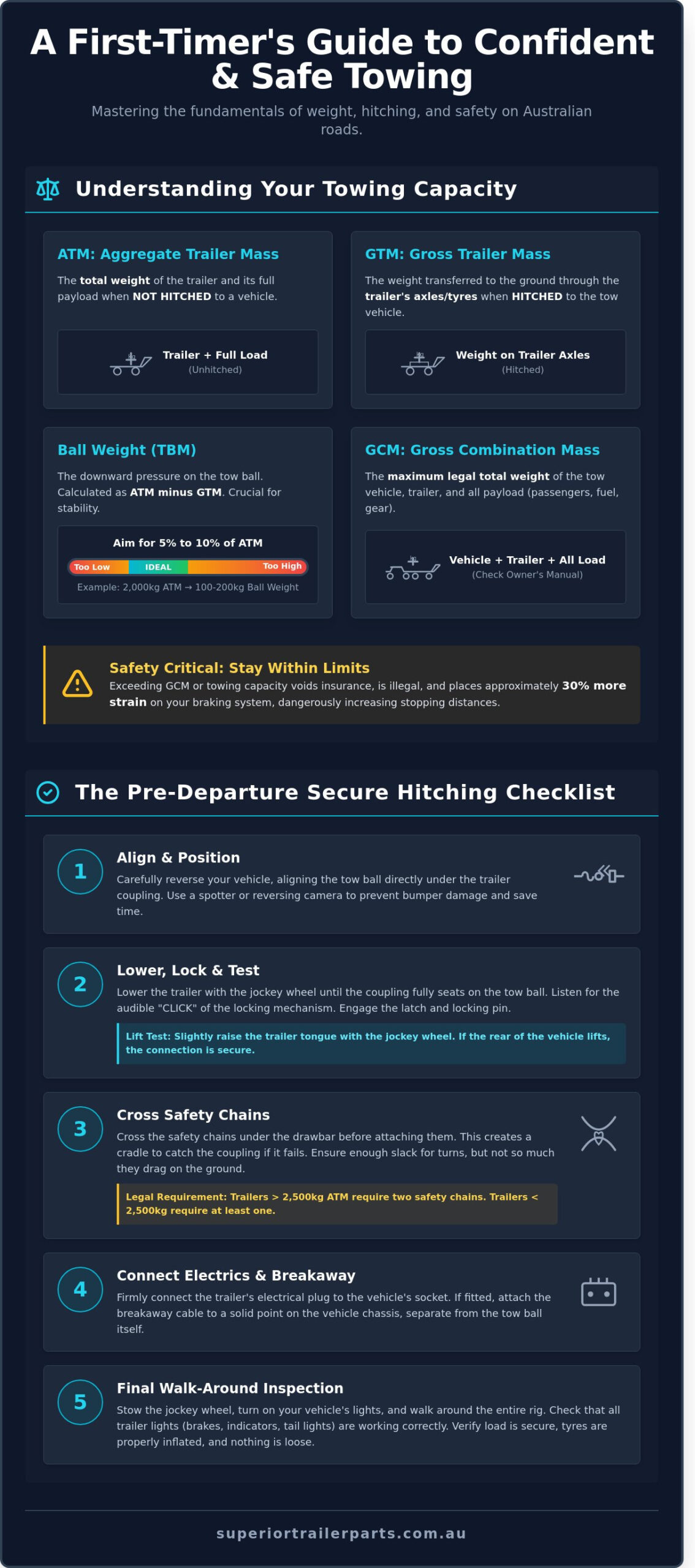
Australian regulations use specific acronyms to define safety limits. ATM (Aggregate Trailer Mass) is the total weight of the trailer plus its maximum payload when it’s not hitched to a vehicle. GTM (Gross Trailer Mass) is the weight transmitted to the ground through the trailer’s tyres when it’s hitched. The difference between these two figures is the Ball Weight. This represents the downward pressure on your tow ball. Aim for a ball weight between 5% and 10% of the total trailer weight. For example, a trailer weighing 2,000kg should have a ball weight between 100kg and 200kg. If you need high-quality trailer parts to manage these loads, ensure they meet or exceed these specifications.
Matching Your Vehicle to the Load
Check your owner’s manual for the maximum braked towing capacity. Many modern dual-cab utes are rated for 3,500kg, but you must also monitor your GCM (Gross Combination Mass). This is the total allowable weight of the car, passengers, fuel, and the trailer combined. If you pack your ute to its maximum capacity, you might not have enough GCM remaining to tow a heavy trailer. Exceeding these limits voids your insurance policy immediately. It also places approximately 30% more strain on your braking system, which increases stopping distances dangerously. Stick to the manufacturer’s numbers to stay legal and safe on Australian roads.
Securing the Connection: Hitching and Mechanical Checks
Safety on the road begins before the engine starts. A repeatable, disciplined hitching sequence is the only way to ensure your trailer remains attached under heavy load or sudden braking. Learning how to tow a trailer confidently for the first time requires moving past guesswork and into a strict mechanical routine. Every connection point represents a potential failure point if you don’t verify its integrity personally.
The Step-by-Step Hitching Process
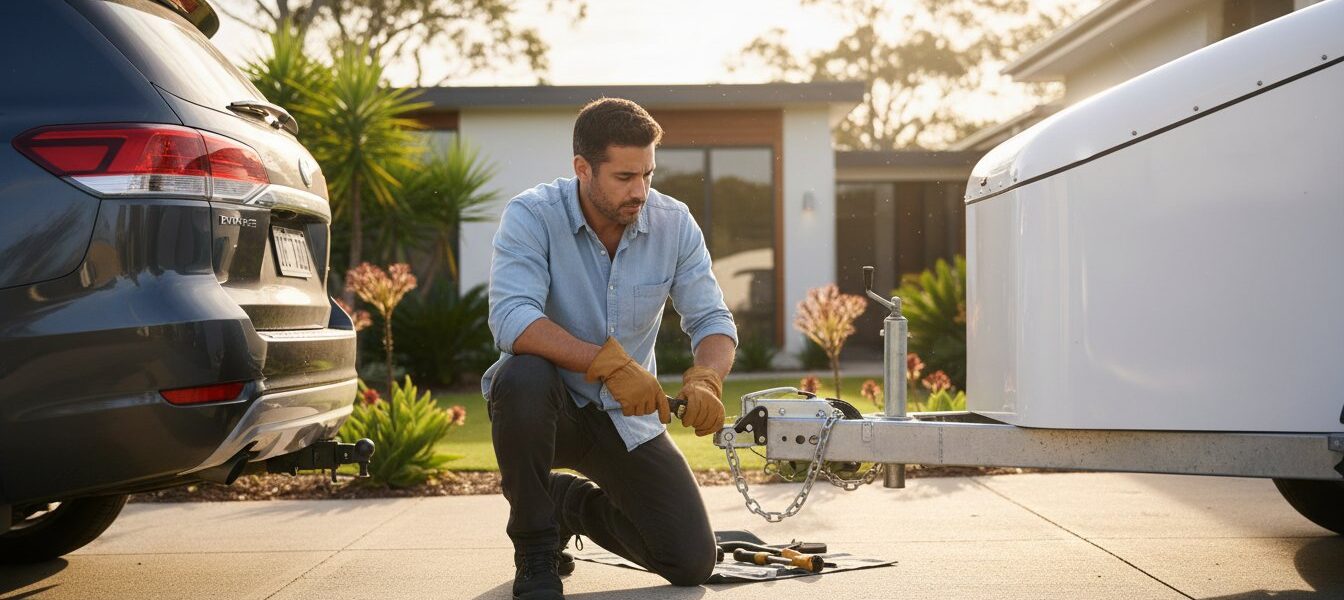
Position your tow vehicle so the ball aligns directly under the trailer coupling. Use a spotter or a high-definition reversing camera to save time and avoid bumper damage. Once aligned, lower the trailer using the jockey wheel until the coupling fully seats on the tow ball. You must hear the locking mechanism click into place. Lift the trailer tongue slightly with the jockey wheel to confirm the ball is gripped tight. If the vehicle rear rises with the trailer, the connection is secure.
Cross your safety chains under the drawbar. This creates a cradle that catches the trailer tongue if the coupling fails, preventing it from digging into the bitumen. Ensure there is enough slack for tight turns but not so much that the chains drag. This procedure aligns with standard Australian road rules and safety guidelines regarding pre-trip mechanical security. Always double check that the locking pin or latch is fully engaged and pinned before you move.
Inspecting Couplings and Safety Hardware
Mechanical wear is inevitable in harsh Australian conditions. Before you depart, check for excessive play or rattling in your couplings and parts. A loose coupling causes surging and can damage the tow ball over long distances. Ensure your safety chains are rated for the Aggregate Trailer Mass (ATM) of your load. For trailers up to 2,500kg, Australian standards require at least one safety chain of a specific grade; over 2,500kg, two chains are mandatory. This isn’t just a suggestion; it’s a legal requirement for road safety.
Verify the electrical connection is solid. Push the trailer plug firmly into the vehicle socket and test all indicators, brake lights, and tail lights. Corroded pins lead to flickering lights, which is a major hazard at night or in heavy rain. Finally, fully retract the jockey wheel, swivel it into the transit position, and lock it. A loose jockey wheel hitting a speed bump can cause significant structural damage to the drawbar. If you’re unsure about your current setup, browse our range of heavy-duty trailer parts to ensure your equipment is up to the task.
On the Road: Driving Techniques for New Towers
Operating a heavy combination requires a total shift in driving logic. You are no longer managing a single vehicle. You are controlling an articulated unit that reacts differently to every steering input. Learning how to tow a trailer confidently for the first time starts with awareness of your physical footprint. Most standard box trailers add between 3 and 5 metres to your total length, while caravans can add much more. This extra size means you must take wider turns to avoid clipping curbs or obstacles. Use specialized towing mirrors to eliminate blind spots. These extensions allow you to see the full length of your trailer and the traffic behind you, which is essential for safe lane changes on Australian motorways.
Managing Speed and Braking Distances
Weight directly impacts stopping power. A standard vehicle traveling at 100 km/h requires approximately 98 metres to stop in dry conditions. Adding a 2,500 kg trailer can push this distance beyond 150 metres. You must double your usual following distance to account for this mass. A five-second gap is the minimum safety standard for towing. This extra space gives your trailer brakes and calipers the time needed to scrub off speed without overheating. When driving through hilly terrain, avoid constant pressure on the brake pedal. This leads to brake fade, where the components become too hot to function. Use engine braking by shifting into a lower gear on descents to maintain a controlled speed. As noted in U-Haul’s towing tips, smooth and predictable movements are the key to maintaining control over a heavy load.
Dealing with Sway and Overtaking
Trailer sway is a dangerous oscillation often caused by improper weight distribution or external forces like high winds. If the trailer starts to fish-tail, do not hit the vehicle brakes. Sudden braking can cause the trailer to jackknife. Hold the steering wheel straight and steady. If your setup includes an electronic brake controller, apply the trailer brakes manually to pull the unit back into line. Be prepared for the “bow wave” when large trucks or road trains pass you at highway speeds. This air pressure will initially push your trailer away and then suck it toward the larger vehicle. Keep a firm grip on the wheel and focus on the road ahead. Mastering these reactions is essential to knowing how to tow a trailer confidently for the first time. Consistent speed and steering inputs are your best defense against instability.
- Maintain Situational Awareness: Check your mirrors every 10 to 15 seconds to monitor trailer tracking.
- Anticipate the Road: Look 12 to 15 seconds ahead to identify potential hazards before they require heavy braking.
- Manage Wind Resistance: Reduce your speed by 10 km/h during high-wind warnings to minimize lateral movement.
Maneuvering with Precision: Reversing for Beginners
Reversing is the most challenging skill to master when learning how to tow a trailer confidently for the first time. It feels counter-intuitive because the trailer moves in the opposite direction of the towing vehicle. You must simplify your physical perspective to succeed. Start your practice sessions in an empty industrial estate or a vacant carpark on a Sunday. This low-pressure environment allows you to understand trailer physics without the stress of a crowded boat ramp or narrow worksite. Avoid busy areas until you can reverse 20 metres in a straight line without significant correction.
A systematic approach prevents the common jackknife scenario. A jackknife occurs when the angle between the vehicle and the trailer exceeds a recoverable limit, usually around 15 to 20 degrees for shorter trailers. Once you pass this point, the trailer will continue to pivot toward the vehicle regardless of steering input. If the angle becomes too sharp, stop immediately. Pull forward to straighten the combination and start the maneuver again. This “reset” is a standard practice for professional drivers and preserves your equipment.
The Hand-at-the-Bottom Steering Technique
Traditional steering methods require mental gymnastics while in reverse. You usually turn the wheel left to make the trailer go right. Eliminate this confusion by placing your dominant hand at the bottom of the steering wheel, known as the 6 o’clock position. This creates a direct relationship between your hand movement and the trailer direction. If you want the trailer to move left in your mirrors, move your hand to the left. This technique is the fastest way to learn how to tow a trailer confidently for the first time.
- Use small, incremental steering inputs to maintain control.
- Avoid “palming” the wheel, which leads to over-correction.
- Monitor both side mirrors constantly to track the trailer’s path.
- Correct the trailer early; 5 degrees of correction is easier to manage than 25 degrees.
Using a Spotter Effectively
A second set of eyes is your most valuable safety tool. Establish clear communication protocols before you shift into reverse. Use UHF radios for voice instructions to keep the dialogue calm and precise. If you rely on hand signals, the spotter must stand in a position where they are clearly visible in your side mirrors. They should never stand directly behind the trailer. Their primary job is to watch for blind spots and overhead obstructions that you cannot see from the driver’s seat.
The “stop” signal must be absolute and non-negotiable. If you lose sight of your spotter for even one second, stop the vehicle immediately. This prevents accidents and protects your investment from impact damage. Clear communication ensures that the reversing process remains efficient and safe, even in tight Australian caravan parks or loading zones.
Ensure your equipment is up to the task before you head out. Shop our range of heavy-duty trailer parts to keep your setup reliable and secure on the road.
Pre-Departure and Component Integrity Checklist
Safety on the road starts with a thorough final walk-around. This routine ensures your equipment is ready for the stresses of highway speeds and varying road surfaces. Learning how to tow a trailer confidently for the first time requires a disciplined approach to mechanical checks. Don’t rush this process. A five-minute inspection can prevent a multi-hour roadside repair or a dangerous trailer sway incident. Every component must be in peak condition before you leave the driveway.
Begin with the tyres. Trailer tyres frequently suffer from flat spots or sidewall degradation if they sit for long periods. Check the pressure on both the tow vehicle and the trailer using a reliable gauge. Under-inflated tyres generate excessive heat, which leads to delamination and blowouts. Ensure your tow vehicle’s rear tyres are inflated to the loaded specification found on the door placard. This extra pressure supports the tongue weight and maintains stability during cornering.
Check your safety chains and D-shackles. The chains must be crossed under the drawbar to create a cradle. This prevents the trailer tongue from hitting the ground if the hitch fails. Ensure the D-shackles are load-rated and the pins are tightened securely. A loose shackle is a liability that can vibrate open over long distances. Verify that the hitch handle is fully engaged and the locking pin is in place. These small mechanical steps provide the foundation for a safe journey.
Checking Axles, Springs, and U-Bolts
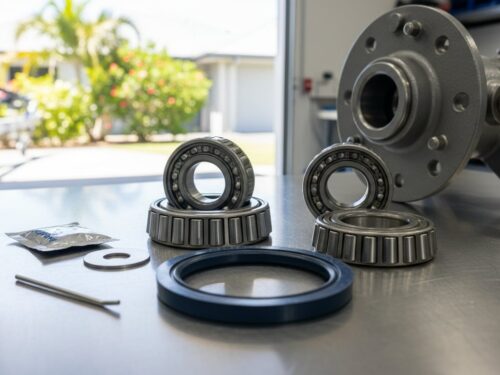
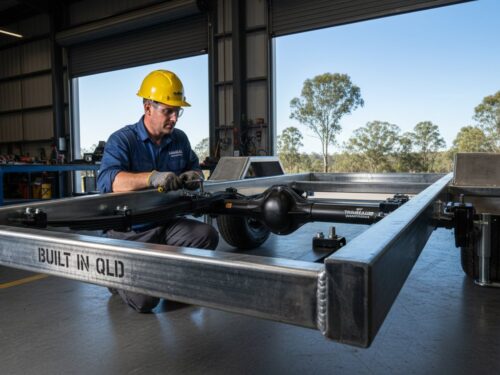
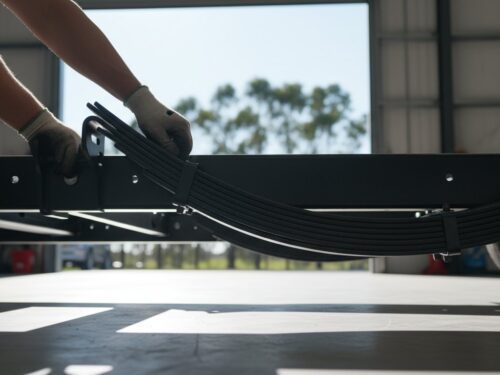
The suspension system carries the entire weight of your cargo. Inspect trailer axles for any signs of bowing or fatigue. A bent axle causes the trailer to dog-track, which makes it difficult to track straight in your mirrors. Verify that all U-bolts are tight and seated correctly around the axle tube. Check your leaf springs for hairline cracks or shifted leaves. Ensure all moving trailer parts, including shackle pins and bushes, are greased. Dry components lead to metal-on-metal wear and eventual mechanical failure.
The Final Light and Load Check
Visibility is a legal requirement under Australian standards. Have a partner stand behind the unit while you test the indicators, brake lights, and clearance lamps. Faulty wiring is a leading cause of roadside fines and safety risks. Next, verify the load distribution. The weight must be balanced over the axle, not concentrated heavily on the hitch or the rear. Excessive tongue weight lifts the front wheels of your car, which reduces steering control. If you’re using a box trailer, double-check that the tailgate is locked and all tie-down straps are tensioned. Physical security is the last step before you pull away.
Master Your Next Towing Mission
Safe towing starts with a clear understanding of your ATM and GTM ratings. Secure hitching and rigorous mechanical inspections eliminate most common failure points before they start. Learning how to tow a trailer confidently for the first time requires you to combine these technical checks with disciplined driving habits. Always verify your safety chain connections and brake controller settings before leaving the driveway. These steps ensure your trailer remains stable across varied Australian road surfaces.
High-quality hardware is the foundation of every successful trip. We offer expert advice for DIY trailer builders to ensure you select the correct heavy-duty components for your specific requirements. We’re Australian Owned and Operated, providing nationwide shipping on all components to keep your downtime to a minimum. Our inventory features galvanised and marine-grade parts designed to withstand the toughest environments. Trusting your gear means you can focus on the road ahead.
Browse our range of heavy-duty trailer parts and accessories
Get your trailer road-ready and enjoy the peace of mind that comes with professional-grade equipment.
Frequently Asked Questions
Do I need a special licence to tow a trailer in Australia?
You don’t need a special licence to tow a standard trailer if you hold a current Class C car licence. This licence allows you to operate vehicles and trailers provided the Gross Combination Mass doesn’t exceed 4.5 tonnes. Always verify your specific vehicle’s towing capacity and your state’s transport regulations, as requirements for heavy duty loads can change if you move into medium or heavy rigid categories.
How do I stop my trailer from swaying at high speeds?
To prevent trailer sway, you must load 60 percent of the cargo weight in the front half of the trailer. This maintains a consistent 10 percent tow ball weight, which keeps the drawbar pressed firmly onto the hitch. Learning how to tow a trailer confidently for the first time requires keeping your speed steady; if sway occurs, avoid the brake pedal and use your electronic brake controller’s manual override to straighten the unit.
What happens if my trailer disconnects while I am driving?
Your safety chains are designed to catch the trailer’s drawbar and prevent it from hitting the road or veering into other lanes. For any trailer with a Gross Trailer Mass over 2,000kg, Australian Design Rule 38 requires a functional breakaway system. This system automatically engages the trailer brakes if the hitch fails. Always use galvanised, rated shackles to ensure your connection points remain secure under extreme tension.
Can I tow a trailer with a small passenger car?
You can tow with a small car as long as the total weight doesn’t exceed the manufacturer’s braked and unbraked towing limits. Most small hatchbacks are rated for an unbraked maximum of 500kg to 750kg. You’ll find these specific figures on the vehicle’s compliance plate or in the owner’s manual. Exceeding these limits puts dangerous stress on your transmission and reduces your braking efficiency on steep descents.
How often should I check the wheel bearings on my trailer?
You should inspect and regrease your wheel bearings every 10,000 kilometres or every 12 months. If you use a boat trailer in salt water, this maintenance should happen every six months to prevent corrosion from ruining the hubs. Using high quality marine grade grease and genuine replacement parts prevents 90 percent of common roadside axle failures. Regular checks ensure your trailer remains reliable during long interstate trips.
Is it harder to tow a boat trailer compared to a box trailer?
Boat trailers are generally more difficult to handle because they’re often 2 to 3 metres longer than a standard 7×4 box trailer. This extra length increases your turning circle and makes reversing into tight boat ramps more technical. The high centre of gravity on large boats also affects stability in crosswinds. You’ll need to allow for more space when merging and take wider lines through suburban roundabouts.
Do I legally need towing mirrors for a standard box trailer?
You only need extension mirrors if your trailer is wider than your tow vehicle and blocks your rearward line of sight. Australian Road Rule 297 requires every driver to have a clear view of the road behind and to both sides of the vehicle. While a standard 1.5 metre wide box trailer usually doesn’t require them, wider caravans and enclosed trailers make towing mirrors a legal necessity for safety.
What is the most common mistake beginners make when towing?
The most frequent error is improper weight distribution, which leads to poor handling and increased braking distances. Many new towers forget that a trailer cuts corners tighter than the car, leading to kerb strikes or collisions. Understanding how to tow a trailer confidently for the first time involves practicing your turning arcs. Statistics show that 25 percent of towing accidents are caused by incorrect loading and failing to maintain a 4 second following distance.