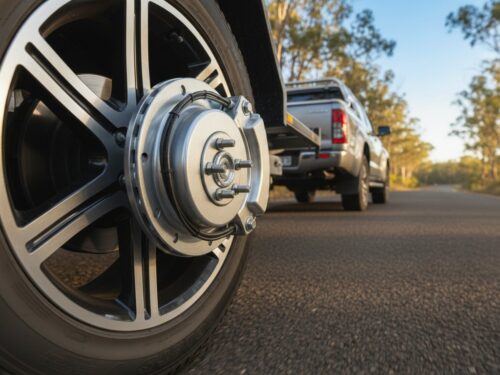
Descending a steep grade with a heavy load is the worst time to question your trailer’s brakes. We see it all the time. Trailer owners battling brake fade on long hauls, fighting corrosion on their boat trailers after a weekend on the water, or feeling uncertain about meeting ADR compliance. These issues aren’t just frustrating; they are a serious compromise on safety and performance. Your equipment should work as hard as you do, without constant maintenance or worry.
This technical overview cuts through the confusion. It’s a no-nonsense breakdown of how to select, install, and maintain hydraulic disc brake kits for maximum stopping power and durability. We provide the expert advice you need to get the job done right, ensuring your trailer is fit for purpose in demanding Australian conditions. You’ll get clear, practical instructions for choosing the right marine-grade components, achieving correct fitment for 45mm or 50mm square axles, and keeping your system in top working order for years to come.
Key Takeaways
- Learn to correctly match your brake kit to your trailer’s axle rating and load capacity to ensure optimal fitment and safe towing performance.
- Evaluate the key differences in stopping power and long-term maintenance between hydraulic, electric, and mechanical trailer brakes.
- Get a clear overview of the installation process, including the critical technique for bleeding brake lines to ensure reliable function.
- Identify the core components that make up high-performance hydraulic disc brake kits and how they contribute to durability in harsh Australian conditions.
Understanding Hydraulic Disc Brake Kits for Australian Trailers
A hydraulic disc brake system is a robust solution for providing safe, reliable stopping power for your trailer. It functions by using non-compressible fluid to transfer force from the trailer coupling directly to the brake calipers at the wheels. When your tow vehicle slows, the trailer’s inertia pushes against the coupling, activating a master cylinder. This action pressurises the brake fluid in the lines, which then forces caliper pistons to clamp brake pads onto spinning rotors. The resulting friction slows the trailer smoothly and in sync with your vehicle, which is critical for maintaining control during sudden stops or on steep descents.
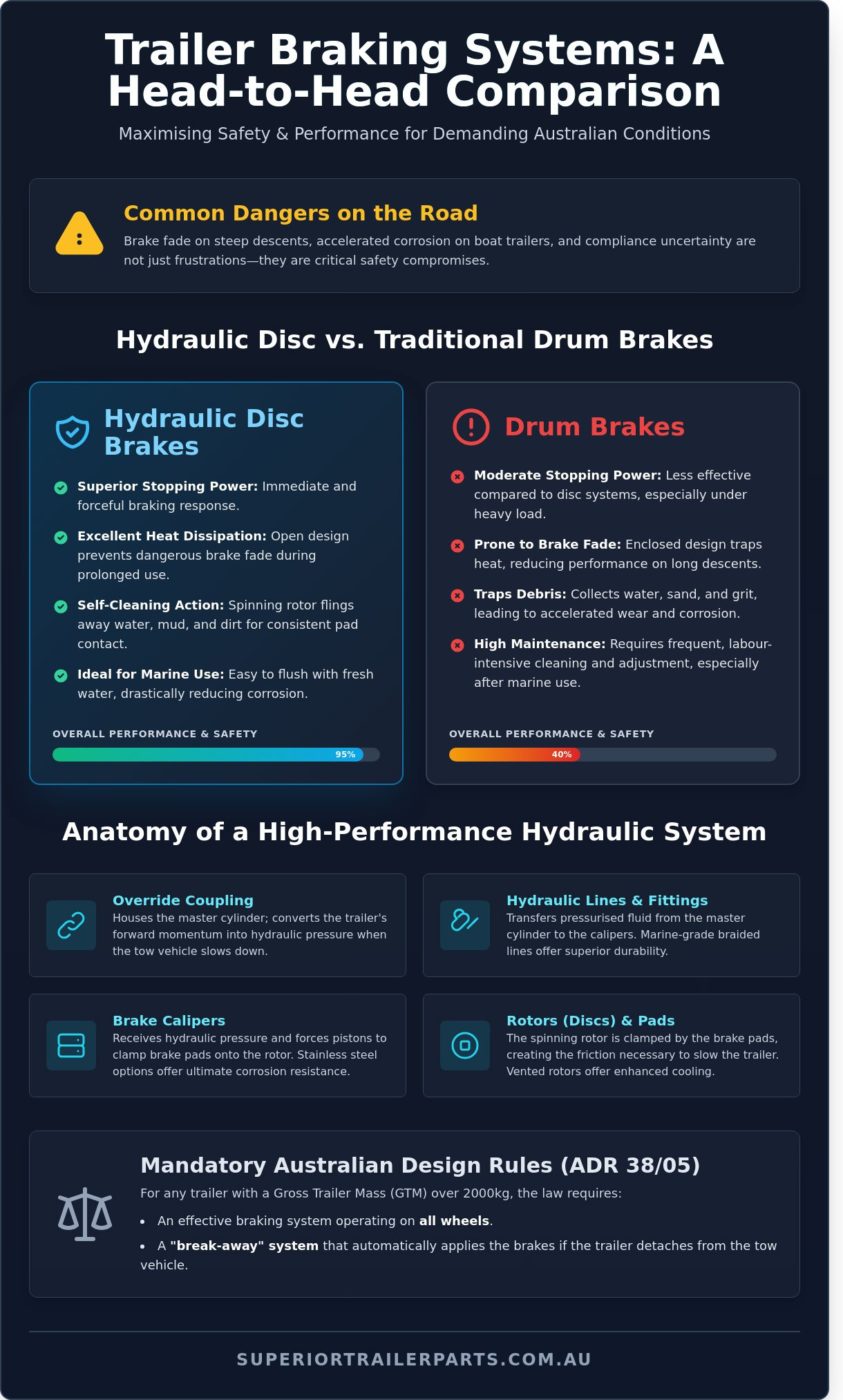
In Australia, trailer safety is governed by strict regulations. The Australian Design Rules (ADR 38/05) mandate that any trailer with a Gross Trailer Mass (GTM) over 2000kg must have an effective braking system on all wheels. Furthermore, these trailers require a “break-away” system that automatically applies the brakes if the trailer detaches from the tow vehicle. High-quality hydraulic disc brake kits are engineered to meet and exceed these standards. The system’s master cylinder, housed in the coupling, is the heart of the operation. It converts the physical force of deceleration into powerful hydraulic pressure. This pressure is a key feature of any Hydraulic brake system, ensuring balanced and consistent braking force is delivered to each wheel simultaneously.
The Mechanics of Disc vs. Drum Braking
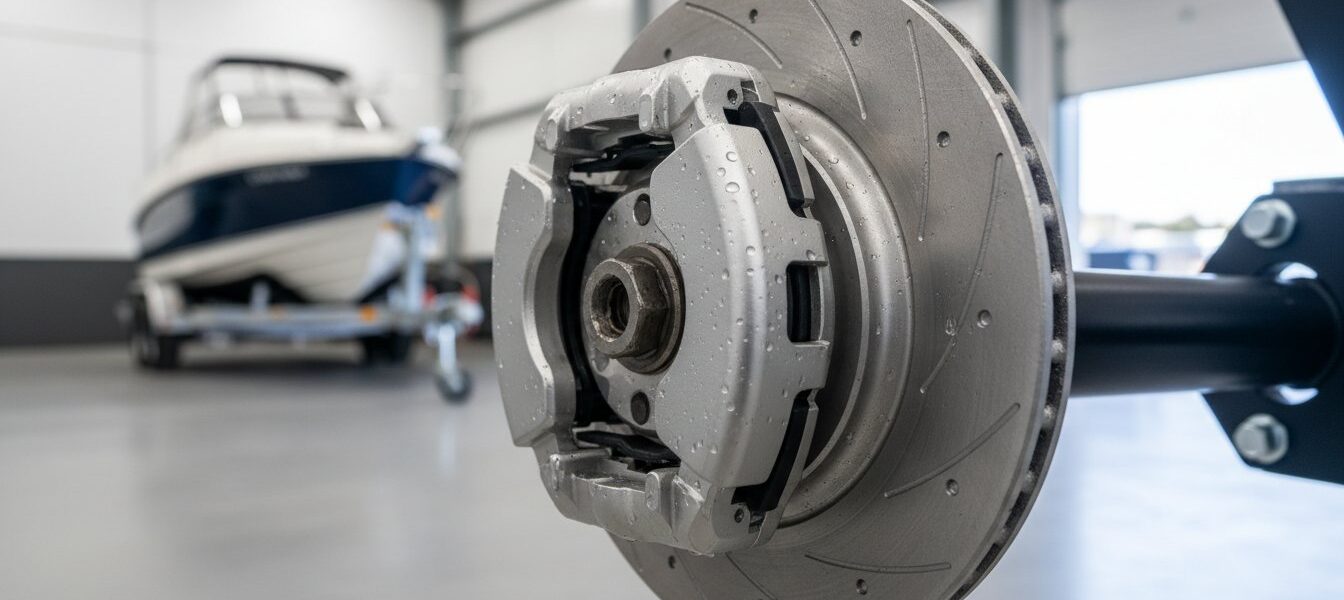
Disc brakes provide a significant performance advantage over older drum brake technology. With a disc system, a heavy-duty caliper applies brake pads directly onto a solid or vented rotor, delivering immediate and forceful stopping power. Its open design allows air to flow freely, dissipating heat far more effectively than an enclosed drum. This prevents the dangerous “brake fade” that can occur with drum brakes during prolonged use, where heat buildup reduces stopping ability. For Australian conditions, the self-cleaning action is a major benefit; dirt, mud, and water are flung away by the spinning rotor, ensuring the brake pads maintain clean, effective contact.
Marine Applications: The Gold Standard for Boat Trailers
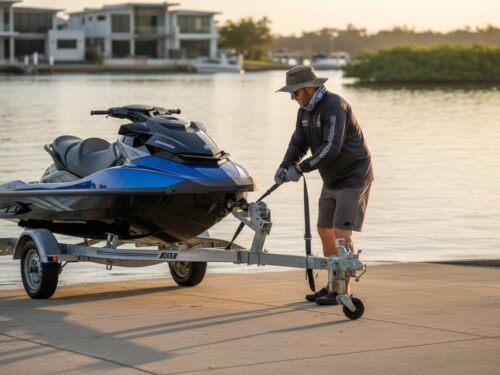
For boat trailers, hydraulic disc brakes are the only practical choice. Submerging a trailer during launch and retrieval is guaranteed to cause problems for drum brakes. Their enclosed design traps saltwater, sand, and grit, leading to accelerated corrosion and seizure of internal components. This requires frequent, labour-intensive maintenance. In contrast, disc brakes are open to the elements. This allows for immediate drainage and makes flushing the components with fresh water after each use a simple, 2-minute job. When choosing a system, consider the materials. Galvanised components provide strong, cost-effective corrosion resistance, while full stainless steel calipers and rotors offer the ultimate in marine-grade longevity, drastically reducing maintenance cycles and replacement costs over the trailer’s life.
Investing in the right braking system is fundamental to safe towing. For any trailer, but especially for boat trailers facing harsh marine conditions, the evidence points decisively to hydraulic disc brakes. They offer superior performance, enhanced safety through better heat management, and far greater durability than their drum counterparts. By ensuring your trailer complies with Australian Design Rules and can handle demanding situations, you secure not just your heavy asset, but also your peace of mind on the road.
Ultimately, reliable equipment is what enables unforgettable experiences on the water. From local fishing trips to legendary charters like those offered by South Louisiana Redfishing, having a trailer you can trust means you can focus on the adventure, not the equipment.
Core Components of a High-Performance Hydraulic Kit
A trailer’s braking power is only as strong as its weakest component. High-quality hydraulic disc brake kits are engineered systems where every part works in unison to provide reliable stopping force. Understanding these core components helps you identify quality and ensure your setup can handle the demands of hauling a heavy boat, especially in wet, corrosive marine environments.
The system starts with the override coupling. When your vehicle decelerates, the trailer’s forward momentum compresses a piston inside the coupling’s master cylinder. This action converts mechanical force into hydraulic pressure. For a technical breakdown of this principle, you can learn more about how hydraulic brakes work through fluid dynamics. This pressurised fluid travels through heavy-duty hydraulic lines to the calipers at each wheel. Don’t overlook the lines and fittings; marine-grade, stainless steel braided lines offer superior resistance to abrasion and corrosion compared to standard rubber hoses, ensuring consistent pressure delivery for years.
Selecting the right master cylinder is critical. A single-axle trailer under 2000kg Gross Trailer Mass (GTM) requires a different fluid displacement capacity than a tandem-axle setup rated for 3500kg GTM. Using an undersized master cylinder results in a spongy pedal feel and dangerously reduced braking performance.
Brake Calipers and Pistons
The caliper houses the piston and brake pads, applying the clamping force that stops your trailer. For boat trailers, calipers must resist constant exposure to salt water. Cast iron calipers with a Dacromet or galvanised coating provide excellent corrosion resistance. A single-piston design is often sufficient for lighter loads, while multi-piston calipers deliver greater, more evenly distributed clamping force for heavier trailers. High-quality seals are non-negotiable; failed seals lead to fluid leaks and complete brake failure.
Rotors and Hub-Discs
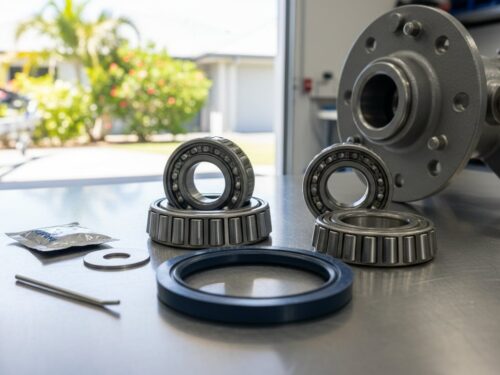
Rotors, or hub-discs, are the friction surface for the brake pads. Vented rotors feature internal fins that draw in air, significantly improving heat dissipation. This is essential for heavy trailers on long, steep descents. Solid rotors are a cost-effective and reliable choice for lighter applications. Our hydraulic disc brake kits are available with standard Australian stud patterns, including Ford 5-stud, Holden HT 5-stud, and Landcruiser 6-stud. Every rotor has a minimum thickness stamped on it, for example “MIN TH 12mm.” Once it wears below this limit, it must be replaced to prevent overheating and failure. Choosing the right components is critical, and our team can provide expert advice on matching parts to your trailer’s specific GTM.
Hydraulic Disc vs. Electric and Mechanical Braking
Choosing the right brake system is a critical decision. It impacts your safety, maintenance schedule, and long-term costs. While electric and mechanical brakes have their place, their performance limitations become clear in demanding conditions, especially marine environments. A direct comparison shows why hydraulic disc brakes are the superior choice for boat trailers and heavy-duty applications.
The core difference lies in how force is applied. Hydraulic systems use incompressible fluid for powerful, consistent pressure. Electric brakes rely on electromagnets, and mechanical systems use steel cables. This fundamental distinction dictates their performance, reliability, and suitability for specific tasks.
Hydraulic vs. Electric Drum Brakes
Electric drum brakes are a common choice for caravans and box trailers, but they fail consistently in marine settings. Saltwater immersion corrodes the electrical components, including the actuator magnets and wiring. This corrosion can lead to intermittent brake failure or complete seizure. Furthermore, electric systems require a compatible in-car brake controller, adding another layer of complexity, cost, and a potential point of failure. Hydraulic surge brakes are self-contained on the trailer, simplifying the entire setup. Drum brakes also require regular manual adjustment every 5,000 to 10,000 kilometres to compensate for shoe wear, a maintenance task that self-adjusting hydraulic calipers eliminate.
Hydraulic vs. Mechanical Disc Brakes
Mechanical disc brakes offer an improvement over drums but are limited by their cable-actuation system. Over time, these cables stretch, fray, and corrode. This leads to spongy brake feel and, more dangerously, uneven braking force between wheels. On a tandem axle trailer, this imbalance can cause the trailer to pull to one side during hard braking. Hydraulic systems use sealed lines and fluid pressure that, according to Pascal’s Law, is distributed perfectly evenly to every caliper. This ensures balanced, predictable stopping power across all axles, every time. While bleeding hydraulic lines requires a specific procedure, it is a more reliable process than tensioning and routing multiple cables without binding.
A cost-benefit analysis makes the case for hydraulics even stronger. While the initial investment for quality hydraulic disc brake kits can be 15-25% higher than electric drum setups, the long-term savings are significant. Consider these points:
- Boat Trailers: The non-negotiable choice. Hydraulic systems withstand repeated saltwater immersion where electrics would fail within one or two seasons. The cost of replacing seized electric components quickly exceeds the initial price difference.
- Heavy-Duty Tipper/Tradie Trailers: For gross trailer masses (GTM) over 2,000 kg, the superior stopping power and heat dissipation of hydraulic discs provide a critical safety margin.
- Box Trailers: For standard, on-road use, electric brakes can be a cost-effective solution. However, for owners seeking maximum reliability and minimal maintenance, an upgrade to a hydraulic system is a sound investment.
For operators in remote Australian regions, reliability is paramount. Hydraulic systems are simple and robust. A fault, such as a fluid leak, is typically easy to diagnose visually. Repairs can often be made with basic mechanical tools. Diagnosing a faulty brake controller or a short in a wiring loom hundreds of kilometres from a workshop is a far more difficult task. This field serviceability makes hydraulic disc brake kits the dependable choice for touring the outback or working in isolated locations.
Selecting the Right Kit for Your Axle and Load
Choosing the correct hydraulic disc brake kit isn’t about guesswork. It’s a precise process based on your trailer’s specific build and intended use. The wrong setup won’t just perform poorly; it can be a serious safety hazard and fail to meet Australian road standards. Your starting point is always the Gross Trailer Mass (GTM), which dictates the level of braking power you legally require.
From there, you must match components directly to your hardware. This ensures a secure fit, reliable operation, and long service life. Get these details right, and you’ll have a braking system you can depend on every time you tow.
Axle Compatibility and Mounting
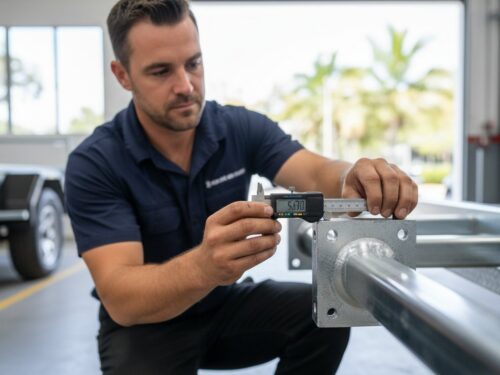
Your trailer’s axle is the foundation for your brake system. You must measure it correctly to ensure the caliper mounting brackets will fit. Most Australian boat trailers use common profiles like 39mm round and 45mm square axles. Measure the diameter of a round axle or the flat side of a square axle to confirm its size. Caliper brackets are designed for these specific dimensions. You have two primary installation options: weld-on or bolt-on flanges. A welded flange offers a permanent, heavy-duty mount. A bolt-on system provides flexibility for adjustments or future replacements. Finally, always check the clearance between the caliper and the inside of your trailer’s rim before final installation.
Weight Ratings and Tandem Setups
Australian regulations are clear. Trailers with a GTM over 750kg need brakes. Once you exceed 2000kg GTM, brakes are mandatory on all wheels, and a breakaway system is required. For heavy-duty applications up to 4500kg GTM, such as those using robust hydraulic tipper trailer kits, the braking system must be engineered to handle maximum loads without failure. On a tandem axle trailer, balanced braking is critical. Hydraulic lines must be split using a tee-piece to distribute fluid pressure equally to all four calipers. This prevents one axle from locking up under heavy braking, ensuring a stable and controlled stop.
Another crucial step is identifying the correct stud pattern of your hubs. This ensures your existing wheels will fit the new brake assembly. Common patterns in Australia include:
- Ford: 5 studs with a 114.3mm Pitch Circle Diameter (PCD).
- Holden HT: 5 studs with a 108mm PCD.
- Holden Commodore: 5 studs with a 120mm PCD.
- Landcruiser: 6 studs with a 139.7mm PCD.
To measure your PCD on a 5-stud hub, measure from the centre of one stud to the outer edge of the stud furthest away. Matching this measurement ensures your new hydraulic disc brake kits will integrate seamlessly with your wheels.
Getting the specifications right is essential for a safe, compliant trailer. If you need help matching components to your trailer’s GTM or axle type, our team can provide the expert advice you need. Explore our full inventory of genuine trailer brake components to find the right fit for your setup.
Installation and Maintenance of Your Hydraulic System
Proper installation and routine maintenance are non-negotiable for getting peak performance and safety from your hydraulic disc brakes. A well-maintained system provides reliable stopping power trip after trip. While many experienced DIYers can fit new hydraulic disc brake kits, always consult a professional if you’re unsure about any step. Your safety depends on it.
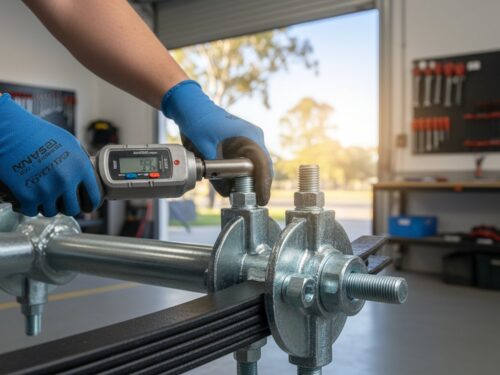
A typical installation follows a clear, logical process. It’s about precision, not speed. First, securely mount the rotors to the hubs and the calipers to the axle mounting brackets. Next, run the hydraulic brake lines along the trailer chassis, using clamps to prevent them from snagging or rubbing. Install the hydraulic actuator on the trailer coupling and connect the main brake line. The final connections are made at each caliper. Ensure every fitting is tightened to the correct torque specification to prevent leaks.
Bleeding and Testing the System
Air in your hydraulic lines is the enemy of effective braking. It compresses, creating a spongy, unresponsive feel at the actuator. Bleeding the system removes this air, ensuring solid pressure is transferred directly to the brake pads. You’ll need a brake bleeder kit, a set of flare nut wrenches, fresh DOT 3 or DOT 4 brake fluid, and plenty of rags. Work from the brake caliper furthest from the actuator and move to the closest, forcing all air out through the bleed nipples until only clean, bubble-free fluid emerges.
Once bled, a road test is critical. Before you haul your boat, test the trailer unloaded in a safe, open area. At low speeds of 20-30 km/h, apply the brakes gently and then firmly. The trailer’s brakes should engage smoothly without pulling to one side or locking up aggressively. The system should feel firm and responsive.
Long-Term Maintenance for Marine Use
Saltwater is highly corrosive. It attacks every component it touches. The single most important maintenance task is a thorough fresh water wash-down of your calipers, rotors, and brake lines after every single boat retrieval. This simple step drastically extends the life of your braking system. Don’t skip it.
This principle of proactive protection extends beyond the trailer to the vessel itself. To learn about advanced, non-toxic hull coatings designed for harsh marine environments, visit Seacoat SCT, LLC.
Create a routine inspection schedule. Before each major trip, perform these checks:
- Brake Pads: Check for a minimum thickness of 3mm.
- Brake Fluid: Inspect the reservoir for correct fluid level and clarity. Cloudy fluid indicates water contamination.
- Lines and Fittings: Look for any signs of cracking, corrosion, or leaks.
- Calipers and Rotors: Ensure caliper pistons are not seized and check rotor surfaces for deep scoring or excessive rust pitting.
Brake fluid is hygroscopic, meaning it absorbs moisture from the air. This lowers its boiling point and causes internal corrosion. We recommend a full system flush and fluid replacement every 12 to 24 months, depending on use. For repairs or upgrades, always use genuine, marine-grade components. Sourcing the right trailer parts in Australia ensures compatibility and durability against harsh conditions.
Need expert advice on your setup or help selecting the right parts for your hydraulic disc brake kits? Contact the team at Superior Trailer Parts today. We’re Australian owned and operated, and we know what works.
Equip Your Trailer for Maximum Stopping Power
Choosing the right braking system isn’t just about compliance; it’s about total control on Australian roads. For heavy loads and marine use, hydraulic brakes deliver superior, smoother stopping power that other systems can’t match. The critical first step is correctly matching your kit to your trailer’s Gross Trailer Mass (GTM) and axle rating. This ensures both safety and long-term performance.
A high-performance trailer starts with reliable parts. Investing in the right hydraulic disc brake kits gives you the confidence to haul heavy loads safely. As an Australian Owned and Operated company, we supply heavy-duty components built for tough conditions. Our expert team is ready to provide technical support, and we offer nationwide shipping to get you the parts you need, fast.
Browse our range of heavy-duty Hydraulic Disc Brake Kits today. Get the right gear and get the job done.
Frequently Asked Questions
Do I need a special brake controller for hydraulic disc brakes?
No, you don’t need an in-cab electric brake controller. Hydraulic surge brakes are a self-contained system activated by an override coupling on the trailer. When your tow vehicle slows, the trailer’s momentum compresses the coupling, which pressurises the master cylinder and applies the brakes. This simple, robust design is highly effective and requires no electronic interface with your vehicle.
Can I install a hydraulic disc brake kit on my existing trailer axle?
Yes, you can install a kit on an existing axle if it has the correct brake mounting flange. Most standard Australian axles, such as a 45mm square profile, are built to accommodate these kits. Before purchasing, verify your axle’s flange pattern and load rating against the kit’s specifications. This ensures a secure, safe fitment and proper brake alignment for reliable operation.
What is the best stud pattern for a heavy-duty hydraulic disc kit?
The 6-stud Landcruiser pattern is the standard for heavy-duty applications. This pattern uses a Pitch Circle Diameter (PCD) of 6/139.7 and is engineered for high load ratings, making it ideal for large boat trailers. It provides the necessary strength and durability to handle the significant weight and stress associated with transporting heavy vessels, ensuring maximum safety on the road.
How often should I change the brake pads on my trailer?
Brake pad life varies with use. For boat trailers frequently launched in saltwater, a visual inspection every 6 months is recommended. A hard rule is to replace the pads when the friction material is worn down to 3mm thickness. Proactive replacement prevents costly damage to the disc rotors and ensures your trailer maintains its full stopping power at all times.
Are hydraulic disc brakes better than electric brakes for boat trailers?
Yes, hydraulic disc brakes are far superior for boat trailers. Their sealed calipers and robust components offer excellent resistance to water and corrosion, a common failure point for electric drum brakes. Our marine-grade hydraulic disc brake kits deliver consistent, powerful stopping performance even after being fully submerged. This reliability makes them the safer and more durable choice for any marine application.
What type of brake fluid should I use in my trailer braking system?
You should use DOT 4 brake fluid for your trailer’s hydraulic system. DOT 4 fluid has a higher boiling point than standard DOT 3, providing a greater margin of safety under the heavy loads and high temperatures generated during trailer braking. Always confirm the manufacturer’s recommendation on your specific override coupling, but DOT 4 is the industry standard for these systems.
Is it difficult to bleed the lines on a tandem axle hydraulic kit?
No, it’s not difficult, but it is a methodical two-person job. You must start at the brake caliper furthest from the master cylinder and work your way forward, bleeding each caliper in sequence. This process ensures all air is purged from the extensive brake lines. A complete and proper bleed is critical for achieving a firm brake feel and balanced, effective stopping power across all four wheels.
Do hydraulic disc brakes require an override coupling?
Yes, a hydraulic override coupling is a non-negotiable component of the system. This special coupling houses the master cylinder that powers the brakes. When you decelerate, the trailer’s momentum compresses the coupling, which in turn pressurises the brake fluid and activates the calipers. Without the override coupling, the braking system has no way to function.