What if the difference between a safe towing experience and a roadside disaster comes down to a single piece of equipment most drivers overlook? Every year, thousands of Australian motorists hit the road with trailers, yet many remain unaware of the critical legal and safety requirements surrounding brake controllers.
You’re right to feel confused about trailer brake controller requirements australia regulations. The maze of different braking systems, installation standards, and state-specific laws can leave even experienced drivers scratching their heads. Getting it wrong isn’t just about avoiding fines – it’s about protecting your family, your cargo, and other road users.
This article will cut through the confusion and deliver the essential facts you need. You’ll discover exactly which trailers require brake controllers, understand the different types available, and learn the specific installation and compliance requirements that keep you legal across all Australian states and territories.
We’ll walk you through the technical specifications, legal obligations, and practical considerations that matter most for safe, compliant towing.
Key Takeaways
- Understanding trailer brake controller requirements australia helps ensure legal compliance and safe towing for trailers over specific weight thresholds.
- Australian regulations mandate brake controllers for trailers exceeding certain gross trailer mass (GTM) limits, with penalties for non-compliance.
- Selecting the right brake controller depends on your trailer type, vehicle compatibility, and specific towing requirements.
- Professional installation ensures proper wiring and optimal brake controller performance, while DIY installation is possible for simpler systems.
- Quality brake controllers from reliable suppliers provide long-term durability and consistent braking performance in Australian conditions.
Understanding Trailer Brake Controllers: An Overview
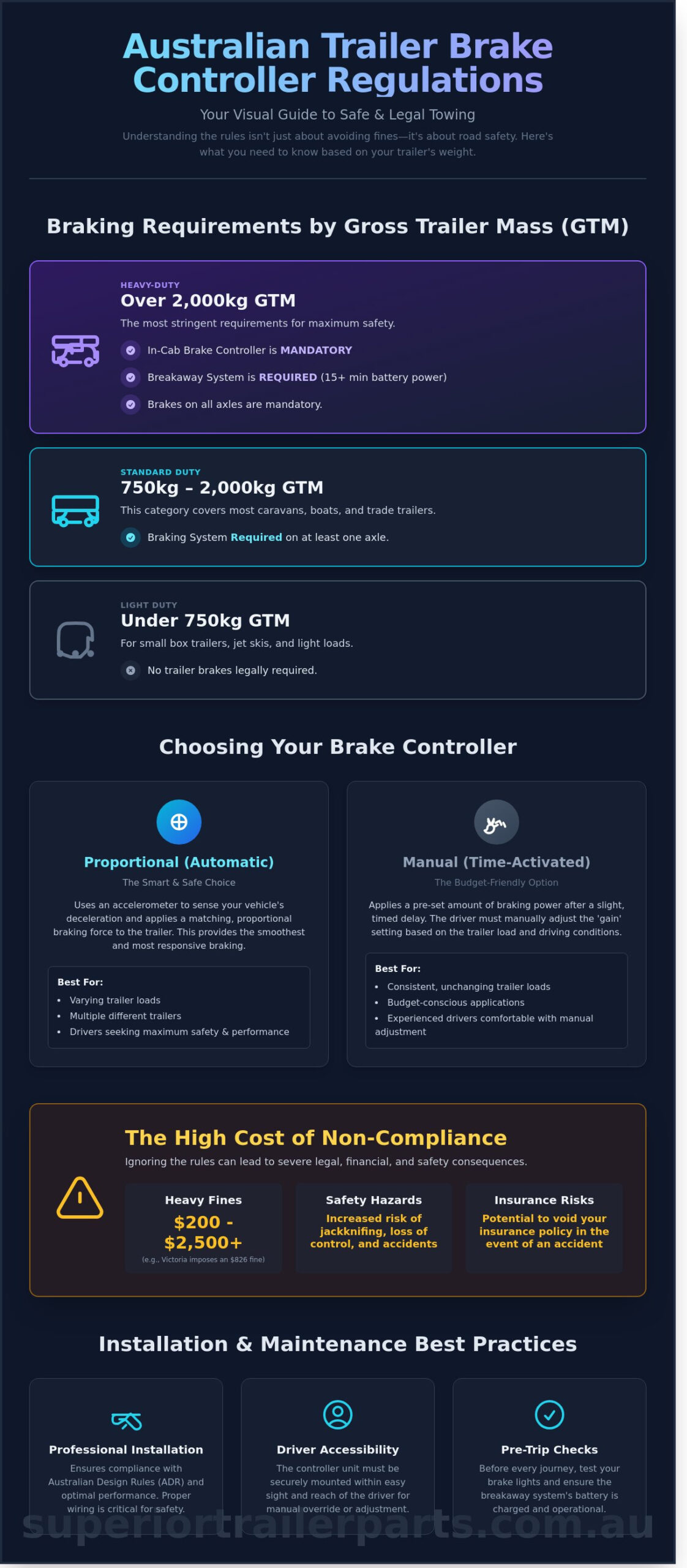
Trailer brake controllers are electronic devices that manage the braking system between your towing vehicle and trailer. They ensure both vehicle and trailer brakes work in sync, preventing jackknifing and reducing stopping distances. In Australia, these controllers are mandatory for trailers exceeding 2,000kg gross trailer mass (GTM).
The primary function involves sending electrical signals to activate your trailer’s electric brakes. When you press the brake pedal, the controller detects this action and applies proportional braking force to the trailer wheels. This coordination prevents the trailer from pushing the towing vehicle during sudden stops.
Modern brake controllers use sophisticated load-sensing technology. They monitor vehicle deceleration rates and automatically adjust brake intensity based on trailer weight and road conditions. This smart technology eliminates guesswork and provides consistent braking performance across different load scenarios.
Types of Brake Controllers
Manual brake controllers require driver input to set brake intensity levels. You adjust the gain manually based on trailer weight and driving conditions. These units cost less but demand more driver attention and experience.
Automatic controllers use built-in accelerometers to detect vehicle deceleration. They apply proportional braking force without manual adjustment. These systems adapt to changing conditions automatically, making them ideal for varying loads or multiple trailer types.
Electronic brake systems work with 12-volt trailer wiring, while override brakes use mechanical surge couplers. Electronic systems offer precise control and better performance, particularly for heavier trailers exceeding 3,500kg.
How Brake Controllers Work
Installation requires connecting the controller to your vehicle’s brake light circuit and trailer plug. The unit mounts inside the cabin within easy reach of the driver. Professional installation ensures compliance with trailer brake controller requirements australia standards.
Load sensing technology measures G-forces during braking events. The controller calculates optimal brake pressure and sends corresponding voltage to trailer brake magnets. Higher voltages create stronger magnetic fields, increasing brake shoe pressure against drums.
Quality controllers feature user-adjustable settings for different trailer weights. You can fine-tune brake response for boat trailers, box trailers, or heavy equipment haulers. This flexibility ensures optimal braking performance regardless of your specific towing application.
Advanced models include diagnostic features that detect brake magnet faults or wiring issues. LED displays show real-time brake output levels, helping drivers monitor system performance during operation.
Legal Requirements for Trailer Brake Controllers in Australia
Australian law mandates specific braking systems for trailers based on their gross trailer mass (GTM). The trailer brake controller requirements australia are governed by the Australian Design Rules (ADR) and enforced through state and territory transport regulations. These rules ensure road safety and prevent accidents caused by inadequate braking capacity.
The primary threshold sits at 750kg GTM. Trailers exceeding this weight must have an operational braking system that connects to the towing vehicle. This isn’t a suggestion. It’s mandatory under ADR 38/00, which specifies performance standards for trailer braking systems across Australia.
Compliance extends beyond simply installing brakes. Your trailer brake controller must meet Australian standards and integrate properly with your vehicle’s electrical system. The controller needs to provide proportional braking force that matches your driving conditions and load weight.
Understanding GTM and Braking Requirements
Gross trailer mass represents the maximum weight your trailer can carry, including its own weight plus cargo. For trailers under 750kg GTM, no braking system is legally required. However, trailers between 750kg and 2000kg GTM need either electric or hydraulic brakes with a breakaway system.
Trailers exceeding 2000kg GTM require more sophisticated braking arrangements. These heavy-duty applications demand breakaway systems that automatically engage if the trailer disconnects from the towing vehicle. The breakaway battery must provide at least 15 minutes of braking power.
Consequences of Non-Compliance
Operating without required braking systems carries serious penalties. Fines range from A$200 to A$2,500 depending on your state and the severity of the breach. Victoria imposes A$826 fines for inadequate trailer braking systems, while Queensland penalties reach A$575 for similar offences.
Beyond financial penalties, non-compliance creates significant safety risks. Trailers without proper braking can cause jackknifing, extended stopping distances, and loss of vehicle control. Insurance claims may be denied if your trailer doesn’t meet legal braking requirements during an accident.
Police conduct regular roadside inspections targeting trailer compliance. Common breaches include disconnected brake controllers, faulty breakaway systems, and using trailers above their GTM rating without appropriate braking. These violations can result in immediate defect notices and mandatory vehicle inspections.
Professional transport operators face additional scrutiny under Chain of Responsibility laws. Company directors and fleet managers can be held personally liable for non-compliant vehicles, with penalties reaching A$10,000 for serious breaches.
For reliable brake controller solutions that meet Australian standards, explore our range of certified trailer parts designed for local conditions and compliance requirements.
Choosing the Right Brake Controller for Your Trailer
Selecting the right brake controller directly impacts your safety and compliance with trailer brake controller requirements australia. The choice depends on your trailer’s weight, braking system type, and vehicle compatibility. Get this wrong, and you’ll face poor braking performance or potential legal issues.
Start by matching the controller to your trailer’s Gross Trailer Mass (GTM). Controllers are rated for specific weight ranges, typically from 750kg up to 4,500kg. A 2,000kg trailer needs a controller rated for at least that weight, with some safety margin built in.
Consider your trailer’s braking system. Electric brake systems require different controllers than electric-over-hydraulic setups. Caravan owners typically need proportional controllers for smooth operation, while utility trailers often work well with time-delayed units.
Key Features to Consider
Adjustability stands as the most critical feature. Quality controllers offer fine-tuning for brake gain, allowing you to match braking force to load conditions. Manual control options let you apply trailer brakes independently, useful for reversing or emergency situations.
Vehicle compatibility can’t be overlooked. Check your vehicle’s electrical system capacity and mounting options. Some vehicles require specific wiring harnesses or adapter modules to work properly with certain controller models.
Popular Brake Controllers in Australia
The Redarc Tow-Pro Elite leads the Australian market with proportional control and wireless connectivity. Users consistently rate its smooth operation and easy installation. Expect to pay around A$400-500 for this premium option.
Tekonsha P3 controllers offer reliable performance at mid-range pricing, typically A$250-350. They provide excellent value for recreational users who don’t need advanced features.
For budget-conscious buyers, the Hopkins Agility controller delivers basic functionality from A$150-200. It handles standard electric brake systems adequately for lighter trailers.
Professional installers often recommend the Hayman Reese Load Leveller for heavy-duty applications. Its robust construction suits commercial use, though it commands premium pricing around A$500-600.
When evaluating options, check manufacturer warranties and local service support. Australian conditions demand reliable performance, so choose brands with proven track records in harsh environments. Quality controllers typically offer 2-3 year warranties and responsive customer support.
Installation complexity varies significantly between models. Some require professional fitting, while others suit DIY installation with basic electrical knowledge. Factor installation costs into your budget if you’re not comfortable with electrical work.
Installation and Maintenance Tips for Brake Controllers
Installing and maintaining your brake controller properly ensures safe operation and compliance with trailer brake controller requirements australia. Whether you tackle the job yourself or hire a professional, understanding the process helps you make informed decisions and keep your system running reliably for years.
DIY Installation Guide
Most brake controller installations require basic tools: wire strippers, electrical tape, multimeter, drill bits, and mounting hardware. Start by disconnecting your vehicle’s battery to prevent electrical shorts during installation.
The installation process follows these key steps:
- Mount the controller within easy reach of the driver’s seat
- Connect the power wire to a 12V source through a 15-amp fuse
- Run the brake wire to the trailer connector
- Attach the ground wire to a solid metal ground point
- Connect the brake light wire to your vehicle’s brake light circuit
Safety comes first. Never work on electrical systems with the battery connected. Test all connections with a multimeter before finalizing the installation. Double-check that your trailer’s electric brakes respond correctly during initial testing.
Professional Installation: When to Call an Expert
Complex vehicle electrical systems often require professional expertise. Modern vehicles with CAN bus networks, integrated trailer modules, or factory tow packages need specialized knowledge to avoid damaging expensive electronics.
Professional installation typically costs between A$150-A$300 depending on vehicle complexity and local labor rates. This investment protects your vehicle’s warranty and ensures proper integration with existing systems.
Before hiring an installer, confirm they have experience with your specific vehicle make and understand current trailer brake controller requirements australia. Ask about warranty coverage on their work and whether they’ll test the complete system after installation.
Regular maintenance keeps your brake controller operating reliably. Inspect electrical connections every six months for corrosion or loose wires. Clean terminals with contact cleaner and apply dielectric grease to prevent moisture damage.
Common issues include intermittent braking, which usually indicates loose connections, and overheating controllers, often caused by incorrect wiring or overloaded circuits. If your controller displays error codes, consult the manual immediately rather than continuing to operate the system.
Test your brake controller monthly by activating the manual override while stationary. This simple check confirms the system responds correctly and helps identify problems before they become safety hazards on the road.
Need quality brake controllers and installation accessories? Browse our range of reliable trailer parts designed for Australian conditions.
Explore Superior Trailer Parts for Quality Brake Controllers
When you need reliable brake controllers that meet trailer brake controller requirements australia standards, Superior Trailer Parts delivers proven solutions. This Australian-owned business specialises in heavy-duty trailer components designed for local conditions. Their brake controller range includes electric and electronic options suitable for various trailer weights and configurations.
Superior Trailer Parts stocks brake controllers from trusted manufacturers. Each unit undergoes quality checks to ensure compliance with Australian Design Rules (ADR) and Australian Standards. The controllers feature robust construction to handle extreme temperatures, dust, and vibration common in Australian operating environments.
The product range covers:
- Electric brake controllers for single and dual-axle trailers
- Electronic proportional controllers with advanced braking algorithms
- Time-delayed controllers for lighter trailer applications
- Wireless brake controller systems for modern vehicles
Technical support comes standard with every purchase. The team provides expert advice on controller selection, wiring requirements, and installation procedures. This guidance helps ensure your setup meets all legal requirements while delivering optimal braking performance.
Quality assurance extends beyond the initial sale. Superior Trailer Parts maintains comprehensive product documentation and offers ongoing technical assistance. Their controllers come with manufacturer warranties and local service support across Australia.
Why Choose Superior Trailer Parts?
Local ownership means genuine understanding of Australian towing conditions. The business operates from Australian facilities with direct access to local technical expertise. This proximity translates to faster service, competitive pricing, and immediate support when issues arise.
Customer service focuses on practical solutions rather than sales pressure. The team matches controllers to specific vehicle and trailer combinations based on actual requirements. This approach prevents costly mistakes and ensures compliance with trailer brake controller requirements australia regulations.
Ready to upgrade your braking system? Explore the full range of trailer parts available through Superior Trailer Parts. Their comprehensive inventory includes everything needed for safe, legal trailer operation across Australia.
Get Your Trailer Road-Ready Today
Understanding trailer brake controller requirements Australia ensures you stay compliant and safe on the road. Remember these key points: trailers over 750kg require electric brake controllers, proper installation affects your vehicle’s warranty, and regular maintenance prevents costly breakdowns. Choose controllers rated for your trailer’s weight and braking system type.
Superior Trailer Parts stocks quality brake controllers designed for Australian conditions. As an Australian owned and operated business, we understand local regulations and harsh operating environments. Our wide range of trailer parts and accessories comes with competitive pricing and quality assurance you can trust.
Supporting local businesses ensures you get products designed for our unique lifestyle; for example, if you’re also passionate about combat sports, The Fight Club is a leading Australian-owned source for premium fightwear and gear.
In the same spirit of choosing local expertise for complex requirements, Australian disability support providers often turn to dock’d for specialized NDIS-compliant management software.
Don’t risk safety or legal issues with substandard equipment. Contact us for expert advice on trailer brake controllers and more! Our technical team provides straightforward guidance to match your specific towing setup.
Get the right controller fitted properly the first time. Your trailer, your cargo, and other road users depend on it.
Frequently Asked Questions
What is a brake controller and why do I need one?
A brake controller is an electronic device that activates your trailer’s electric brakes when you apply your vehicle’s brakes. You need one because it’s legally required for trailers over 2,000kg gross trailer mass (GTM) in Australia and provides essential safety control for heavy loads. Without a brake controller, your trailer brakes won’t engage, creating dangerous stopping distances and potential jackknifing situations.
Are there specific brake controller laws in Australia?
Yes, Australian Design Rules (ADR 38) mandate that trailers exceeding 2,000kg GTM must have electric brakes controlled by a brake controller. Each state enforces these regulations, with penalties ranging from A$200 to A$500 for non-compliance. The controller must be easily accessible to the driver and properly calibrated to your trailer’s braking system.
How do I know if my trailer needs a brake controller?
Check your trailer’s compliance plate for the GTM rating. If it exceeds 2,000kg, you legally require electric brakes and a controller. Additionally, if your trailer has electric brake assemblies installed (identifiable by brake wires running to each wheel), you need a controller to operate them. Heavy-duty trailers, caravans, and boat trailers typically fall into this category.
What are the differences between manual and electronic brake controllers?
Manual controllers require you to activate trailer brakes using a hand lever, giving direct control but demanding constant attention. Electronic controllers automatically sync with your vehicle’s braking system, applying proportional brake force based on deceleration. Electronic units offer smoother operation and hands-free convenience, while manual controllers provide precise control for experienced operators in challenging conditions.
How can I install a brake controller myself?
Connect the controller’s power wire to a 12V ignition-switched source, ground the earth wire to your vehicle’s chassis, and link the brake output wire to your trailer’s brake circuit via the 7-pin connector. Mount the controller within easy reach of the driver’s seat using the provided bracket. Most installations take 2-3 hours and require basic electrical tools, though professional installation ensures compliance and warranty coverage.
What maintenance do brake controllers require?
Inspect connections monthly for corrosion or loose wires, particularly around the 7-pin trailer plug. Test the controller’s operation before each trip by manually activating it while stationary. Clean terminals annually and check calibration settings match your trailer’s specifications. Electronic controllers typically last 5-7 years with proper maintenance, while manual units can operate for decades with basic upkeep.
Can I use a brake controller for multiple trailers?
Yes, but you must recalibrate the controller settings for each different trailer’s weight and brake specifications. Electronic controllers store multiple user presets, making switching between trailers straightforward. Manual controllers work universally but require adjustment of the gain setting to match each trailer’s braking requirements. Always verify compatibility between your controller’s output rating and each trailer’s brake current draw.