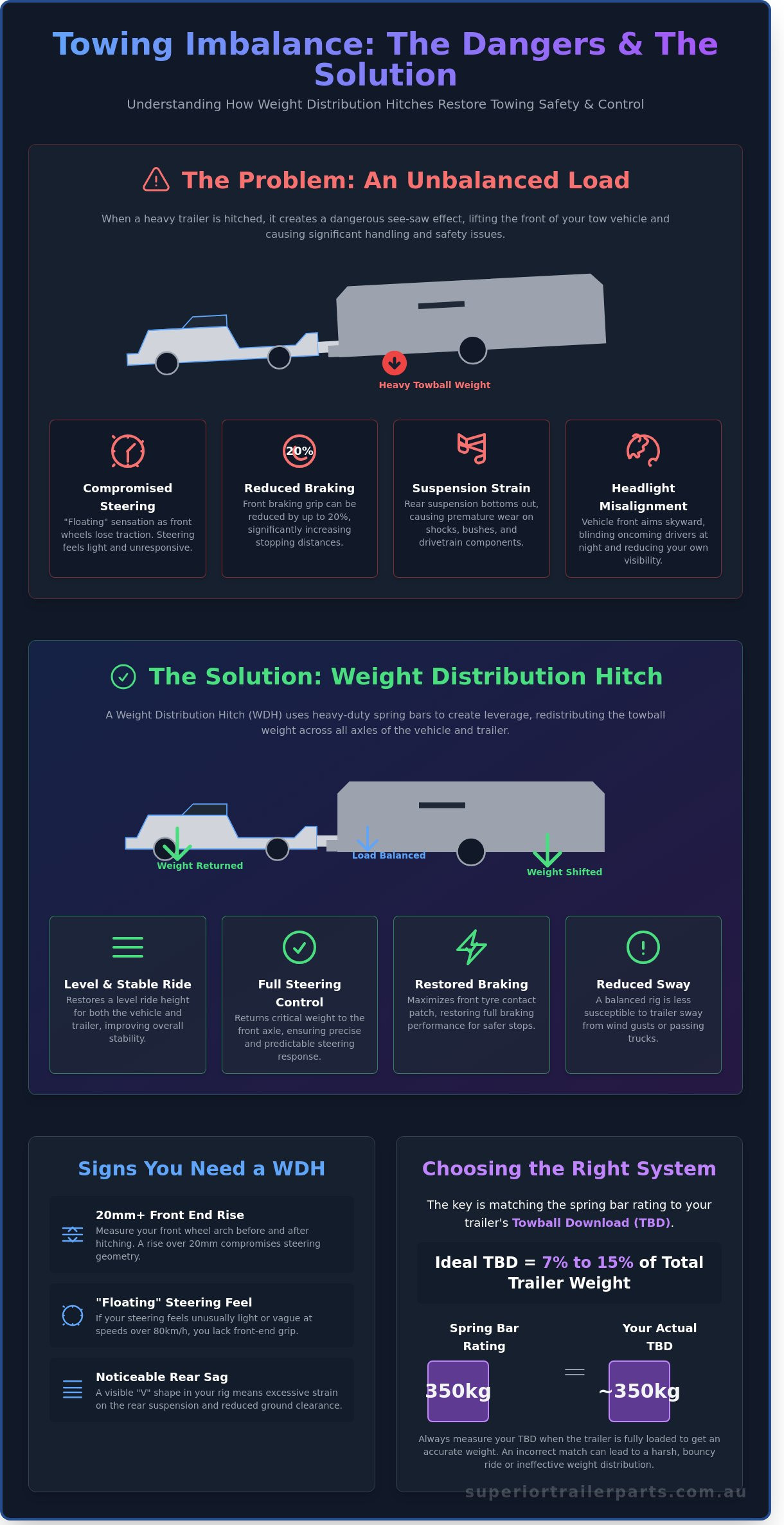
You’re cruising at 100km/h on the highway when a passing B-double creates a pressure wave that sends your caravan into a nerve-wracking sway. Your steering feels light, the front of your 4WD is pointing at the sky, and your rear suspension is bottomed out. It’s a common scenario for many Australian towers, yet it remains one of the most dangerous. You already know that a heavy trailer changes how your vehicle handles, but you might not realize that excessive ball weight can lift the front wheels enough to reduce braking grip by up to 20 percent.
Using weight distribution hitches is the most effective way to solve these stability issues. These heavy-duty systems don’t just support the weight; they redistribute it across all axles to restore a level ride height and improve steering response. This article provides the expert advice you need to understand how these hitches work to eliminate trailer sway and ensure your rig meets Australian towing safety standards. We’ll examine the technical mechanics of spring bars and show you how to regain full control over your heavy load.
Key Takeaways
- Restore steering and braking performance by redistributing towball weight across all vehicle and trailer axles.
- Select the correct weight distribution hitches by matching spring bar ratings to your trailer’s actual Towball Download.
- Utilise leverage principles to return traction to the front axle, ensuring your vehicle remains level and stable under heavy loads.
- Master professional installation steps and height measurement protocols to guarantee safety and compliance on Australian roads.
- Maintain long-term hardware reliability with expert advice on inspecting hitch heads and lubricating critical wear points.
Understanding Weight Distribution Hitches and Towing Dynamics
A weight-distributing hitch is a specialized towing system designed to redistribute the load of a trailer across all axles of both the tow vehicle and the trailer. When you drop a heavy caravan or trailer onto a standard tow ball, the weight creates a see-saw effect. The rear of the vehicle sinks while the front end rises. This leverage removes weight from the front tyres, which is where your steering and primary braking force reside. Weight distribution hitches use spring bars and leverage to force the front end back down, ensuring the vehicle stays level and maintains a firm grip on the road.
The primary purpose of this equipment is restoring the front-end steering and braking geometry. If the front of your 4WD or ute sits too high, your tyres have a smaller contact patch with the bitumen. This leads to longer braking distances and less predictable steering response during emergency manoeuvres. In Australia, where road conditions can change from smooth highways to corrugated surfaces in an instant, maintaining this geometry is a safety requirement rather than an optional upgrade. Proper weight distribution ensures the vehicle handles as the manufacturer intended, even when towing a 3,500kg load.
Rear-end sag is more than just an aesthetic issue for Australian drivers. It places immense stress on the rear suspension components and can lead to premature failure of shocks and bushes. A sagged rear end also changes the angle of the driveshaft, potentially causing vibrations and drivetrain wear. Beyond the mechanical strain, it significantly reduces ground clearance. This makes it easier to bottom out on speed bumps or driveway transitions. Using weight distribution hitches corrects this posture, protecting your vehicle’s underside and ensuring the suspension operates within its designed travel range.
It’s important to distinguish between a standard ball mount and a weight distribution system. A standard mount is a static connection point that simply carries the vertical load of the trailer. It does nothing to move that weight forward. An active weight distribution system uses high-tensile spring bars to create a bridge between the vehicle and trailer frames. This connection acts like the handles of a wheelbarrow, lifting the rear of the car and pushing the weight toward the front axle and back toward the trailer axles.
How Weight Distribution Differs from Sway Control
Weight distribution focuses on vertical load management. It levels the vehicle. Sway control manages horizontal movement, or the side-to-side “fishtailing” caused by wind gusts or passing trucks. While they solve different problems, 85% of modern setups combine both functions for maximum safety. When selecting a system, check your couplings and parts for compatibility. Some friction-based sway controls require specific attachment points that must align with the weight distribution brackets.
Signs Your Setup Requires a Weight Distribution System
Identifying the need for a system starts with a tape measure. Measure the height of your front wheel arch before and after hitching the trailer. If the front arch rises by more than 20mm, your steering is compromised. You might also notice your headlight aim shifting upward, which blinds oncoming traffic at night. A “floating” or light sensation in the steering wheel at speeds above 80km/h is a definitive sign that the front tyres lack sufficient downward pressure. These symptoms indicate an unbalanced load that requires mechanical correction.
Selecting the Right Weight Distribution System for Your Setup
Choosing the correct equipment requires more than a guess. You need hard data to ensure your vehicle and trailer operate safely. Towball Download (TBD) serves as the primary metric for selecting weight distribution hitches. This is the actual weight the trailer tongue applies to the rear of the tow vehicle. In most Australian setups, the TBD should sit between 7% and 15% of the total loaded trailer mass. For a caravan weighing 2,800kg, a TBD of approximately 280kg is standard. You must measure this weight when the trailer is fully loaded with water, gas, and gear to get an accurate reading.
Matching the spring bar rating to your actual loaded weight is critical for performance. If you choose bars rated for 350kg but your TBD is only 200kg, the ride will be incredibly harsh. Understanding how weight distribution systems work reveals that these components rely on controlled flex to level the load. A bar that is too stiff won’t flex, transferring high levels of stress directly into the vehicle’s chassis and the trailer’s A-frame. This can lead to structural fatigue or cracking over long distances on corrugated Australian roads.
Always verify the vehicle manufacturer’s maximum towball weight limits before purchasing. A vehicle might have a 3,500kg towing capacity but a maximum towball load of only 300kg. Exceeding this limit is illegal and dangerous. You also need to measure the distance between the coupling and the trailer’s A-frame. This ensures there’s enough room to mount the snap-up brackets without interfering with battery boxes, gas bottle holders, or stone guards. If you’re unsure about fitment, you can find high-quality caravan parts designed to work with various A-frame configurations.
Understanding Weight Ratings: 600lb to 1200lb
Weight distribution systems are typically categorised by their maximum ball weight capacity. A 600lb system handles up to 275kg, making it ideal for medium-sized caravans and dual-axle trailers. For larger setups, 800lb (365kg) and 1200lb (545kg) heavy-duty options provide the necessary leverage to level heavy loads. Don’t over-spec your system. Using a 1200lb bar on a light trailer creates a rigid connection that lacks the necessary dampening, which often results in the tow vehicle’s front wheels losing traction on uneven surfaces.
Round Bar vs. Trunnion Bar Systems
Round bar systems are a popular choice for standard A-frames where the coupling is mounted on top of the frame. They generally offer more ground clearance, which is a major advantage when navigating driveways or fuel station entries. Trunnion bar systems provide higher weight capacities and are often better suited for trailers with underslung couplings. The trunnion design allows the bars to sit more flush with the trailer frame, providing a streamlined profile. Both styles of weight distribution hitches are effective, but your choice depends on your specific trailer frame height and coupling position.
Getting the right fit ensures your setup remains stable at highway speeds. If you need assistance selecting the correct hardware for your specific ATM, you can contact our team for expert advice on the best components for your towing needs.
The Mechanics of Load Levelling and Vehicle Balance
Understanding the physics of weight distribution hitches starts with the principle of leverage. Think of the spring bars as the handles of a wheelbarrow. When you lift the handles, you shift the weight forward toward the wheel. A weight distribution hitch works by using these spring bars to create a bridge between the tow vehicle and the trailer. This tension forces the nose of the tow vehicle down and the rear up, effectively levelling the entire combination.
When you drop a heavy trailer onto a standard towball, the rear suspension of the car compresses. This creates a see-saw effect that lifts the front wheels. Losing just 20mm of height at the front axle can reduce steering precision and increase braking distances by over 15 percent. By engaging the spring bars, you restore the weight to the front tyres. This ensures the steering remains responsive and the front brakes can do their job during an emergency stop.
This leverage doesn’t just help the car. It also affects the trailer axles by transferring a portion of the load backward. While the majority of the weight is shifted to the front of the tow vehicle, roughly 10 to 15 percent of that redistributed mass moves back to the trailer wheels. This shared burden stabilises the entire rig and prevents the “porpoising” effect often felt on uneven Australian highways.
Don’t mistake a WDH for a solution to an overloaded vehicle. It’s a common myth that these systems increase your towing capacity. They don’t. If your vehicle has a Gross Vehicle Mass (GVM) limit of 3,100kg and you’re at 3,300kg, no amount of levelling will make that legal or safe. These tools are for balance, not for bypassing manufacturer engineering limits. You must always stay within your legal GVM, GCM, and axle load ratings.
These principles of balance and adherence to weight limits are universal, applying just as much to industrial transport as they do to towing a caravan. For professionals managing bulk materials, using the right containment is the first step to a secure load; you can discover Container Authority for a wide selection of industrial drums and totes.
The Role of the Towball Download
Towball download is the vertical pressure the trailer coupling exerts on the hitch. In Australia, the standard rule of thumb is that this weight should be approximately 10 percent of the total loaded trailer mass. If you’re towing a 3,000kg caravan, you need roughly 300kg on the ball to maintain stability. If you load too much weight at the very rear of the trailer, the towball weight drops, which leads to dangerous trailer sway. A weight distribution hitch cannot fix a poorly balanced trailer; you must get your internal loading right before tensioning the bars.
Chassis Stress and Structural Integrity
Applying these mechanical forces puts significant stress on the vehicle and the towbar. You must verify that your towbar is specifically rated for weight distribution use. Most heavy duty, Hayman Reese style hitches are designed for this, but many factory-fitted light duty bars are not. Adhering to Australian towing safety standards is vital here.
The type of vehicle you drive also dictates how these forces are absorbed. Ladder-frame chassis, found on most 4WD utes and wagons like the Hilux or LandCruiser, are rigid and handle the torque of spring bars well. Monocoque or unibody vehicles, common in smaller SUVs, may lack the structural reinforcement to handle the twisting force. Always check your owner’s manual before installation. Some manufacturers explicitly prohibit the use of weight distribution hitches because the forces can cause the chassis to crack or the hitch mounting points to fail.
Installation and Safety Protocols for Australian Roads
Correctly installing weight distribution hitches is a non-negotiable step for safe towing on Australian highways. Start by parking your vehicle and trailer on a perfectly level concrete surface. Measure the distance from the ground to the center of the wheel arch for both the front and rear axles of the unladen vehicle. Record these baseline figures. They are your target points for a balanced rig. These measurements represent the vehicle’s natural geometry before the load is applied.
Lower the trailer coupler onto the hitch ball and lock it. You will see the rear axle sag and the front axle rise. This movement unweights the steering tires, which reduces your ability to brake and steer effectively in emergencies. Measure the new heights to see how much the front end has lifted. The goal is to use the spring bars to lever that weight back onto the front axle. This process restores the contact patch of your tires for better grip.
Adjust the hitch head angle and engage the spring bars. Tighten the chains until the front axle returns as close as possible to its original unladen height. Check all hardware thoroughly. Ensure every pin, clip, and u-bolts kit is secured and torqued to manufacturer specifications. A single loose bolt can cause the entire system to fail under the stress of corrugated roads or sudden braking maneuvers. Reliability starts with a solid mechanical connection.
Setting the Correct Tension
Don’t over-tension the bars. If you apply too much force, you can actually lift the rear wheels of the tow vehicle. This reduces traction and can bend the vehicle’s chassis or the trailer’s A-frame. Once you find the sweet spot, count the number of chain links under tension. Use this count for a consistent, repeatable setup every time you hitch up. Use your jockey wheel to your advantage. After locking the coupler, wind the jockey wheel up to lift both the trailer and the rear of the car. This slackens the system and allows you to engage the spring bars with minimal physical effort.
ADR Compliance and Legal Requirements
Towing equipment in Australia must meet strict Australian Design Rules (ADR). Specifically, ADR 62/02 dictates the requirements for mechanical connections between vehicles. Your hitch must be rated for the load you’re pulling. Safety chains are a legal requirement and must be crossed under the drawbar. They need enough slack for cornering but must prevent the drawbar from hitting the bitumen if the hitch disconnects. DIY modifications to hitch components are strictly prohibited. Welding or drilling into high-tensile components can cause stress fractures and immediate failure. Stick to genuine, ADR-compliant parts to ensure your insurance remains valid and your rig stays safe on the road.
Get the right gear for your next trip. Browse our range of heavy-duty towing accessories today.
Maintaining Your Towing Hardware for Long-Term Reliability
Maintaining your towing hardware ensures safety and protects your investment. Weight distribution hitches endure extreme physical stress during every trip. They manage thousands of kilograms of force across the hitch head and spring bars. Neglecting these components leads to accelerated wear and potential mechanical failure on the highway. Consistent maintenance keeps the system operating at peak efficiency and prevents costly replacements.
Just as you manage the safety of your mobile assets, many travellers also plan for their long-term home base. For those exploring property as the next big investment, you can visit Regal Gateway Property for insights into the market.
Start with a visual inspection of the hitch head and spring bar sockets before every trip. Look for signs of metal-on-metal grinding or unusual scoring. These sockets bear the brunt of the weight transfer and require regular attention. Apply a high-quality multi-purpose grease to the trunnion or round bar pivot points every 1,000 kilometres. This lubrication reduces friction and prevents the metal from galling. Don’t apply grease to friction sway control surfaces. These components rely on dry contact to function; grease will ruin their ability to manage trailer sway.
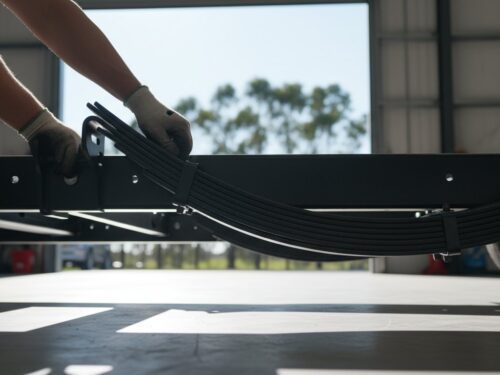
Spring bars require close monitoring for stress fractures. Clean the bars and look for hairline cracks, especially near the head attachment points. If a spring bar shows a permanent bend exceeding 15mm from its original factory profile, its structural integrity is compromised. Heavy use on corrugated roads or overloaded setups accelerates this fatigue. Replace bars immediately if they don’t return to their straight position when uncoupled.
Coastal Queensland environments pose a specific threat to towing gear. Salt air causes rapid oxidation on non-galvanised steel components. Surface rust can quickly transition into deep pitting, which weakens the metal. Clean your hardware with fresh water after any trip near the coast. Apply a thin layer of lanolin or a corrosion inhibitor before storing the parts. Keep the spring bars in a dry gear bag and store the hitch head off the ground to prevent moisture buildup.
Wear Patterns and Replacement Signs
Trunnion studs often develop a flared edge known as “mushrooming” when the metal deforms under high pressure. This indicates the material is reaching its fatigue limit. Check the towball hole for elongation; if the hole has stretched by more than 2mm, the hitch head is no longer safe for use. Inspect the hitch pin for visible grooving or thinning that occurs over thousands of kilometres of travel. Owners must perform a comprehensive teardown and safety check of all weight distribution hitches every 10,000 kilometres or 12 months to maintain peak operational safety.
The Superior Trailer Parts Advantage
Superior Trailer Parts provides Australian-owned reliability for local towing conditions. We understand the demands of the Outback and the humidity of the coast. Our inventory includes heavy-duty components designed to withstand the harshest environments. We offer genuine parts that ensure your setup remains compliant with Australian standards. You get expert advice from a team that values durability and performance over everything else. We provide the technical support you need to keep your fleet or family caravan moving safely across the country. Contact Superior Trailer Parts for technical support on your towing setup.
Secure Your Load for Australian Roads
Maintaining vehicle balance is a non-negotiable requirement for safe travel on local highways. Correctly fitted weight distribution hitches ensure that your tow vehicle’s front wheels maintain 100% of their necessary contact with the road surface. This mechanical leverage prevents dangerous trailer sway and improves braking response times by redistributing weight across all axles. Selecting a system rated for your specific ball weight is the difference between a white-knuckle drive and a controlled journey. Every component must meet strict safety protocols to handle the harsh conditions found across the country.
Superior Trailer Parts provides heavy-duty solutions built for the toughest environments. We’re a 100% Australian owned and operated business that understands the importance of gear reliability. Our team offers expert technical advice to ensure your setup complies with Australian towing standards. We provide nationwide shipping to all 8 states and territories on all trailer components to get your parts to you fast. Browse our range of heavy-duty weight distribution hitches to find the right fit for your towing needs. It’s time to get your trailer back on the road with confidence.
Frequently Asked Questions
Do I need a weight distribution hitch for a boat trailer?
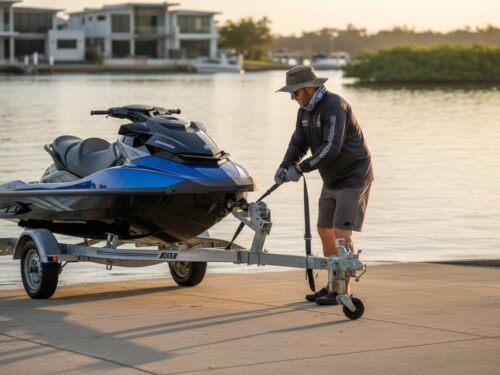
You usually don’t need one because boat trailers typically have lower ball weights of 5% to 8% compared to caravans. Most boat trailer frames aren’t designed to handle the torsion these systems apply. Check your manufacturer’s specifications, as 90% of aluminium boat trailers will void their warranty if you fit one.
Can a weight distribution hitch damage my vehicle’s chassis?
Yes, damage can occur if you use an incorrectly rated hitch or if your vehicle has a monocoque chassis. Some modern 4WDs specifically prohibit weight distribution hitches because the stress can crack the frame. Always verify your vehicle’s towing guide to ensure it’s compatible with heavy-duty weight distribution hitches before installation.
How do I know what size weight distribution hitch I need?
You need to measure your trailer’s actual ball weight when it’s fully loaded for a trip. These hitches are sold in weight increments, such as 135kg, 250kg, or 350kg capacities. Use a ball weight scale to get a precise figure, as guessing can lead to a 20% error in weight management and poor handling.
Is a weight distribution hitch the same as a sway bar?
No, these are two distinct components with different jobs. A weight distribution hitch levels your vehicle by shifting load to the front axle, while a sway bar uses friction to stop the trailer from swinging sideways. While some premium units combine both features, they remain separate mechanical functions for trailer stability.
Can I use a weight distribution hitch with an off-road coupling?
Most standard systems are incompatible with articulated off-road couplings like the DO35. These hitches restrict the 360-degree rotation needed for rugged tracks, which can snap the hitch head on uneven ground. Stick to sealed roads if you’re using this combination, as 100% of off-road manufacturers warn against high-torsion setups on tracks.
Should I remove the weight distribution bars when reversing?
You should remove the bars before reversing into tight driveways or over kerbs. Sharp turns put massive lateral stress on the spring bars and brackets, which can lead to component failure. Taking 60 seconds to unhook the bars prevents permanent damage to your trailer’s A-frame and ensures your equipment lasts longer.
Does a weight distribution hitch increase my maximum towing capacity?
No, it doesn’t change your vehicle’s legal towing capacity or Gross Combined Mass (GCM). It only improves the safety and handling of the load within your vehicle’s existing limits. Exceeding your manufacturer’s rated capacity can result in fines of A$450 or more and will likely void your insurance policy in Australia.
What happens if I use spring bars that are too heavy for my trailer?
Using bars that are too stiff creates a rigid ride that can crack your trailer’s A-frame. You lose the necessary flex between the vehicle and trailer, which reduces rear-wheel traction by up to 15% on bumpy roads. Always match the bar rating to your actual ball weight to maintain a safe and reliable connection.