Standard drum brakes often fail when you need them most, especially after repeated submersion in salt water. If you’re tired of fighting seized calipers and inadequate stopping power, it’s time to consider a better solution. Choosing hydraulic disc brakes for boat trailers isn’t just about convenience; it’s a critical safety decision for any heavy vessel. These systems provide the reliable performance required to handle highway speeds and sudden stops without the constant maintenance headache of traditional mechanical setups.
You likely know the frustration of a trailer that feels like it’s pushing your tow vehicle rather than stopping with it. We understand that durability is non-negotiable when you’re dealing with harsh marine environments. This resource explains why hydraulic disc brakes have become the industry standard for marine applications and shows you how to select a system that fits your specific needs. We’ll cover everything from corrosion resistance to Australian Design Rules compliance, ensuring your trailer remains safe and legal on the road. Learn how to maintain your investment so it delivers smooth, reliable stopping power for every trip to the ramp.
Key Takeaways
- Understand why hydraulic systems deliver superior stopping power and better heat dissipation compared to traditional mechanical drum brakes.
- Learn to select the right hydraulic disc brakes for boat trailers by calculating your Aggregate Trailer Mass (ATM) and choosing between single or tandem configurations.
- Identify essential kit components, such as DACROMET or galvanised coatings, that provide the necessary resilience against harsh saltwater corrosion.
- Discover why electric drum brakes are unsuitable for submersible marine use and how hydraulic alternatives ensure long-term reliability.
- Master a simple maintenance routine centered on fresh water rinsing and pad inspections to prevent seized calipers and ensure consistent highway safety.
Why Hydraulic Disc Brakes Are the Marine Industry Standard
Hydraulic systems operate on the principle of fluid pressure. When you apply the brakes, a master cylinder pushes hydraulic fluid through lines to the calipers. This fluid is incompressible, which means it transfers force instantly and efficiently. Understanding how hydraulic brakes work helps explain why they outperform mechanical cables. Cables stretch and corrode; fluid does not. This results in a system that delivers superior clamping force. It is exactly what you need when stopping a heavy boat and trailer combination on a steep ramp or at highway speeds.
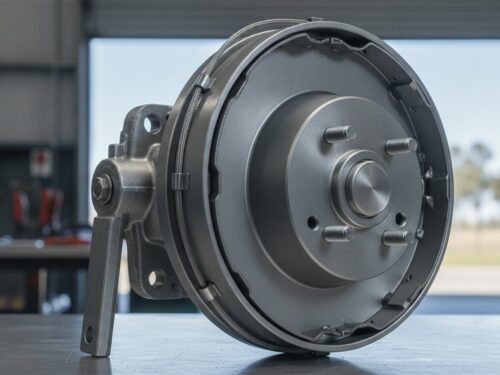
The open architecture of a disc brake is its greatest asset in marine environments. Unlike drum brakes, which house components inside a closed cylinder, disc rotors and calipers are fully exposed. This design allows for rapid heat dissipation during long descents. It also ensures that water is flung away from the braking surface by centrifugal force. Using hydraulic disc brakes for boat trailers eliminates the brake fade often experienced with drums, where trapped heat and water significantly reduce friction. You get consistent, reliable stopping power every time you hit the pedal.
The Impact of Saltwater on Trailer Braking
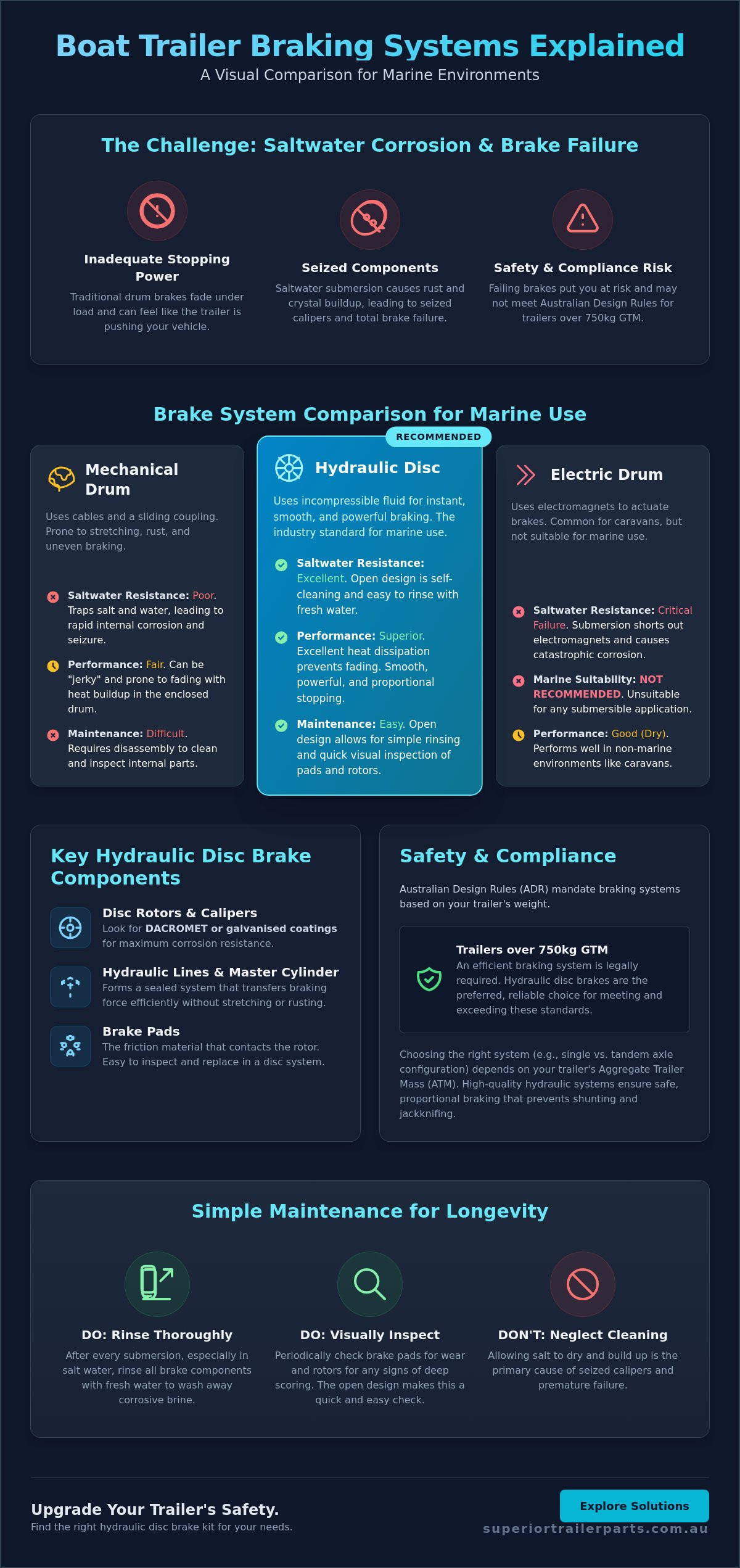
Saltwater is inherently destructive to trailer hardware. In closed drum systems, salt crystals accumulate inside the drum and grind against the shoes and springs. This leads to seized components and total brake failure. Disc brakes provide a clear advantage because they are self-cleaning. Every time the rotor spins, the pads wipe the surface clean. After a day on the water, you can easily access your boat trailer parts to rinse away brine. This accessibility prevents the internal corrosion that typically destroys mechanical alternatives.
Safety and Australian Design Rules Compliance
Safety on Australian roads is governed by strict standards. According to Australian Design Rules, any trailer with a Gross Trailer Mass (GTM) over 750kg must be fitted with an efficient braking system. Hydraulic systems are the preferred choice for meeting these legal requirements on heavier trailers. They provide proportional braking, meaning the trailer slows down in direct relation to the tow vehicle’s deceleration. This prevents the trailer from shunting or pushing the car, which is a common cause of jackknifing. High-quality hydraulic disc brakes for boat trailers ensure your setup remains compliant and safe under heavy loads.
Comparing Hydraulic, Mechanical, and Electric Trailer Brakes
Choosing the right braking setup requires an understanding of how different systems handle weight and moisture. Mechanical override brakes are the most basic option. They use a sliding coupling and steel cables to pull the brakes when the tow vehicle slows down. While affordable, these systems are prone to “jerking” as the coupling slides back and forth. In coastal environments, steel cables stretch and rust, often leading to uneven braking. Transitioning to hydraulic disc brakes for boat trailers solves these issues by replacing cables with fluid pressure. This provides a smoother, more consistent stopping force that doesn’t degrade as quickly in salt air.
Hydraulic vs. Mechanical Override
The physical difference between these systems is significant. A mechanical system relies on physical tension. If a cable snaps or rusts into its housing, you lose braking power on that wheel. Hydraulic systems use a master cylinder to push fluid through lines. This fluid applies equal pressure to both calipers simultaneously. This balanced force is vital for maintaining control during emergency stops. If you’re currently dealing with a clunky mechanical setup, upgrading to marine-grade boat trailer parts can significantly improve your towing safety.
Electric drum brakes are a standard choice for caravans, but they are unsuitable for boat trailers. These systems use electromagnets to actuate the brake shoes. When you submerge these magnets in water, especially salt water, they short circuit or corrode almost instantly. Even “sealed” units eventually leak. Once salt enters a drum, it creates a grinding paste that destroys the internal springs and adjusters. Disc brakes avoid this by keeping all moving parts exposed and easy to wash.
The Role of Electric-Over-Hydraulic (EOH) Systems
For trailers with a Gross Vehicle Mass (GVM) exceeding 2000kg, standard surge or override systems often lack the necessary control. This is where Electric-Over-Hydraulic (EOH) systems become essential. An EOH actuator uses an electric signal from your in-cab controller to drive a hydraulic pump on the trailer. This setup combines the power of hydraulic disc brakes for boat trailers with the precision of electronic control. It allows you to adjust brake sensitivity from the driver’s seat, which is a major advantage when hauling heavy offshore vessels.
Compliance is also a factor for heavy loads. Many regions have specific federal trailer brake regulations regarding breakaway systems and proportional control. EOH systems meet these high safety standards by ensuring the trailer brakes can be applied independently or automatically if a decoupling occurs. While the initial investment is higher, the performance-to-maintenance ratio is far superior for heavy-duty marine applications. You spend less time adjusting cables and more time on the water.
Essential Components of a Hydraulic Disc Brake Kit
A reliable braking system is only as strong as its weakest link. It consists of several key parts designed to work in unison under extreme pressure. The master cylinder sits at the front of the trailer, usually integrated into a 4-hole over-ride coupling. It converts the physical force of the trailer pushing against the tow vehicle into fluid pressure. This pressure travels through a network of brake lines. High-quality kits use a combination of hard lines for long runs along the chassis and flexible lines near the wheels to allow for suspension movement. Using hydraulic disc brakes for boat trailers requires components that can withstand both internal pressure and external corrosion.
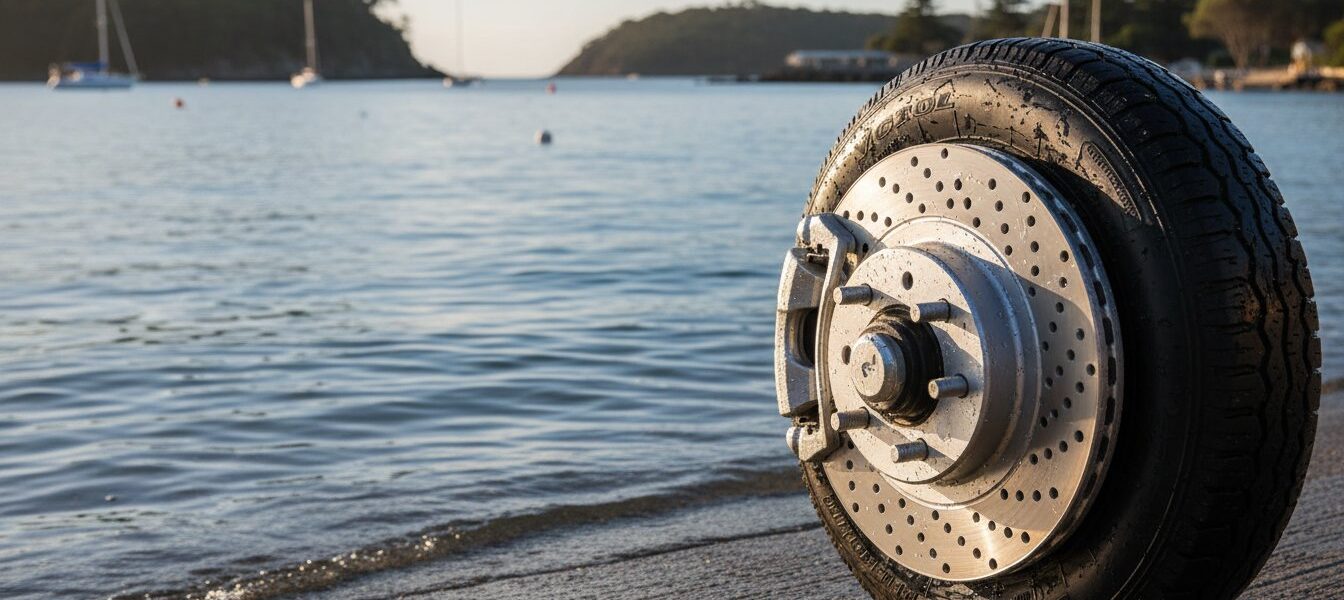
Saltwater demands specialized protection for every exposed surface. Standard steel rotors will rust overnight if left unprotected. Most marine-grade kits feature rotors with DACROMET or galvanised coatings. DACROMET is a specialized coating made of zinc and aluminium flakes. It provides superior salt spray resistance without affecting the friction needed for stopping. These coatings ensure your rotors remain smooth and functional, preventing the “pitting” that often destroys brake pads in harsh coastal environments.
Calipers and Pistons: Marine Grade Requirements
Standard cast iron calipers are common on box trailers, but they’re a poor choice for boat ramps. Saltwater eventually causes cast iron to flake and seize. Marine-grade calipers are typically made from aluminium or stainless steel to prevent this. The internal pistons are the most critical failure point. If a piston seizes, the brake will either fail to apply or fail to release. Phenolic or stainless steel pistons are the Superior Trailer Parts standard for marine applications. These materials don’t rust or swell, ensuring the caliper moves freely even after months of storage.
Rotors and Hubs: Vented vs. Solid
Heat management is a major factor when towing heavy boats. Vented rotors feature an internal air gap between the two braking surfaces. This design acts like a fan, pulling air through the rotor to cool it down during long descents. Solid rotors are lighter and cheaper, but they’re prone to warping under heavy loads. Choosing the right rotor also requires matching your hub to your trailer’s wheel bolt pattern. Common Australian standards include Ford, Holden, and Landcruiser patterns. Ensuring your hubs match your axles is essential for a safe fitment. Proper component selection, combined with consistent trailer maintenance practices, will significantly extend the life of your braking system. Always check that your hub bearings are well-greased before any long trip to prevent heat buildup at the spindle.
How to Choose the Correct Braking System for Your Trailer Weight
Selecting the right components starts with knowing your numbers. You cannot guess the weight of a boat. You must determine the Aggregate Trailer Mass (ATM), which is the total weight of the trailer, boat, fuel, and gear. This figure dictates the legal and physical requirements for your braking setup. Installing hydraulic disc brakes for boat trailers that are undersized for the load leads to overheating and premature failure. Conversely, an oversized system on a light trailer may cause the wheels to lock up too easily. Follow these steps to ensure a safe match.
- Step 1: Weigh your fully loaded trailer at a weighbridge to find the true ATM.
- Step 2: Decide on the axle configuration. Heavier loads require tandem setups to distribute weight and braking force.
- Step 3: Select rotor diameters. A 10-inch rotor is standard for most 3,500lb axles, while 12-inch rotors provide the extra surface area needed for heavier offshore boats.
- Step 4: Match your coupling to the master cylinder. The mounting pattern must align with the cylinder’s flange.
- Step 5: Verify brake line pressure ratings. Ensure your lines can handle the high PSI generated by the master cylinder or EOH actuator.
Single Axle vs. Tandem Axle Braking
In Australia, trailers with a GVM up to 2,000kg can legally operate with brakes on a single axle. However, legal minimums aren’t always the safest choice. For tandem trailers, braking all four wheels provides significantly more control and reduces the strain on individual components. This setup prevents the trailer from “shoving” the tow vehicle during hard stops. If you are building a heavy-duty rig, look at welded galvanised tandem trailers to see how professional configurations balance load and braking capacity across both axles.
Matching Couplings and Master Cylinders
The relationship between your coupling and the master cylinder is a matter of physics. The bore size of the master cylinder must be compatible with the total volume of the caliper pistons. If the bore is too small, you won’t have enough fluid displacement to move the pads effectively. Most boat trailers utilize a 4-hole over-ride coupling to house the cylinder. You should browse our range of couplings and parts to find a hitch that matches your mounting pattern. Choosing a 2-hole or 4-hole pattern depends on your existing drawbar setup and the required towing capacity. If you’re unsure which kit fits your ATM, contact our technical team for a specific recommendation based on your boat’s specifications.
Maintenance Practices to Prevent Saltwater Corrosion
Submerging your trailer in the ocean is an act of mechanical aggression. Saltwater is a catalyst for rust that can destroy even the best hydraulic disc brakes for boat trailers if left unchecked. The most important rule for longevity is a thorough fresh water rinse. You must hose down the calipers, rotors, and pads after every single launch. Don’t just mist them; use a high-pressure stream to flush salt crystals from the gaps between the pads and the rotor. These crystals act as abrasives that quickly wear down friction material and pit the metal surfaces.
Regular inspections keep your system reliable. Check your brake pads for uneven wear or salt-crusting. If one pad is significantly thinner than the other, your caliper might be sticking. You should also look at the hydraulic fluid in the master cylinder reservoir. Brake fluid absorbs moisture over time, which leads to internal corrosion in the lines and master cylinder. Flush the system and replace the fluid periodically to maintain a high boiling point and prevent “spongy” performance. This is especially critical for boat trailer parts that spend half their life submerged in brine.
Don’t forget the mechanical side of your hydraulic setup. The sliding mechanism on your over-ride coupling needs regular lubrication. Use a marine-grade grease on the slide and the master cylinder lever assembly to ensure smooth movement. If the coupling doesn’t slide freely, the brakes won’t engage or disengage correctly. You can find high-quality couplings and parts designed for easy grease access to simplify this task.
Bleeding the Hydraulic System
Air in the brake lines is a major safety hazard. It compresses under pressure, resulting in a “spongy” brake feel that lacks stopping power. To bleed the system, start at the wheel furthest from the master cylinder. Open the bleeder valve, pump the coupling, and close the valve before releasing the coupling. Repeat this until only clear fluid without bubbles emerges. Perform this task whenever the lines are opened or if you notice a drop in braking efficiency. It’s a simple process that ensures your hydraulic disc brakes for boat trailers respond instantly when you hit the pedal.
Inspecting Calipers for Seizing
A seized caliper is a common result of poor maintenance. Check that the pistons retract fully once you release the pressure. You can identify early signs of trouble by looking at the rotor surface. A healthy rotor should have a shiny, clean “track” where the pads make contact. If you see heavy rust on the braking track itself, the pads aren’t applying enough pressure. Conversely, if the hub is excessively hot after a short drive, the brake is likely dragging. To verify engagement before you leave the driveway, manually apply the override lever and ensure the trailer wheels resist movement.
Secure Your Investment on the Road and Ramp
A well-specified braking system protects your boat, your vehicle, and other road users. Our components are specialized for harsh Australian saltwater conditions and are fully ADR compliant. We provide nationwide shipping to ensure you get the parts you need without delay. Browse our range of marine-grade hydraulic disc brake kits today to upgrade your setup. Invest in reliable hardware and enjoy total confidence on the highway and at the ramp.
Frequently Asked Questions
Do I need hydraulic brakes if my boat trailer is under 750kg?
Legally, you don’t require a braking system in Australia if your trailer’s Gross Trailer Mass is under 750kg. However, fitting brakes to lighter trailers can improve stopping distances and reduce wear on your tow vehicle. If you decide to add them, hydraulic systems offer the best protection against corrosion for jet ski trailers and small tinnies. It’s a practical safety upgrade for anyone towing in heavy traffic.
Can I use standard automotive brake fluid in my boat trailer?
You can use standard automotive DOT 3 or DOT 4 brake fluid in most marine systems. Always check the specifications on your master cylinder cap to ensure compatibility before refilling. Never mix different types of fluid, such as silicone-based DOT 5 with glycol-based DOT 3 or 4. This can lead to seal failure and a total loss of braking pressure when you need it most.
How often should I replace the brake pads on a marine trailer?
There is no set timeframe for pad replacement as it depends on your towing frequency and terrain. You should inspect the pad thickness every six months or before any long trip. Replace the pads if the friction material is worn down to 2mm or if you notice salt-crusting that has compromised the surface. Marine environments often cause pads to wear faster due to salt grit.
Is it possible to convert mechanical brakes to hydraulic disc brakes?
It’s entirely possible to convert a mechanical setup to hydraulic disc brakes for boat trailers. You will need a conversion kit that includes a master cylinder, calipers, rotors, and new brake lines. This process involves replacing your existing mechanical override coupling with one that houses a master cylinder. It’s a significant safety upgrade that provides much smoother stopping power and easier maintenance than traditional cable systems.
What is the difference between stainless steel and galvanised brake rotors?
Stainless steel rotors offer the highest level of corrosion resistance for saltwater use but come at a higher cost. Galvanised or DACROMET-coated rotors are a more affordable alternative that still provides strong protection against rust. While galvanised rotors are durable, stainless steel is less likely to pit or flake over several years of submersion. Both options are superior to untreated cast iron for boat ramps.
Why are my hydraulic brakes sticking after the trailer has been sitting?
Brakes usually stick because the caliper pistons or the slide mechanism have seized due to salt buildup. If the trailer has been sitting for months, moisture can cause the pads to bond to the rotors. This is why fresh water rinsing is vital after every launch. You may need to disassemble the caliper to clean the piston or replace the seals if the sticking persists despite cleaning.
Do hydraulic disc brakes work in reverse?
Hydraulic disc brakes will engage in reverse if you have a surge or override system. The trailer’s momentum pushes against the coupling, applying the brakes as you back up. Most modern systems include a reverse lockout solenoid or a manual pin to prevent this. This ensures the brakes don’t lock up while you are trying to reverse your boat down a boat ramp.
How do I know if my master cylinder needs replacing?
You should replace the master cylinder if you notice fluid leaking from the rear seal or if the brakes feel spongy despite bleeding the lines. Another sign is “bypassing,” where the cylinder fails to hold pressure under a constant load. If your hydraulic disc brakes for boat trailers don’t respond immediately when the coupling is compressed, the internal seals are likely worn out and require immediate attention.