A failed safety inspection isn’t just a blow to your schedule; it’s a $49.75 mistake that forces you back to the workshop for a re-test. It’s frustrating to be caught out by a worn shackle bolt or a faulty trailer plug when you’re trying to finalise a sale or transfer registration. We know the stress of navigating complex ATM weight categories and the uncertainty of whether to repair a component or replace it with a heavy-duty alternative. Passing a Queensland Safety Certificate isn’t about luck. It’s a systematic check of mechanical integrity that starts with quality, compliant parts.
This resource explains the specific trailer roadworthy requirements qld inspectors look for, from ADR-compliant braking systems on trailers over 750kg GTM to the mandatory dual safety chains required for loads exceeding 2.5 tonnes. We provide a technical checklist for self-inspection, helping you identify issues with your suspension, couplings, or LED lighting before the examiner arrives. You’ll gain the expert knowledge needed to source the right galvanised hardware and ensure your trailer meets every safety standard on the first try.
Key Takeaways
- Identify the specific legal triggers that require a Queensland Safety Certificate, such as selling a registered trailer or transferring ownership from interstate.
- Review the essential trailer roadworthy requirements qld for mechanical systems, focusing on axle structural integrity and wheel bearing maintenance.
- Learn the mandatory lighting standards and the practical benefits of installing LED submersible lights to avoid common electrical faults.
- Evaluate chassis rust, tyre tread depth, and safety chain requirements to ensure your trailer meets the official Queensland Light Vehicle Inspection Manual standards.
- Understand how sourcing genuine, heavy-duty replacement parts simplifies the inspection process and prevents the cost of a secondary re-test.
Queensland Safety Certificate Regulations and Timing
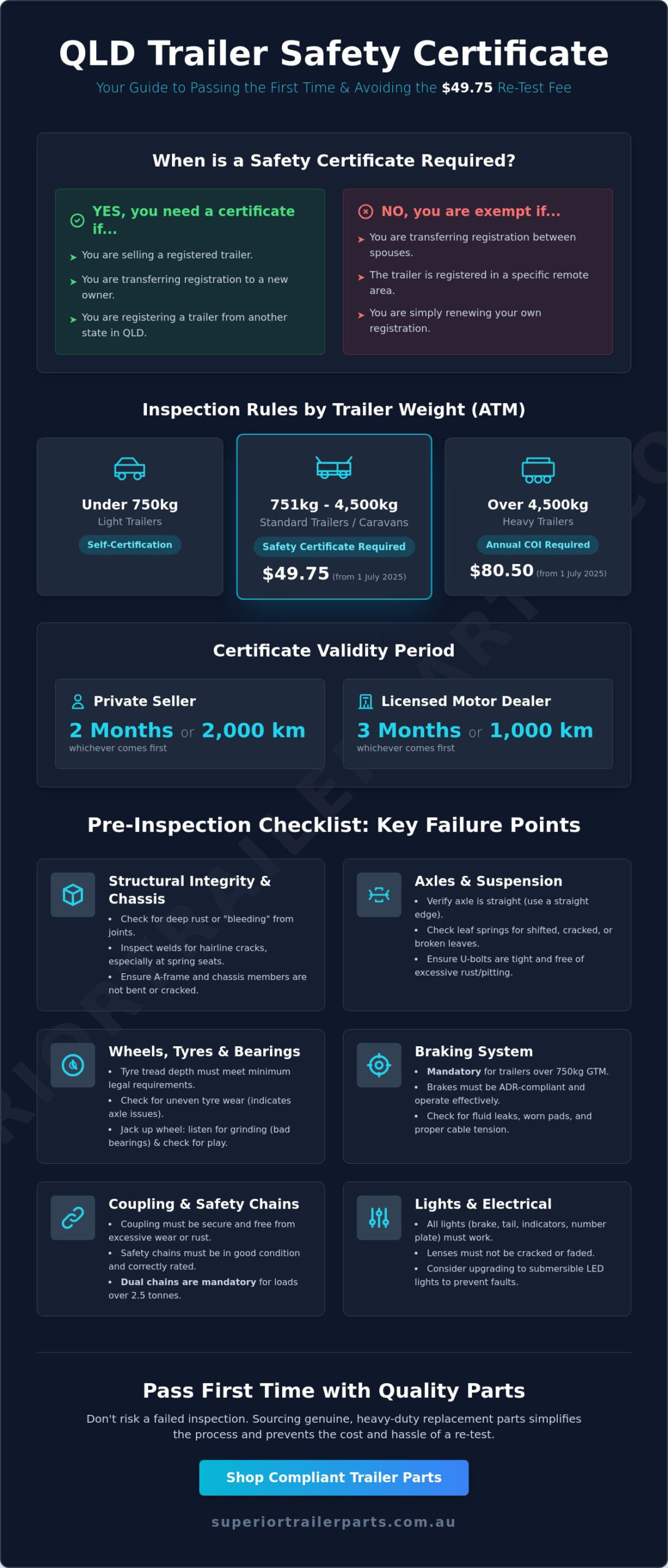
A Queensland Safety Certificate is a mandatory document that confirms a vehicle meets minimum safety standards for use on public roads. Previously known as a roadworthy certificate, this document focuses on critical components like brakes, tyres, and suspension. It’s important to understand that a safety certificate is a baseline check of Roadworthiness; it’s not a guarantee that every part of the trailer is in peak mechanical condition. For trailers with an Aggregate Trailer Mass (ATM) between 750kg and 4,500kg, the standard inspection fee is $49.75, effective from 1 July 2025. You must obtain this from an Approved Inspection Station (AIS), which is a workshop licensed by the Department of Transport and Main Roads.
You can’t skip this step during specific legal transitions. You need a valid certificate when selling a registered trailer, transferring registration to a new owner, or moving a registration from another state into Queensland. If you’re a private seller, the certificate stays valid for two months or 2,000km, whichever occurs first. Licensed motor dealers have a slightly different timeframe, with certificates lasting three months or 1,000km. If you’re caught advertising a trailer for sale without a valid certificate, you risk receiving an on-the-spot fine.
Trailer Weight Categories and Compliance
The specific trailer roadworthy requirements qld inspectors follow depend heavily on the trailer’s weight. For light trailers under 750kg ATM, you don’t need a professional safety certificate. Instead, owners usually self-certify that the trailer is safe and compliant with basic lighting and structural standards. Once a trailer hits the 751kg to 4,500kg ATM bracket, professional AIS inspection becomes mandatory. This weight range covers most tandem box trailers, horse floats, and large boat trailers. Heavy trailers exceeding 4,500kg ATM operate under a different system. These require a Certificate of Inspection (COI) annually, which costs $80.50 as of 1 July 2025.
Common Situations Where a Certificate is Not Required
Exemptions do exist, though they’re limited. You don’t need a certificate for transfers between spouses or for trailers registered in specific remote areas. It’s also not required if you’re simply renewing your own registration. Don’t confuse a safety certificate with a comprehensive mechanical report. A safety certificate only checks for immediate hazards. Proactive maintenance using genuine trailer parts is a better strategy than waiting for a sale. Replacing worn components like 39mm round axles or rusted couplings before they fail an inspection saves you the cost and hassle of a re-test.
Mechanical Inspection Standards for Trailer Axles and Braking Systems
A successful safety certificate depends on the unseen components that keep your load stable. Inspectors don’t just look at the surface; they examine the mechanical foundation. To meet trailer roadworthy requirements qld, you must ensure your axle is straight and structurally sound. A bent axle is a common failure point. You can spot this by checking for scrubbing on the inside or outside edges of your tyres. Look closely at the spring seats for hairline cracks in the welds. If you see “bleeding” rust coming from a joint, it usually indicates a structural crack or a loose connection that needs immediate attention.
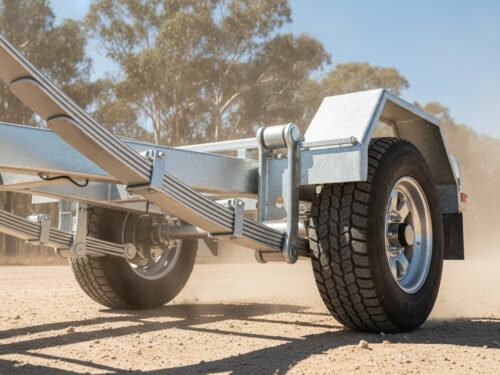
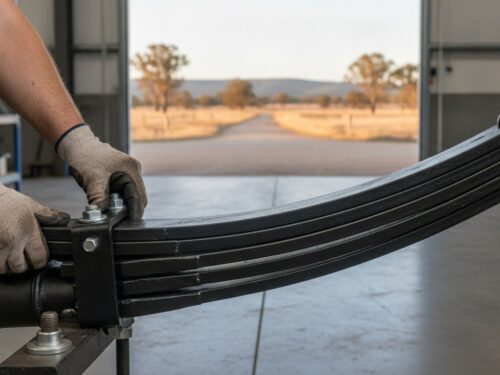
Suspension systems are equally critical. Check your leaf springs for any leaves that have shifted out of alignment or snapped. If the trailer sits lower on one side, the springs might need a reset or replacement. Rust that has eaten into the metal, rather than just surface scale, will result in an automatic fail. It’s a simple check that prevents a costly re-test.
Inspecting Axles and Hubs
Different axle types require different focus areas. While 39mm round axles are reliable for light-duty use, they can bow under stress more easily than 50mm square alternatives. Use a straight edge against the axle beam to verify it hasn’t lost its shape. Secure these components with galvanised U-bolts that are free from heavy pitting. To check wheel bearings, jack the trailer up and spin each wheel. A rumbling sound or a wheel that grinds to a halt quickly suggests the bearings are shot. Grasp the tyre at the 12 and 6 o’clock positions and rock it. Any noticeable “knock” or play means you need to adjust or replace the bearings before the inspector arrives. This process is a core part of any standard trailer roadworthy inspection checklist.
Braking System Compliance
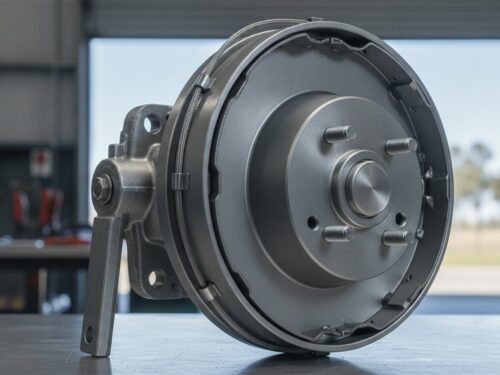
Braking standards are non-negotiable in Queensland. Any trailer with a Gross Trailer Mass (GTM) over 750kg must have an efficient braking system. If your trailer exceeds 2,000kg GTM, the law requires brakes on all wheels and a functional breakaway system that can hold the trailer for at least 15 minutes if it disconnects. Test your over-ride coupling by ensuring the internal damper still works. If the coupling “clunks” hard when you brake, the damper has likely failed. Check your handbrake mechanism. It should engage firmly and lock the wheels without needing excessive force. If your braking components are showing their age, consider upgrading to heavy-duty replacement parts to ensure long-term compliance and safety.
Electrical Systems and LED Lighting Compliance
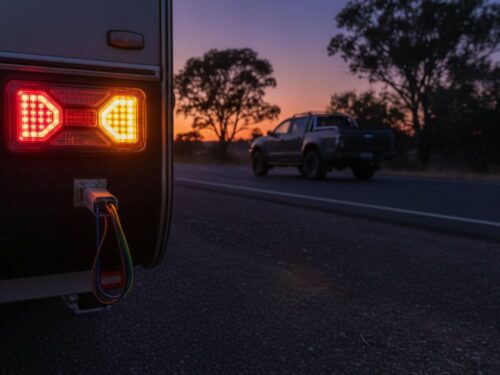
Electrical faults are one of the most common reasons for an inspection failure. To satisfy trailer roadworthy requirements qld, every light on your trailer must function without flickering or dimming. This includes your tail lights, brake lights, indicators, and the number plate light. A frequent oversight is the number plate light; it must illuminate the registration plate clearly so it is readable from a distance of 20 metres. If a single diode in an LED cluster is out, or if a traditional bulb has blown, the inspector will issue a fail. We recommend upgrading to LED submersible tail lights. These units are vibration-resistant and sealed against moisture, which prevents the internal corrosion that typically kills standard bulb-based systems.
Reflectors are another mandatory safety feature. You must have at least two red, non-triangular reflectors at the rear, positioned symmetrically. If your trailer is over 2.1 metres wide, you also need front clearance lights. Side reflectors must be amber. If these reflectors are cracked, faded by the sun, or missing, they won’t meet the visibility standards required for a safety certificate. Wiring integrity is just as vital. Any exposed wires or DIY joins wrapped in peeling electrical tape will be flagged. Ensure all wiring is secured with cable ties or protected by conduit to prevent damage from road debris.
Wiring and Connection Standards
Most electrical issues start at the plug. 7-pin and 12-pin trailer plugs often suffer from “green death,” which is copper oxidation inside the terminals. This corrosion increases resistance and causes heat damage. Check that the pins have enough tension to maintain a solid connection with the vehicle socket. For a clear breakdown of pin configurations, refer to our guide on Trailer Plug Wiring: The Standard Reference. A flickering light usually points to a weak earth. Ensure the white earth wire is bolted to a clean, paint-free section of the chassis to maintain a stable circuit.
Visibility and Positioning
Inspectors follow strict Australian Design Rules (ADRs) for light placement. Rear lights must generally be mounted between 350mm and 1,500mm from the ground. They also need to be visible from an angle of 45 degrees to the left and right. If your spare tyre or a jerry can holder blocks this line of sight, you’ll need to relocate the lights or install an additional set. Replacing faded lenses and ensuring your indicators aren’t obscured is a simple way to avoid a re-test fee.
Structural Integrity, Tyres, and Safety Chains
The chassis and drawbar are the primary structural components under scrutiny during an inspection. Inspectors use a visual probe or hammer test to identify rust that compromises safety. Surface scale is common on older units, but deep pitting or flaking metal indicates structural failure. Pay close attention to the drawbar’s underside and the areas where the spring hangers meet the frame. These are high-stress zones. Any cracks in the main frame rails or signs of uncertified DIY welding on structural members will result in an immediate fail under trailer roadworthy requirements qld. As an Australian owned specialist, we know how harsh local roads can be on a trailer’s frame, so we recommend regular inspections for stress fractures.
Tyre health is about more than just tread depth. While 1.5mm of tread is the legal minimum, the age of the rubber is a major factor. Tyres often develop sidewall cracking from UV exposure if left outside for long periods. Expert advice suggests replacing tyres every five to seven years, even if the tread looks deep. Check for flat spots if the trailer has been sitting in one position for months. Every tyre must have a load rating that meets or exceeds the trailer’s Gross Trailer Mass (GTM). We suggest using light truck (LT) rated tyres for heavy-duty applications. They handle heat and heavy loads better than standard passenger tyres. Ensure all wheel nuts are present and tightened to the correct torque; a single missing nut is an automatic fail.
Tyre and Wheel Safety
Checking your wheels involves more than a quick glance. Look for cracks in the rims, especially around the stud holes. If you’ve recently replaced an axle, verify that the wheel offset doesn’t cause the tyre to rub against the chassis or mudguard. This is a common mistake that leads to a failed safety certificate. Maintain correct tyre pressure to prevent uneven wear and ensure the trailer tracks straight behind your vehicle.
Couplings and Safety Chains
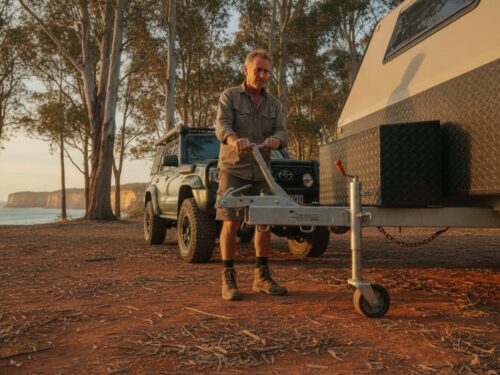
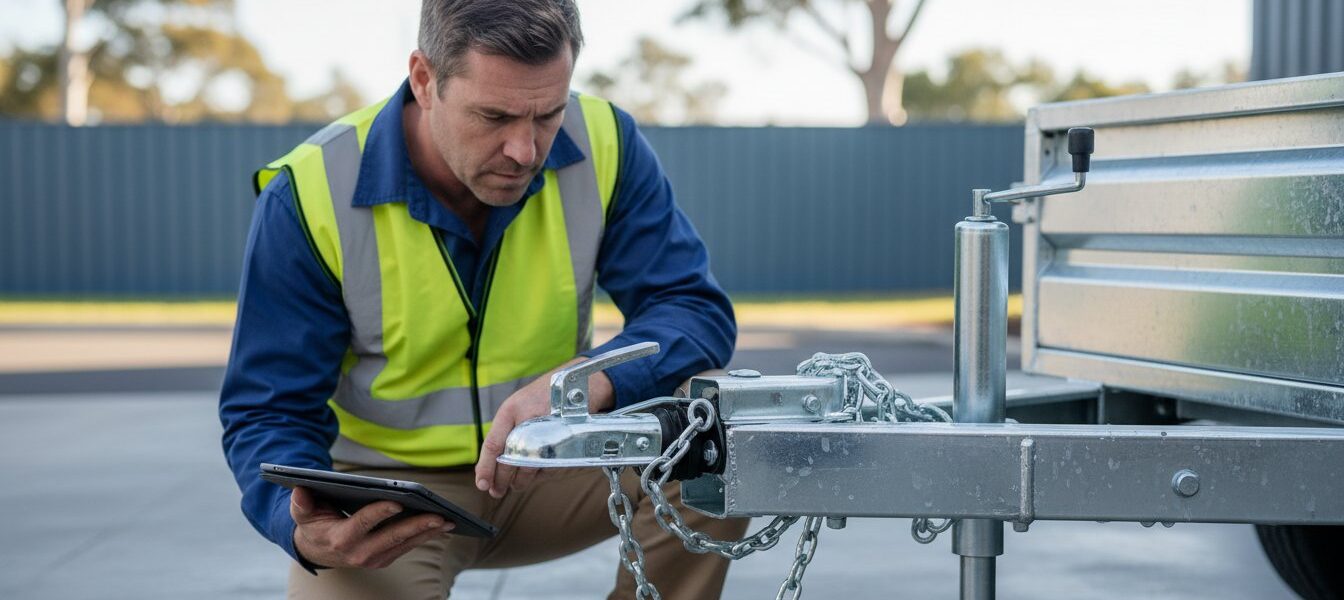
Safety chains are your last line of defence. They must be permanently attached to the trailer, usually by welding a rated link directly to the drawbar. For trailers between 2,500kg and 3,500kg ATM, you must have two safety chains fitted. Each chain link should be stamped with a capacity rating. Use D-shackles that are also rated and show a clear Working Load Limit (WLL). Your coupling must also be in top shape. Test the trigger mechanism; it should snap shut and lock the tow ball firmly. If there’s excessive vertical play when the coupling is hitched, the internal spring or housing is likely worn out. Replace these components before booking your inspection to avoid the cost of a re-test.
Ensure your trailer remains compliant and secure by browsing our selection of genuine trailer couplings and safety chains.
Maintaining Roadworthiness with High-Quality Trailer Components
Passing a safety certificate is a direct result of using components that exceed the minimum standards. Cheap, unbranded hardware often fails to meet trailer roadworthy requirements qld because it lacks the structural resilience needed for harsh Australian conditions. Investing in genuine trailer parts is a practical decision that reduces long-term maintenance costs. High-quality materials like galvanised steel and marine-grade components resist the deep-seated corrosion that leads to structural failures. When you perform DIY repairs, you must ensure every replacement part is ADR-compliant. This isn’t just about passing a one-off test; it’s about the safety of your load and other road users on the highway.
Choosing Compliant Hardware
Selecting the right hardware is essential for maintaining long-term compliance. For boat trailers, using galvanised axles and U-bolts is the only way to prevent the structural rust that compromises safety. If you’re hauling heavier loads, upgrading to electric brakes provides a significant improvement in stopping power and ensures you meet the higher standards for trailers over 2,000kg GTM. Always ensure replacement axles match the original manufacturer’s specifications for track width and load capacity. This precision prevents issues with tyre clearance and wheel alignment during the certification process.
Preparing for Your AIS Inspection
A successful inspection starts before you arrive at the Approved Inspection Station. Use this final pre-inspection checklist to ensure your trailer is ready for the examiner:
- Clean the chassis and drawbar so the VIN and compliance plate are clearly visible.
- Test all lights, including the number plate light, to ensure they don’t flicker.
- Verify that tyres have at least 1.5mm of tread and show no signs of sidewall cracking.
- Check that the safety chains are permanently fixed and the rated D-shackles are secure.
Bring your registration papers and VIN details to the appointment. If you’ve recently performed major repairs, have your receipts ready to show the quality of the parts used. Need parts to pass your roadworthy? Contact Superior Trailer Parts for expert advice and nationwide shipping. We provide the reliable components you need to get the job done right.
Secure Your Compliance with Heavy-Duty Components
Meeting the $49.75 inspection fee standard isn’t just about passing a test; it’s about long-term road safety. You now understand how weight categories determine your testing path and why structural integrity is non-negotiable for axles and safety chains. Adhering to trailer roadworthy requirements qld ensures your vehicle stays legal and reliable on the road. Don’t risk a re-test by using inferior hardware that can’t handle local conditions. A failed inspection costs time and money, so it’s better to invest in durability from the start.
Shop ADR-Compliant Trailer Parts Australia Wide
Frequently Asked Questions
Do all trailers in QLD need a roadworthy certificate?
No. Professional safety certificates are only mandatory for trailers with an Aggregate Trailer Mass (ATM) between 751kg and 4,500kg. If your trailer is 750kg ATM or less, you can typically self-certify its safety during a sale or registration transfer. This exemption covers most small single axle box trailers used for light domestic duties or small watercraft.
How much does a trailer safety certificate cost in Queensland?
The official fee for a safety certificate for trailers over 0.75t up to 4.5t ATM is $49.75. This rate is a government-set fee that became effective on 1 July 2025. Keep in mind that mobile inspection services usually charge an additional travel fee on top of this base price to cover their fuel and time spent on the road.
What happens if my trailer fails the safety inspection?
You will receive a failure report listing the specific items that don’t meet trailer roadworthy requirements qld standards. You have 14 days to rectify these faults. If you fix the issues and return to the same inspection station within this timeframe, the examiner only checks the failed items rather than performing a full, expensive re-inspection.
Can I sell an unregistered trailer in QLD without a roadworthy?
Yes. You can sell a trailer without a safety certificate if it is unregistered at the time of the sale. The legal requirement for a certificate only triggers when you sell a registered trailer or when the new owner applies for fresh registration. Selling an unregistered trailer “as is” is a common practice for project builds.
Are LED lights required to pass a trailer roadworthy?
No, LED lights are not mandatory as long as your existing incandescent bulbs meet trailer roadworthy requirements qld and function perfectly. However, many owners upgrade to LED submersible units because they are more resilient against vibration and moisture. Every light, including the number plate light, must illuminate correctly to pass the inspection on the first try.
How long is a QLD trailer safety certificate valid for?
For private sellers, the certificate remains valid for two months or 2,000km, whichever occurs first. If you are a licensed motor dealer, the validity period is three months or 1,000km. You only need one valid certificate for the duration of a single sale, even if several different potential buyers inspect the trailer before it is sold.
Do I need a safety certificate to transfer a trailer to a family member?
It depends on the relationship. Transfers between spouses are exempt from the safety certificate requirement in Queensland. Most other family transfers, such as from a parent to a child, are treated like a standard commercial sale. You will need a valid certificate to complete the registration transfer paperwork at the Department of Transport and Main Roads.
What is the minimum tyre tread depth for a trailer to pass roadworthy?
The legal minimum tread depth is 1.5mm across the entire tread surface. Examiners also check for “flat spots” or sidewall cracking, which often occurs when a trailer sits in the sun for several months. Ensure your tyres are correctly load-rated for the trailer’s GTM to avoid an automatic failure during the structural inspection process.