A trailer is only as reliable as its weakest weld or mismatched component. Building a heavy-duty trailer requires more than just a welder and some steel; it requires an exact understanding of load distribution and legal compliance. It’s frustrating to spend weeks in the workshop only to have a registration inspector reject your build because of VSB1 non-compliance or incorrect braking configurations. You need a trailer built for harsh conditions that passes inspection the first time.
By following professional 8×5 tandem trailer build plans, you’ll master the engineering requirements and component selection needed to build a durable, road-legal asset. We’ll provide a clear understanding of build specifications and a comprehensive list of required hardware, from 45mm square axles to rocker roller spring sets. This overview covers the critical technical standards for tandem axles and braking systems, ensuring your finished trailer is safe, sturdy, and ready for registration.
Key Takeaways
- Determine the correct Aggregate Trailer Mass (ATM) ratings and deck dimensions to ensure your build stays within legal compliance from the start.
- Select the right chassis materials and suspension components, like rocker roller spring sets, to handle heavy-duty loads on harsh terrain.
- Master the braking requirements for tandem axles, including the threshold where brakes are mandatory on all four wheels for safety and registration.
- Follow professional 8×5 tandem trailer build plans to source matched hardware like 50mm square axles and over-ride couplings for a reliable, road-ready result.
- Learn the step-by-step fabrication sequence to maintain structural integrity and ensure your trailer passes its final inspection without delays.
Understanding 8×5 Tandem Trailer Specifications and Compliance
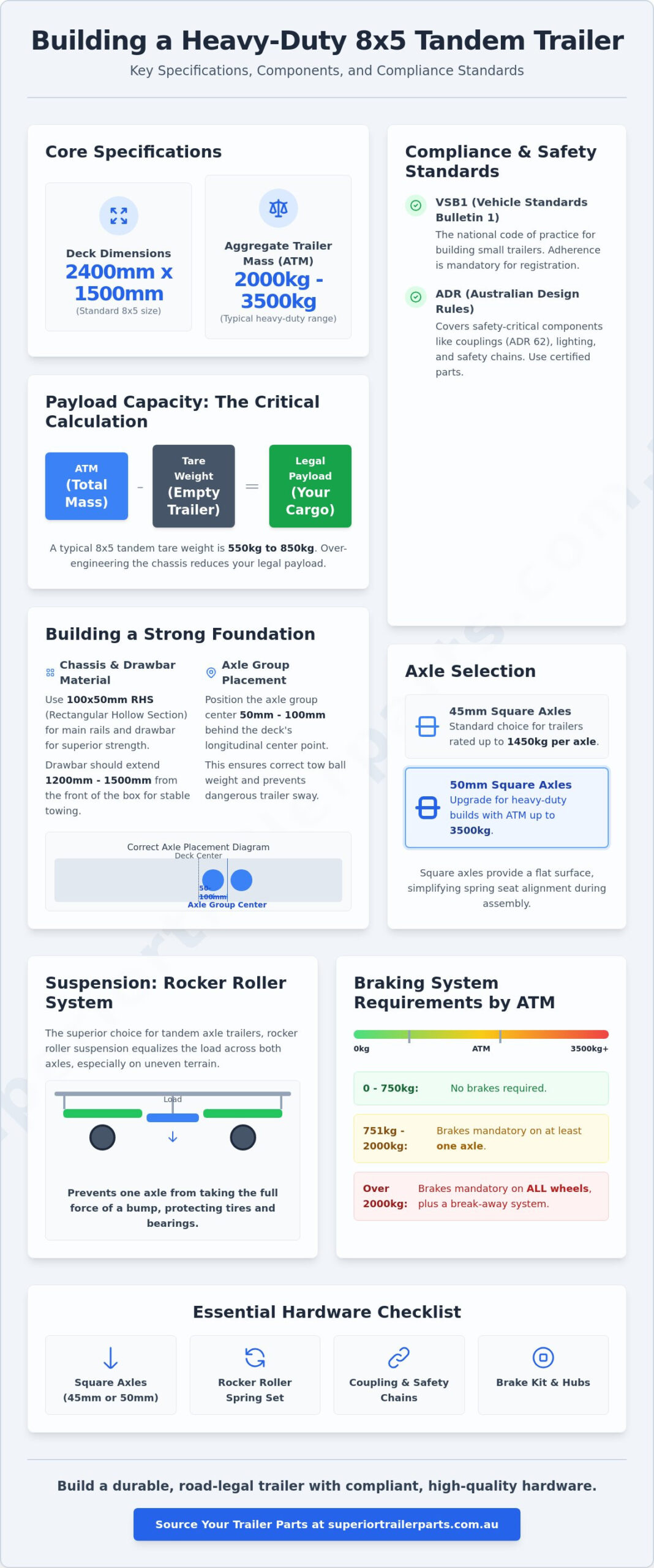
An 8×5 tandem trailer is defined by its 2400mm x 1500mm deck and dual-axle configuration. This size is the industry standard for trade and agricultural applications. It provides enough surface area to carry standard building materials while maintaining manageable towing dimensions. Developing accurate 8×5 tandem trailer build plans is the first step toward a successful project. When you use professional plans, you are designing for a specific Aggregate Trailer Mass (ATM). Most tandem builds fall within the 2000kg to 3500kg range.
Every new build must adhere to Vehicle Standards Bulletin 1 (VSB1). This document serves as the national code of practice for small trailers. It covers everything from structural integrity to safety chain specifications. A Trailer (vehicle) intended for public roads must meet these standards to be eligible for registration. Ignoring these rules often results in a trailer that is legally unusable and structurally unsafe. Using compliant 8×5 tandem trailer build plans ensures your hard work translates into a road-legal asset.
ATM vs. Tare Weight: Calculating Your Payload
Your payload capacity isn’t just a random number. It’s the ATM minus the tare weight. The tare weight is the weight of the empty trailer. For a heavy-duty 8×5 tandem, tare weights typically range from 550kg to 850kg. If you build a heavy, over-engineered chassis, you reduce the amount of gear you can legally carry. Use a simple formula: ATM minus Tare equals Legal Payload. Always calculate this during the design phase to ensure the finished product meets your operational needs.
Australian Design Rules (ADR) for New Builds
Compliance requires following specific Australian Design Rules. ADR 62 focuses on mechanical connections, specifically drawbars and safety chains. Your drawbar must be rated to handle the full ATM of the trailer. Lighting and reflector placement are also critical. Wide trailers have specific requirements for front and side clearance lights. Safety-critical components, such as axles and couplings, should come with manufacturer certification. This ensures they meet the stress requirements for tandem axle configurations and pass local registration inspections without issue.
Selecting Chassis Materials and Suspension Components
Your choice of steel determines the service life of your build. For heavy-duty 8×5 tandem trailer build plans, structural Rectangular Hollow Section (RHS) is the preferred material for the main frame. Use 100x50mm RHS for the drawbar and main rails to handle the stress of a dual-axle load. This material offers superior resistance to bending compared to lighter angle iron or C-channel. The drawbar is the backbone of your trailer; it must extend at least 1200mm to 1500mm from the front of the box to ensure stable tracking and easier reversing.
Correct axle placement is equally vital for safety. Position the center of the axle group approximately 50mm to 100mm behind the deck’s center point. This creates the necessary downward pressure on the tow ball. Without proper ball weight, the trailer will sway at high speeds, creating a dangerous towing environment. Always verify your measurements against your 8×5 tandem trailer build plans before you strike the first arc.
Axle Selection: Square vs. Round
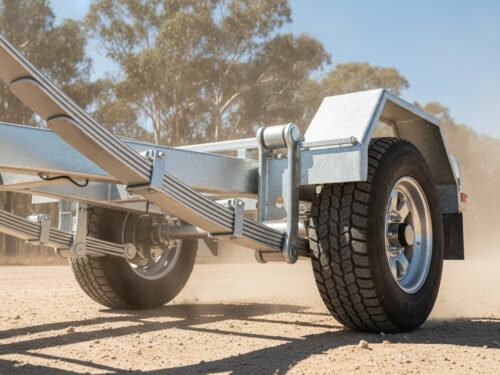
Axle geometry impacts both strength and ease of installation. 45mm square axles are the standard choice for trailers rated up to 1450kg per axle. They provide a flat surface for spring seats, which simplifies alignment during assembly. If you’re building for a 3500kg ATM, upgrade to 50mm square axles. These heavier units offer the thickness required to support massive payloads without bowing. When sourcing axles, confirm your track width matches your chassis width plus the required clearance for your wheels and tires.
Suspension Systems for Tandem Axles
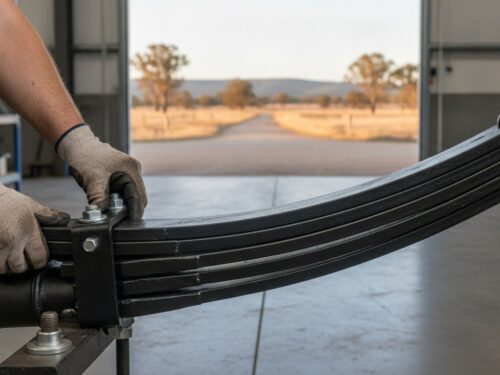
Tandem trailers require a suspension system that can equalize loads. While slipper springs are affordable, rocker roller spring sets are the superior choice for dual-axle configurations. This system uses a central rocker arm to distribute weight evenly between both axles when traveling over uneven ground. It prevents one axle from taking the full force of a bump, which protects your tires and bearings from premature failure. When installing leaf spring kits, ensure the hangers are perfectly parallel. If you’re unsure which setup fits your load requirements, browse our range of high-quality trailer parts to find a matched kit.
Braking Systems and ADR Requirements for Tandem Trailers
Braking compliance is a non-negotiable aspect of any trailer project. Australian regulations state that any trailer with a Gross Trailer Mass (GTM) exceeding 750kg must be fitted with an efficient braking system. For most tandem configurations, you’ll be well above this limit. When you’re finalizing your 8×5 tandem trailer build plans, the chosen braking system will determine your maximum legal Aggregate Trailer Mass (ATM) and your overall road safety.
There’s a critical legal threshold at 2000kg that every builder must understand. If your trailer’s ATM is 2000kg or less, you can typically utilize brakes on a single axle. However, once you move into the 2001kg to 3500kg range, Australian Design Rules (ADR) mandate brakes on all four wheels. Additionally, trailers over 2000kg ATM must feature a functional breakaway system. This safety device automatically applies the trailer brakes if the unit detaches from the tow vehicle. The system must include a dedicated power source that keeps the brakes engaged for at least 15 minutes.
Selecting the right hardware early prevents costly retrofitting later. Mechanical systems are often sufficient for lighter tandem builds, but they lack the fine control of electric alternatives. For heavy-duty applications, the ability to modulate braking force from the cab is a significant advantage. This control helps prevent jackknifing on slippery surfaces and reduces the thermal load on your tow vehicle’s braking components during long descents.
Mechanical Over-ride Brakes
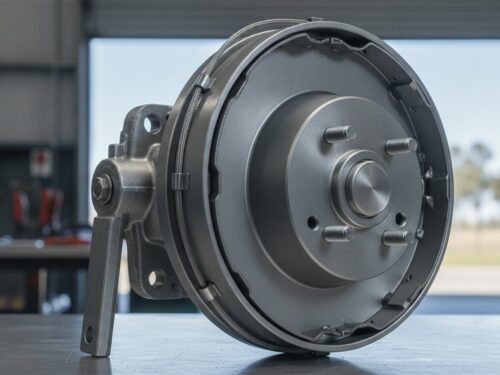
Mechanical over-ride systems are common for trailers with an ATM up to 1990kg. These systems use 9-inch mechanical drum brakes activated by a sliding coupling. When the tow vehicle slows down, the trailer pushes against the hitch, pulling a cable that expands the brake shoes. It’s a reliable, cost-effective solution because it doesn’t require an in-car electronic controller. However, cable-actuated systems require frequent maintenance. You must regularly check for cable stretch and ensure the pulleys and linkages are lubricated to maintain consistent stopping power under load.
Electric Braking Solutions
For trailers rated over 2000kg, 10-inch electric drum brakes are the industry standard for performance and compliance. These units offer superior control because they allow the driver to adjust braking intensity from the dashboard via an electronic controller. This integration ensures smoother deceleration and significantly reduces wear on the tow vehicle. When wiring a tandem setup, use heavy-duty automotive cable to prevent voltage drop between the front and rear axles. Consistent voltage is essential for ensuring all four wheels provide equal braking force. If you’re designing high-capacity 8×5 tandem trailer build plans, electric brakes are the most dependable choice for heavy payloads and long-distance hauling.
The Essential Hardware Bill of Materials
Even the most precise 8×5 tandem trailer build plans fail without the correct hardware. Sourcing matched components is essential for both structural integrity and long-term reliability. A tandem build requires a specific set of hardware designed to handle higher ATM ratings. This bill of materials ensures every fastener and fixture meets the required standards for heavy-duty use. Using professional-grade components reduces the risk of mechanical failure and ensures your trailer remains road-legal for years to come.
Your hardware list must be comprehensive. Beyond the main structural steel, you need specific items to complete the build safely. These include rated safety chains, load-rated D-shackles, and a reliable wiring system. Every item on your list should be selected based on the final ATM specified in your 8×5 tandem trailer build plans. Cutting corners on small hardware often leads to major maintenance headaches down the road. Focus on fit, finish, and corrosion resistance to protect your investment.
Coupling and Hitch Selection
Selecting the right couplings and hitches depends entirely on your trailer’s ATM. For trailers up to 2000kg, a 2-hole or 3-hole fixed coupling is standard if the trailer has independent braking. However, a 4-hole over-ride coupling is mandatory for mechanical braking systems. If your build is intended for rough terrain, poly block off-road couplings provide the necessary articulation that standard ball hitches lack. Safety chains are another critical compliance item. Tandem trailers must have two safety chains of a specific grade welded directly to the drawbar. Ensure your D-shackles are load-rated and match the chain’s capacity to pass inspection.
Fasteners and Finishing Touches
Corrosion is the enemy of any road-going hardware. Using galvanised U-bolts is essential for securing your axles to the leaf springs. Raw steel fasteners will rust quickly, which eventually compromises the suspension’s security. For lighting, LED submersible tail lights are the preferred standard. They resist vibration and water ingress far better than traditional bulb units. Pair these with a high-quality wiring harness and trailer plug adapter to ensure a reliable electrical connection. Finally, select a heavy-duty swing-up jockey wheel. A standard light-duty unit will struggle with the tongue weight of a fully loaded tandem trailer. You can find all these components and more in our extensive range of trailer parts to ensure your build meets professional standards.
From Blueprint to Road-Legal: Fabrication and Registration
Surface protection is your final defense against the elements. While industrial paint is a common DIY choice, hot-dip galvanising offers superior longevity. Galvanising involves dipping the entire welded chassis into molten zinc, providing a protective coating inside and out. This is especially important for trailers used in coastal areas or for hauling wet materials. If you choose paint, use a high-quality zinc-rich primer followed by a durable topcoat to slow the inevitable onset of rust.
Fabrication Best Practices
Quality welding is the difference between a reliable tool and a safety hazard. Use tack welds to hold the entire structure together first. This allows you to make minor adjustments before committing to full penetration welds. Pay close attention to the drawbar-to-chassis connection. This area experiences the highest stress during towing. Reinforce these joints with steel gussets to distribute the load. Finally, verify your axle alignment one last time. Measure from the center of the coupling to the ends of each axle to ensure the wheel assembly is perfectly perpendicular to the direction of travel.
Final Compliance and Registration
Your finished trailer must be registered before it hits the road. This process starts with obtaining a Vehicle Identification Number (VIN) from your state transport authority. You must also attach a permanent compliance plate that clearly states the Aggregate Trailer Mass (ATM), tare weight, and manufacturer details. A safety inspection is mandatory for all home-built trailers. The inspector will check your welds, braking system, safety chains, and lighting placement against VSB1 standards. If you find the fabrication process too demanding, you can always view our range of professionally welded tandem trailers that are already built to these exact specifications.
Start Your Road-Ready Tandem Build
Successful builds rely on precise engineering and matched components. You’ve learned how to calculate payloads, select the right axles, and meet ADR braking requirements for heavy loads. Proper fabrication techniques like staggered welding and diagonal squaring help ensure your frame remains straight and durable. When you follow professional 8×5 tandem trailer build plans, you eliminate the guesswork and build with confidence. This approach helps ensure your finished product is safe for the highway and capable of handling demanding trade or farm work.
As an Australian-owned and operated specialist, we provide the hardware you need to get the job done right. We offer nationwide shipping on all components and expert technical support for DIY builders. This ensures you have access to the same high-quality parts used by professional manufacturers. Source high-quality hardware for your next trailer build and ensure your project meets professional standards for longevity and performance. Get your workshop ready and start your build today.
Frequently Asked Questions
Do I need a license to build my own 8×5 tandem trailer?
You don’t need a specific manufacturer’s license to build a trailer for personal use in Australia. However, the finished product must comply with Vehicle Standards Bulletin 1 (VSB1) and relevant Australian Design Rules to be registered. Every home-built trailer requires a formal safety inspection and the issuance of a Vehicle Identification Number (VIN) before a state transport authority will grant registration.
Can I use 39mm round axles on a tandem trailer build?
You can use 39mm round axles, but they are typically limited to a rating of 750kg per axle. This configuration caps your total axle capacity at 1500kg, which is low for a dual-axle setup. For most heavy-duty 8×5 tandem trailer build plans, builders prefer 45mm or 50mm square axles. These square options provide higher load ratings and a more stable mounting surface for the leaf springs.
What is the maximum legal width for a trailer in Australia?
The maximum legal width for a trailer in Australia is 2.5 meters (2500mm). This measurement includes the wheels, tyres, and any mudguards or protrusions. When designing your 8×5 tandem trailer build plans, ensure the external width of the wheel arches stays within this limit. Exceeding 2.5 meters makes the trailer illegal for standard road use without special permits and signage.
Do all four wheels on a tandem trailer need brakes?
Brakes are mandatory on all four wheels if the trailer has an Aggregate Trailer Mass (ATM) exceeding 2000kg. For trailers between 751kg and 2000kg ATM, a braking system on at least one axle is required. Most tandem builds are designed for higher capacities, making a four-wheel electric or hydraulic braking system the standard choice for compliance and safety.
What size steel RHS should I use for an 8×5 chassis?
Use 100x50mm Rectangular Hollow Section (RHS) with a minimum thickness of 3mm for the drawbar and main chassis rails. This provides the structural rigidity needed for a tandem load. For the cross members and floor supports, 50x50mm RHS or 40x40mm Square Hollow Section (SHS) is usually sufficient. Always choose structural grade steel to ensure the frame can withstand high stress and vibrations.
How do I calculate the correct axle position for an 8×5 trailer?
Position the center of the axle group approximately 50mm to 100mm behind the longitudinal center of the trailer deck. This offset ensures that roughly 10% of the total weight rests on the tow ball. Correct ball weight is essential for preventing trailer sway and maintaining vehicle stability. Measure carefully from the front of the deck to find the center before marking your hanger positions.
Is hot-dip galvanising better than painting for a new trailer?
Hot-dip galvanising is the superior choice for long-term corrosion protection. Unlike paint, which only covers the exterior, the galvanising process coats the inside of the RHS chassis rails. This prevents rust from developing where you can’t see it. While industrial paint is more affordable upfront, a galvanised finish significantly increases the resale value and service life of the trailer.
What safety chains are required for a 3500kg ATM build?
A 3500kg ATM build requires two safety chains permanently attached to the drawbar. These chains must be stamped with a load rating that meets or exceeds the trailer’s ATM. Use 10mm or 13mm Grade 80 or Grade T rated chains for this capacity. Ensure the chains are long enough to allow for turning but short enough to catch the drawbar if the coupling fails.