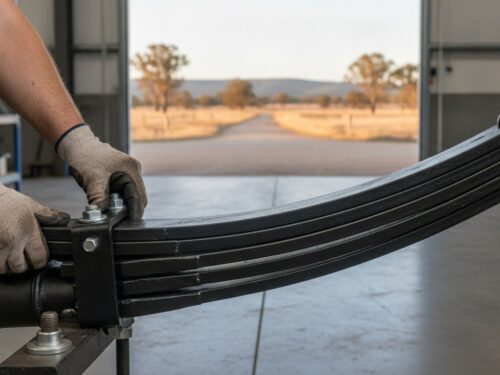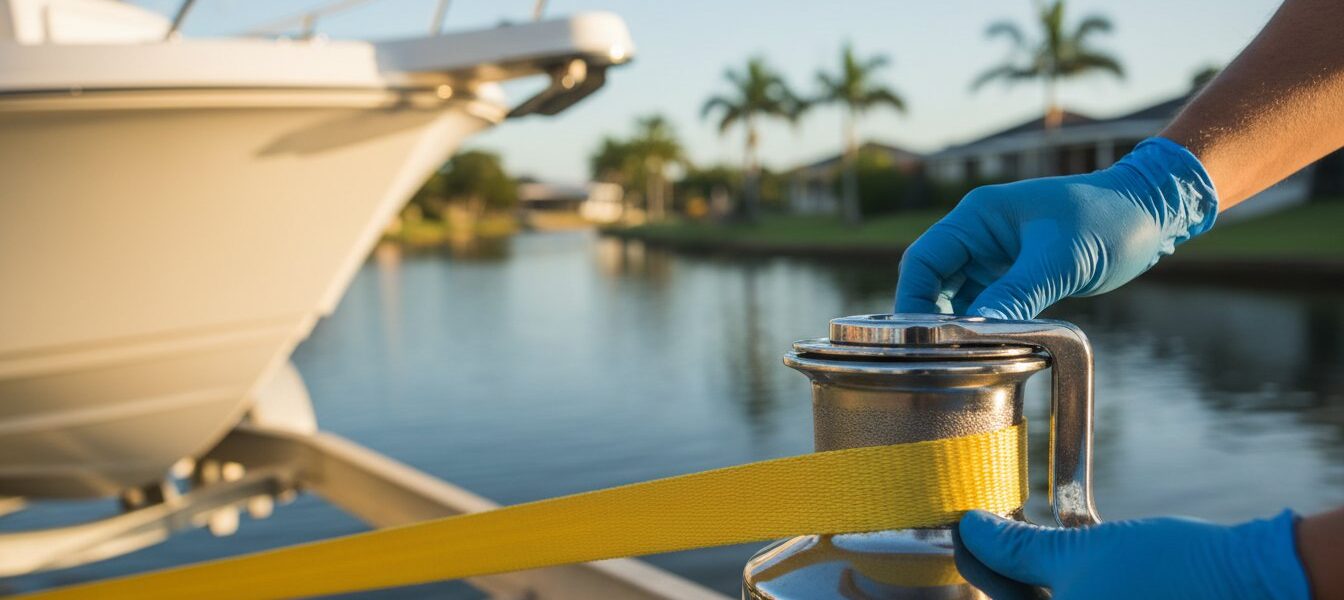
A single 50mm polyester strap is often the only thing standing between your five-tonne vessel and a concrete boat ramp. It’s a heavy burden for a piece of fabric, yet many boaties wait for a visible fray before they consider maintenance. Saltwater corrosion on the hook and UV degradation can reduce a strap’s rated capacity by up to 30% in a single summer season. You shouldn’t wait for a snap during a busy Sunday retrieval to take action.
If your gear is showing signs of age, performing a boat trailer winch strap replacement is the most reliable way to secure your investment. This guide provides the expert advice you need to select the correct break strength for your boat weight and ensure your hardware is up to the task. You’ll learn how to identify failure points early and maintain a jam-free operation in harsh Australian conditions. We’ll walk you through the technical specifications of marine-grade webbing and provide a step-by-step process for a safe, professional installation. Get the job done right so you can focus on the water, not the winch.
Key Takeaways
- Identify critical wear like UV degradation and edge fraying before equipment failure occurs.
- Compare the hand safety of synthetic webbing against the heavy-duty abrasion resistance of steel cable.
- Calculate total loaded vessel weight to ensure your strap break strength provides a reliable safety margin.
- Execute a proper boat trailer winch strap replacement by clearing the winch drum and inspecting for rust or burrs.
- Protect your gear from harsh Australian marine environments with fresh water rinses and correct tension management.
Identifying Critical Winch Strap Wear and Tear
Inspecting your gear before heading to the ramp prevents expensive failures and safety risks. A boat trailer winch strap replacement is a standard maintenance task for any Australian boatie dealing with harsh marine environments. Start by pulling the entire length of the webbing off the drum. You need to see every centimetre to ensure the integrity of the material. Look for “furring” or fuzziness on the surface. This indicates broken micro-fibres that can no longer support their rated load. Check for stiffness throughout the length. If the strap feels like a rigid board, salt crystals have likely colonised the weave. These crystals act like tiny knives, slicing the internal structure from the inside out when the strap is under tension. Closely evaluate the stitching where the strap meets the hook. Any loose threads or pulling in the stitch pattern mean the strap’s primary attachment point is compromised.
Visual Inspection for UV Damage
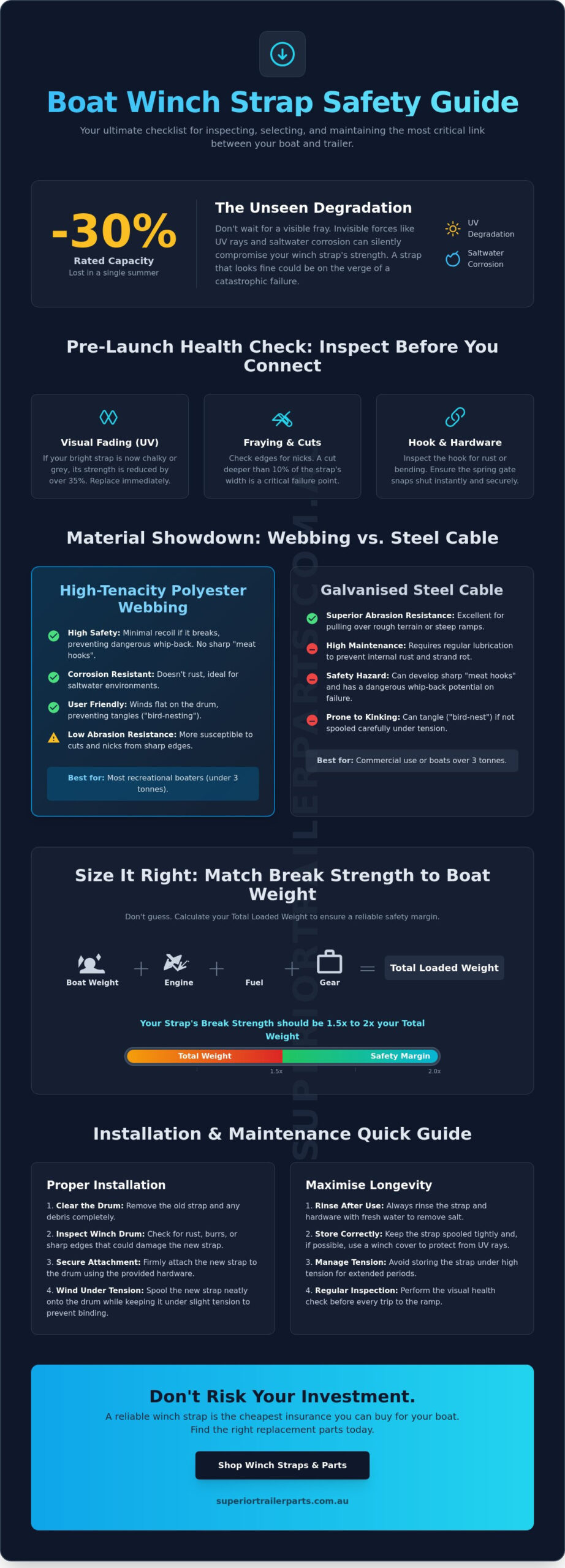
Australia’s sun is brutal on synthetic materials. UV rays penetrate polyester and nylon webbing, breaking down the molecular bonds that provide tensile strength. Fading is your primary indicator of this degradation. If your bright blue or yellow strap now looks grey, white, or chalky, its break strength is likely reduced by more than 35%. This damage usually occurs on the outermost layers of the winch drum where exposure is constant. Don’t trust a strap that has lost its original pigment, as it may snap without warning during a heavy retrieval.
Mechanical Fraying and Abrasion
Rough winch drums or misaligned rollers create sharp points of contact that lead to edge wear. Inspect the sides of the strap for nicks, snags, or deep cuts. A cut deeper than 10% of the strap width is a critical failure point. Under the high tension of a boat retrieval, these small nicks can propagate into a total snap. You don’t want your vessel sliding back down the ramp because of a 5mm tear. Ensure you check your boat trailer parts for any burrs or sharp metal edges on the winch housing that might be causing this friction during operation.
Hook and Hardware Corrosion
The strap is only as strong as its connection points. Check the heavy-duty snap hook for signs of rust, pitting, or structural deformation. Even galvanised or stainless steel hardware can succumb to constant salt spray over time. Test the spring-loaded gate for smooth operation. It must snap shut instantly and stay secure to prevent the hook from detaching from the bow eye. Verify the condition of the bolt or pin securing the strap to the winch drum. If this hardware is bent or heavily corroded, it creates a weak link that compromises the entire system’s safety. Reliable hardware is just as vital as the webbing itself for a secure haul.
Comparing Winch Strap Materials: Webbing vs. Steel Cable
Choosing the right material depends on your boat’s weight and where you launch. Synthetic webbing is the standard for most recreational setups in Australia. It resists corrosion and keeps your hands safe from “meat hooks” or frayed metal strands. Steel cable offers better abrasion resistance for commercial operators who pull boats over rough terrain or steep ramps. A boat trailer winch strap replacement using polyester is usually faster and easier than re-spooling steel.
Thickness matters for your winch drum capacity. A 50mm wide polyester strap takes up more room than a 5mm steel cable. Check your winch specifications before you swap materials. Overfilling the drum causes the material to jam against the winch housing. This leads to premature wear and potential failure during recovery. Most winches designed for webbing have wider drums to accommodate the bulk of the strap.
Saltwater is the enemy of all trailer hardware. Polyester webbing doesn’t rust, but salt crystals weaken the fibres over time if you don’t rinse it with fresh water. Steel cable requires constant attention. Even galvanised versions need regular lubrication with lanolin-based sprays to stop internal strand rot. When you replace the winch strap, consider your maintenance habits. If you prefer a “set and forget” approach, webbing is the superior choice for your boat trailer winch strap replacement.
The Benefits of High-Tenacity Polyester Webbing
Webbing is the go-to for most Australian trailers. It’s affordable and reliable. Unlike steel, synthetic webbing has minimal recoil. If a strap breaks under tension, it drops to the ground rather than whipping back toward the winch operator. It winds flat on the drum. This prevents “bird-nesting,” where the line tangles and locks itself under load. It’s a safer, user-friendly option for weekend boaties.
When to Choose Galvanised Steel Cable
Heavy-duty applications often require the rigidity of steel. Large offshore vessels or multi-axle trailers weighing over 3 tonnes benefit from the high tensile strength of galvanised cable. It handles friction better if the line rubs against the trailer frame during a difficult retrieve. You must use high-quality marine-grade boat trailer parts to ensure your cable system survives the salt. Check the cable monthly for kinks or broken wires that compromise integrity.
Browse our range of heavy-duty trailer components to find the right fit for your rig.
Matching Strap Break Strength to Your Boat Weight
Choosing the right boat trailer winch strap replacement requires precise calculations. You can’t rely on the dry weight listed in a manufacturer’s brochure. Factor in a full tank of fuel, which weighs approximately 0.74kg per litre, along with batteries, safety gear, and the day’s catch. A boat with a dry weight of 500kg often reaches 750kg when fully loaded for the ramp. Always select a strap with a break strength that exceeds this total vessel weight to ensure safety during recovery.
You must also account for the mechanical advantage and gear ratio of your specific winch. High gear ratios, like 10:1 or 15:1, make cranking easier for the operator but don’t reduce the physical tension applied to the webbing. Verify your winch drum width before purchasing. Most Australian winches use a standard 50mm wide strap. Using the wrong width causes the webbing to bunch or track unevenly, which leads to rapid material degradation.
Understanding Working Load Limits (WLL)
The breaking strain is the absolute maximum force a strap handles before snapping. The Safe Working Load (SWL) or Working Load Limit (WLL) is a lower, more practical figure for daily operations. For marine environments, maintain a safety factor of at least 1.5:1 to account for salt degradation and sudden shocks. Break strength is the specific point where the material fails under tension. Following Mercury Marine’s guide to winch strap replacement ensures you account for these ratings during the installation process.
Calculating Safety Margins for Vessel Weight
Check your boat’s tare weight on the registration papers as a baseline. Remember that gravity works against you on steep boat ramps. An incline increases the effective load on the strap significantly compared to pulling a boat on flat ground. For mid-sized aluminium tinnies, a 1500kg rated strap is the industry standard. Larger fiberglass boats require heavy-duty straps rated at 2500kg or higher to handle the increased mass and hull friction against the trailer rollers.
Strap Length and Drum Capacity
Measure your winch drum capacity before buying new webbing. Don’t buy a 9m strap if your drum is designed for 6m. An overfilled drum causes the strap to rub against the winch frame or crossbars, leading to premature fraying. This friction generates heat and weakens the polyester fibres. Standard lengths for Australian trailers include 6m, 7.5m, and 9m options. Pick the shortest length that comfortably reaches your boat in the water at a low-tide ramp. This keeps the winch efficient and prevents the strap from tangling on the drum.
Installing Your New Winch Strap: A Step-by-Step Procedure
Performing a boat trailer winch strap replacement is a straightforward task if you have the right tools. Most DIY owners can finish this job in under 20 minutes. It requires focus on tension and alignment to ensure the strap survives the harsh Australian marine environment. Follow these steps to get your trailer back in service quickly.
Removing the Old Winch Line
Start by fully unwinding the old strap until the bare metal drum is exposed. You’ll usually find a cross-bolt or a pin securing the end of the strap to the drum. Use a standard socket set or a spanner to loosen the nut. While the drum is empty, take 60 seconds to inspect the winch gears for chipped teeth or old, hardened grease. It’s also a good time to check your trailer couplings and hardware for signs of corrosion or mechanical wear. Use a wire brush to remove any rust or sharp burrs from the drum surface. These rough spots can snag and fray a new polyester strap during its first use.
Securing the New Strap to the Drum
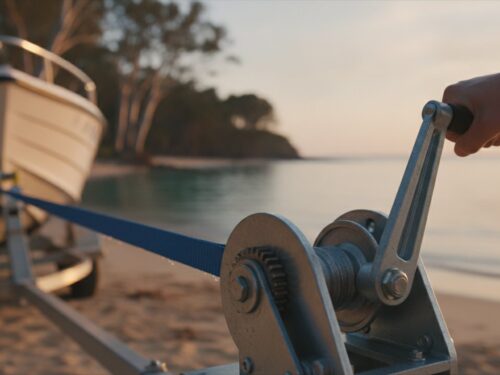
Thread the looped end of the new strap through the opening in the winch drum. Slide the mounting bolt through the drum and the strap loop. Ensure the strap is oriented so it pulls directly from the center of the drum. Tighten the nut until it’s secure, but don’t crush the strap loop; it needs enough room to pivot as the winding angle changes. A loose mounting bolt can lead to failure when the strap is under peak load at the ramp. Double check that the bolt is a high-tensile, galvanised fastener to prevent premature snapping or seizing.
Proper Winding Techniques for Tension
Winding the strap on a “dry” or loose drum is a common mistake. If the base layers are loose, the strap will bind and jam when you try to launch your boat later. This is an essential step in your boat trailer winch strap replacement project. Have a helper hold the strap under firm tension using a heavy rag or gloves while you turn the winch handle. This ensures a flat, even lay across the drum.
Pay close attention to the winding direction. Most winches are designed for an “under-wind” where the strap feeds from the bottom of the drum, or an “over-wind” where it feeds from the top. Check the winch frame for any clearance issues. The strap should never rub against the winch housing or the trailer frame. A correctly wound strap looks uniform and feels rock-solid to the touch.
Ready to refresh your towing gear? Update your towing setup with marine-grade winch components.
Maximising Winch Longevity in Harsh Marine Environments
The Australian coastline presents some of the most demanding conditions for towing equipment. Saltwater exposure quickly leads to corrosion and degrades synthetic fibres if left unchecked. You must rinse the winch and strap with fresh water after every salt immersion. This simple habit removes corrosive salt residues that eat into galvanised steel and weaken webbing fibres. Don’t leave the strap under extreme tension for long storage periods. Constant high tension stretches the material and puts unnecessary pressure on the winch gears and bushings. This can lead to premature mechanical failure.
Apply marine-grade grease to the winch gears and bushings annually. This ensures the gear teeth mesh correctly and prevents the handle from seizing. A well-lubricated winch operates smoothly and reduces the physical effort required at the ramp. Inspect the winch post and base for structural integrity and rust. Look for pitting or flaking in the galvanised finish. A compromised winch post is a significant safety risk. If the base shows signs of structural thinning, replace it immediately to prevent the assembly from ripping off the trailer frame under load.
Preventative Maintenance for Winch Systems
UV radiation in Australia is exceptionally high. A heavy-duty winch cover protects your gear from sun damage that weakens polyester webbing. Industry data suggests that a 50mm strap can lose up to 20% of its break strength after 12 months of direct sun exposure. Salt crystals are another hidden threat. When saltwater dries on the webbing, it leaves behind sharp crystals. These act like sandpaper inside the webbing fibres, cutting them from the inside out during every use. Regular cleaning extends the time between each boat trailer winch strap replacement. For more information on maintaining your setup, check our boat trailer parts maintenance resources.
Safe Winching Practices at the Boat Ramp
Safety at the ramp is about redundancy. Always use a safety chain in addition to the winch hook. This provides a secondary fail-safe if the winch mechanism or strap fails during retrieval. Don’t use the winch as the primary tie-down during road transport. Winches are designed for pulling, not for securing a boat against the vertical and lateral forces of highway travel. Use dedicated transit straps to keep the boat snug against the rollers. Before heading out on long trips, check your heavy-duty trailer axles and bearings. Mechanical failures often happen when you’re far from home. Proper boat trailer winch strap replacement and regular gear checks keep you on the water and off the shoulder of the road. Being Australian Owned and Operated, we understand the local conditions and provide gear built for the task.
Secure Your Vessel for the Road Ahead
Superior Trailer Parts provides the hardware needed to withstand salt spray and heavy loads. We’re Australian Owned and Operated, offering expert advice for marine and transport applications to ensure your setup is reliable and compliant. Our team provides nationwide shipping on all trailer components, getting parts to your door quickly so you don’t miss the next tide. Don’t risk a snapped line during your next launch or retrieval.
Browse our range of heavy-duty boat trailer winches and straps
Invest in gear that works as hard as you do and enjoy a hassle-free day on the water.
Frequently Asked Questions
How often should I replace my boat trailer winch strap?
Replace your boat trailer winch strap every 2 to 3 years depending on your frequency of use and UV exposure. Australian conditions are particularly harsh on polyester webbing, so check for fraying, sun bleaching, or stiffness at the start of every season. If you notice a 10% reduction in strap thickness or visible tears, perform a boat trailer winch strap replacement immediately to prevent failure at the ramp.
Can I use a standard 4×4 recovery strap as a winch replacement?
Don’t use a 4×4 recovery strap for your boat winch. Recovery straps are engineered to stretch up to 20% of their length to absorb kinetic energy during a snatch recovery. Winch straps must be low-stretch to maintain constant tension while pulling a boat onto a trailer. Using a high-stretch strap creates a dangerous slingshot effect if a fitting fails, potentially causing serious injury or property damage.
What is the best material for a winch strap in saltwater environments?
High-tenacity polyester is the industry standard for saltwater environments because it resists rot, mildew, and chemical degradation. Ensure the strap features a galvanised or stainless steel snap hook to prevent corrosion in coastal conditions. Expert advice suggests marine-grade polyester because it retains 90% of its strength even when wet. This material handles the salt and heat typical of Australian boat ramps without degrading quickly.
How do I know if my winch strap is rated high enough for my boat?
Choose a strap with a minimum breaking strain at least 1.5 times the total weight of your boat, motor, and fuel. If your boat weighs 1,000kg, use a strap rated for at least 1,500kg to account for the extra load caused by ramp incline and hull friction. Check the manufacturer tag near the hook for the specific rating. Using an undersized strap increases the risk of snapping under the 20% extra tension often encountered during steep retrievals.
Why does my winch strap keep getting jammed or tangled?
Winch straps usually jam because they were wound onto the drum without sufficient tension. This causes the top layers to bite into the loose layers underneath, creating a bird’s nest. Always keep the strap taut while winching to ensure it lays flat. If the strap is twisted, it will stack unevenly and rub against the winch frame. Ensure the strap width matches your winch drum exactly to prevent 5mm gaps where edges can catch.
Should I use a winch strap or a steel cable for a jet ski trailer?
Use a heavy-duty polyester strap for jet skis to avoid damaging the gelcoat or fiberglass hull. Steel cables can fray and develop small wire protrusions that cause hand injuries or scratch the PWC finish. A 50mm wide strap provides a flat, stable pull that suits the lightweight nature of jet skis. Most modern jet ski trailers come standard with webbing because it’s easier to handle and won’t rust in the surf.
Is it safe to repair a frayed winch strap by cutting and re-stitching?
Never attempt to repair a frayed or cut winch strap with home stitching or knots. Industrial sewing machines use specific box-stitch patterns and bonded nylon thread to achieve certified load ratings. A hand-sewn repair won’t hold the 1,000kg or more of tension required during retrieval. If you see damage, a full boat trailer winch strap replacement is the only safe option to protect your vessel and bystanders.
How much strap should be left on the drum when the boat is fully launched?
Keep at least three full wraps of webbing on the winch drum when the boat is fully launched. These initial wraps use friction to take the load off the cross-bolt or mounting point. Relying solely on the bolt can cause the strap to tear away from the drum under load. Ensure your strap length is at least 1 metre longer than the trailer’s total length to maintain this safety margin at the ramp.