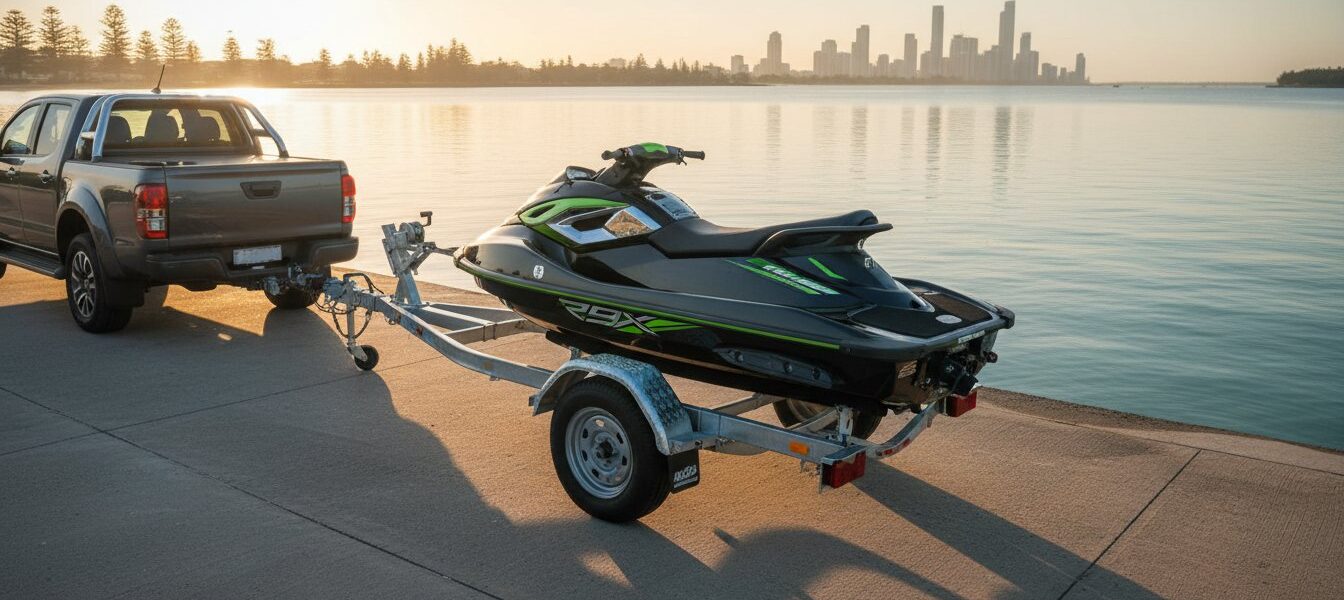
A trailer that rusts through or sways at 110km/h on the Pacific Highway isn’t just a nuisance; it’s a serious safety risk. Salt water is relentless, and without the right configuration, a standard trailer can show signs of structural fatigue in under 12 months. This jet ski trailer setup guide delivers the practical specifications required to build a rig that survives the harsh Australian coast.
It’s frustrating when a quick morning session is ruined by a winch that won’t turn or a ski that refuses to sit straight on the bunks. You need a setup that works every time, regardless of the tide or ramp incline. We’ll show you how to configure a reliable, marine-grade jet ski trailer setup that guarantees effortless solo launching and total corrosion resistance. This article covers the critical hardware choices, from hot-dipped galvanised components to waterproof LED systems, ensuring your trailer remains stable at highway speeds and rust-free for years to come.
Key Takeaways
- Select marine-grade galvanised hardware to withstand harsh Australian salt water and prevent premature corrosion.
- Identify the optimal configuration for your hull using bunks or rollers and choose a heavy-duty axle for marine use.
- Follow this jet ski trailer setup guide to accurately measure tow ball weight and maintain towing stability at highway speeds.
- Install fully sealed LED submersible lighting to eliminate the common failure points associated with traditional trailer bulbs.
- Establish a strict maintenance routine including post-launch rinsing and bearing inspections to ensure long-term trailer durability.
Fundamentals of a Reliable Jet Ski Trailer Setup
A reliable trailer ensures your PWC stays secure on the highway and slides off easily at the boat ramp. While Boat trailer fundamentals apply to most marine transport, jet ski trailers require tighter tolerances due to the compact nature of the craft. Personal watercraft have a high power-to-weight ratio and specific hull shapes that need precise support to prevent fiberglass stress. A proper jet ski trailer setup guide focuses on speed and ease of use. For frequent users, a “set and forget” configuration is essential. This means aligning your rollers or bunks so perfectly that the craft self-centers every time you retrieve it. This efficiency reduces ramp congestion and prevents hull damage caused by misaligned hardware. In Australia, where coastal conditions are the norm, your setup must withstand constant exposure to salt and grit.
- Core Requirements: High-tensile frames, waterproof lighting, and winch systems rated for the specific weight of your ski.
- Utility: The trailer must allow for easy rinsing of the PWC engine and undercarriage while the craft is still loaded.
- Durability: Every bolt and bracket must resist the vibration of corrugated roads and the corrosive nature of sea air.
Why Marine-Grade Hardware is Non-Negotiable
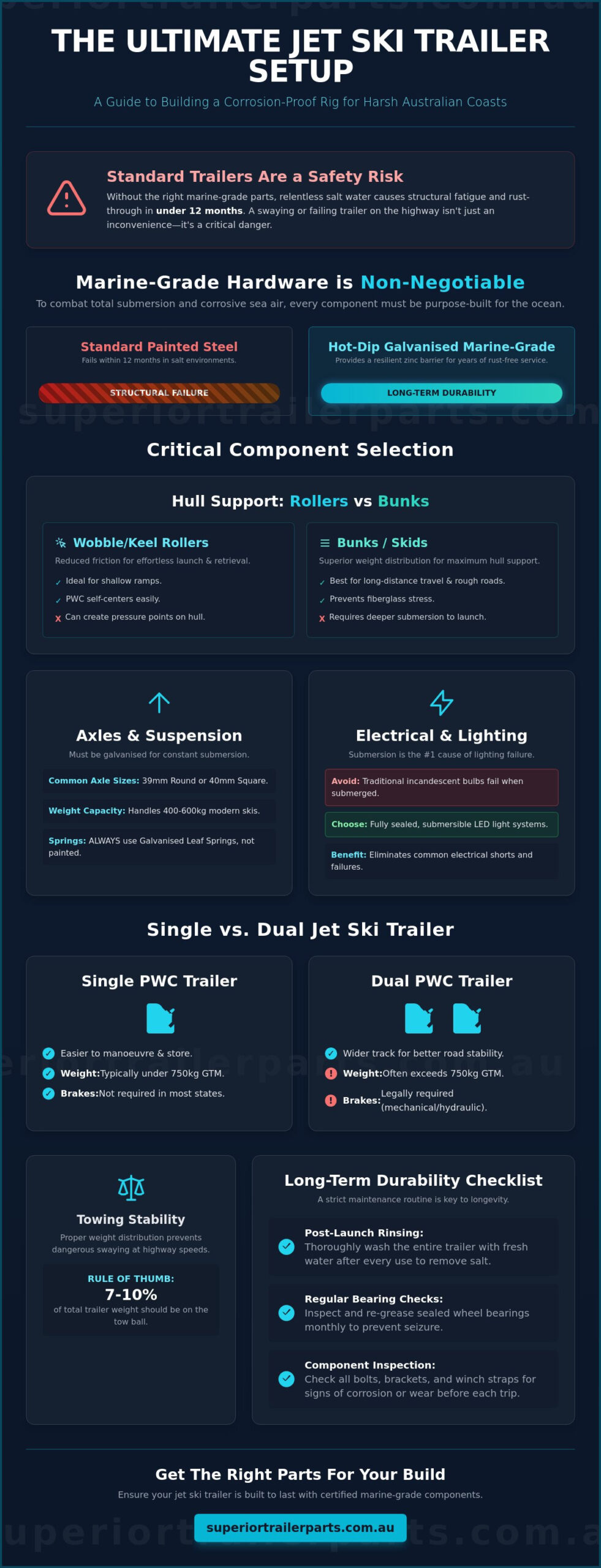
Saltwater environments are unforgiving to standard metal. Standard steel components will rust through within 12 months if exposed to the Pacific or Indian Oceans. You must use boat trailer parts specifically designed for total submersion. This hardware includes sealed bearings and LED lights with waterproof housings to prevent electrical shorts. Marine-grade hot-dip galvanisation is the industry standard for longevity because it provides a resilient zinc barrier against corrosive brine. Expert advice suggests checking these components monthly to maintain structural integrity.
Single vs Dual Jet Ski Trailer Considerations
Choosing between single jet ski trailers and tandem setups depends on your fleet and towing vehicle. Single trailers are narrower and easier to manoeuvre in tight residential driveways. Most single units weigh under 750kg, so they don’t require independent braking systems in most Australian states. Dual trailers carry two skis and offer better road stability due to a wider wheel track. However, the combined weight often exceeds 750kg, which triggers the legal requirement for mechanical or hydraulic brakes. Your jet ski trailer setup guide should account for this extra weight to ensure your vehicle’s towing capacity is never exceeded.
Selecting and Installing Essential Marine Components
Choosing the right hardware is the most critical step in your jet ski trailer setup guide. Australian coastal conditions are brutal on metal. Saltwater accelerates corrosion, so every component needs to be marine-grade. Using specialised brackets allows for an adjustable setup. This ensures your trailer fits the hull geometry perfectly. You can adjust the height and angle of your supports to keep the centre of gravity low. This improves stability during highway towing and prevents the ski from shifting.
Rollers vs Bunks: Which is Better for Your PWC?
The choice between rollers and bunks depends on your primary use case. Both have specific advantages for different hulls.
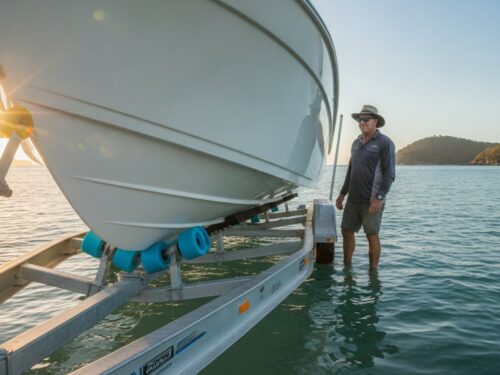
- Wobble rollers: These make launching and retrieving a breeze by reducing friction. They’re ideal for shallow ramps where you can’t submerge the trailer deeply.
- Bunks: These provide superior weight distribution. This is vital if you’re travelling long distances on corrugated roads where hull stress is a concern.
- Keel rollers: Position these along the centreline to protect the hull from hitting the trailer frame during loading.
- Skids: These are effective for lightweight PWC models and reduce maintenance because they have no moving parts to seize.
Positioning your keel rollers correctly ensures the strongest part of the hull takes the load. This prevents structural damage during high-speed transit.
Axles and Suspension for Marine Use
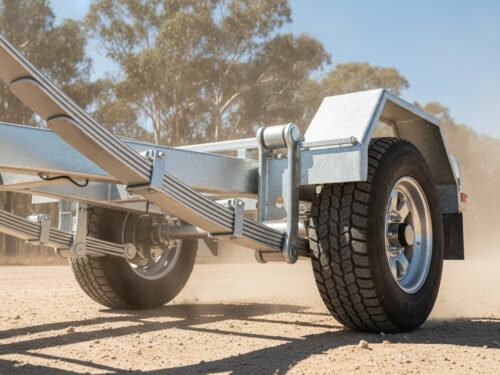
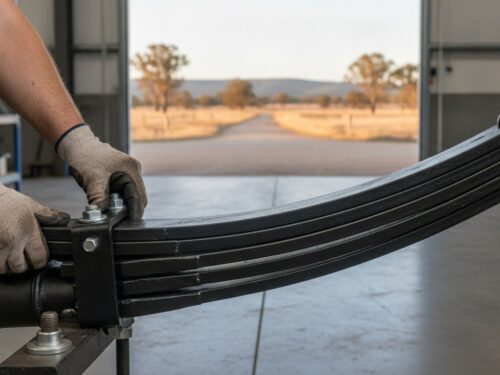
Your trailer needs axles designed for constant submersion. Most PWC trailers use 39mm round or 40mm square axles. These sizes handle the 400kg to 600kg weight of modern three-seater skis without flexing. Always choose galvanised leaf springs over standard painted versions. Painted springs will rust through in less than 12 months in salt environments. Following Queensland towing regulations ensures your suspension and safety chains meet legal standards for road use. This keeps you safe and compliant on the way to the ramp.
Winch and Coupling Selection
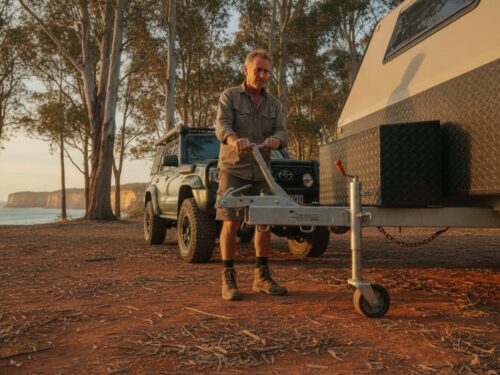
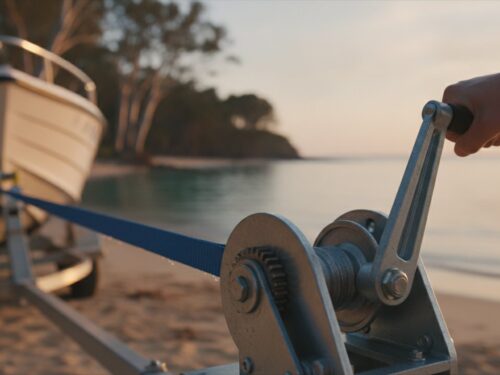
Solo retrieval requires a reliable manual winch. Select a unit with a gear ratio like 3:1 or 5:1 for effortless cranking. A higher ratio makes it easier to pull the ski up the last few inches onto the bow roller. High-quality couplings are non-negotiable for safety. They keep the trailer securely attached to your vehicle over bumps and dips. Inspect your winch straps every three months for UV damage or fraying. Sunlight in Australia is intense and weakens nylon webbing quickly. If you’re building a new rig, browse our range of boat trailer parts to find the right fit for your PWC.
Optimising Weight Distribution and Towing Stability
Correct weight distribution ensures the trailer tracks straight and responds predictably to braking. Tow ball weight is the downward force exerted on the tow vehicle’s hitch. It’s a critical factor in any jet ski trailer setup guide. Too much weight on the ball compresses the rear suspension, lifting the front wheels and reducing steering traction. Conversely, insufficient weight causes the trailer to lift the rear of the car, leading to dangerous swaying at highway speeds.
Follow these steps to establish a stable towing platform:
- Step 1: Measure the Aggregate Trailer Mass (ATM). This is the total weight of the ski, trailer, fuel, and all onboard gear.
- Step 2: Aim for a ball weight between 10% and 15% of the total ATM. You can adjust this by shifting the axle position or moving the winch post.
- Step 3: Secure the PWC using marine-grade tie-downs at the bow and transom to eliminate movement.
- Step 4: Conduct a road test at 60km/h and 80km/h. Check your mirrors for any sign of lateral sway or “snaking.”
Calculating the Ideal Ball Weight
Precision is vital for safety on Australian roads. A trailer with neutral or negative ball weight will fish-tail. This often results in a total loss of vehicle control. Use a dedicated ball weight scale to get an accurate reading rather than guessing. If the nose is too light, move the winch post forward to shift the center of gravity toward the drawbar. All modifications must comply with the Vehicle Standards Bulletin 1 (VSB1) to ensure the trailer remains roadworthy and legally compliant. Small adjustments of just 50mm can significantly alter handling characteristics.
Securing the Load for Highway Travel
High-speed travel creates constant vibration that can loosen components over time. Properly securing your craft is a fundamental part of a reliable jet ski trailer setup guide for long-distance travel. Use heavy-duty galvanised U-bolts to secure the winch post and roller assemblies. These provide the necessary clamping force and resist the corrosive effects of saltwater. Always use transom tie-down straps at the rear of the PWC. These straps pull the hull downward against the bunks, which prevents the ski from bouncing on uneven surfaces. Don’t rely on inferior polyester straps. Low-quality webbing can stretch by up to 10% when wet. This creates slack during transit, allowing the ski to shift and potentially damaging the hull or the trailer frame.
Electrical Systems and Submersible Lighting Setup
Traditional incandescent bulbs are a liability on any jet ski trailer. When you reverse into the boat ramp, the hot glass bulbs meet cold water. This creates a vacuum that sucks in salt water, instantly corroding the socket and blowing the fuse. Sealed LED units eliminate this risk entirely. They don’t rely on fragile filaments or air-tight housings that fail under pressure. This section of our jet ski trailer setup guide focuses on building a system that survives constant saltwater immersion.
Implementing Waterproof LED Solutions
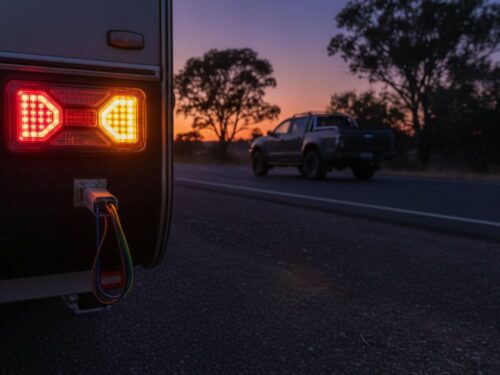
Look for an IP68 rating when selecting lamps for your trailer. An IP67 rating means the light can withstand temporary immersion, but IP68 is designed for continuous submersion at depths greater than 1 metre. High-quality LED units are potted in resin, making them 100% waterproof. To maintain this protection, you must use tinned copper wiring for the entire loom. Standard copper wire suffers from “green rot” within 12 months of salt exposure because moisture travels up the strands via capillary action. Tinned copper has a corrosion-resistant coating that stops this process. Additionally, LED lights reduce the draw on the tow vehicle electrical system by up to 80% compared to halogen bulbs, which prevents overheating in the wiring loom.
Trailer Plugs and Connection Reliability
Australia uses several plug configurations, but the 7-pin flat plug is the current industry standard for most light trailers. Some older 4WDs or heavy-duty vehicles might still use 7-pin small or large round plugs. You should check this trailer plug wiring guide to ensure your pins match the Australian Standard. A single crossed wire can result in non-functional indicators or brake lights, which is a major safety risk on the highway. Following a proper jet ski trailer setup guide helps you avoid these common wiring faults.
To ensure long-term reliability, follow these maintenance steps:
- Apply Dielectric Grease: Coat every pin and socket with dielectric grease. This non-conductive silicone grease blocks moisture and prevents oxygen from reaching the metal surfaces.
- Secure the Loom: Use UV-rated cable ties every 300mm to fix the wiring to the trailer frame. This prevents the wires from sagging or snagging on road debris.
- Check the Ground: Ensure the white ground wire is bolted to a clean, unpainted section of the galvanised frame to prevent flickering.
Reliable lighting is non-negotiable for road safety and legal compliance in every Australian state.
Maintenance Routine for Long-Term Durability
Australian saltwater is notoriously aggressive on metal components. A reliable jet ski trailer setup guide must prioritise a strict maintenance schedule to prevent premature failure. Most trailer damage occurs because salt is allowed to sit and corrode surfaces after a day on the water. Establish a routine that starts the moment you pull the trailer out of the boat ramp. This immediate action prevents salt from bonding to the galvanised surface.
Rinse every component thoroughly with fresh water for at least 10 minutes. Don’t just give the exterior a quick spray. Focus on the leaf springs, axle, and light fittings where salt accumulates. Salt crystals form quickly and can eat through protective coatings if left unchecked. You should also lubricate moving parts like the winch handle, gears, and the jockey wheel assembly every 30 days. Use a high-quality marine grease that resists water washout to ensure smooth operation during your next launch.
Wheel Bearing Care for Marine Trailers
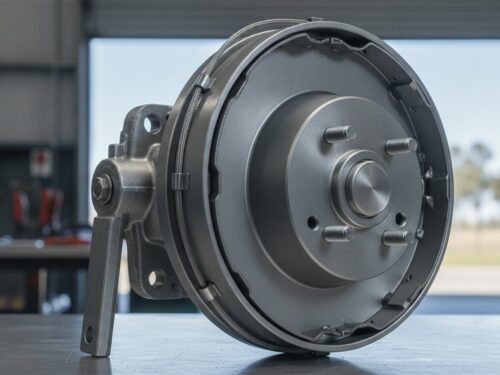
Wheel bearing failure causes approximately 70% of trailer-related roadside breakdowns. You can identify a blown bearing seal by checking the inner side of the wheel rim for grease splatter. If you see dark residue, the seal has failed. Water is likely inside the hub; this leads to heat build-up and eventual seizure within 50 kilometres of highway driving.
Install bearing protectors, such as Bearing Buddies, to provide constant internal pressure. This pressure stops water from being sucked into the hub when cold water hits the warm metal during launch. Check the spring-loaded piston on your protectors before every trip to ensure they’re full. For high-quality replacements and servicing kits, check our boat trailer parts selection to find components designed for frequent submersion. Regular inspections here are vital for any jet ski trailer setup guide to be effective over several seasons.
Corrosion Prevention and Frame Care
Fresh water rinsing is the single most effective way to extend your trailer’s life. Critical salt traps exist inside the hollow box sections of the trailer frame. Saltwater enters these sections during launch and stays there; it creates rust from the inside out. Direct your hose into the drainage holes for at least 60 seconds per section to flush salt out completely.
Inspect the entire frame for signs of structural fatigue or rust every six months. Look closely at the welds and the areas around the U-bolts. If you spot brown staining or bubbling, treat the area immediately with a cold galvanising spray. Keeping the frame clean ensures it remains strong enough to handle high-speed highway towing across Australia. Visit our trailer parts hub for all your marine-grade components and heavy-duty hardware.
Secure Your Jet Ski for Australian Coastal Conditions
A reliable jet ski trailer setup guide focuses on durability and road safety. Australian coastal roads and salt water demand heavy-duty, galvanised components. Ensure your tow ball weight stays between 10% and 15% of the total loaded trailer weight for maximum towing stability. Submersible LED lighting systems rated to IP67 or higher prevent electrical failure during repeated launch cycles. Regular maintenance routines, including fresh water rinses after every salt water trip, prevent corrosion and extend the life of your marine-grade axle and bearings.
Superior Trailer Parts provides the hardware needed to handle these harsh environments. We’re 100% Australian Owned and Operated. We offer nationwide shipping on all parts to ensure you get what you need fast. If you have technical questions about torsion axles, load ratings, or specific component fitment, our team provides expert technical advice. We help you find the right solution for your specific trailer configuration. Don’t risk a breakdown on the way to the boat ramp. Get the job done right with parts built for local conditions.
Shop Marine-Grade Jet Ski Trailer Parts at Superior Trailer Parts
Frequently Asked Questions
Is it better to use rollers or bunks for a jet ski trailer?
Bunks are generally superior for jet skis because they distribute the weight of the hull over a larger surface area. This prevents hull deformation and stress spots during long hauls on rough Australian roads. Rollers are only preferable if you frequently launch in extremely shallow water where you can’t submerge the trailer. A proper jet ski trailer setup guide recommends high-density polyethylene (HDPE) bunks to reduce friction while maintaining maximum support.
How much weight should be on the tow ball of a jet ski trailer?
You should maintain a tow ball weight between 7% and 12% of the total loaded trailer mass for optimal stability. For a standard 450kg PWC and trailer combination, this equals roughly 31kg to 54kg of downward pressure on the hitch. Correct weight distribution is vital to prevent trailer sway and ensure your tow vehicle maintains steering traction. Use a dedicated ball weight scale to confirm these figures before you hit the highway.
Can I use a standard trailer for a jet ski if I add rollers?
You shouldn’t use a standard utility trailer for a jet ski even if you install aftermarket rollers or bunks. PWC hulls require specific longitudinal support that flat-bed frames don’t provide, which can lead to structural damage over time. Purpose-built marine trailers are engineered with galvanised steel and sealed components to withstand constant salt water immersion. Investing in a dedicated jet ski trailer setup guide ensures your equipment meets marine safety standards and protects your investment.
What is the best way to prevent rust on a jet ski trailer?
Hot-dipped galvanisation provides the most reliable protection against salt water corrosion in Australian coastal conditions. You must rinse the entire frame, axle, and leaf springs with fresh water immediately after every trip to the ramp. Apply a heavy-duty lanolin-based spray or marine-grade fish oil to the internal box sections and moving parts twice per year. This simple maintenance routine can extend the functional life of your trailer by 5 to 10 years.
Do I need brakes on a single jet ski trailer in Australia?
Australian Design Rules (ADR) specify that trailers with a Gross Trailer Mass (GTM) under 750kg don’t require independent braking systems. Most single jet skis on a standard trailer weigh between 350kg and 600kg, meaning they fall below this legal requirement. If you’re towing a dual trailer or a heavy 3-seater PWC with a full 70-litre fuel tank and gear, always check the total weight on a weighbridge. Exceeding the 750kg limit without brakes is illegal and compromises your stopping distance.
How often should I service the wheel bearings on my PWC trailer?
Service your wheel bearings every 6 months or every 5,000km to prevent roadside failures. Marine environments are incredibly harsh; salt water ingress will destroy bearing surfaces and cause seizing within weeks if left unchecked. Use high-quality marine-grade grease and install bearing protectors to maintain constant internal pressure against water. Check the hub temperature by hand after the first 20km of every trip to ensure everything is running cool.
What type of lights are best for a submersible trailer?
IP68-rated LED lights are the industry standard because they’re fully submersible and resistant to road vibration. Traditional incandescent bulbs often fail when the hot glass hits cold water, which causes the filament to shatter instantly. LEDs are sealed in solid epoxy to prevent water ingress and electrical shorts. Ensure all your wiring connections are soldered and covered with marine-grade heat-shrink tubing to stop the salt air from corroding the copper strands.
How do I stop my jet ski trailer from swaying on the road?
Move heavier gear toward the front of the jet ski to increase tow ball weight and stabilise the trailer. Swaying usually occurs when too much weight is positioned behind the trailer axle, which lightens the rear of the tow vehicle. Check that your trailer tyres are inflated to the manufacturer’s recommended pressure, typically between 35 and 50 PSI. Inspect your suspension bushes and hitch for wear, as any mechanical play can amplify swaying at speeds over 80km/h.