Most boaters focus solely on the weight rating of their manual boat winches, but raw capacity is useless if the gear ratio forces you to struggle against the handle. Relying on a winch that isn’t calibrated for your specific ramp conditions leads to unnecessary physical strain and potential equipment failure. You need a precision tool that provides a genuine mechanical advantage, especially when dealing with steep inclines or slippery surfaces.
It’s frustrating to deal with salt-corroded components or fraying straps when you’re ready to head home. We understand that reliability is non-negotiable for boaters and fleet managers alike. You’ll learn how to select the correct manual boat winch capacity, gear ratio, and pull material to ensure safe and efficient vessel retrieval every time. We cover the industry-standard 1.5x capacity rule, the performance differences between galvanised cables and synthetic straps, and the specific maintenance steps required to keep your hardware rust-free and operational in harsh conditions.
Key Takeaways
- Differentiate between ‘dead lift’ and ‘rolling’ capacity to ensure your trailer hardware safely matches the total loaded weight of your vessel.
- Evaluate the trade-offs between galvanised steel cables and synthetic webbing to choose the most durable material for your specific marine environment.
- Select the optimal gear ratio for your manual boat winches to achieve the necessary mechanical advantage without sacrificing retrieval speed.
- Implement consistent maintenance and alignment checks to prevent saltwater corrosion and ensure the long-term reliability of your winch components.
- Follow professional mounting standards to guarantee that the winch and bow eye remain perfectly aligned for a smooth and safe loading process.
Understanding Manual Boat Winch Mechanics and Pull Capacities
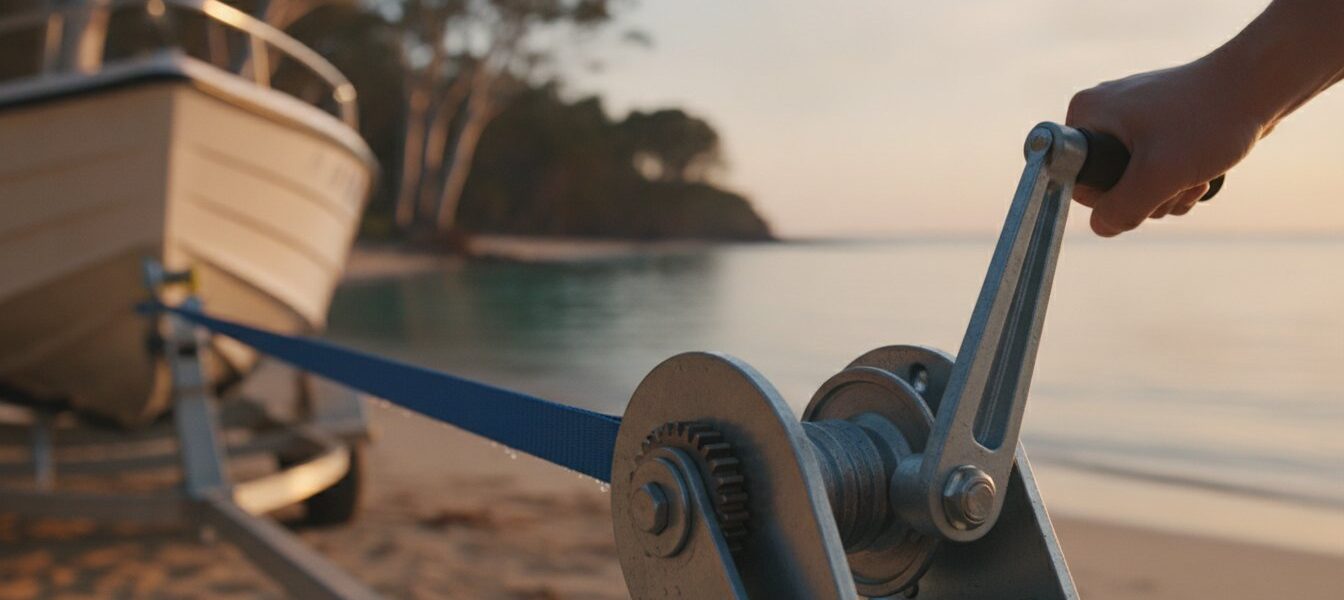
A manual boat winch is a mechanical tool designed to multiply the force you apply to a handle. It allows a single operator to move vessels weighing several tonnes with manageable physical effort. To understand the fundamental Winch mechanics and history, you must view the device as a torque converter. It transforms your circular cranking motion into a powerful linear pull across the trailer bed. This mechanical advantage is what makes solo retrieval possible at the ramp.
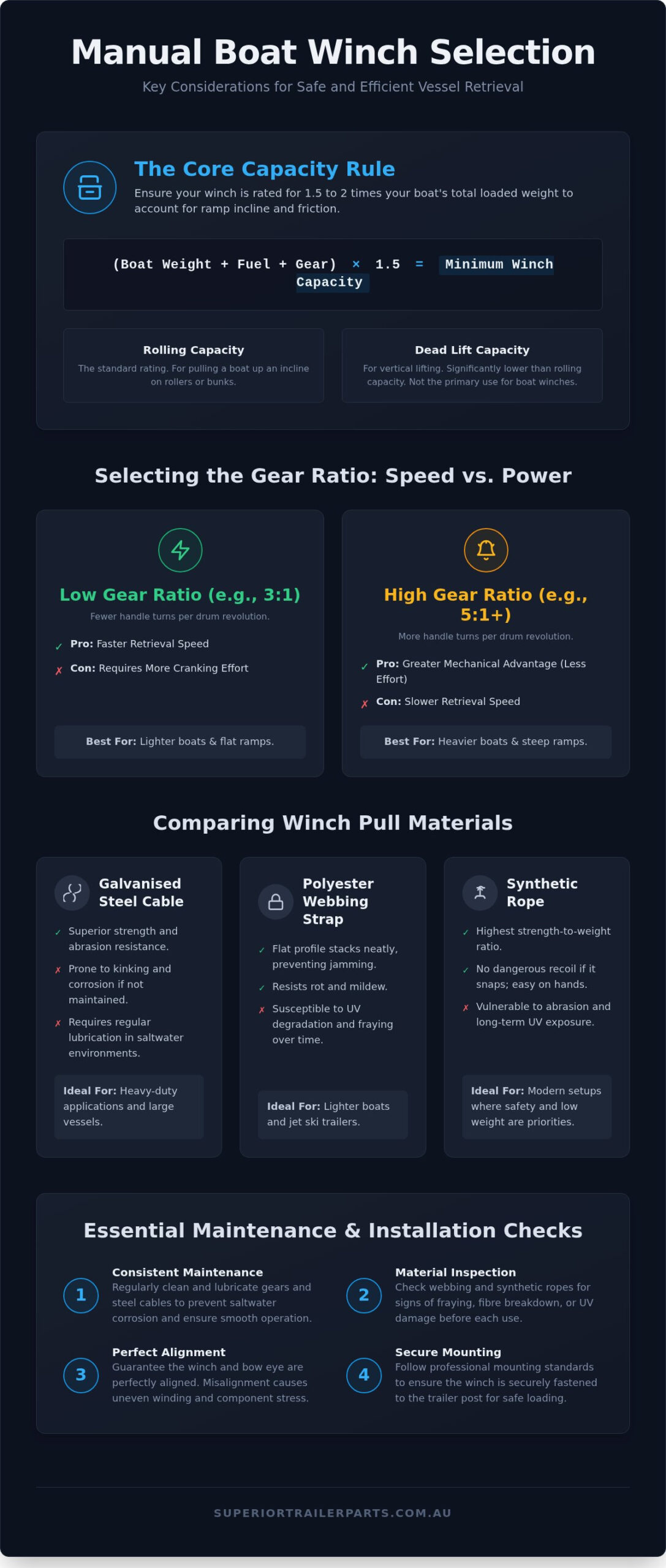
There is a critical distinction between ‘dead lift’ and ‘rolling’ capacity. Most manual boat winches are rated for rolling loads. A winch that can pull a 1000kg boat up a trailer might only be safe for lifting 300kg vertically. Gravity and friction are your primary opponents. On a steep ramp, the effective weight of the boat increases significantly as gravity pulls the vessel back toward the water. You aren’t just moving the boat; you’re fighting the incline.
Standard industry practice recommends a winch rated for at least 1.5 to 2 times the boat’s total loaded weight. This calculation must include fuel, gear, and the motor. This extra headroom accounts for the resistance of the ramp incline and the efficiency of your trailer rollers. If you frequently use steep or slippery ramps, aim for the higher end of that scale. It’s better to have excess capacity than to reach the mechanical limit of your hardware mid-retrieval.
Calculating the Right Capacity for Your Boat
For boats under 4.5 metres with a standard aluminium hull, a 3:1 or 5:1 ratio winch is usually sufficient. Larger fiberglass vessels require more robust boat trailer parts to handle the increased mass and hull drag. The type of trailer support also changes your requirements. Keel rollers create more friction than wobble rollers, which means you need a higher line pull to overcome the initial drag of a dry hull. Line pull is defined as the maximum weight the winch can move on the first layer of the drum.
The Role of Mechanical Advantage in Manual Retrieval
Gear systems are the heart of mechanical advantage. A 5:1 gear ratio means you must turn the handle five times to complete one full drum revolution. This reduces the force required from your arm, making retrieval effortless. However, there is a direct trade-off between retrieval speed and cranking ease. Higher ratios are easier to turn but take longer to bring the boat to the winch post. Choosing an undersized winch often leads to premature gear failure or handle snapping under the strain of an overloaded pull. Don’t risk a mechanical breakdown at a crowded ramp. Match the tool to the task.
Comparing Winch Cable, Webbing, and Synthetic Rope
Choosing the right pull material for manual boat winches is just as critical as selecting the gear ratio. In the harsh Australian marine environment, your choice directly impacts the longevity of your setup and the safety of the retrieval process. You must evaluate how each material handles saltwater exposure, UV radiation, and the physical mechanics of the winch drum. Each option offers specific trade-offs between raw strength and ease of handling.
Galvanised Steel Cable: Strength and Durability
Galvanised steel cable remains the standard for heavy-duty retrieval. Its high breaking strain and superior abrasion resistance make it ideal for larger vessels and rough ramp conditions. Unlike softer materials, steel cable won’t fray if it accidentally contacts submerged debris or trailer components. However, it requires disciplined management. Improper winding often leads to ‘bird-nesting’ or kinking, which permanently weakens the cable structure. Regular lubrication with marine-grade grease is essential to maintain the galvanised coating and prevent internal corrosion in saltwater settings.
Polyester Webbing and Synthetic Rope
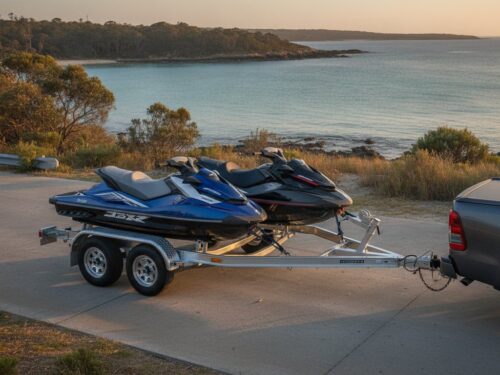
Polyester webbing is the preferred choice for lighter boats and jet ski trailers. Its flat profile allows it to stack neatly on the drum without the risk of overlapping or jamming. This neat stacking ensures a consistent pull and prevents the material from binding under tension. For those seeking the highest strength-to-weight ratio, synthetic rope offers a modern alternative. It provides the strength of steel without the dangerous recoil risk if a snap occurs. Synthetic ropes are also easier on the hands, though they are more susceptible to UV degradation over time.
When storing your trailer outdoors, UV resistance is a primary concern. Constant sun exposure breaks down the fibres in webbing and synthetic rope, leading to a significant loss in breaking strength. Inspect your pull material regularly using this checklist:
- Check for ‘fuzziness’ or surface pilling on webbing, which indicates UV damage.
- Look for stiff or brittle sections in synthetic rope that suggest fibre breakdown.
- Identify any visible rust or broken strands in steel cables.
- Ensure the hook attachment point remains secure and free of structural cracks.
The thickness of your chosen material also dictates your drum capacity. Steel cable takes up more volume than high-density synthetic rope, which means you might fit less length on a standard drum. Always verify that your winch drum is rated for the specific diameter and length of the material you intend to install. If you’re looking to upgrade your setup, browsing high-quality boat trailer parts can help you identify the right specifications for a reliable retrieval system.
Selecting the Gear Ratio: Speed vs. Power
Gear ratio is the primary factor determining how much effort you must exert at the trailer winch handle. It is defined as the number of handle rotations required to complete one full revolution of the winch drum. A higher ratio provides more mechanical advantage but requires more time to retrieve the vessel. Selecting the right ratio for your manual boat winches ensures you aren’t exhausted before you even leave the boat ramp.
Single-Speed vs. Multi-Speed Winches
A 1:1 gear ratio is a direct-drive system where one turn of the handle equals one turn of the drum. This setup is only appropriate for very light loads, such as small aluminium tinnies or single jet ski trailers, where the rolling resistance is minimal. For mid-sized vessels, a 3:1 or 5:1 ratio is standard. These ratios provide a balance of speed and power, allowing for a relatively quick retrieval without excessive physical strain.
Heavy fiberglass boats often require multi-speed winches featuring ratios as high as 10:1 or 12:1. These winches typically have multiple drive shafts. You begin the retrieval on a lower ratio (like 5:1) to bring the boat in quickly while it is still floating. As the hull makes contact with the boat trailer parts and weight increases, you shift the handle to the high-torque shaft. This ‘low gear’ provides the power needed for the final pull onto the bow stop. Always ensure the ratchet pawl is fully engaged before switching handle positions to prevent the load from slipping.
Self-Actuating Braking Systems
Automatic braking systems are a vital safety feature for heavy-duty retrieval. A brake winch uses internal friction plates to hold the load automatically whenever you stop cranking. This prevents the handle from ‘spinning out’ or kicking back if you lose your grip. Spinning handles are a leading cause of injury at boat ramps and can lead to the vessel sliding back into the water uncontrollably.
These systems are essential when navigating steep ramps where gravity constantly pulls against the winch. The internal components ensure a smooth, controlled release when you are launching the boat. Unlike a standard ratchet winch which requires manual pawl manipulation, a brake winch allows you to wind the boat out under tension. This provides maximum control and prevents the boat from gaining dangerous momentum during the launch phase. Investing in a self-actuating system is a practical choice for anyone prioritising operator safety and equipment longevity.
Installation and Maintenance for Australian Marine Conditions
Correct installation of manual boat winches is the only way to ensure the mechanical advantage you’ve paid for actually works. A poorly mounted winch doesn’t just make retrieval harder; it creates structural risks for your trailer and vessel. You must ensure the winch post is secured and the winch itself is positioned to handle the specific geometry of your boat’s bow. Precision during the setup phase prevents mechanical failure when you’re at a crowded ramp.
Mounting and Alignment Best Practices
Position the winch so the strap or cable pulls horizontally or slightly upward toward the bow eye. If the winch is mounted too low, the downward pull forces the bow into the trailer rollers, increasing friction and physical strain. This misalignment can also lead to ‘side-loading’, where the strap bunches on one side of the drum. Side-loading causes uneven wear and can lead to the strap binding or jamming during a critical retrieval. Use high-tensile U-bolts to secure the winch base to the post. These fasteners must resist both the constant vibration of road travel and the significant sheer forces generated when winching a heavy vessel onto the trailer.
Corrosion Protection and Lubrication
Inspect your hardware for wear indicators at the start of every season. A pawl spring that feels ‘mushy’ or a ratchet that fails to click sharply indicates internal fatigue. Look for visible pitting on the gear teeth or cracks in the handle casting. If you notice the winch strap has developed ‘fuzziness’ or the steel cable has broken strands, replace them immediately. Operating with compromised hardware is a safety risk you don’t need to take. If your current setup shows signs of terminal rust or mechanical failure, you can find reliable replacements in our range of boat trailer parts designed specifically for local conditions.
Reliable Boat Winch Solutions from Superior Trailer Parts
Superior Trailer Parts is an Australian-owned specialist in marine retrieval systems. We provide hardware that withstands saltwater and the physical demands of frequent ramp use. Our selection of manual boat winches is built for durability and performance. It ensures you have a reliable tool for every launch. We don’t just sell hardware. We provide technical solutions backed by industry knowledge.
Our Range of Manual Marine Winches
We stock a versatile range of manual boat winches for different vessel types. Our inventory includes light-duty winches for jet ski trailers and high-capacity multi-speed units for heavy fiberglass boats. Each winch features a high-quality galvanised finish. These coatings resist rust and pitting in the harsh Australian climate. Whether you need a 3:1 ratio for a tinny or a 10:1 brake winch for an offshore cruiser, we have the stock ready for dispatch.
Maintaining your equipment is simple with our inventory of boat trailer parts. A broken spring or bent handle shouldn’t require a full replacement. We carry spare components to help you repair your existing setup. This focus on longevity keeps your towing setup safe for years of service. It also ensures that your hardware remains functional in the most demanding marine environments.
Expert Advice and Nationwide Support
Selecting the right winch involves more than a weight rating. You must account for ramp angles, hull friction, and physical effort. Our team is a comprehensive resource for all trailer parts. We offer practical guidance on gear ratios and line pull requirements. If you’re unsure which capacity fits your vessel, contact us for technical advice. We help you find the right fit for your towing setup.
We offer nationwide shipping across Australia to ensure you get the parts you need regardless of your location. Our logistics processes are efficient and reliable. We understand that boaters and fleet managers need a quick turnaround for trailer repairs. We maintain high stock levels to facilitate immediate processing. From regional boat ramps to metropolitan workshops, we deliver engineering that balances quality and affordability. Trust a specialist who stands behind every product.
Optimise Your Vessel Retrieval System
Selecting the right manual boat winches is a matter of safety and mechanical efficiency. You now understand that matching the gear ratio to your boat weight and ramp incline is more important than raw capacity alone. Whether you choose the abrasion resistance of galvanised steel cable or the user-friendly profile of polyester webbing, regular maintenance and correct alignment remain the keys to hardware longevity. Rinsing your equipment after saltwater exposure and ensuring your winch pulls horizontally to the bow eye will prevent premature failure and keep your retrieval process effortless.
Superior Trailer Parts is an Australian-owned and operated business dedicated to providing industrial-grade hardware for local conditions. We offer nationwide shipping across Australia and provide expert technical support for all trailer builds. If you need assistance with capacity selection or are looking for specialised marine accessories, our team is ready to help. Browse our range of high-quality manual boat winches and marine parts here to ensure your setup is ready for the rigours of the boat ramp.
Frequently Asked Questions
What size winch do I need for a 5-metre aluminium boat?
A winch with a 500kg to 700kg capacity is typically sufficient for a 5-metre aluminium boat. This follows the 1.5x weight rule, assuming the boat, motor, and fuel weigh approximately 350kg to 450kg. Always check your vessel’s total loaded weight including gear before purchasing. If you frequently use steep or slippery ramps, choose a higher rating to ensure effortless retrieval every time.
Is a winch strap better than a steel cable for saltwater use?
A polyester winch strap is generally superior for saltwater environments because it cannot rust or corrode. Unlike galvanised steel cables, straps don’t develop sharp ‘burrs’ that can injure your hands during handling. They also stack flat on the drum, which prevents the binding and kinking common with wire rope. For most recreational boaters, the durability and safety of a strap outweigh the raw abrasion resistance of steel.
What does a 5:1 gear ratio mean on a boat winch?
A 5:1 gear ratio means you must rotate the winch handle five times to complete one full revolution of the drum. This system provides a significant mechanical advantage, making it five times easier to pull the boat compared to a direct-drive 1:1 winch. While it makes cranking easier, it also means the retrieval process will be slower. This is the standard ratio for mid-sized vessels on Australian boat trailers.
Can I replace the strap on my winch without buying a new unit?
You can easily replace a worn strap or cable without replacing the entire manual boat winch assembly. Most drums feature a standard bolt or cross-pin system for securing the pull material. Ensure the replacement strap matches the width and breaking strain requirements of your winch drum. Regular replacement of frayed straps is a cost-effective way to maintain safety without investing in a completely new hardware setup.
How do I stop my boat winch from rusting?
Rinsing your winch with fresh water after every saltwater immersion is the most effective way to prevent rust. This removes salt deposits that trap moisture against the metal surfaces. Applying a marine-grade lanolin spray or grease to the gear teeth and shafts provides a durable protective barrier. For maximum longevity, choose manual boat winches with high-quality galvanised or stainless steel finishes designed specifically for harsh coastal conditions.
Why is my winch handle so hard to turn when retrieving my boat?
A hard-to-turn handle usually indicates either an insufficient gear ratio or excessive friction in the trailer system. If your winch is rated correctly but still difficult to operate, inspect your keel or wobble rollers for flat spots or seized bearings. Dry rollers increase the physical force required for retrieval. You should also check the alignment between the winch post and the bow eye to ensure the strap isn’t pulling at an awkward angle.
What is a brake winch and do I need one for my boat trailer?
A brake winch features an internal friction mechanism that automatically holds the load when you release the handle. This prevents the boat from sliding back and the handle from spinning out dangerously. You should consider a brake winch if you have a heavy vessel or frequently use steep boat ramps. It provides a higher level of safety and control during both the launch and retrieval phases compared to standard ratchet models.
How often should I lubricate my manual boat winch?
You should lubricate the gear teeth and drive shafts of your winch at least once every three months. If you use your boat weekly in saltwater, monthly lubrication is recommended. Use a heavy-duty marine grease that won’t wash away easily. Regular lubrication reduces internal friction, prevents the gears from seizing, and ensures the ratchet pawl continues to engage and disengage smoothly during operation.