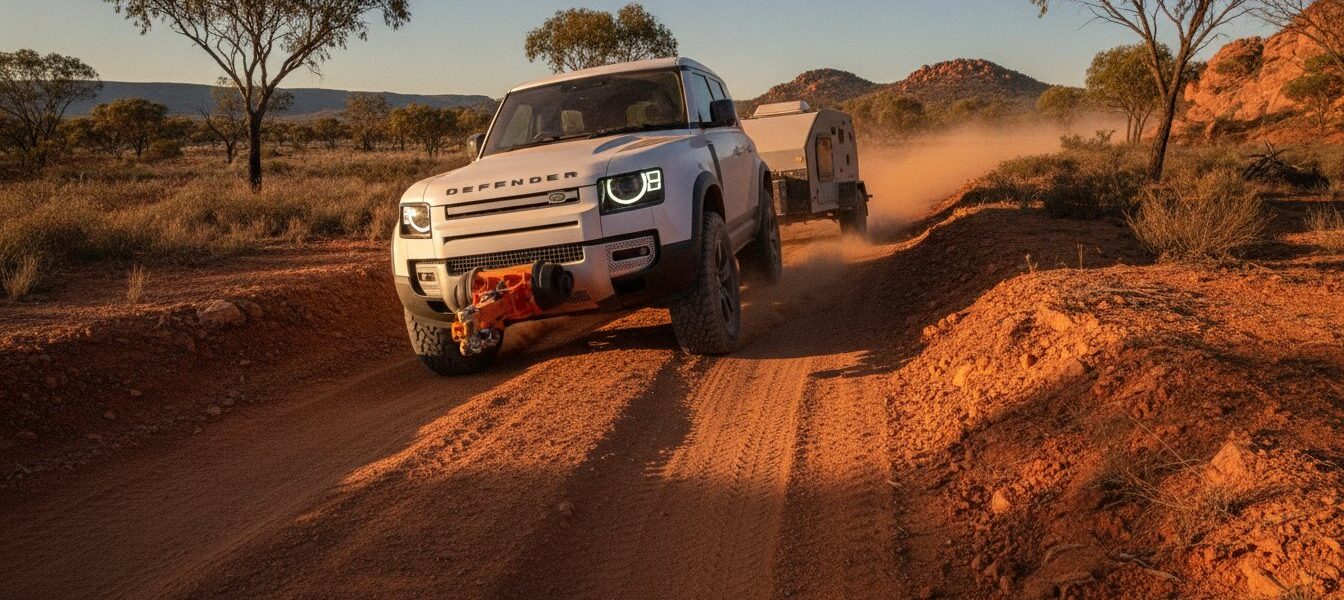
A standard 50mm ball hitch is restricted to roughly 30 degrees of articulation. This is often the exact moment a steep track turns into a mechanical disaster. If you’ve ever felt your trailer bind or heard that gut-wrenching metal-on-metal groan while navigating a washout, you know the limits of traditional hardware. Switching to poly block off-road couplings provides the vertical movement and rotation necessary to handle rugged conditions without risking a snapped hitch or a damaged drawbar.
You need a towing setup that remains quiet and stable on uneven terrain. This article explains how these couplings improve trailer performance and keep your rig safe during demanding treks. We’ll look at the technical benefits of 360-degree rotation, the requirements for ADR 62/02 compliance, and how to maintain your coupling for maximum longevity on Australian tracks.
Key Takeaways
- Understand how poly block off-road couplings provide superior vertical movement and 360-degree rotation to prevent hitch binding on uneven terrain.
- Verify the necessity of ADR 62/01 compliance to ensure your trailer setup meets Australian safety standards and remains insurance-compliant.
- Compare the performance of traditional 50mm ball hitches against off-road couplings to determine the best hardware for rugged tracks versus highway use.
- Learn to identify critical wear signs like block deformation or pin hole play to maintain a quiet, vibration-free towing experience.
- Select the correct coupling type by matching fixed or over-ride configurations to your trailer’s specific mechanical or hydraulic braking requirements.
Understanding the Mechanics of Poly Block Off-Road Couplings
A poly block off-road coupling is a mechanical connection designed specifically for extreme articulation. It replaces the traditional ball and socket with a heavy-duty polyurethane block and a vertical steel pin. This design, often referred to as the ‘Treg’ or ‘Trigg’ style, has been a staple in Australian off-roading for decades. It’s a proven system built for durability in dust, mud, and sand. The design is simple, effective, and handles the grit of the outback without the seizing issues common in more complex hitches.
The primary mechanical advantage is the ability to rotate fully. When your vehicle is tilted one way and the trailer is tilted the other, the coupling rotates 360 degrees. This prevents the trailer drawbar from twisting or applying extreme leverage to the tow bar. Understanding Coupling Mechanics helps clarify why this multi-axis movement is essential for mechanical longevity. Without this rotation, the stress on your hardware increases significantly, which can lead to structural fatigue over time.
Vertical and Horizontal Articulation Explained
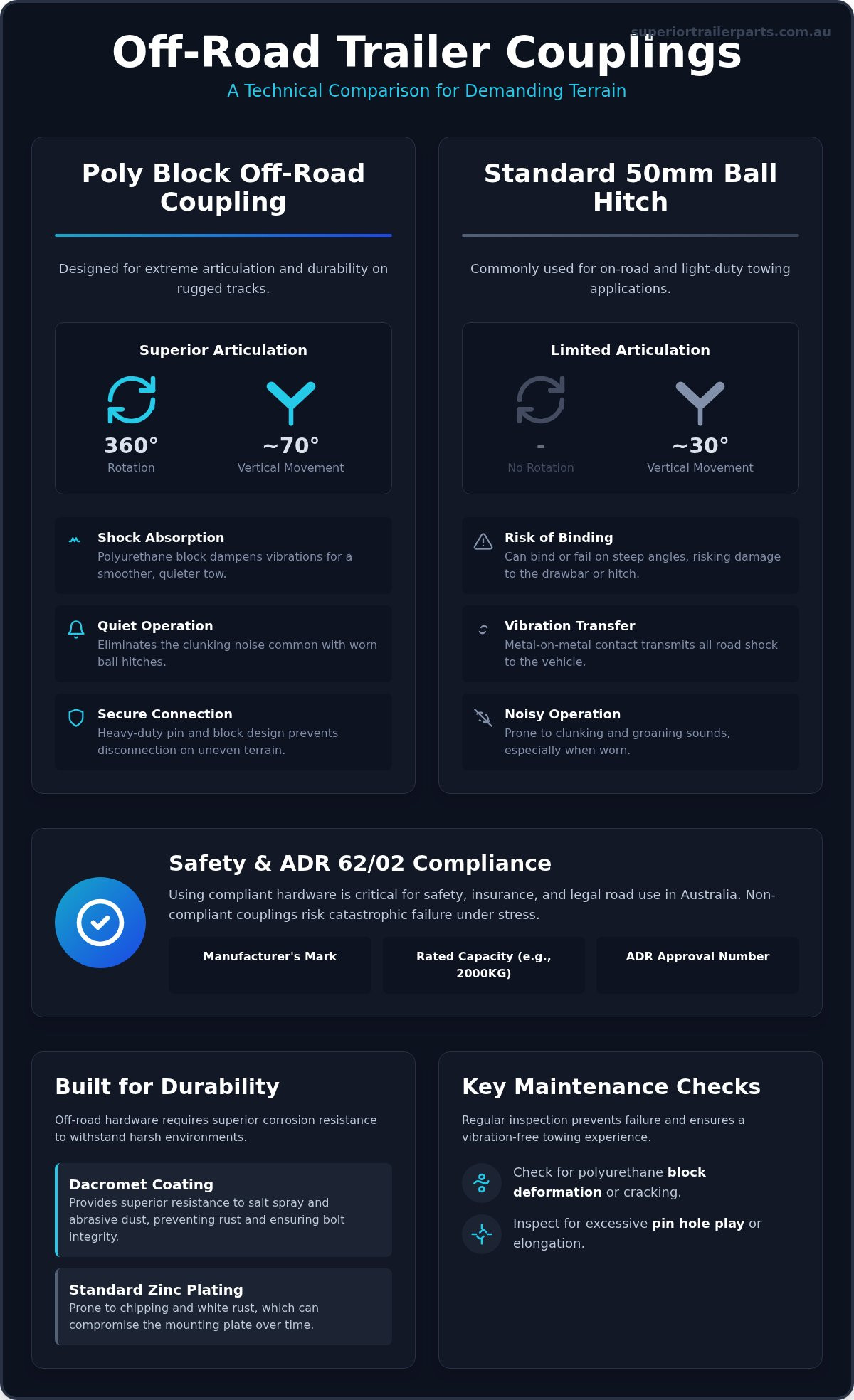
Standard 50mm balls often fail on technical tracks because they’re limited to roughly 30 degrees of articulation. They bind when the angle between the vehicle and trailer becomes too steep. This binding can lead to catastrophic failure or bent hitches. Poly block off-road couplings solve this by offering approximately 70 degrees of vertical movement. The pin-and-block system creates a secure, physical link that doesn’t rely on a friction-fit socket. It ensures the trailer stays attached regardless of the terrain’s pitch or roll. Using high-quality couplings and parts ensures your setup remains reliable under these heavy loads.
Shock Absorption and Towing Comfort
Metal-on-metal hitches transmit every vibration directly into the chassis. High-density polyurethane acts as a natural dampener. It absorbs road shock before it reaches the vehicle’s tow bar, reducing fatigue on both the trailer and the tow vehicle. This material choice also eliminates the rhythmic clunking noise found in worn ball couplings. You get a quieter, more stable towing experience on corrugated roads. The block manages the energy of the trailer’s movement, which prevents the jerking feeling often felt during low-speed technical maneuvers. It’s a practical solution for long-distance travel on unsealed surfaces.
ADR Compliance and Safety Standards for Australian Towing
Operating a trailer on Australian roads requires strict adherence to the Australian Design Rules (ADR). For mechanical connections, ADR 62/02 is the current standard. This regulation ensures that poly block off-road couplings and other hitch types can withstand the static and dynamic forces encountered during travel. Using a non-compliant coupling is a significant risk. It can void your insurance and lead to structural failure on technical tracks. Compliance isn’t just a legal checkbox; it’s a guarantee that the hardware has undergone rigorous testing for longitudinal and vertical loads.
Every compliant coupling must feature clear markings on the casting. Look for the manufacturer’s mark, the rated capacity, and the ADR approval number. If these details are missing or illegible, the coupling should not be used. Safety chains are also mandatory. Even though poly block systems use a secure pin, you still need rated safety chains that meet Australian standards. For trailers with an Aggregate Trailer Mass (ATM) up to 2500kg, at least one safety chain is required. Ensuring these chains are correctly sized and attached prevents a runaway trailer if the primary connection fails.
The 2000kg Rating: Why It Matters
The 2000kg (2T) rating is the industry standard for most single-axle off-road trailers. You must match your coupling’s capacity to the trailer’s ATM. Don’t cut it close. Over-specifying your coupling is a smart move for off-road applications. A 2000kg coupling on a 1500kg trailer provides a safety margin against the extreme “snatch” loads that occur when climbing steep washouts. This hardware works in tandem with your trailer axles to manage the total weight and stress of the rig. If your axle and coupling ratings don’t align with your load, you risk mechanical fatigue.
Dacromet Coating and Corrosion Resistance
Standard zinc plating often fails in the harsh Australian environment. It’s prone to chipping and white rust. Dacromet is the preferred finish for serious off-road hardware. This coating provides superior resistance to salt spray during beach driving and prevents corrosion from abrasive dust. It maintains the integrity of the 4-hole mounting pattern, ensuring your bolts stay torqued and secure. A corroded mounting plate can lead to play in the hitch, which eventually damages the drawbar. You can find a range of ADR-compliant couplings and parts finished in Dacromet for maximum longevity in coastal or muddy conditions.
Off-Road Hitch Comparison: Poly Block vs. 50mm Ball
A 50mm ball hitch is the industry standard for a reason. It’s simple, quick to connect, and reliable on sealed roads or light corrugations. However, its design relies on a socket sitting over a ball, which works best when the vehicle and trailer stay on a similar plane. Once you move into technical terrain, the limitations of a ball coupling become a liability. Poly block off-road couplings represent the first real step into serious off-road towing. They offer a physical connection that cannot simply pop off like a ball hitch might when pushed beyond its angular limits.
The hitching process for a poly block requires more precision than a standard latch. You must align the car adapter with the poly block and drop a heavy-duty steel pin through the center. While this takes more effort than a drop-on ball hitch, it provides a visible, mechanical lock. You know the trailer is secure because the pin is either in or it isn’t. This transparency is valuable when you’re operating in remote areas where equipment failure isn’t an option. It’s a no-nonsense system that prioritizes security over convenience.
When to Upgrade from a Standard Ball
Hitch bind occurs when the trailer and vehicle reach an angle that exceeds the coupling’s range of motion. In a standard 50mm ball setup, this usually happens around 30 degrees. When the hitch binds, the force doesn’t just stop. It transfers directly into your vehicle’s tow bar and the trailer’s drawbar. This stress can bend components or crack welds over time. If you frequently navigate tracks with deep washouts or steep creek entries, an upgrade is necessary. Most off-road trailers use a standard 4-hole bolt-on pattern. This makes the switch to a poly block a straightforward mechanical task for most owners.
Poly Block vs. Automatic Drop-On Couplings
Modern automatic drop-on hitches are popular because they’re easier to align on uneven ground. However, poly block off-road couplings maintain a strong following due to their mechanical simplicity. In the bush, fewer moving parts mean fewer points of failure. There are no internal springs or complex locking latches to get jammed with grit, sand, or mud. From a cost-to-performance perspective, poly blocks are significantly more affordable than high-end drop-on alternatives. They provide the same 360-degree rotation and high vertical articulation without the premium price tag. For builders who value durability and budget, they remain a logical choice. You can view various configurations by browsing our couplings and parts to find the right fit for your rig.
Maintenance and Replacement of the Polyurethane Block
Polyurethane is a resilient material, but it’s a sacrificial component within poly block off-road couplings. It’s designed to absorb the energy that would otherwise fatigue your trailer’s steel frame. Over time, heat, friction, and heavy loads take their toll. You must inspect the block regularly for signs of physical failure. Look for deep cracks, permanent deformation, or a “squashed” appearance where the block no longer returns to its original shape. If the material feels brittle or shows surface chalking, UV damage has compromised its structural integrity. Australian conditions are particularly harsh on polymers; don’t wait for a total failure before deciding to swap it out.
Lubrication is often misunderstood with these hitches. You should grease the vertical pin through the provided grease nipple to ensure smooth rotation. However, you must keep the polyurethane block itself dry. Applying grease to the outer surface of the block attracts trail dust and sand. This creates an abrasive paste that grinds down the coupling housing and the block. Clean the housing with a dry rag during your pre-trip inspection to remove any grit that could cause premature wear. For high-mileage trailers, replacing the block every two to three years is a standard preventative measure. You can find replacement poly blocks and pins to keep your hitch in peak condition.
Inspecting the Pin and Car Adapter
The steel pin and the car adapter bracket are subject to high shear forces. Inspect the car bracket for “egging” or ovalisation of the pin hole. This happens when a loose pin hammers against the bracket over thousands of kilometers. If the vertical pin displays more than 1mm of lateral play within the car adapter or the block itself, the components have likely reached their service limit. Check your R-clip or lynch pin for tension. A bent or loose clip can vibrate out on corrugated roads, leading to a disconnected trailer. Replace these small fasteners immediately if they show signs of fatigue.
Replacing the Block: A Step-by-Step Guide
Replacing a worn block is a straightforward task that requires basic hand tools. Follow these steps to ensure a secure fit:
- Unbolt the coupling from the trailer drawbar to gain full access to the housing.
- Remove the central bolt that secures the polyurethane block within the cast housing.
- Slide out the old block and thoroughly clean the internal surfaces of the housing to remove rust and old debris.
- Insert the new 105 x 75 x 75mm block, ensuring it’s aligned correctly with the bolt holes.
- Slide the retaining bolt back through and tighten it securely.
- Re-mount the coupling to the drawbar and torque the mounting bolts to the manufacturer’s specifications.
Proper torquing is vital. A loose coupling housing will vibrate against the drawbar, causing wear on the bolt holes and potentially leading to structural cracks in the trailer frame.
Selecting the Right Off-Road Coupling for Your Build
Choosing the correct hitch for your trailer is a matter of matching mechanical capability to your specific towing requirements. Your selection hinges on the trailer’s braking system and the intended Aggregate Trailer Mass (ATM). While all poly block off-road couplings offer the same articulation benefits, the housing design varies significantly between fixed and over-ride models. You must ensure your choice aligns with Australian towing regulations to maintain a legal and safe rig on public roads. A mismatched setup can lead to poor braking performance or mechanical failure on steep gradients.
Most off-roaders prefer the 4-hole bolt-on car adapter for its versatility. It fits standard 50mm square tow bar tongues and allows for quick removal when you’re not towing. Weld-on adapters are an option for custom-engineered builds, but they lack the modular convenience of bolt-on systems. Regardless of the mounting style, a park brake lever is essential for off-road camping. It allows you to secure the trailer on uneven ground before unhitching, preventing the rig from rolling while you’re setting up camp. Integrating your coupling with high-quality couplings and parts ensures your entire towing system remains reliable under heavy loads.
Fixed Poly Block Couplings for Unbraked Trailers
Fixed couplings are designed for trailers where the braking system is either non-existent or controlled electronically from the cab. In Australia, trailers with a GTM under 750kg don’t require brakes, making a fixed coupling the most cost-effective choice. These units are compact and feature the standard 4-hole mounting pattern, which makes them ideal for retrofitting older box trailers or small camper pods. They provide a solid, direct connection that doesn’t require the internal sliding mechanisms found in over-ride systems. This simplicity reduces maintenance needs in dusty environments.
Over-ride Poly Block Options for Heavier Loads
If your trailer weighs between 750kg and 2000kg and uses mechanical or hydraulic brakes, you need an over-ride coupling. These systems use the trailer’s own momentum to apply the brakes during deceleration. When the tow vehicle slows down, the trailer pushes against the coupling, sliding the internal shaft forward to activate the braking system. This is particularly effective on technical descents where you need the trailer to stay behind you without pushing the vehicle’s rear end around. Regular maintenance of the over-ride shaft is critical; you must keep the grease nipples serviced to prevent the shaft from seizing due to dust or water ingress. For a reliable setup, ensure you select hardware rated for your trailer’s full weight and verify your mounting bolts are high-tensile. Check the torque settings after your first 100km of off-road travel to ensure everything remains seated correctly.
Upgrade Your Towing Capability
Relying on a standard ball hitch for technical tracks is a gamble that eventually leads to mechanical failure. High-quality poly block off-road couplings provide the rotation and vertical movement necessary to navigate Australian washouts without binding. You now understand how these systems manage road shock and maintain a secure, compliant connection under heavy loads. Regular inspection of the polyurethane block and vertical pin ensures your rig remains quiet and reliable for thousands of kilometers across any terrain.
Don’t let a restricted hitch limit your next trek. Choose a coupling that matches your trailer’s ATM and braking system to ensure maximum control on steep descents. We provide 2000kg ADR 62/01 rated options featuring durable Dacromet corrosion resistance for long-term performance in harsh environments. This hardware is built to endure the salt, dust, and grit of the outback while keeping your trailer tracking straight.
Shop our range of ADR-compliant poly block off-road couplings and take advantage of our nationwide Australian shipping. Get your trailer ready for the tracks with hardware you can trust.
Frequently Asked Questions
What is the degree of articulation in a poly block coupling?
Poly block hitches provide approximately 70 degrees of vertical movement and a full 360 degrees of rotation. This is a significant improvement over standard 50mm ball hitches; those are generally limited to just 30 degrees of articulation. This increased range prevents the trailer from binding or snapping the hitch when navigating steep washouts or technical off-road tracks.
Can I use a poly block coupling with a standard tow ball?
No, you cannot use this system with a standard tow ball. The connection relies on a specific pin and block mechanism that requires a compatible car adapter bracket. You must remove the tow ball from your vehicle’s tongue and replace it with the correct bracket to secure the connection. These adapters are designed to fit standard 50mm square tow bar tongues.
How do I know if my poly block coupling is ADR compliant?
A compliant coupling features the ADR approval number, the manufacturer’s name, and the rated capacity stamped or cast directly into the metal body. Look for markings that specifically reference ADR 62/01 or ADR 62/02 standards. Using unlabelled or non-compliant poly block off-road couplings can void your insurance and compromise your safety on public roads.
Is it harder to hitch up a poly block coupling compared to a ball?
Hitching up a poly block is more technical because you must align the holes perfectly to drop the vertical pin through. It requires more precise backing or manual trailer positioning than a standard drop-on ball hitch. While it takes more effort to line up, the resulting connection is far more secure for rugged Australian conditions and won’t pop off during extreme articulation.
How often should I replace the polyurethane block component?
Replace the polyurethane block every two to three years for trailers that see frequent off-road use. You should also replace it immediately if you identify cracks, permanent deformation, or signs of brittleness. UV exposure and extreme loads eventually degrade the polymer; this reduces its ability to absorb road shock and protect your trailer’s drawbar from fatigue.
Does a poly block coupling require special maintenance after creek crossings?
Yes, you should regrease the vertical pin through the grease nipple after every water crossing to displace moisture and prevent corrosion. Check the internal housing for sand or silt that may have entered during the crossing. Keeping these surfaces clean prevents grit from acting like an abrasive against the block and the car adapter bracket.
Can I use a poly block coupling on a 3500kg rated trailer?
Most standard poly block hitches are rated for a maximum Aggregate Trailer Mass (ATM) of 2000kg. They aren’t suitable for 3500kg trailers. If you’re towing a heavy caravan or a large tandem trailer, you must use a heavy-duty off-road hitch specifically rated for that higher weight capacity. Always check the casting for the official load rating before installation.
Do I need a specific car adapter for a poly block hitch?
You must use a dedicated car adapter designed specifically for poly block off-road couplings. These adapters replace your tow ball and provide the required housing for the vertical steel pin. Most adapters use a standard 4-hole mounting pattern or a single-bolt tongue mount. Ensure the adapter is rated to match or exceed the capacity of your coupling and trailer.