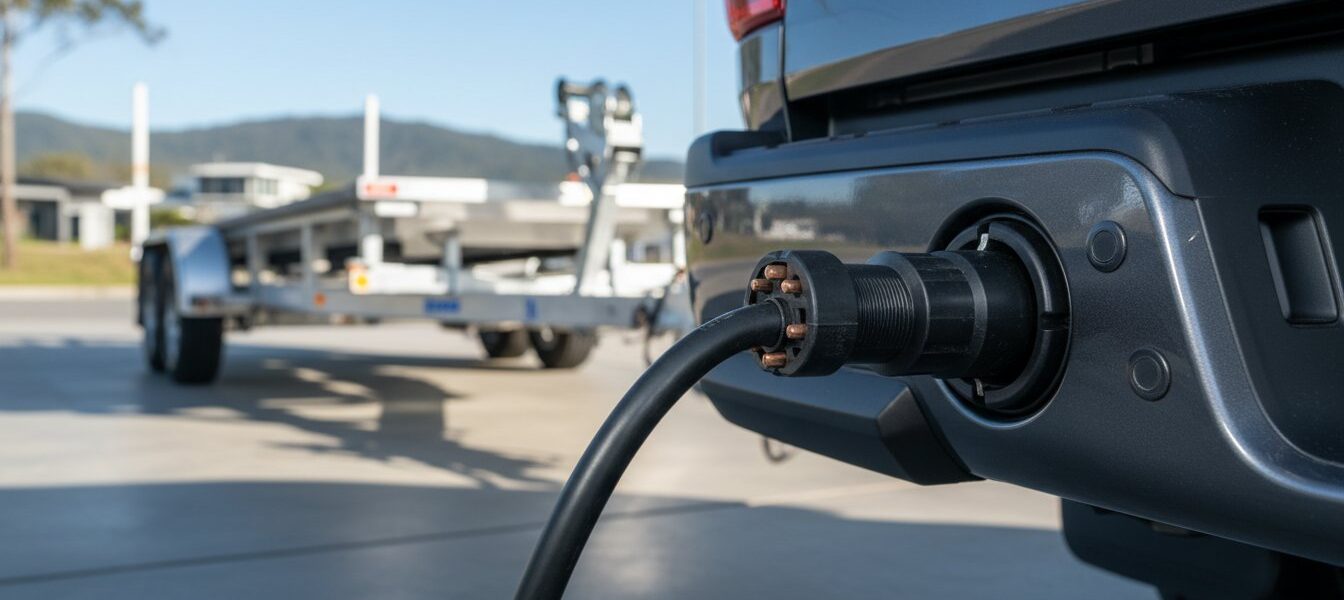
What if the flickering lights on your trailer aren’t a wiring fault, but simply the result of an outdated plug standard? It’s a common headache for Australian drivers facing the 7 pin flat vs 7 pin round plug australia dilemma. You want a connection that stays secure on corrugated roads and provides clear signals every time you hit the brakes. We understand the frustration of dealing with multiple “standard” connectors that don’t actually talk to each other.
This article identifies the key differences between flat and round trailer plugs to ensure you achieve a reliable connection. You’ll learn why the 7 pin flat plug has become the industry norm and how it complies with current Australian Standards. We provide the wiring color codes for DIY repairs and show you how to select heavy-duty parts that survive harsh local conditions. Standardization is better than adaptation when you’re hauling heavy loads across the outback. We’ll compare the legacy round plugs used in Queensland and Victoria against modern flat alternatives to help you decide which hardware belongs on your vehicle.
Key Takeaways
- Identify the core differences between the AS 4177.5-2004 flat standard and legacy round connectors to ensure your trailer remains road legal and safe.
- Compare physical mounting requirements and pin layouts to find the most practical connection for your specific vehicle and towing setup.
- Evaluate the 7 pin flat vs 7 pin round plug australia comparison based on how each design resists bull-dust, moisture, and vibration on unsealed roads.
- Understand why permanent rewiring is superior to using temporary adapters for maintaining reliable electrical continuity during long hauls.
- Learn how to select genuine, heavy-duty components designed to withstand the harsh conditions of the Australian outback.
Understanding the 7 Pin Trailer Plug Standards in Australia
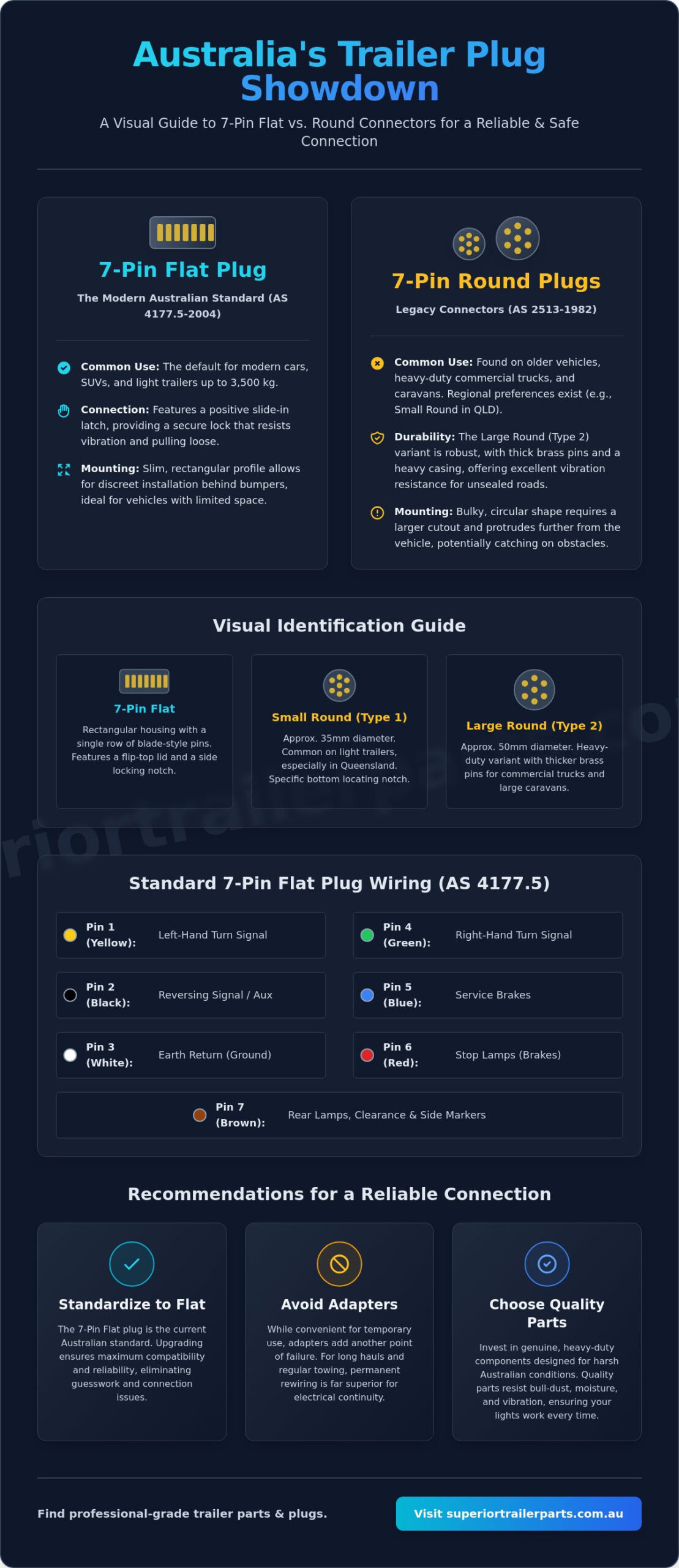
Australia maintains a unique dual-standard system for trailer electrical connections. You’ll primarily encounter the 7-pin flat plug and the 7-pin round plug. Both designs provide the same seven electrical circuits required for basic towing safety. These include signals for indicators, brake lights, tail lights, and electric brakes. Despite sharing the same electrical functions, the physical housing and pin configurations differ significantly. This creates the ongoing 7 pin flat vs 7 pin round plug australia debate among trailer owners and fleet managers.
The Australian trailer connector standards are governed by two primary documents. AS 4177.5-2004 covers the flat connectors used on most light trailers up to 3,500 kg. The older AS 2513-1982 standard remains relevant for round connectors, which persist due to legacy use and regional preferences. Unlike Europe or North America, where single standards often dominate, Australia’s vast geography and state-level history led to these competing designs. Every 7-pin plug, regardless of shape, carries these standard circuits:
- Pin 1: Left-hand turn signal
- Pin 2: Reversing signal or auxiliary power
- Pin 3: Earth return
- Pin 4: Right-hand turn signal
- Pin 5: Service brakes
- Pin 6: Stop lamps
- Pin 7: Rear lamps, clearance, and side markers
The 7 Pin Flat Plug Standard
Modern passenger vehicles and SUVs almost exclusively use the 7-pin flat plug. It features a slim, rectangular profile that easily hides behind bumper covers or integrated hitch assemblies. Manufacturers prefer this design because it doesn’t require a large circular cutout in the vehicle’s bodywork. The flat plug utilizes a slide-in locking mechanism. This physical latch provides a positive connection that resists pulling loose during transit. It’s a reliable choice for standard trailer parts and light-duty towing. Its compact size makes it ideal for tight spaces where a bulky round socket won’t fit.
The 7 Pin Round Plug Variants
Round plugs are divided into two distinct categories: Small Round (Type 1) and Large Round (Type 2). Small round plugs are roughly 20mm in diameter and are common on light trailers in Queensland. Large round plugs, measuring approximately 35mm, are the heavy-duty standard for commercial transport and caravan parts. They feature robust brass pins and a thicker casing. This bulkier build handles the vibration of unsealed roads better than some plastic flat plugs. However, the lack of compatibility between small and large round sockets often leads to confusion at the boat ramp or worksite.
Physical Comparison: 7 Pin Flat vs 7 Pin Round Plug Australia
The physical footprint of your connector determines where and how you mount it on your vehicle. When comparing 7 pin flat vs 7 pin round plug australia, the most obvious difference is the orientation of the internal pins. Flat plugs use a linear or staggered row layout. Round plugs arrange pins in a circular pattern around a central point. Modern vehicles often have limited space around the hitch. The slim profile of a flat socket allows for a discreet installation that won’t catch on obstacles when off-roading. Round sockets require a larger mounting surface and usually protrude further from the bumper or bracket.
Visual Identification Guide
Identifying your plug type quickly is essential when selecting replacement trailer parts. Use these physical markers to distinguish between the three common designs:
- 7-Pin Flat: Rectangular housing with a flip-top lid. The pins are arranged in a single row (or slightly staggered). It features a built-in locking notch on the side.
- Small Round (Type 1): This socket is approximately 35mm in diameter. It has a specific locating notch at the bottom of the housing to ensure the plug only goes in one way.
- Large Round (Type 2): Measuring roughly 50mm in diameter, this heavy-duty variant is significantly bulkier. It uses thicker brass pins to provide a larger surface area for electrical contact, making it common on commercial trucks.
Pin Layout and Functionality
While the physical shapes differ, the internal wiring logic remains consistent across all Australian standards. Both flat and round plugs serve the same seven circuits. These include the left turn signal, reversing lights, earth return, right turn signal, service brakes, stop lamps, and tail lights. If you’re upgrading from a 7-pin flat to a 12-pin flat system, you’ll find they are backwards compatible. A standard 7-pin flat plug will fit into the first row of a 12-pin flat socket, allowing you to tow different trailers without needing a permanent change. This flexibility is a major reason why the flat standard is gaining dominance.
High-quality housing materials are vital for longevity. Look for connectors made from reinforced nylon or heavy-duty UV-stabilized plastic. These materials resist cracking when exposed to the harsh Australian sun. In muddy or dark conditions, a well-designed plug should provide tactile feedback. You should feel a distinct “click” or seat when the connection is secure. If you’re struggling with a loose or corroded connection, our team provides expert advice on selecting a robust replacement that fits your specific mounting bracket.
Durability and Performance in Harsh Towing Environments
Driving across the Nullarbor or through the Kimberley exposes your electrical system to extreme stress. The 7 pin flat vs 7 pin round plug australia comparison changes when you factor in fine particulate bull-dust and heavy mud. Dust ingress causes high resistance at the terminals, leading to dim indicators or non-functional brake lights. On unsealed roads, fine dust acts as an abrasive. It wears down the plating on brass pins over time. This wear reduces the surface area available for electrical contact, eventually causing the connector to overheat under load. Choosing between the 7 pin flat vs 7 pin round plug australia requires a practical look at your typical driving conditions and maintenance habits.
Dust and Water Ingress
Flat plugs typically feature spring-loaded sealing lids that create a tighter barrier against road grime. These lids use a rubber or foam gasket to seal the face of the socket when it’s not in use. Round plugs, particularly the large Type 2 variants, can trap moisture inside the barrel if the drain holes become blocked by mud. This trapped water accelerates terminal corrosion, especially in coastal regions where salt air is present. Always apply a liberal amount of dielectric grease to the pins. This simple step prevents oxidation and ensures the electrical connection remains reliable during water crossings. For those launching vessels in salt water, selecting marine-grade boat trailer parts with submersible ratings is essential to prevent rapid wiring failure. Corrosion often starts at the wire entry point, so ensure your plug has a high-quality cable gland.
Mechanical Security
Vibration is the primary enemy of electrical continuity on corrugated outback tracks. Constant shaking can cause the pins in a standard plastic socket to lose tension. Metal-bodied round plugs offer superior mechanical strength for heavy-duty applications. They resist impact damage from road debris and maintain a firmer grip on the plug. When evaluating the 7 pin flat vs 7 pin round plug australia for off-road use, consider that the flat plug’s plastic locking tab can sometimes snap if hit by a stray rock. Reliable connections are critical for safety systems. Many caravan parts, such as 10-inch electric drum brakes, depend on a stable 12V supply to function. A loose plug results in intermittent braking, which is dangerous on steep descents. Check your plug for physical wear every 5,000 kilometers to ensure the locking mechanism still functions correctly. If the pins feel loose, use a small screwdriver to gently spread the split pins for a tighter fit.
Transitioning Between Plug Types and Using Adapters
Many drivers find themselves with a mismatched vehicle and trailer setup. This often occurs when you upgrade to a modern SUV with a factory-fitted flat socket while keeping an older trailer with a round plug. Resolving the 7 pin flat vs 7 pin round plug australia conflict requires a choice between a temporary adapter or a permanent rewire. While both solutions get the lights working, they offer different levels of reliability for long-distance travel. You must consider the mechanical stress of your route before deciding on the best approach.
When to Use an Adapter
Adapters are practical for occasional use or for fleet managers who tow multiple trailers with different standards. They provide an immediate fix without the need for tools or wiring knowledge. However, every adapter introduces an additional mechanical failure point into your electrical system. They can vibrate loose on corrugated roads or be accidentally knocked out in tight spaces. If you must use one, select a model with integrated locking tabs to secure the connection. Cheap, unbranded adapters often suffer from poor internal contact. This leads to flickering lights or significant voltage drops that can interfere with modern vehicle lighting modules.
The Case for Permanent Rewiring
For long-distance towing or heavy-duty applications, a permanent rewire is the superior choice. This process involves removing the mismatched socket and installing a genuine Australian Standard replacement. It eliminates the extra resistance found in adapter interfaces. This is critical for trailers equipped with electric brakes, where consistent voltage is a non-negotiable safety requirement. Rewiring also allows you to manage the “hang” distance of the trailer lead. A correctly fitted socket prevents the cable from dragging on the bitumen, which quickly wears through insulation and causes short circuits.
To convert your vehicle socket, start by disconnecting the vehicle battery to prevent shorting. Remove the existing socket and identify the wire functions. Strip the ends of the wires to reveal 5mm of clean copper. Connect each wire to the corresponding terminal on the new socket according to the standard layout. For a detailed reference on color codes and circuit positions, consult our guide on trailer plug wiring. Once the terminals are tight, secure the housing and test all functions. Using a multimeter ensures each pin receives the correct signal before you hit the road. If you need a reliable connection for your next trip, browse our range of heavy-duty trailer plugs and adapters to find the right fit for your setup.
Selecting Professional Grade Trailer Plugs and Components
The decision between a 7 pin flat vs 7 pin round plug australia setup is only the first step in building a reliable towing system. Hardware quality determines how long that connection lasts before the signals start to fail. A standard-compliant plug is useless if the housing cracks after one summer in the sun. You should always prioritize genuine Australian Standard components. These parts meet strict requirements for electrical conductivity and mechanical resilience. Choosing professional-grade hardware prevents the common issues of flickering lights and intermittent brake signals that plague inferior setups.
Why Quality Materials Matter
Cheap plastic housings are a liability in local conditions. They quickly become brittle under intense UV exposure and snap during routine use. High-quality connectors utilize UV-stabilized reinforced nylon to maintain their structural integrity over years of service. Terminal material is equally important. Brass terminals offer superior conductivity compared to coated steel alternatives. Steel terminals eventually rust; this oxidation increases electrical resistance and creates dangerous heat build-up within the plug. Additionally, check the tension of the socket lid. Heavy-duty springs ensure a tight seal against dust and moisture. This seal is your primary defense against terminal corrosion during highway travel or water crossings.
National Support and Expertise
Superior Trailer Parts is a 100% Australian owned and operated specialist. We select our inventory based on proven performance in the harshest environments. Whether you’re hauling a heavy-duty single axle box trailer or a tandem axle hydraulic tipper, your electrical connection is the backbone of your safety system. We provide expert advice for complex wiring or braking setups to ensure you find the right solution the first time. Our deep knowledge of the 7 pin flat vs 7 pin round plug australia standards means you get hardware that fits perfectly and performs reliably.
Maintenance is a critical part of towing safety. Don’t wait for a total failure on the highway to check your gear. Inspect your wiring looms every six months for fraying, exposed copper, or UV damage on the insulation. If you find brittle wires or loose pins, replace the components immediately to prevent a short circuit. Our nationwide shipping ensures you have access to professional-grade gear regardless of your location. We stand behind every product we sell because we know the conditions they must endure. Browse our range of trailer parts for reliable towing gear and secure your connection today.
Secure Your Connection for the Long Haul
Superior Trailer Parts is a 100% Australian Owned and Operated business. We provide nationwide shipping on components tested for harsh Australian conditions. Our inventory includes everything you need to maintain a safe, reliable towing setup. Shop Professional Trailer Plugs and Wiring Accessories today to get the job done right. We stand behind our gear so you can tow with confidence across any terrain.
Frequently Asked Questions
Can I plug a 7 pin flat trailer plug into a 12 pin flat socket?
Yes, a 7-pin flat plug is designed to be backwards compatible with a 12-pin flat socket. The seven pins on the plug align perfectly with the first row of seven pins in the 12-pin socket. This allows you to operate basic lighting and braking circuits without using an adapter. It is a practical solution for owners who tow multiple trailers with different electrical requirements.
What are the wiring color codes for a 7 pin round plug in Australia?
The standard Australian wiring follows a specific seven-color sequence for both flat and round connectors. Pin 1 is yellow (Left Turn), Pin 2 is blue (Reverse or Auxiliary), Pin 3 is white (Earth), Pin 4 is green (Right Turn), Pin 5 is brown (Service Brakes), Pin 6 is red (Stop Lamps), and Pin 7 is black (Tail Lamps). Always verify these connections with a multimeter before finalizing any DIY repair or installation.
Is a 7 pin flat plug better than a 7 pin round plug for off-roading?
Flat plugs are often preferred for off-roading because their slim, low-profile design stays clear of ground obstacles. When evaluating the 7 pin flat vs 7 pin round plug australia for rugged tracks, the flat plug’s integrated locking tab provides a secure physical connection that resists vibration. However, heavy-duty metal round plugs offer greater impact resistance if the connector is mounted in an exposed position where it might strike rocks or debris.
Why do my trailer lights flicker when using a plug adapter?
Flickering lights usually indicate a poor electrical connection or high resistance within the adapter housing. Using an adapter adds two extra contact points where dust, moisture, or vibration can interrupt the circuit. Permanent rewiring is the most reliable solution for long-distance towing. Check for corrosion on the internal pins and ensure the adapter is seated firmly with its locking mechanism engaged to maintain continuity.
What is the difference between a small round and a large round trailer plug?
The primary difference is the physical diameter and pin size. Small round plugs measure approximately 35mm in diameter, while large round plugs are roughly 50mm across. These two standards are not interchangeable. Large round plugs are more common on commercial vehicles and heavy-duty trailers because their thicker brass pins handle higher current loads with less heat build-up over long periods of use.
Do I need a different plug for a boat trailer with electric-hydraulic brakes?
A standard 7-pin plug can operate electric-hydraulic actuators, but you must ensure Pin 5 is correctly wired for the braking signal. Some high-draw actuators require a 12-pin flat setup to provide dedicated auxiliary power on the larger bottom pins. Always check your specific brake manufacturer’s specifications. For marine use, prioritize connectors with high-quality seals to prevent salt water from entering the cable entry point and causing rapid corrosion.
Can I rewire my trailer from round to flat myself?
Yes, rewiring a trailer plug is a straightforward task that requires basic hand tools. You will need a wire stripper, a small flat-head screwdriver, and a multimeter to test the circuits. Follow the Australian Standard color codes and ensure every wire is stripped to exactly 5mm of clean copper. Secure the cable gland tightly to prevent the wires from pulling out of the terminals during transit on corrugated roads.
How do I prevent corrosion in my trailer plug terminals?
Apply a liberal coating of dielectric grease to the pins and internal terminals to block moisture and oxygen. This is especially important for boat trailers or vehicles driven in coastal regions. Regularly inspect the spring-loaded lid on your socket. If the gasket is perished or the spring is weak, replace the unit immediately to ensure the housing remains sealed and protected when the trailer is disconnected.