What if your next trailer inspection could be handled with total certainty instead of guesswork? A trailer that fails its Blue Slip isn’t just a paperwork headache; it’s a mechanical failure that keeps you off the road. Many owners struggle with confusing weight categories and the fear of being rejected at the inspection station because of an overlooked safety component. Understanding the trailer registration requirements in NSW is about matching heavy-duty parts to your trailer’s ATM to ensure compliance before you even book an appointment.
It’s frustrating to deal with the uncertainty of which brakes are required or how to secure a VIN through the federal ROVER system. You deserve a clear path to getting your gear registered without the hassle. This explainer provides the essential standards and inspection steps you need to follow for a successful registration every time.
We’ll examine the specific weight limits that trigger different braking needs, the current Blue Slip fees of 41 and 58 dollars, and a practical checklist to ensure your galvanised components meet state standards. You will also learn about the 42-day validity window for inspection reports and how the Register of Approved Vehicles (RAV) impacts your setup.
Key Takeaways
- Identify the 750kg ATM threshold to determine if your setup requires independent braking systems for mechanical compliance.
- Learn how to navigate the federal ROVER system to secure a mandatory 17-character VIN for new or modified trailers.
- Master the trailer registration requirements in NSW to prepare your equipment for a successful Blue Slip inspection.
- Determine when a certified weighbridge ticket is required to verify tare mass for trailers without official specification sheets.
- Choose ADR-compliant, heavy-duty components to ensure your trailer remains roadworthy and meets Australian safety standards.
Understanding NSW Trailer Categories and Weight Limits
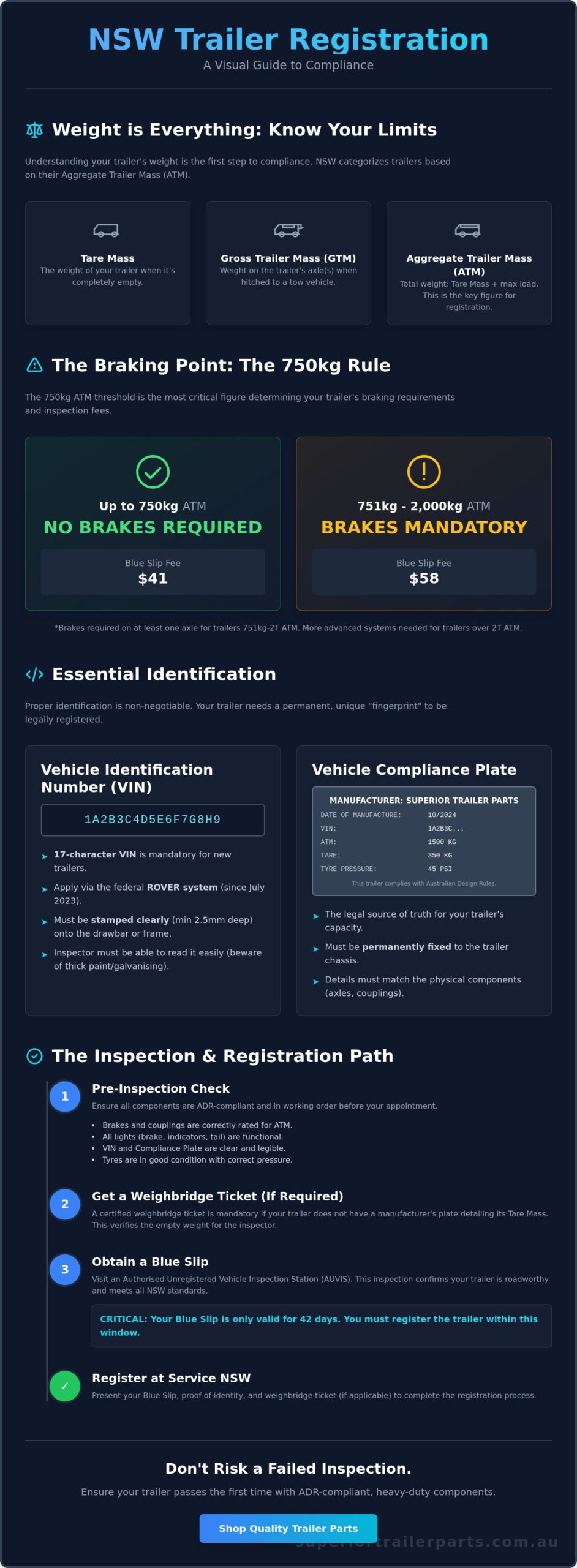
The NSW registration system treats weight as the primary safety metric. Trailers are split into light and heavy categories. Light trailers have an Aggregate Trailer Mass (ATM) up to 4.5 tonnes. Heavy trailers exceed this 4.5-tonne limit. Most standard box trailers stay within the light category, but compliance complexity increases as your trailer gets heavier. Understanding the broader context of Australian vehicle registration systems helps you see how these state rules fit into national standards. Meeting the trailer registration requirements in NSW starts with an accurate weight assessment. You can’t guess these figures. You need to know exactly what your trailer weighs and what it’s rated to carry before you approach an inspector.
Light Trailers vs. Heavy Trailers
Most trailers on NSW roads fall into the light vehicle category. If your trailer exceeds 2 tonnes ATM, it requires more rigorous inspection and advanced braking systems. You must distinguish between Tare Mass, which is the empty weight, and ATM, which is the total weight plus maximum load. Gross Trailer Mass (GTM) refers to the weight on the tyres when hitched. The ATM is the figure the inspector will check against your compliance plate. If these weights aren’t clearly marked on a manufacturer plate, you’ll need a certified weighbridge ticket to proceed with your application.
Calculating Your Aggregate Trailer Mass (ATM)
Your choice of trailer axles determines your legal ATM. A single axle works for light utility trailers. Tandem setups are required for heavier loads. Moving to tandem axles often increases registration costs because the higher tare weight usually moves the trailer into a more expensive vehicle tax bracket. However, the added stability is worth the investment for heavy-duty applications that demand durability.
The 750kg ATM threshold is the most critical figure for any owner. Trailers under 750kg don’t require brakes. Once you hit 751kg, brakes are mandatory on at least one axle. This is why the Blue Slip fee for a braked trailer is 58 dollars, compared to 41 dollars for an unbraked unit. For recreational owners, a 40% motor vehicle tax reduction applies to privately registered caravans and camper trailers weighing between 255kg and 4.5 tonnes. This discount is applied automatically by Service NSW. Exceeding your plated ATM is a serious offence. It leads to registration cancellation and heavy fines during roadside checks.
Essential Identification: VINs, Chassis Numbers, and Compliance Plates
A trailer without a valid identification number is just a pile of steel in the eyes of the law. You must have a 17-character Vehicle Identification Number (VIN) to meet the trailer registration requirements nsw 2026. This number acts as a permanent fingerprint for your equipment. For trailers built before 1989, a shorter chassis number may still be valid if it’s already on the system. However, any new registration or major modification usually triggers the need for a modern VIN. If you are unsure about the paperwork, reviewing how to register a trailer in NSW ensures you have the right forms before visiting an inspection station.
Primary Identifiers and Build Dates
Trailers built after 1989 must be recorded in the Register of Approved Vehicles (RAV). Since July 1, 2023, Transport for NSW stopped issuing VINs for new homemade trailers. You now apply through the federal Road Vehicle Regulator (ROVER) system. Once you receive your VIN, you must stamp it into a permanent part of the trailer frame. The drawbar is the industry standard location for this. Ensure the characters are at least 2.5mm deep and clearly legible. If the inspector cannot read the number due to heavy galvanising or fresh paint, they will fail the Blue Slip. It’s a simple requirement that causes unnecessary delays if ignored.
The Role of the Vehicle Compliance Plate
The compliance plate is the legal source of truth for your trailer’s capacity. It must be permanently fixed to the chassis, usually near the VIN or on the front of the trailer body. This plate lists the manufacturer’s name, the build date, and the Aggregate Trailer Mass (ATM). It also includes tyre pressure specifications and a formal statement of compliance with Australian Design Rules (ADRs). The ratings on this plate must match the physical limits of your axles and suspension components. If you’ve upgraded your trailer to carry more weight, you must update the plate to reflect the new engineering. Plates are often rejected if they are loose, missing information, or show signs of tampering.
Keeping your identification clear and accurate is the fastest way through the inspection lane. If your current plate is damaged or illegible, you can find durable replacement trailer parts and plates to keep your equipment compliant and secure.
Technical Standards for Brakes, Axles, and Lighting
Mechanical standards in NSW are non-negotiable. Your trailer must meet specific hardware requirements based on its total weight to pass a safety inspection. The most basic rule involves the 750kg ATM threshold. If your trailer weighs less than this when fully loaded, you don’t need a braking system. However, once you cross into the 751kg to 2,000kg range, you must have brakes fitted to at least one axle. Meeting the trailer registration requirements nsw 2026 means ensuring these systems are not just present but fully functional and ADR-compliant. These rules exist to prevent your trailer from pushing your tow vehicle during heavy braking scenarios.
Braking Requirements for Different Weights
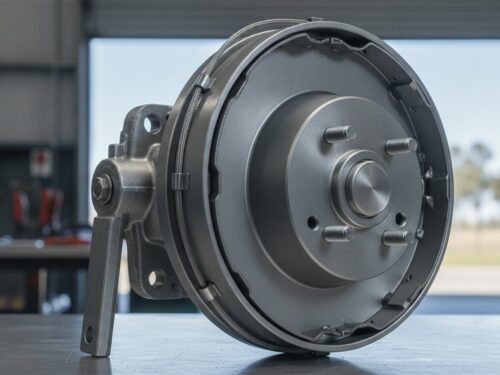
For trailers between 751kg and 2,000kg, mechanical over-ride brakes are the industry standard. These systems use the trailer’s own momentum to apply pressure to the brakes and calipers via a sliding coupling. They are reliable and easy to maintain for standard utility trailers. Once you exceed 2,000kg ATM, the requirements become much stricter. You must install a breakaway system. This safety device automatically applies the trailer brakes for at least 15 minutes if the trailer becomes detached from the tow vehicle. Most heavy-duty setups in this category use electric brakes, which allow for fine-tuned control from the driver’s seat. You must ensure your tow vehicle has a compatible controller to operate these systems legally.
Lighting and Reflective Standards
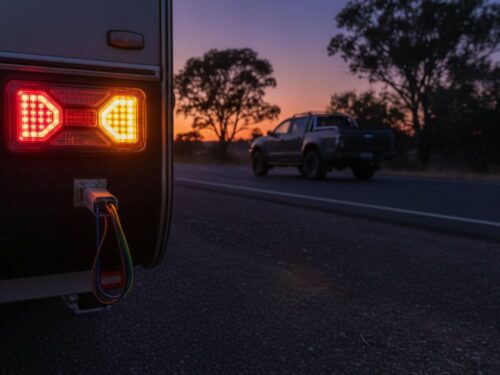
Visibility is the second pillar of trailer compliance. Every trailer in NSW must have a complete set of ADR-compliant lights. This includes red stop lights, amber indicators, and a white number plate lamp that makes the plate legible from 20 metres. If your trailer is wider than 2.1 metres, you also need front and rear clearance lights. All trailers require rear reflectors to ensure visibility when parked or if the electrical system fails. Your trailer plug wiring must follow the Australian Standard 7-pin or 12-pin layout to ensure consistent communication with the tow vehicle. Cheap, non-compliant LED units often fail Blue Slip inspections due to poor light dispersion or lack of required markings. We recommend using heavy-duty, marine-grade lighting for trailers that face harsh Australian conditions. This reduces the risk of moisture ingress and electrical shorts that lead to expensive roadside fines.
Navigating the Inspection Process: Blue Slips and Weighbridge Tickets
When Do You Need a Blue Slip?
You need a Blue Slip for any new registration, when transferring a trailer from another state, or if your NSW registration has been expired for more than 3 months. Inspectors conduct a thorough check of high-wear items. They focus on tyre tread depth, the play in your wheel bearings, and the structural integrity of your couplings and parts. Any sign of excessive rust or makeshift repairs will result in an immediate failure. The inspector will also verify that the VIN stamped on your drawbar matches your RAV entry or ROVER paperwork. You have a 42-day window from the date of issue to complete your registration at a Service NSW centre. If you wait 43 days, the report is void and you’ll pay for a new one.
Obtaining a Weighbridge Ticket
Transport for NSW requires a certified weighbridge ticket if your trailer’s tare mass cannot be confirmed from a manufacturer’s specification sheet. This is a mandatory requirement for all homemade builds, imported trailers, or units that have undergone major structural modifications. You must take your trailer to a public weighbridge in its ‘unladen’ state. This means the trailer should be empty. Remove tools, spare tyres, and loose equipment before weighing. The resulting certificate provides the official Tare weight used for your compliance plate and vehicle tax calculations. For trailers with an ATM over 2 tonnes, you must book a heavy vehicle inspection at a specialised station. These inspections are more detailed and focus on the heavy-duty braking systems discussed in previous sections. This process ensures that the registered weight matches the physical capability of the chassis. If you need to replace worn components before your booking, you can order genuine trailer parts to ensure you pass on the first attempt.
Ensuring Long-Term Compliance with Quality Components
Upgrading Parts for Registration Success
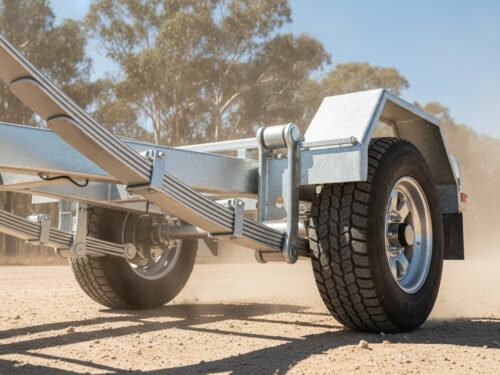
Suspension components take the most abuse on our roads. Rusted U-bolts and sagging leaf springs are common reasons for inspection rejection. Replacing these items before your appointment ensures a level and safe ride. We also recommend upgrading to LED lighting. These units eliminate the common electrical faults found in old bulb systems that frequently fail safety checks. If you’re building or refurbishing a box trailer, selecting components that meet specific NSW weight ratings is essential. A single weak link in your suspension or coupling can void your registration and lead to heavy fines during roadside checks.
Sourcing ADR-Compliant Components
Australian Design Rules (ADRs) set the benchmark for safety and performance. Many unbranded parts sold online don’t meet these standards, making them illegal for use on NSW roads. Choosing ADR-compliant trailer parts guarantees your equipment is fit for purpose and ready for professional scrutiny. Superior Trailer Parts provides Australia-wide access to reliable hardware that stands up to the toughest conditions. Our team offers expert advice based on years of industry experience. If you’re tackling a registration-ready build and need technical support, you can contact Superior Trailer Parts for no-nonsense guidance. We stand behind every product we sell because we know the conditions they must endure. Staying compliant means choosing quality over shortcuts every time.
Get Your Trailer Inspection Ready
Navigating the registration process requires strict attention to weight thresholds and component quality. Remember that the 750kg ATM limit determines your braking needs; a 17-character VIN is essential for any modern build. Meeting the trailer registration requirements nsw 2026 ensures you pass your Blue Slip without the frustration of costly re-inspections or registration delays. Every component from your leaf springs to your lighting must meet Australian Design Rules to be legally roadbound. Shortcuts in hardware usually lead to long-term mechanical headaches.
Superior Trailer Parts is an Australian Owned and Operated specialist providing expert technical advice since 2014. We offer nationwide shipping on heavy-duty, galvanised components designed to endure the harshest local conditions. Don’t risk a rejection at the inspection station with unbranded hardware that lacks the necessary durability. Shop ADR-Compliant Trailer Parts at Superior Trailer Parts to secure the reliable hardware you need for a successful registration. Get your gear sorted and get back to work with confidence knowing your trailer is safe and compliant.
Frequently Asked Questions
Do I need a Blue Slip to renew my trailer registration in NSW?
No, you don’t need a Blue Slip for a standard registration renewal if your current registration is still active. You only require a Pink Slip (safety check) annually for trailers with an Aggregate Trailer Mass (ATM) over 250kg. A Blue Slip is reserved for trailers that are currently unregistered or have had their registration expired for more than 3 months.
What is the maximum width allowed for a trailer in NSW?
The maximum allowable width for any trailer in New South Wales is 2.5 metres. This measurement includes the trailer body and any load it carries, though it excludes mirrors and side signaling devices. If your trailer width exceeds 2.1 metres, you must install front and rear clearance lights to meet mandatory visibility standards during your inspection.
Can I register a trailer in NSW without a VIN?
No, every trailer must have a 17-character Vehicle Identification Number (VIN) to be registered. Since July 1, 2023, Transport for NSW stopped issuing VINs for new homemade trailers directly. You must now apply through the federal Road Vehicle Regulator (ROVER) system to secure a VIN before you can book an Authorised Unregistered Vehicle Inspection.
How much does it cost to register a standard box trailer in NSW?
Total costs depend on your trailer’s weight and usage, including a registration fee, number plate fee, and vehicle tax. As of July 1, 2025, the mandatory Blue Slip inspection fee is 41 dollars for trailers without brakes and 58 dollars for those with brakes. You should use the official Service NSW calculator to get an exact total based on your specific tare weight.
Are brakes mandatory for all trailers in NSW?
Brakes are only mandatory if your trailer has an ATM exceeding 750kg. If your trailer and its maximum load weigh 750kg or less, you can legally operate without a braking system. Once the weight reaches 751kg, you must have functional brakes on at least one axle to satisfy the trailer registration requirements nsw 2026 and pass a safety check.
Do I need a weighbridge ticket for a brand-new manufactured trailer?
You generally don’t need a weighbridge ticket if the manufacturer provides a specification sheet that confirms the tare mass. Certified weighbridge tickets are mandatory for homemade trailers, imported units, or trailers that have undergone major structural modifications. This ticket provides the ‘unladen’ weight required for the inspector to verify your compliance plate data.
What happens if my trailer registration has been expired for more than 3 months?
If your registration is expired for more than 3 months, it’s automatically cancelled by Service NSW. You’ll have to re-register the trailer as a new vehicle, which involves obtaining a fresh Blue Slip and paying for new number plates. Following the trailer registration requirements nsw 2026 is necessary in this case to prove the trailer still meets current safety and identity standards.
Is a safety chain mandatory for all NSW trailers?
Yes, all trailers must have at least one safety chain that complies with Australian Standards. Trailers with an ATM up to 2.5 tonnes require one safety chain, while those exceeding 2.5 tonnes must be fitted with two. The chain must be permanently fixed to the trailer and have a load rating that matches the trailer’s maximum capacity to prevent accidental detachment.