A trailer is only as reliable as the components it is built on. If an axle or coupling fails during a heavy haul, a low purchase price won’t matter. You’ve likely seen many trailers for sale that look decent but lack the structural integrity required for Australian conditions. It’s common to feel confused by weight ratings like ATM and GTM or to fear buying a flimsy import that won’t have replacement parts available when you need them.
We value durability and performance over marketing fluff. You’ll discover how to select a high quality trailer that meets the Road Vehicle Standards Act 2018 and the latest VSB1 Revision 6 requirements. We provide a clear breakdown of specifications for components like 50mm square axles and electric drum brakes. This ensures you gain the confidence to choose a trailer that is safe, legal, and easy to maintain for the long haul.
Key Takeaways
- Understand how ADR compliance and hot-dipped galvanised steel protect your trailer from corrosion and structural failure.
- Identify the ideal configuration when browsing trailers for sale, focusing on the stability differences between single and tandem axle models.
- Learn why the axle is the most critical engineering component and how to select the correct braking system for loads over 750kg.
- Match your trailer to your vehicle by calculating towing capacity and managing tow ball weight for safer handling.
- Secure long-term performance by choosing Australian-owned components that simplify future maintenance and part replacement.
Understanding Australian Design Rules for Trailers
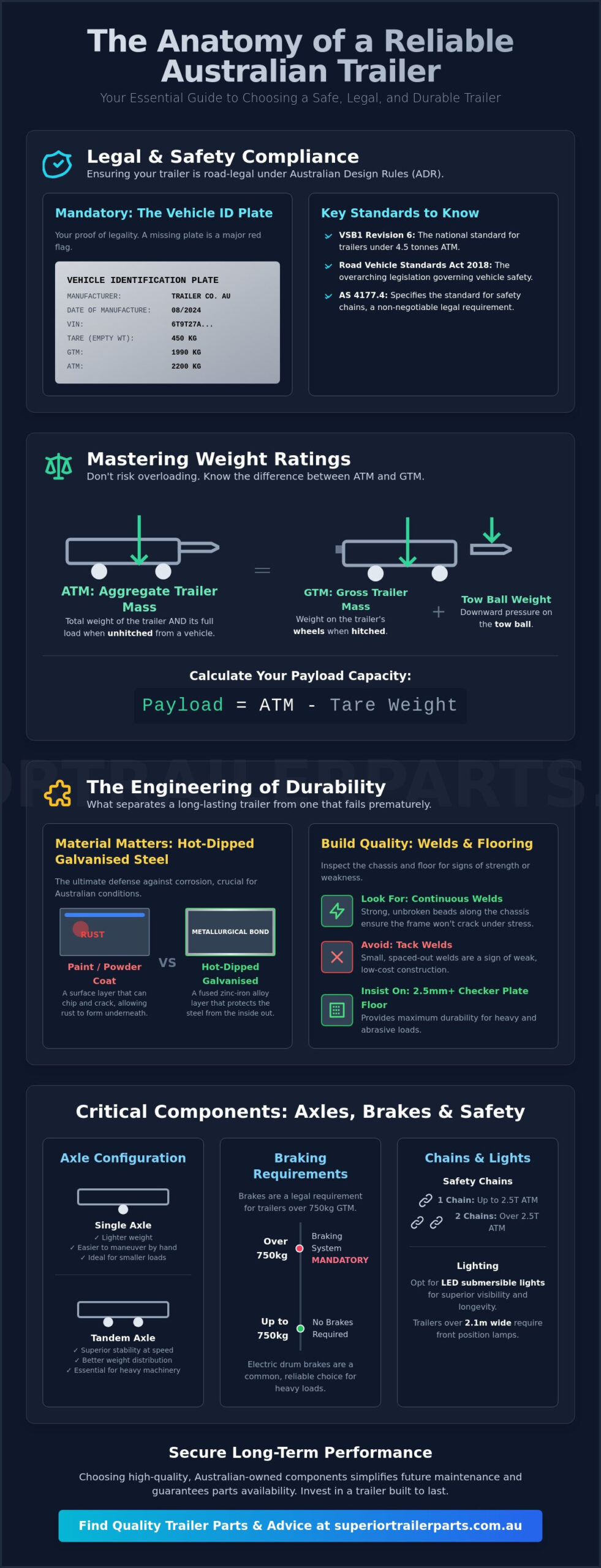
Buying trailers for sale requires more than just checking the price tag. You must ensure the unit is legal for Australian roads. The Road Vehicle Standards Act (RVSA) governs this through Australian Design Rules (ADR). For trailers under 4.5 tonnes ATM, the key national standard is the Vehicle Standards Bulletin 1 (VSB1) Revision 6. ADR compliance is a mandatory set of national standards that ensures every component from the coupling to the tail lights operates safely under load.
Every compliant trailer must have a Vehicle Identification Plate. This is your proof of legality. It has to display the manufacturer’s name, the VIN, the date of manufacture, and the weight ratings. If a trailer lacks this plate, it’s likely not built to standard. For long term durability, look for hot-dipped galvanised steel. This material is the industry standard for corrosion resistance. Unlike paint or powder coating, the galvanisation process creates a metallurgical bond that protects the steel from the inside out, which is vital for trailers exposed to salt air or wet conditions.
ADR Compliance and Safety Standards
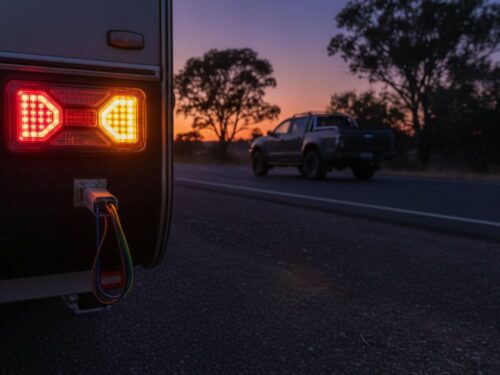
Safety chains and rated shackles are legal requirements, not suggestions. Under national law, trailers up to 2.5 tonnes ATM must have at least one safety chain that meets AS 4177.4. Once you exceed 2.5 tonnes, two chains are mandatory. Lighting configurations also follow strict rules. Recent regulatory revisions clarify requirements for components like front position lamps. Trailers over 2.1m wide must include these lamps to signal their width to oncoming traffic. Reliability starts with the electrical connection. Ensure your trailer follows Australian trailer connector standards to prevent lighting failures during transit. High quality trailer parts like LED submersible tail lights provide better visibility and longevity than older bulb systems.
ATM vs GTM: Understanding Weight Ratings
Confusion over weight ratings leads to overloaded vehicles and safety risks. Aggregate Trailer Mass (ATM) is the total weight of the trailer plus its maximum load when it’s not coupled to a tow vehicle. Gross Trailer Mass (GTM) is the weight transmitted to the ground by the tyres when the trailer is coupled to the vehicle. The difference between the two is the weight supported by the tow ball. To calculate your payload capacity, subtract the Tare weight (the empty trailer weight) from the ATM. If you’re inspecting heavy duty single axle box trailers, always verify these figures on the VIN plate before purchase. It’s the only way to know if the trailer fits your specific hauling requirements.
Selecting the Right Configuration: Box, Tipper, and Specialty Models
Heavy-Duty Box Trailers for General Hauling
Residential users typically choose between 6×4 and 7×4 single axle box trailers. These are versatile for home maintenance and small trade jobs. When your payload consistently exceeds 750kg, it’s time to upgrade to a tandem axle box trailer. Before you buy, inspect the build quality closely. Look for a 2.5mm or 3.0mm checker plate floor for maximum durability. Check the welds along the chassis; they should be continuous beads rather than small tack welds to ensure the frame doesn’t crack under stress.
Hydraulic Tippers and Plant Trailers for Trade Use
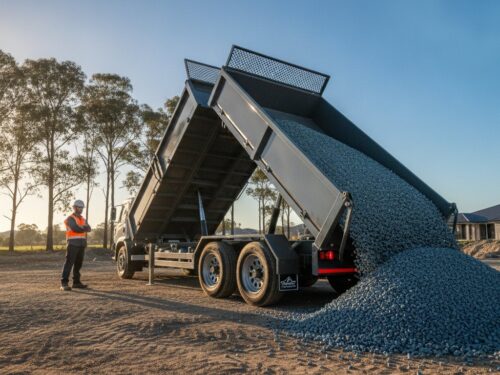
Efficiency is key in landscaping and construction. Hydraulic tipper trailers eliminate the need for manual shoveling, allowing you to dump sand, soil, or gravel in seconds. These trailers require regular maintenance of the hydraulic rams and battery systems to ensure consistent lifting power. If your business involves moving heavy machinery, plant trailers are the right tool. They feature heavy-duty ramps and a lower deck height for safe loading of scissor lifts or excavators. Always verify the trailer registration requirements for your specific state, as trade-use trailers often have stricter inspection standards for brakes and lighting.
Marine and Jet Ski Trailers
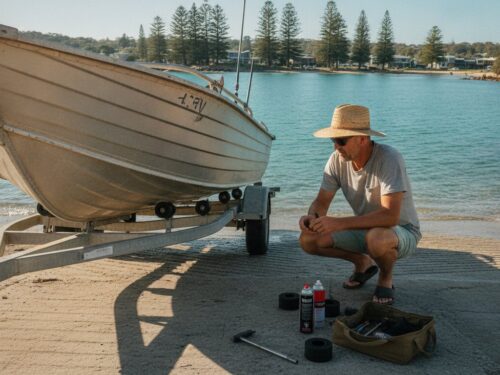
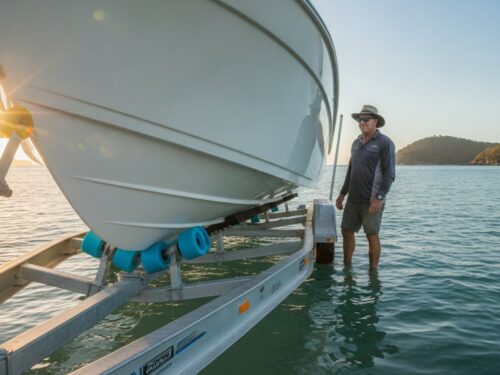
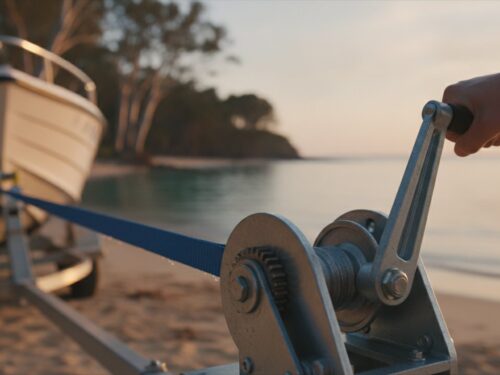
Saltwater is a trailer’s worst enemy. Jet ski trailers and boat trailers must be built with galvanised frames and non-corrosive fittings. Use a combination of keel rollers to support the hull’s weight and wobble rollers to keep the craft centered during retrieval. High-quality boat trailer parts like marine-grade winches and submersible LED lights are non-negotiable for longevity. If you’re unsure which setup fits your vessel, get expert advice from our team to ensure your trailer matches your hull’s specifications perfectly.
The Engineering Behind a Reliable Trailer
A trailer is only as strong as its weakest component. While many trailers for sale look identical on the surface, the engineering underneath determines if it survives corrugated roads or fails under load. Focus on the axle, suspension, and braking systems. These parts manage the stress of heavy hauling and protect your cargo from road vibrations. When comparing trailers for sale, the braking system often dictates the final price and safety rating.
Axle and Suspension Selection
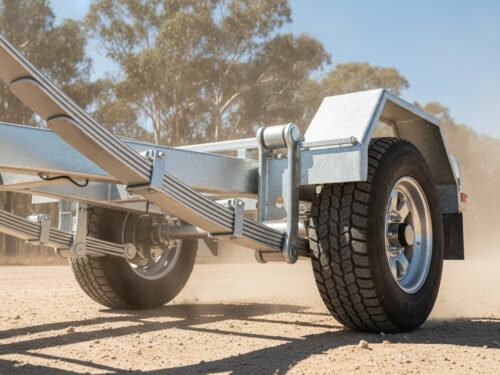
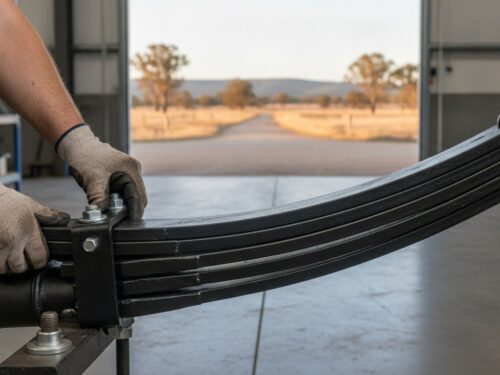
Choosing the right axle is about matching the steel’s thickness to your maximum load. You’ll often choose between 39mm round axles vs 45mm and 50mm square axles. Round axles are standard for light domestic use, but square axles offer more surface area for the spring seats, which increases stability. For a tandem axle setup, a 45mm square axle typically provides a combined load rating of 2800kg when paired correctly. Suspension choice is equally critical. Slipper springs are a cost-effective, durable solution for light-duty single axle units. If you’re building or buying a tandem trailer, rocker roller spring sets are the better choice. They allow the axles to move independently, ensuring the load remains level even on uneven terrain.
Braking System Requirements
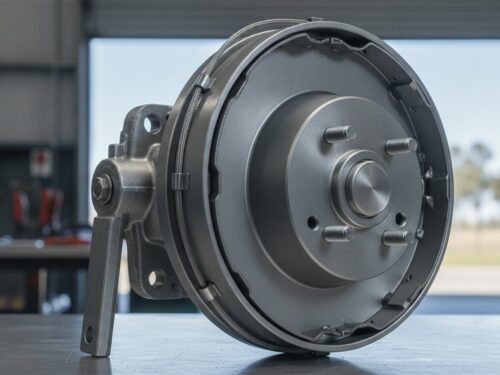
Safety standards in Australia are clear about stopping power. Any trailer with an ATM over 750kg must have a braking system fitted to at least one axle. For trailers between 750kg and 2000kg, you can choose between mechanical over-ride brakes or electric systems. Many owners prefer 10-inch electric drum brakes because they allow the driver to adjust braking force from the cabin. This is a significant advantage when descending steep hills or hauling varying loads. Once a trailer exceeds 2000kg ATM, the law requires brakes on all wheels and a functional breakaway system. This system automatically applies the trailer brakes if it becomes detached from the tow vehicle.
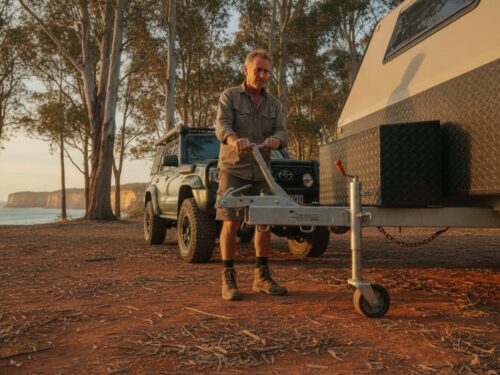
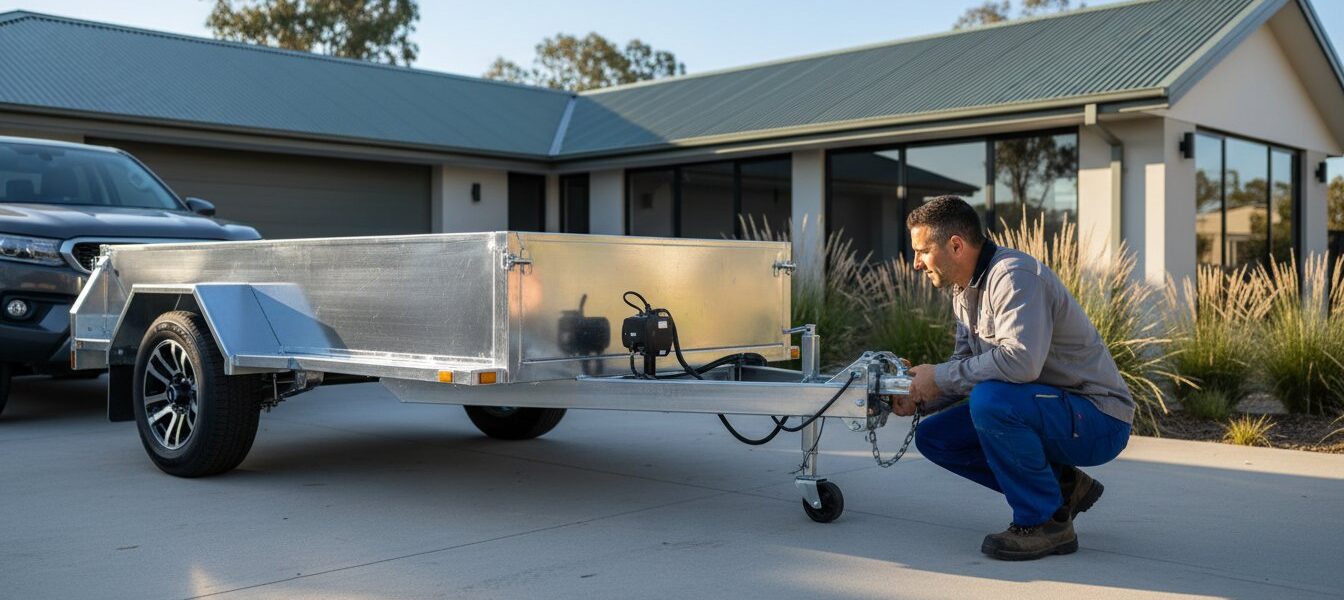
Finally, consider the coupling. A standard 2-hole or 3-hole fixed coupling works for sealed roads. If you’re heading off-road, a poly block coupling provides the 360-degree rotation needed to handle extreme angles without snapping the hitch. Selecting a coupling that matches your towing environment ensures the connection remains secure regardless of the track conditions.
Matching Your Trailer to the Towing Vehicle
Before you finalize your choice from the available trailers for sale, you must verify your vehicle’s towing limits. Every vehicle has two distinct ratings: unbraked and braked capacity. In Australia, the unbraked limit is capped at 750kg, regardless of the vehicle’s size. If you plan to tow a tandem axle box trailer or a large boat, you’ll rely on the braked capacity. Check your vehicle’s compliance plate or owner’s manual for the Gross Combination Mass (GCM). This figure represents the absolute maximum weight of the car and trailer combined. Exceeding the GCM is illegal. It also voids your insurance and manufacturer warranty immediately.
Towing Capacity and Ball Weight
Safe towing requires a balanced load. The 10% rule is the industry standard; your tow ball weight should be roughly 10% of the total loaded trailer weight. If the ball weight is too low, the trailer will sway. If it’s too high, the front wheels of your vehicle lose traction and steering becomes unresponsive. To maintain a low center of gravity, place the heaviest items directly over the axles. Secure the load to prevent shifting during braking or cornering. For heavy tandem loads that cause the rear of your car to sag, consider using weight distribution hitches. These components redistribute the weight across all axles of the vehicle and trailer, restoring steering control and braking efficiency.
Wiring and Connection Standards
A secure mechanical connection is useless without a reliable electrical one. You’ll encounter 7-pin flat, 7-pin round, or 12-pin configurations. Standardizing your setup with the correct trailer plug wiring ensures your indicators and brake lights function correctly every time you hitch up. Poor grounding is the most common cause of lighting failure. If your LED lights flicker, check the white ground wire first. Beyond wiring, inspect the physical attachment of your running gear. High-quality U-bolt kits are essential for keeping the axle firmly mated to the leaf springs. Loose or rusted U-bolts lead to axle misalignment and catastrophic failure on the highway.
Matching your vehicle to the right specs prevents costly mechanical repairs down the road. If you’re looking for trailers for sale that fit your specific towing setup, contact us for expert advice on weight ratings and component compatibility.
Why Superior Trailer Parts is the Preferred Choice
Superior Trailer Parts operates as a dependable specialist for the transport industry. We understand that a trailer is a critical tool for your livelihood. When you evaluate trailers for sale, you need more than a low price; you need a long-term asset that stays on the road. We prioritize durability and performance over marketing fluff. Our business maintains a massive inventory of genuine components. This ensures that when you need a replacement part, you don’t have to deal with international shipping delays or anonymous call centers. We provide immediate solutions to mechanical problems with a practical, get-the-job-done attitude.
Australian-Owned Manufacturing and Parts
Our business is Australian Owned and Operated. This status is a primary trust signal for our customers. We understand the harsh conditions our products must endure, from extreme heat to corrosive salt air. We stock a comprehensive range of trailer parts in-house to facilitate quick shipping and technical accuracy. Whether you need heavy-duty couplings for off-road environments or multi-leaf leaf springs for tandem setups, we have the stock ready. Having a contactable expert available means you get technical support from someone who knows the hardware. We provide the expert advice required by both professional fleet managers and DIY owners.
Custom Assembly and Nationwide Shipping
We do not just sell standard models off the rack. Our team provides custom assembly services to meet specific trade requirements. If your business needs a specialized hydraulic tipper or a plant trailer for a specific machine, we build it to ADR standards. We maintain competitive pricing by managing our supply chain efficiently; we never compromise on material grade or weld quality. Our Australia Wide accessibility ensures your location does not limit your access to high-quality engineering. We ship components and assembled units to every corner of the country. This ensures your vehicle stays operational with minimal downtime.
Finding trailers for sale that meet national safety standards is essential for your legal protection and safety. We stand firmly behind every product we sell. Browse our range of box trailers today to find a solution built for Australian conditions. Our team is ready to provide the technical specifications and support you need for a hassle-free transaction.
Secure Your Load with Australian Standards
Choosing from the many trailers for sale requires a focus on ADR compliance and technical specifications. You now understand how VSB1 Revision 6 standards and hot-dipped galvanisation protect your investment from structural failure. Matching your vehicle’s GCM and maintaining the 10% tow ball weight rule are essential steps for road safety. A trailer is only as reliable as the axles and brakes it sits on; cutting corners here leads to costly downtime.
Superior Trailer Parts has provided expert technical support for over a decade. We are an Australian Owned and Operated business that understands the demands of local industries. We provide Australia Wide shipping to ensure you have access to genuine parts and assembled units wherever you work. Our team values durability and performance. We focus on getting the job done right the first time. Invest in a trailer that meets Australian safety standards and fits your specific hauling requirements perfectly.
View Our Range of High-Quality Trailers for Sale
Frequently Asked Questions
What is the difference between a braked and unbraked trailer?
An unbraked trailer relies entirely on the tow vehicle’s braking system and is limited to a maximum ATM of 750kg. A braked trailer uses its own mechanical or electric systems to help stop the load. Australian law requires brakes on at least one axle for any trailer exceeding 750kg ATM. This ensures the tow vehicle’s brakes don’t overheat or fail during heavy hauling or emergency stops.
Do I need a special license to tow a trailer in Australia?
You don’t need a special license to tow a trailer in Australia if you hold a standard C-class car license, provided the Gross Combination Mass (GCM) remains within legal limits. Most state regulations allow drivers to tow trailers with an ATM up to 4.5 tonnes on a standard license. Always check your specific state transport authority as rules for P-platers can vary regarding trailer weight and towing restrictions.
Can I tow a tandem axle trailer with a standard car?
You can tow a tandem axle trailer with a standard car only if the trailer’s loaded weight does not exceed the vehicle’s braked towing capacity. Many modern SUVs and utes have a 3,500kg limit; however, smaller sedans often cap at 1,200kg or 1,600kg. When looking at tandem trailers for sale, verify your vehicle’s tow bar rating and GCM to ensure the setup is legal and safe for highway speeds.
How often should I service my trailer wheel bearings?
Service your trailer wheel bearings every 10,000 kilometres or every 12 months, whichever comes first. For boat trailers or jet ski trailers that enter salt water, you should inspect and regrease bearings every 6 months. Use high-quality marine-grade grease to prevent water ingress and corrosion. Routine maintenance prevents the bearings from seizing, which is a leading cause of roadside breakdowns on Australian highways.
What is the maximum width allowed for a trailer on Australian roads?
The maximum width allowed for a trailer on Australian roads is 2.5 metres. This measurement includes the wheels, mudguards, and any permanent fixtures, but excludes lights and mirrors. If your trailer is over 2.1 metres wide, it must be fitted with front and rear clearance lamps according to VSB1 standards. Exceeding the 2.5-metre limit requires special permits and “Oversize” signage depending on the specific state jurisdiction.
Why is hot-dipped galvanising better than painted steel?
Hot-dipped galvanising provides superior corrosion resistance because the steel is submerged in molten zinc, creating a metallurgical bond that protects both the interior and exterior of the chassis. Painted steel only offers a surface layer that chips easily, leading to rapid rust in the Australian climate. Galvanised trailers often last 3 times longer than painted alternatives in coastal environments. It’s the industry standard for heavy-duty trade and marine applications.
What happens if my trailer exceeds the ATM rating?
Exceeding the Aggregate Trailer Mass (ATM) rating makes your trailer illegal and structurally dangerous. It places extreme stress on the 50mm square axles and slipper springs, leading to catastrophic component failure. If you’re involved in an accident while overloaded, your insurance policy is likely void. Police can also issue heavy fines and prevent you from continuing your journey until the excess weight is removed from the trailer.
How do I choose between a 7-pin and 12-pin plug?
Choose a 7-pin plug for standard light trailers that only require indicators, brake lights, and parkers. If you’re browsing trailers for sale with electric brakes or internal batteries, a 12-pin plug is often necessary. The 5 additional pins provide high-current power for features like breakaway battery charging, internal lights, or electric fridges. Check your vehicle’s socket type before purchase to ensure the connections are compatible without needing adapters.