If you select a jockey wheel based solely on your trailer’s total ATM, you are setting yourself up for a mechanical failure. Tandem trailers demand significantly higher static stability and lateral strength than single-axle units. It’s common to see standard units bend under heavy tongue weight or seize up when you try to swivel the trailer on soft ground. You need hardware that doesn’t just fit the drawbar but actually handles the physical stress of a loaded tandem axle setup.
A collapsed jockey wheel is more than an inconvenience; it’s a safety risk and a project delay. This article shows you how to choose a heavy duty jockey wheel for tandem trailer applications that offers long-term resistance to Australian environmental conditions. You’ll learn why a 60mm shaft is often necessary for 3500kg loads and how to calculate a 20 percent safety margin for dynamic weight. We provide the technical specifications you need to ensure easy manoeuvrability and total stability every time you unhitch.
Key Takeaways
- Understand why tandem trailers exert unique lateral stress on hardware and require specialized vertical support compared to single-axle units.
- Identify the structural benefits of heavy-duty mounting systems, specifically comparing bolt-on clamps and weld-on swivel brackets for high-stress use.
- Calculate the necessary load capacity for your heavy duty jockey wheel for tandem trailer by applying a 20 percent safety margin to your measured nose weight.
- Ensure operational safety by using high-tensile bolts and locking nuts to maintain structural integrity under extreme weight distributions.
- Select components with sealed bearings and high-tensile lead screws to resist rust and ensure smooth winding in harsh Australian environments.
Understanding Requirements for Tandem Axle Trailers
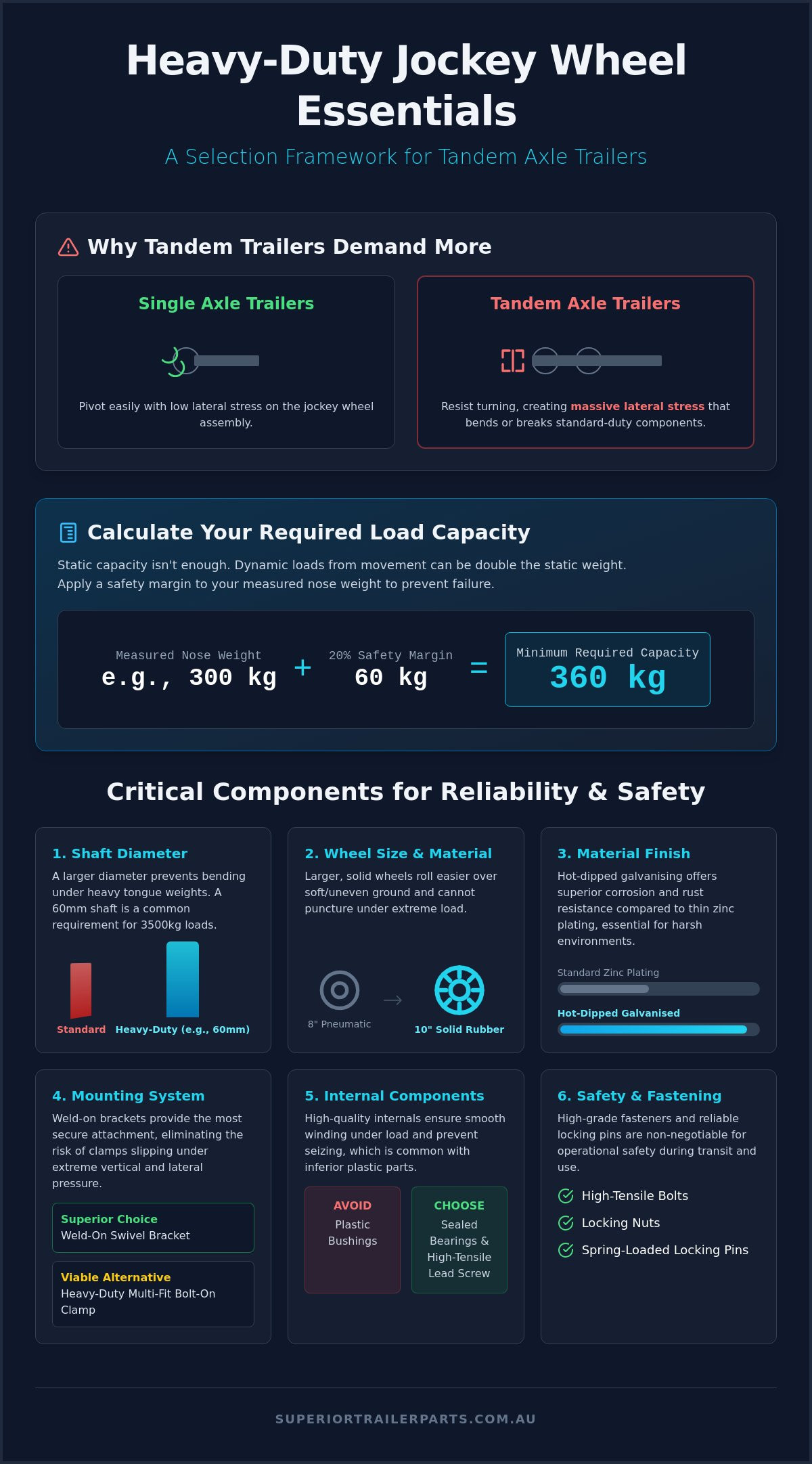
Tandem trailers are built for high-capacity hauling. They carry a much higher Aggregate Trailer Mass (ATM) than single-axle models, which puts your towing hardware under constant pressure. While a single-axle trailer is relatively easy to pivot, a dual-axle setup resists turning. This resistance creates massive lateral stress. When you attempt to manoeuvre a dual-axle trailer by hand, the tyres scrub against the ground. This horizontal force transfers directly to the jockey wheel shaft. A standard unit designed for a light box trailer will often bend or snap under these specific conditions.
Choosing a heavy duty jockey wheel for tandem trailer applications is about more than just vertical strength. You need a component that can handle the sheer weight of a fully loaded welded galvanised heavy duty dual axle tandem trailer while remaining mobile. If the hardware isn’t rated for these stresses, you risk a total collapse during unhitching or while the trailer is parked on a slope.
The Role of Tongue Weight in Jockey Wheel Selection
Tongue weight is the downward force exerted on the tow ball or jockey wheel. For a balanced load, this should stay between 5% and 10% of the total loaded trailer weight. On a tandem trailer, the axle positioning creates a stable platform, but it also concentrates downward pressure on the drawbar. If you load your cargo too far forward, the tongue weight can quickly exceed the capacity of a standard wheel. This pressure causes the inner tube to bow. Once the tube is no longer perfectly straight, the internal lead screw will jam, making it impossible to wind the trailer up or down.
Static vs Dynamic Load Ratings
You must distinguish between static and dynamic loads to avoid equipment failure. What is a Jockey Wheel? It is the primary support for your trailer tongue when it’s not coupled to a vehicle. A static load rating refers to the weight supported while the trailer is stationary on a flat, hard surface. Dynamic load involves the stresses applied when you move the trailer over ruts, grass, or uneven driveways. These movements create shock loads that can be double the static weight. Tandem trailers require a higher dynamic safety margin because their dual-axle design makes them less forgiving on uneven terrain.
Essential Features of a Robust Jockey Wheel
A heavy duty jockey wheel for tandem trailer setups must be built with structural integrity in mind. The mounting system is your first consideration. While standard trailers use simple bolt-on clamps, high-ATM tandem trailers benefit from reinforced weld-on swivel brackets. These brackets eliminate the risk of a clamp slipping under vertical pressure. If you prefer a bolt-on model, ensure it uses a heavy-duty multi-fit clamp with high-tensile fasteners to distribute the load across the drawbar frame effectively.
Internal components determine how long your hardware lasts. Look for winding mechanisms that use high-tensile lead screws and sealed ball bearings. These features ensure smooth operation even when the tongue weight is high. Many standard units use plastic bushings that wear out or seize quickly. A robust unit uses metal components that can withstand constant friction and high pressure. If the winding handle feels flimsy, it likely won’t survive the weight of a loaded dual-axle trailer.
Material finishes are often overlooked in favour of load ratings. Standard zinc plating is thin and prone to scratching, which leads to rapid rust in Australian coastal conditions. Hot-dipped galvanised steel offers superior protection. The galvanising process creates a thick, metallurgical bond that resists corrosion and physical impact. This level of durability is essential for trailers stored outdoors or used in marine environments where salt air accelerates metal fatigue.
Wheel Material and Diameter
Wheel size directly impacts how easily you can move your trailer. An 8-inch wheel is standard, but a 10-inch wheel rolls much easier over gravel, soft soil, and uneven ground. Larger diameters provide better leverage over small obstacles. Solid rubber wheels are the preferred choice for heavy tandem trailers. They don’t develop flat spots under high pressure and cannot puncture like pneumatic tyres. For extremely soft surfaces like sand or mud, dual-wheel configurations are available. These distribute the weight across a wider surface area to prevent the wheel from sinking into the ground.
Swivel and Locking Mechanisms
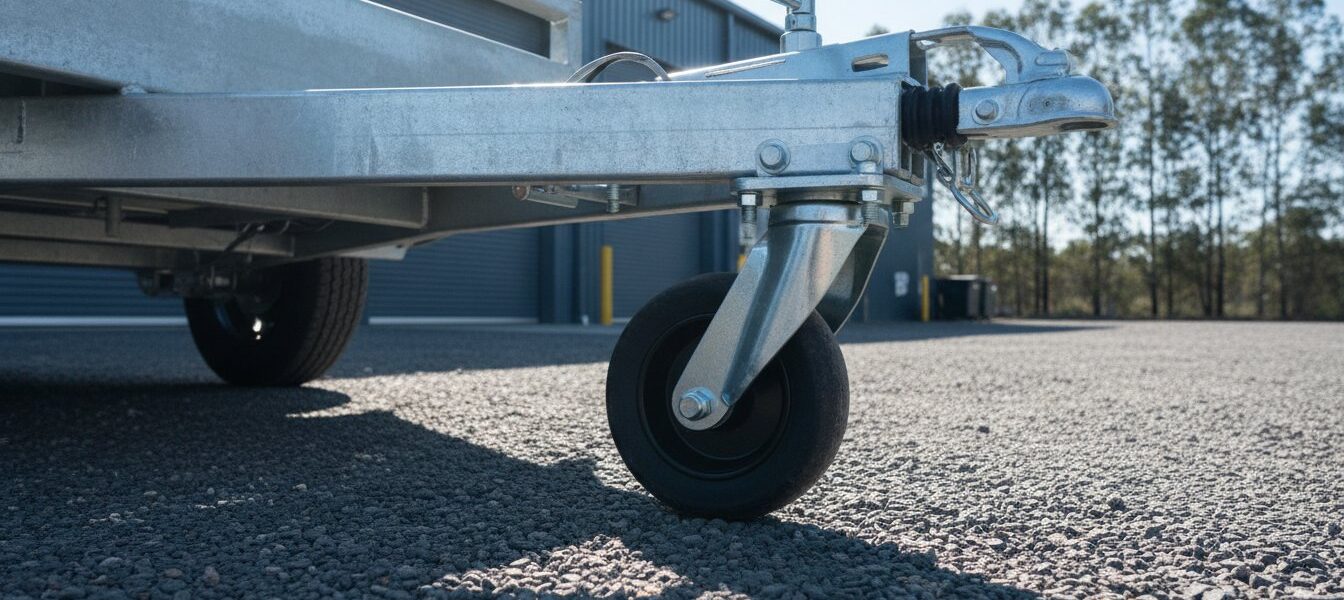
A reliable heavy duty jockey wheel for tandem trailer use must also feature a secure swivel mechanism. Safety during transit is non-negotiable. Spring-loaded locking pins are essential to ensure the wheel stays in the retracted position while you are on the road. Following Operational Safety Guidelines ensures that your trailer remains stable both on and off the hitch. Swing-up designs are particularly useful for heavy-duty trailers with low ground clearance. These allow the entire assembly to rotate 90 degrees, tucking it safely along the drawbar. These high-strength swivel points are designed to integrate seamlessly with other heavy-duty couplings and parts to create a reliable towing system. If you aren’t sure which bracket fits your frame, you can contact our team for technical advice.
Calculating Load Ratings and Weight Capacity
Start by identifying the Aggregate Trailer Mass (ATM) of your tandem trailer from the compliance plate. This figure represents the maximum total weight of the trailer and its cargo. However, the ATM doesn’t tell you the weight the jockey wheel actually carries. You must focus on the tongue weight, which is the downward force exerted at the coupling point. For most trailers, this is between 5 and 10 percent of the total loaded mass, but this ratio changes depending on how you distribute your cargo.
Why ATM Alone is Misleading
Static load ratings are the figures you typically see in product specifications. This rating refers to the weight the wheel can hold while the trailer is parked on a level, hard surface. Dynamic load occurs when you move the trailer over ruts, bumps, or slopes. These movements create sudden spikes in pressure that can exceed static ratings. You should always apply a 20 percent safety buffer to your measured tongue weight to account for these dynamic forces. If your measured tongue weight is 300kg, you need a unit rated for at least 360kg.
When selecting a heavy duty jockey wheel for tandem trailer applications, compare the common ratings: 350kg, 500kg, and 750kg. A 350kg unit suits most standard tandem box trailers. Heavy plant trailers or hydraulic tippers often require 500kg or 750kg models to handle the extreme vertical pressure of unevenly distributed loads.
Matching the Axle Capacity
Your choice of a heavy duty jockey wheel for tandem trailer use should reflect the overall build of the chassis. High-capacity tandem trailers often utilise 50mm square axles to support heavy loads. It’s impractical to pair industrial-grade axles with a light-duty jockey wheel. The hardware must match the industrial nature of the trailer to ensure long-term reliability and safety during unhitching.
Consider the height of the drawbar when selecting the extension range of the wheel. Tandem trailers often sit higher than single-axle units due to their larger tyres and suspension setups. You need enough extension range to lift the coupling off the tow ball without over-extending the inner tube. Over-extension weakens the shaft and increases the risk of the tube bowing under load. Check that the retracted height also provides enough ground clearance to avoid bottoming out on driveways or speed bumps.
Installation Techniques and Operational Safety
Proper mounting is critical for a heavy duty jockey wheel for tandem trailer. Placement on the drawbar must balance accessibility with structural support. Position the wheel far enough forward to allow easy operation but ensure it does not interfere with the coupling or handbrake. For clamp-on models, use only high-tensile bolts and locking nuts. Standard bolts can shear under the lateral forces common with dual-axle trailers. A secure mount prevents the assembly from shifting when you are winding under full load.
Maintenance prevents mid-job failures. Grease the internal worm gear every six months to ensure smooth winding. Check the pivot point for excessive play or wear. If the wheel wobbles significantly, the bearings or pivot pin may need replacement. Always ensure the locking pin is fully engaged before you start towing. A loose pin can allow the wheel to drop while you’re at highway speeds, causing severe damage to the trailer and road surface.
Mounting to Galvanised Chassis
Never drill into a galvanised drawbar to mount a bracket. Drilling destroys the protective coating and invites internal rust. Instead, use heavy-duty galvanised U-bolts to secure the clamp. This method preserves the chassis integrity while providing a rigid connection. Always check for clearance against the handbrake lever and coupling housing before final tightening. If you need hardware for a custom setup, you can contact us for technical support regarding your specific drawbar dimensions.
Safe Operation on Inclines
Never rely solely on a jockey wheel to hold a tandem trailer on a slope. These components are designed for vertical support, not as a primary braking system. Always use wheel chocks in conjunction with a heavy duty jockey wheel for tandem trailer when unhitching on an incline. Watch for early signs of failure like tube deformation or a handle that becomes increasingly difficult to turn. These symptoms often precede a catastrophic collapse. If you notice the inner tube bowing, replace the unit immediately to avoid injury or equipment loss.
Sourcing Reliable Trailer Components in Australia
Selecting a heavy duty jockey wheel for tandem trailer use is the first step toward a reliable towing setup. Buying from an Australian-owned specialist provides a distinct advantage. Local experts understand the specific demands of our environment, from coastal salt air to corrugated inland tracks. Superior Trailer Parts supplies components engineered for professional and trade applications where failure is not an option. National shipping ensures you can access high-quality hardware regardless of your location. This logistical efficiency is essential for businesses that cannot afford to have trailers sitting idle.
Technical support is vital for custom tandem builds. Choosing the right combination of axles, springs, and jockey wheels requires precise calculations. Our team provides the data you need to ensure every component works together safely. This authoritative approach helps you avoid the common mistakes associated with generic retail outlets that lack deep industry knowledge. We focus on physical attributes like strength and fit rather than marketing rhetoric. You get parts that work the first time.
Comprehensive Spare Parts Support
Maintaining a heavy-duty trailer requires more than just a strong jockey wheel. You need access to a full range of trailer parts to keep your fleet operational. Regular maintenance involves checking the compatibility between your support gear and your suspension systems. Ensure your jockey wheel doesn’t just lift the load but integrates with the height and clearance of your braking system. Proper upkeep extends the life of your hardware and prevents expensive roadside repairs. We provide a comprehensive resource for technical knowledge to guide your maintenance schedule.
Quality Assurance for Heavy Hauling
Trade-quality components are a long-term investment. While cheaper alternatives might save money upfront, they often lead to increased downtime through premature wear or mechanical failure. Hardware that meets Australian standards provides the peace of mind necessary for heavy hauling. Using resilient materials like hot-dipped galvanised steel ensures your trailer remains roadworthy for years. This durability is a hallmark of our product range. If you need assistance with a specific configuration or a heavy-duty setup, you can reach out for expert advice from our technical team. We stand behind the hardware we provide and support the working people who rely on it every day.
Secure Your Load with Industrial Grade Hardware
Selecting the right equipment ensures your tandem trailer remains a reliable asset rather than a safety liability. You now understand that a heavy duty jockey wheel for tandem trailer applications must account for dynamic load spikes and the unique lateral scrubbing forces of dual axles. Prioritising hot-dipped galvanised finishes and sealed bearings is essential to combat the harsh Australian environment. These technical choices prevent the common failures of bowed tubes and seized winding handles that plague lighter units.
As an Australian owned and operated specialist, Superior Trailer Parts provides trade-quality components designed for the toughest hauling tasks. We offer nationwide shipping on all heavy-duty components and provide expert technical support for custom trailer builds. Our focus is on providing the strength and fit your industrial projects demand. Browse our range of heavy-duty jockey wheels and trailer parts to upgrade your setup today. Invest in hardware that works as hard as you do.
Frequently Asked Questions
How do I know if my jockey wheel is heavy-duty enough for a tandem trailer?
Check the static load rating against your measured tongue weight. For a heavy duty jockey wheel for tandem trailer use, the rating should exceed your tongue weight by at least 20 percent to account for dynamic stress. Look for a shaft diameter of 48mm to 60mm and a reinforced mounting bracket that can handle lateral forces without flexing during turns.
What is the difference between a swing-up and a fixed jockey wheel?
A swing-up model rotates 90 degrees to sit parallel to the drawbar during transit, while a fixed model stays vertical and usually requires a removable clamp. Swing-up designs are preferred for heavy-duty trailers with low ground clearance to prevent the wheel from hitting the road. Fixed models often provide higher vertical stability for trailers that remain stationary for long periods.
Should I choose a solid or pneumatic wheel for a heavy tandem trailer?
Choose a solid rubber wheel for heavy tandem trailers to prevent flat spots and punctures. Pneumatic tyres often fail under the high tongue weight of dual-axle setups. Solid wheels provide the necessary structural support for high-ATM trailers and roll more reliably on hard or packed surfaces without losing pressure over time.
Can I replace just the wheel or do I need the whole assembly?
You can replace the wheel alone if the shaft and winding mechanism remain in good condition. Most heavy-duty units use standard axle bolts that allow for easy wheel swaps. However, if the inner tube is bowed or the lead screw is stripped, you must replace the entire assembly to ensure operational safety and load-bearing integrity.
How often should I grease my heavy-duty jockey wheel?
Grease the internal worm gear and pivot points every six months under normal conditions. If you operate in coastal areas or frequently tow in wet environments, increase this maintenance to every three months. Regular lubrication prevents the lead screw from seizing and ensures the handle remains easy to turn even when supporting maximum tongue weight.
Is a 750kg rated jockey wheel necessary for a 2000kg tandem trailer?
It is not strictly necessary but provides a significant safety margin. A 2000kg trailer usually has a tongue weight between 100kg and 200kg, which a 350kg or 500kg unit can handle. However, a 750kg rated heavy duty jockey wheel for tandem trailer applications offers superior lateral strength and durability, which is beneficial if you frequently move the trailer on uneven terrain.
What causes a jockey wheel to bend while the trailer is unhitched?
Bending is typically caused by exceeding the static load rating or experiencing sudden lateral shifts. On tandem trailers, trying to pivot the unit on soft ground creates massive horizontal pressure on the shaft. Over-extending the inner tube also weakens the structure, making it prone to bowing under the downward force of the trailer tongue.
Are dual jockey wheels better for heavy loads?
Dual wheels are better for soft surfaces like sand or mud because they distribute the weight over a larger footprint. They reduce the risk of the trailer sinking and provide extra stability during hand-manoeuvring. For hard surfaces, a single high-quality solid wheel is usually sufficient, provided the shaft and bracket are rated for the specific tongue weight of your tandem setup.