Last month, a trailer owner in Perth paid A$95 in unnecessary shipping fees because they didn’t know how to measure trailer axle length correctly. It is a frustrating error that happens to roughly 15% of DIY builders who guess their dimensions instead of verifying them. You already know that a tiny measurement discrepancy leads to tyres rubbing against the chassis or a trailer that fails a basic safety inspection. Ordering the wrong part doesn’t just cost money; it leaves your equipment off the road and your project at a standstill.
Key Takeaways
- Identify the Hub-Face (HF) measurement as the industry standard for ordering to ensure a precise fit for your trailer.
- Master how to measure trailer axle length on existing setups by removing wheels to access the hub face directly.
- Calculate dimensions for custom builds by factoring in external chassis width and the mandatory 50mm tyre clearance per side.
- Ensure Australian compliance by selecting axles that match your Aggregate Trailer Mass (ATM) and stay within the 2.5-metre width limit.
- Select the right hardware and finish, such as galvanised steel or braked hubs, based on your specific environmental and load requirements.
Essential Axle Measurement Terms and Definitions
Getting the right fit starts with the right language. Precision ensures your trailer tracks straight and stays legal on Australian roads. You’ll encounter several technical terms when learning how to measure trailer axle length. Understanding Axle Terminology prevents costly ordering mistakes. At Superior Trailer Parts, we see many DIY builders struggle because they confuse overall length with functional mounting points.
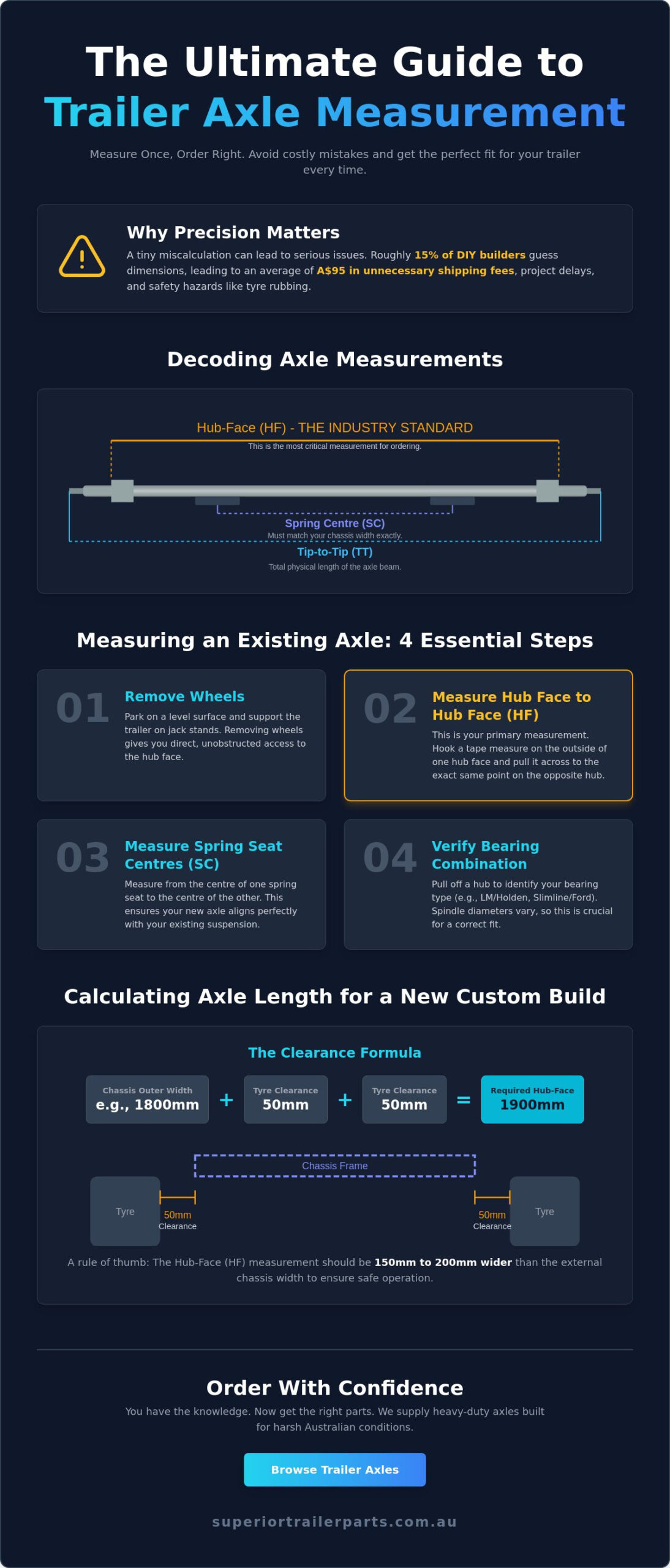
The Hub-Face (HF) is your primary data point. It dictates the distance between your wheels. If this is wrong, your tyres won’t align with your guards. Hub-Face is the distance between the two outside surfaces where the rims bolt on. Tip-to-Tip (TT) covers the entire length of the axle from one threaded end to the other. While important for shipping, it’s often secondary to Hub-Face. This is especially true on braked axles where spindle lengths vary between different brands.
Spring Centre (SC) is the distance between the centres of the spring seats. This measurement must match your chassis width exactly. If the SC is off by even 5mm, your springs will be under constant lateral stress. People often swap Track Width and Axle Length in conversation. Track width usually refers to the centre-to-centre distance between the tyres. It changes based on your wheel offset. Axle length is a fixed physical dimension of the steel itself. For those building from scratch, checking our range of trailer axles helps identify standard sizes used in the Australian market.
Understanding the Hub-Face Measurement
The hub-face is the flat mounting surface where the wheel studs emerge. It’s the most reliable measurement for ordering replacement parts. It determines exactly where your wheels sit in relation to the chassis rail. Getting this right ensures adequate clearance between the tyre sidewall and the trailer frame. It’s the only way to guarantee your wheels won’t rub on the suspension components during travel. Hub-Face is the distance between the two outside surfaces where the rims bolt on.
Tip-to-Tip vs Chassis Width
Tip-to-Tip represents the total steel length including the threaded spindles. Your chassis width acts as the foundation for all other trailer geometry. An axle must always be wider than the chassis. You need this extra width to allow for spring hangers, shackles, and clearance for the wheels to rotate without obstruction. Standard Australian builds often require a Hub-Face measurement that is 150mm to 200mm wider than the outside chassis width to maintain safe operation. As an Australian Owned and Operated business, we recommend double-checking these figures before you weld your spring seats.
Measuring an Existing Axle for Replacement
Accuracy is the difference between a trailer that tracks straight and one that eats through tyres. Before you start, park the trailer on a flat, level concrete surface. Support the chassis with sturdy jack stands. Never work under a trailer supported only by a hydraulic jack. Safety is your first priority. Once the trailer is secure, follow these steps to learn how to measure trailer axle length for a perfect replacement fit.
- Step 1: Remove the wheels. You can’t get an accurate reading with wheels in the way. Removing them allows you to access the hub face directly. This is the flat mounting surface where the wheel studs are located.
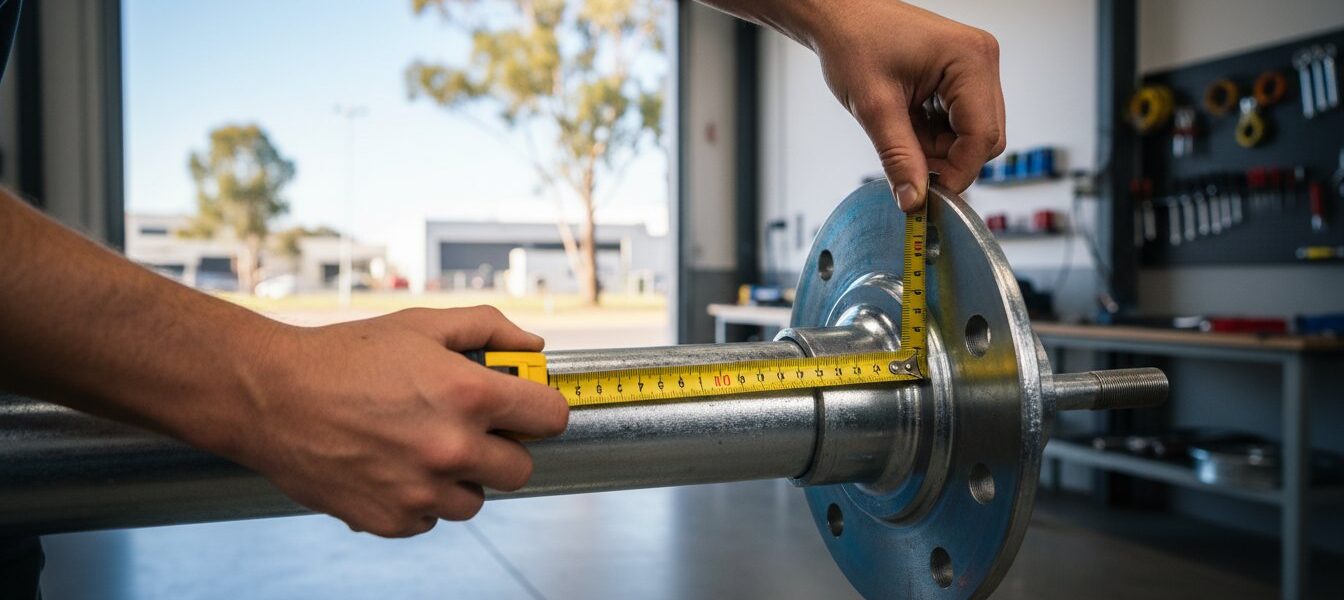
- Step 2: Measure Hub Face to Hub Face. Hook your tape measure on the outside of one hub face. Pull it across to the exact same point on the opposite side. This is your primary measurement for ordering a new axle.
- Step 3: Measure Spring Seat Centres. Locate the centres of the spring seats where the axle meets the leaf springs. Measure from the centre of one seat to the centre of the other. This ensures the axle aligns perfectly with your existing suspension.
- Step 4: Verify bearing combinations. Pull one hub off to inspect the bearings. Identify if you’re running LM (Holden), Slimline (Ford), or Parallel bearings. This is vital because spindle diameters vary between these standards.
While taking these measurements, consider your total load requirements. While Federal Axle Weight Limits provide a global reference for axle stresses and tandem configurations, you must ensure your replacement meets specific Australian standards for your trailer’s ATM.
How to Measure with Hubs Removed
If you’ve already stripped the axle, you’ll need to measure from the spindle “shoulder.” This is the raised section where the inner bearing and seal sit. Measure the distance from shoulder to shoulder. To find the hub face measurement, you must add the offset of your specific hubs. Typically, you’d add approximately 50mm to 100mm depending on the hub brand. Measure the spindle length from the shoulder to the tip to ensure it matches your hub depth and allows the split pin to engage correctly.
Identifying Axle Profiles and Steel Sections
Axle strength depends on the steel profile. Don’t guess the size by eye; use a vernier caliper for a precise reading. You’ll generally find 39mm Round Axles as the standard for light-duty 750kg trailers across Australia. For heavier applications, identify if you have 40mm, 45mm, or 50mm square sections. Square axles offer more surface area for the spring seats and higher resistance to bending under heavy loads. If you’re upgrading, ensure your new trailer parts and U-bolts match the new profile exactly.
Calculating Axle Length for New Custom Builds
Building a trailer from scratch requires exact specifications. You don’t have an old axle to measure, so you must calculate the dimensions based on your chassis and wheel choice. This process ensures your tyres sit correctly and provides enough room for the suspension to work. When learning how to measure trailer axle length for a custom project, the goal is to determine the Hub Face to Hub Face distance.
The Hub Face is the flat surface where the wheel studs are located. To find this measurement, use the Golden Formula:
- Hub Face = Chassis Width + (2 x Tyre Clearance) + (2 x Wheel Backspace)
Start with the external width of your chassis frame. This is the widest point of the steel structure where the axle will be mounted. Use a high-quality steel tape measure for accuracy. Even a 5mm error can cause alignment issues later. This baseline measurement is the foundation of your entire trailer geometry.
Factoring in Wheel Backspace and Offset
Rims dictate where the tyre sits in relation to the hub. Offset is the distance from the rim’s centreline to the mounting face. Zero offset means the mounting face is perfectly centred. Positive offset pushes the wheel further over the hub, while negative offset pushes it out. For trailer builds, you need the backspace measurement. This is the distance from the innermost edge of the rim to the hub mounting face.
To measure this, place a straight edge across the back of the rim. Measure down to the mounting plate. If you use high-offset automotive rims, you’ll likely need a longer axle to prevent the tyre from hitting the chassis. Don’t guess these figures. Physical measurement of your specific rim and tyre combo is the only way to ensure a perfect fit. Using incorrect backspace data often leads to tyres rubbing on the frame or mudguards.
Determining Necessary Tyre Clearance
Tyre clearance is the air gap between the inner tyre sidewall and the trailer chassis. The industry standard is a 50mm minimum per side. This gap allows for tyre bulge when the trailer is fully loaded and accounts for heat expansion during long hauls. If you’re building a heavy-duty off-road trailer, increase this clearance to 60mm or 70mm. This extra space prevents mud and rocks from jamming between the tyre and the frame.
You must also consider your suspension type. Standard Leaf Springs allow for slight lateral movement when cornering. If your clearance is too tight, the tyres will scrub against the chassis rails during sharp turns. This creates friction, damages the sidewalls, and can lead to tyre failure. Understanding how to measure trailer axle length correctly means prioritizing a wider safety margin if your calculations sit on the edge of the 50mm limit. A little extra width is always safer than a tyre that rubs.
Load Ratings and Australian Compliance Standards
Aggregate Trailer Mass (ATM) is the most critical figure when selecting your components. It represents the total weight of the trailer plus its maximum payload. Your choice of axle must meet or exceed this rating to ensure safety and legal compliance on Australian roads. If you select an axle that cannot support your ATM, you risk structural failure and heavy penalties. Understanding how to measure trailer axle length is only the first step; you must also ensure the steel thickness and hub type are fit for purpose.
Australian regulations enforce a 2.5-metre maximum width limit for all trailers. This measurement includes the widest point of the trailer, which is usually the outside of the mudguards or the tyre sidewalls. Tyres cannot protrude past the mudguards. Specifically, mudguards must cover the full width of the tyre tread to prevent road debris from being kicked up. For trailers with an ATM over 2,000kg, Australian law requires load-sharing suspension. This system ensures weight stays evenly distributed across all wheels, even when moving over uneven ground or under heavy braking.
Matching Axle Thickness to ATM
Choosing the right axle profile depends entirely on your load requirements. Use these standard Australian ratings as a baseline for your build:
- 39mm Round or 40mm Square: These are standard for light-duty trailers with an ATM between 750kg and 1000kg.
- 45mm Square: This is the industry standard for single-axle setups rated for 1400kg to 1450kg.
- 50mm Square: Used for heavy-duty applications, these axles support up to 2500kg per axle.
For more detailed technical specifications on load capacities and bearing types, refer to our Trailer Axles resource. Always match your axle capacity to the heaviest load you intend to carry.
Legal Considerations for Track Width
In the context of the Vehicle Standards Bulletin (VSB1), the ‘Track’ measurement is the distance between the centre of one tyre and the centre of the opposite tyre on the same axle. Precision is vital when learning how to measure trailer axle length to avoid legal traps. If your track width causes the trailer to exceed the 2.5m limit, you face immediate fines and the risk of voiding your insurance policy in the event of an accident.
The axle thickness you choose also dictates the size of your mounting hardware. U-Bolts must be correctly sized to match the axle diameter or square profile. A loose fit caused by incorrect sizing leads to axle shift, which ruins tyre alignment and compromises road handling. Stick to high-quality, Australian-tested hardware to keep your trailer secure under load.
Need reliable components for your next build?
View our range of heavy-duty trailer axles today.
View our range of heavy-duty trailer axles today.
Selecting Your Replacement Axle and Hardware
Once you understand how to measure trailer axle length, you need to select the right material and hardware for your specific application. Your choice of material depends entirely on where you plan to tow. Raw steel axles work well for standard utility trailers kept in dry storage. If you operate near the coast or in high-humidity areas, choose a hot-dipped galvanised finish to prevent structural corrosion. This choice directly impacts the lifespan of your trailer’s drivetrain and ensures long-term safety.
Braking requirements are determined by your trailer’s Aggregate Trailer Mass (ATM). In Australia, trailers with an ATM under 750kg don’t usually require brakes. If your load exceeds this 750kg limit, you must install a braked axle. This ensures your vehicle can stop safely under heavy loads. Check your wheel stud pattern before ordering. The four most common patterns in the Australian market include Ford (5-stud), HT (Holden), HQ (Holden), and Landcruiser (5 or 6-stud). Matching these correctly ensures your existing wheels fit the new hubs without issue.
Don’t overlook the mounting hardware. Your U-bolts and fish plates must match the axle profile exactly. A 45mm square axle requires different hardware than a 50mm round axle. Using mismatched components leads to vibration and potential hardware failure on the road. Ensure all bolts are rated for the load you intend to carry.
Marine vs Standard Axles
Boat trailers face the harshest conditions due to constant saltwater submersion. These setups require fully galvanised axles and specialised marine-grade seals to protect the bearings. Standard axles will fail quickly in these environments. We recommend browsing our range of Boat Trailer Parts for components designed for saltwater. Galvanised finishes provide a sacrificial layer of zinc that stops rust before it reaches the steel core, which reduces maintenance costs over time.
Final Pre-Order Checklist
Before you finalise your order, run through this technical checklist to confirm your measurements are accurate. Mistakes at this stage cause delays and extra shipping costs. Double-check your figures against the physical trailer one last time.
- Verify the Spring Centre measurement is compatible with your Hub-Face distance.
- Check that the bearing set (Slimline, Parallel, or LM) matches your spindle type.
- Confirm the axle capacity (e.g., 1000kg or 1450kg) meets your ATM requirements.
- Ensure the stud pattern matches your spare tyre.
Getting the right fit starts with knowing how to measure trailer axle length correctly. Ready to upgrade? Browse our range of heavy-duty axles for nationwide delivery. Our Australian owned and operated team provides expert advice to ensure you get the right part the first time.
Get Your Trailer Back on the Road with Precision Measurements
Superior Trailer Parts delivers the hardware you need to get the job done. We’re an Australian Owned and Operated business that understands local conditions. We offer nationwide shipping and expert technical support to help you choose the right axle for your specific build. Don’t risk a poor fit with generic parts. Grab the right gear and get your trailer back in service today.
Shop Heavy-Duty Australian Trailer Axles
Frequently Asked Questions
Can I measure my trailer axle with the wheels on?
No, you can’t get an accurate measurement while the wheels are attached. You must remove the wheels to access the hub-face, which is the flat surface where the wheel studs are located. Measuring with wheels on often leads to errors because of varying wheel offsets and rim thicknesses. Taking the time to strip the hubs ensures you get a precise measurement for a perfect fit.
What happens if I order an axle that is too long?
An axle that’s too long causes the tyres to protrude past the mudguards. This is a safety hazard and a breach of Australian Design Rules (ADR), which can result in heavy fines or a failed registration inspection. It also places unnecessary leverage on the bearings and spindles, leading to premature mechanical failure. Stick to the correct dimensions to keep your trailer legal and reliable.
How do I find the spring centre measurement on my trailer?
Measure from the centre of one leaf spring to the centre of the opposite leaf spring. This measurement is vital because the axle’s spring seats must weld or bolt exactly to these points. Understanding how to measure trailer axle length correctly ensures your suspension remains aligned and stable on the road. If the spring centres are off by even 5mm, the axle won’t track straight.
Is the hub-face measurement the same as the track width?
No, these are two distinct technical figures. The hub-face measurement is the distance between the mounting surfaces of the hubs where the wheel sits. Track width refers to the distance between the centre of the tyre treads once they’re fitted. You need the hub-face measurement to order the correct axle from a supplier. Relying on track width alone often results in the wrong axle size.
Does the axle length change if I switch from 13-inch to 15-inch wheels?
The physical length of the axle doesn’t change, but your clearance requirements will. Larger 15-inch wheels are often wider and have different offsets compared to 13-inch wheels. You must check that the new tyre won’t rub against the trailer chassis or the internal mudguard before committing to the swap. Upgrading wheel sizes often requires a wider hub-face measurement to maintain proper safety gaps.
What is the standard axle length for a 6×4 box trailer?
Most Australian 6×4 box trailers use a hub-face measurement of 1650mm. This fits a standard 1200mm wide floor with enough clearance for the springs and tyres. However, some manufacturers use wider frames or different spring configurations, so you should always verify your specific chassis width. Don’t guess based on the trailer size, as a 25mm difference can ruin your wheel alignment.
How much clearance do I need between the tyre and the trailer side?
You should maintain a minimum of 50mm clearance between the inner tyre wall and the trailer side. This space prevents the tyre from rubbing against the body when the trailer hits bumps or carries a heavy load. It also allows for better airflow to cool the tyres during long hauls in hot Australian conditions. Anything less than 50mm risks a sidewall blowout or structural damage over time.
Why is my new axle longer than the old one even though the hub-face is the same?
The overall tip-to-tip length can vary between manufacturers because of different spindle designs or thread lengths. This doesn’t affect the fitment of your wheels or the track of your trailer. Focus on the hub-face and spring centre dimensions, as these are the critical measurements for a successful installation. As long as those two figures match your old axle, the extra spindle length won’t cause any issues.