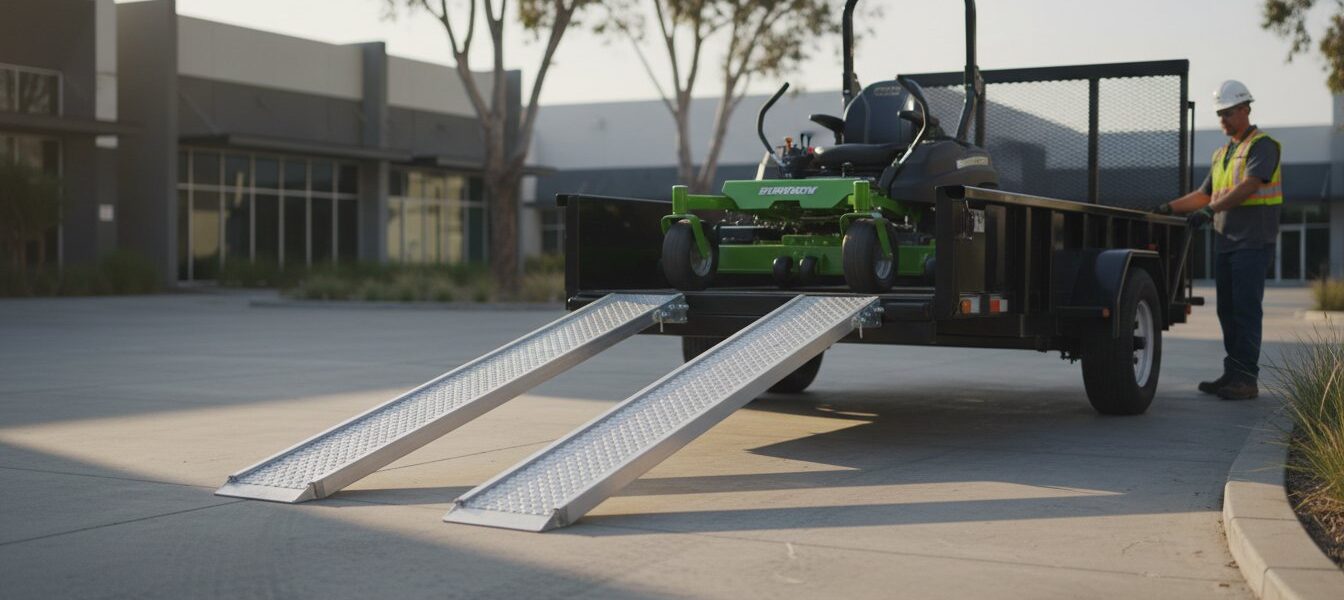
What if your loading safety was a simple calculation rather than a guessing game? Safe loading isn’t about guesswork; it’s a mathematical equation where your machine’s wheelbase and your trailer’s tray height dictate the equipment you need. Most operators choose trailer ramps based on weight capacity alone, but ignoring the approach angle is a fast way to bottom out a mower or damage a loading lip. As the trailer market continues to expand with more equipment hitting Australian roads every day, the need for precision increases. If your ramp is too short, the angle becomes too steep, which creates a significant safety risk and puts unnecessary strain on your gear.
You’ve likely felt that hesitation when driving a heavy machine up a set of ramps that feel flimsy or look too steep. It’s a common frustration for many Australian fleet managers and DIY owners who want to avoid equipment damage and workplace accidents. We’ll show you how to calculate the exact ramp length, load rating, and material required to ensure your loading process is efficient and secure. This article covers the physics of load distribution, the benefits of heavy-duty aluminium, and how to select a rust-resistant solution that stays reliable in harsh conditions.
Key Takeaways
- Stop using dangerous timber planks and learn why engineered solutions are required for safe equipment transition.
- Determine the difference between static and dynamic weight to select trailer ramps with the correct load rating.
- Evaluate the performance of aluminium versus galvanised steel to find a rust-resistant solution for Australian conditions.
- Use the “1 in 4” rule to calculate the precise ramp length needed for your trailer’s tray height.
- Prevent ramp kick-out and equipment damage by using safety straps and conducting regular structural inspections.
Essential Factors for Selecting Trailer Loading Ramps
Purpose-built trailer ramps are engineered tools designed for the controlled transition of equipment from the ground to a trailer bed. They aren’t just accessories; they’re critical safety components that manage the physics of weight transfer. A standard Trailer (vehicle) requires a stable mechanical interface to ensure gear moves safely. Using improvised solutions like timber planks is a serious mistake. Timber doesn’t have a certified load rating. It can split under the pressure of a 500kg machine without any warning. Purpose-built ramps use specific alloys and reinforced weld patterns to handle these intense stresses.
Understanding load distribution is the first step in selection. A point load occurs when the entire weight of a machine rests on a single rung or a very small surface area. This happens frequently with narrow tyres on mowers or dirt bikes. Conversely, a distributed load spreads the weight across multiple rungs, which is typical for tracked machinery. You must match the ramp surface to your specific gear. If the ramp width isn’t at least 50mm wider than your tyre or track, you risk a slip-off during the loading process. Precision matters here to avoid expensive equipment damage.
Common Applications for Loading Ramps
- Light-duty: These ramps handle residential gear like ride-on mowers or landscaping equipment. They’re often lightweight and foldable for easy storage in a shed or ute tray.
- Medium-duty: Built for recreational ATVs and motorcycles. These require higher traction surfaces to prevent wheel spin on steep inclines.
- Heavy-duty: Industrial setups, such as a heavy-duty plant trailer, require ramps capable of supporting multi-tonne excavators. These feature reinforced rungs designed for steel tracks and high-impact use.
The Consequences of Incorrect Ramp Choice
Structural failure is the most immediate risk. If you choose a ramp with a 1,000kg capacity for a 1,500kg skid-steer, the metal will eventually fatigue and buckle. This failure usually happens at the peak of the loading arc. This is the moment when the machine’s center of gravity shifts and the pressure is at its highest. Incorrect choice also damages the trailer itself. Under-sized ramps put excessive leverage on the rear cross-member, which can bend the frame or snap tailgate hinges. Unstable transitions create a severe safety hazard for the operator. Steep angles can cause a machine to flip backward, leading to catastrophic injuries and workplace safety violations.
Understanding Load Capacities and Weight Ratings
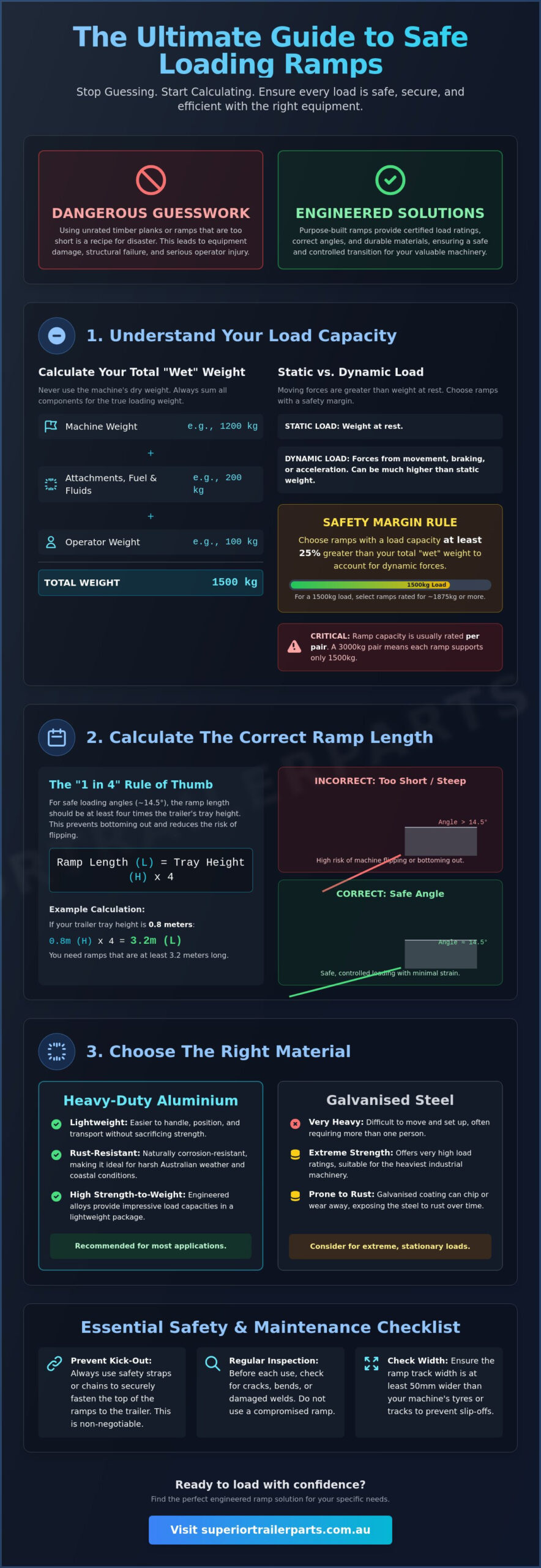
Load capacity is the most critical technical specification you will encounter when selecting trailer ramps. Most manufacturers list capacity as a “per pair” rating. If a set of ramps is rated at 3,000kg, each individual ramp is only engineered to support 1,500kg. You cannot use a single ramp from that set to load a 2,000kg piece of equipment. Doing so will likely result in immediate structural failure. You must also calculate the total “wet” weight of your equipment. This figure includes the machine itself, a full tank of fuel, any hydraulic fluids, added attachments like buckets or augers, and the weight of the operator. Missing even one of these variables can lead to an overloaded and dangerous loading scenario.
Loading is a high-stress event for your trailer axles. As the machine moves onto the ramps, the rear of the trailer acts as a fulcrum. This concentrates a massive amount of downward force on the rear axle and suspension components. Before you deploy your ramps, verify your trailer’s Gross Vehicle Mass (GVM). If the combined weight of the trailer and the machine exceeds this limit, you risk bending an axle or snapping a leaf spring. Ensuring your trailer is rated for the specific load is just as important as the ramps you choose to get it there.
Static vs Dynamic Loading Forces
A static load is simply the weight of a machine at rest. A dynamic load is the force generated when that machine moves, brakes, or accelerates on the ramp surface. Standards such as OSHA Roll-on Roll-off (Ro-Ro) Operations highlight that ramps must be marked and maintained to handle these shifting forces. If you accelerate too quickly or hit the brakes while on the incline, the dynamic force can significantly exceed the static weight of the machine. We recommend choosing ramps with a capacity at least 25% higher than your total wet weight to provide a safe buffer against these forces and prevent ramp kick-back.
Weight Distribution and Trailer Balance
Stability during the climb depends heavily on your trailer configuration. Using tandem trailers provides a major advantage because the dual-axle setup spreads the loading stress across four wheels. This reduces the “teeter-totter” effect where the front of the trailer wants to lift off the tow ball. As the machine moves from the ramp onto the tray, the weight shifts toward the trailer tongue. You must ensure the final position of the equipment maintains roughly 10% of the total load weight on the tow ball to prevent dangerous swaying while driving. If you have questions about matching a ramp to your specific setup, you can get expert advice from our team to ensure your configuration is safe.
Aluminium vs Steel Trailer Ramps: Material and Design Comparison
Choosing between aluminium and galvanised steel trailer ramps involves balancing weight, durability, and the specific environment where you work. Aluminium offers a superior weight-to-strength ratio. It’s typically about one-third the weight of steel while maintaining high load ratings. This makes it the standard choice for operators who frequently move ramps by hand. In Australian coastal regions, salt air accelerates corrosion on unprotected metals. Aluminium forms a natural oxide layer that resists rust, which is a significant advantage over painted steel. For rural applications where mud and fertilisers are present, this chemical resistance ensures the structural integrity of the ramp remains intact over years of service.
The design of the ramp surface is just as important as the metal itself. Straight ramps provide maximum rigidity for loading heavy machinery. Folding designs offer portability but introduce a pivot point that can become a failure zone if not engineered correctly. Surface grip varies by application. Rungs are ideal for tracked excavators, while mesh or punched-plate surfaces provide better traction for rubber tyres. Adhering to OSHA trailer ramp safety standards ensures that these surfaces remain slip-resistant and safe for operators during all weather conditions. Proper material selection prevents premature fatigue and ensures your loading gear survives the harsh Australian sun.
The Benefits of Aluminium Ramps
Aluminium is the preferred material for most light to medium-duty tasks. It reduces the risk of back strain because a single person can usually position the ramps without assistance. When featuring punched-hole surfaces, aluminium performs exceptionally well in wet conditions. The raised edges provide mechanical grip that rungs alone cannot match. Because it doesn’t require galvanising or paint, there’s no coating to chip away. This means the ramp stays maintenance-free even in high-use scenarios where surface abrasions are constant.
When to Consider Galvanised Steel
Galvanised steel is the workhorse of heavy industrial loading. It’s often used for permanent loading dock installations where the ramps don’t need to be moved manually. Steel is highly resilient in high-impact environments where heavy plant machinery might drop or scrape against the surface. While heavier, it’s a cost-effective solution for fixed setups. If you’re building a custom transport solution, choosing the right trailer parts like heavy-duty steel ramps ensures your setup can withstand the daily rigours of a construction site or farm. Steel’s high density also makes it more resistant to the abrasive wear caused by steel-tracked vehicles over long periods.
Calculating the Correct Ramp Length for Safe Loading Angles
Safe loading requires more than just structural strength. It requires the right geometry. The industry standard for a safe loading angle is approximately 15 degrees. This is commonly known as the “1 in 4” rule. For every 1 unit of vertical rise, you need 4 units of horizontal length. If your trailer bed sits 500mm off the ground, you need trailer ramps that are at least 2,000mm long. Using a shorter ramp increases the steepness, which leads to wheel spin and potential equipment damage. This calculation is the foundation of a safe loading setup.
Wheelbase length is the second critical factor in this equation. A machine with a long wheelbase and low ground clearance, such as a zero-turn mower or a low-slung vehicle, is prone to “bottoming out” at the apex where the ramp meets the trailer. This occurs when the chassis hits the trailer edge before the rear wheels have made the transition onto the tray. To prevent this, you must increase the ramp length beyond the standard 1 in 4 ratio to create a shallower approach. It’s a simple adjustment that prevents thousands of dollars in undercarriage damage.
Measuring Your Trailer for the Perfect Fit
Accuracy starts with a tape measure. Measure the vertical height from the ground to the top of the trailer bed while it’s hitched to your vehicle. It’s best to measure the “loaded” height, accounting for how much the suspension will compress once the weight of the machine is applied. If your trailer has a beaver-tail design, measure from the end of the slope rather than the main deck. Ensure the ramp’s attachment lip or tongue fits securely over the rear cross-member without creating a significant bump or gap that could catch a small wheel.
Safety Margins and Steepness
Don’t cut corners on length to save space. A steep ramp significantly reduces traction, especially in wet weather. If the metal is slick, a machine can slide sideways or fail to climb entirely. This creates a dangerous situation where the operator might over-rev the engine to gain momentum, leading to a loss of control at the top of the incline. For low-clearance equipment, consider curved trailer ramps. These feature a slight arch that levels out the approach at the top, providing the extra clearance needed to move onto the tray without high-centering. If you’re unsure about the geometry of your setup, contact us for expert advice on selecting the right length for your specific machine.
Securing Your Load and Maintaining Trailer Ramps
Safe loading doesn’t end once the machine reaches the trailer bed. It requires a 100% secure connection between the equipment and the vehicle. A common cause of workplace accidents is ramp “kick-out.” This occurs when the torque from the machine’s drive wheels pushes the ramp backward and away from the trailer. This usually happens at the moment of peak incline when the weight distribution is most volatile. To prevent this, your trailer ramps must be secured with mechanical fasteners. Never rely on the machine’s weight alone to hold a ramp in place. Friction is not a reliable substitute for a physical lock.
Maintenance is just as critical as the initial setup. Mud, grease, and hydraulic oil frequently build up on the rungs, which significantly reduces traction and increases the risk of a sideways slip. Clean your ramps after every use in harsh environments to maintain a high-grip surface. When you aren’t using them, store them securely. If you use box trailers, ensure the ramps are bolted down or locked in a dedicated rack to prevent them from becoming road hazards. Incorporate these checks into your standard trailer parts inspection routine to ensure long-term reliability.
Mechanical Attachment Methods
Pins and straps are your primary lines of defence against movement. If your trailer has pre-drilled holes in the rear cross-member, always use high-tensile connection pins. For trailers without these built-in points, heavy-duty ratchet straps are mandatory. Attach the strap to the underside of the ramp and secure it to the trailer frame. This creates constant tension that prevents horizontal shifting. Ensure the ramp’s tongue sits perfectly flush against the tray. Any gap creates a high-point stress zone that can bend the loading lip or fatigue the ramp head over time.
Long-Term Maintenance and Inspection
- Weld Inspection: Check for hairline cracks in aluminium welds before every loading session. Aluminium doesn’t show fatigue as clearly as steel, so a close visual check around the rungs and attachment points is necessary.
- Grip Integrity: Verify that rubber feet or non-slip coatings aren’t worn smooth. If the mechanical grip on the rungs is rounded off from heavy use, the ramp may need replacement to ensure operator safety.
- Hinge Care: For folding models, keep the hinges free of grit and debris. Lubricate them with a marine-grade grease to prevent seizing and ensure smooth operation in all weather conditions.
Secure Your Loading Process with the Right Equipment
Safe loading is a matter of precise calculation and consistent maintenance. You’ve learned how to apply the “1 in 4” rule to determine the exact length needed for your specific trailer bed height. You also know how to differentiate between static and dynamic weight to select trailer ramps that won’t buckle under pressure. Whether you choose lightweight aluminium for portability or galvanised steel for industrial durability, matching the ramp to your machine’s wheelbase is essential to prevent structural damage. Regular inspections of welds and attachment points ensure your setup remains reliable for years of service.
We’re an Australian Owned and Operated business providing nationwide shipping across Australia. Our team offers expert advice on heavy-duty loading solutions to ensure your gear stays in top condition. Don’t risk your safety or your equipment with improvised setups that lack certified load ratings. Invest in professional-grade parts built to withstand harsh local conditions and high-impact use.
View our range of durable trailer parts and accessories to find the right fit for your next job. Get your equipment on the road with total confidence.
Frequently Asked Questions
How long should my trailer ramps be for a standard trailer height?
Use the 1 in 4 rule to determine the minimum length for safe operation. Multiply your trailer bed height by four to find the horizontal distance required for a safe 15-degree loading angle. For a standard trailer bed height of 500mm, you need ramps at least 2,000mm long. Shorter lengths create steep inclines that cause wheel spin and increase the risk of the machine flipping backward during the climb.
Can I use one set of ramps for both a mower and an ATV?
You can use one set if the load rating exceeds the heaviest machine and the surface provides grip for both. A mower often has smaller tyres and lower clearance, requiring a shallower angle and closer rung spacing. Ensure the ramps are wide enough for the ATV’s larger wheelbase. Always calculate the “wet” weight of your heaviest equipment, including fuel and operator, to ensure you don’t exceed the pair’s rated capacity.
What is the difference between a rungs surface and a plate surface on a ramp?
Rung surfaces feature horizontal bars designed for high traction with rubber tyres or steel tracks. They allow mud and debris to fall through, keeping the contact area clean. Plate surfaces, often made of punched or embossed aluminium, provide a continuous contact area. These are better for small-diameter wheels, like those on trolleys or pallet jacks, which might get stuck between the gaps of a standard rung design.
Are aluminium ramps strong enough for heavy machinery like bobcats?
Aluminium trailer ramps are engineered to handle heavy plant machinery, including skid-steers and bobcats, provided they have the correct structural reinforcement. Heavy-duty models use specific alloy grades and internal bracing to support loads exceeding 6,000kg. While lighter to move by hand, these ramps are just as capable as steel alternatives when used within their specified load limits. Always verify the individual ramp’s tonnage rating before loading industrial gear.
How do I stop my ramps from slipping off the trailer while loading?
Secure your ramps using high-tensile steel pins or heavy-duty ratchet straps to prevent “kick-out.” Pins are the most reliable method if your trailer has pre-drilled holes in the rear cross-member. If not, attach a safety strap from the underside of the ramp to the trailer chassis and tighten it until there is no horizontal movement. This prevents the torque of the drive wheels from pushing the ramp backward during the transition.
Do I need to worry about the ramp weight if I am loading by myself?
Ramp weight is a significant factor if you frequently load equipment alone. A single galvanised steel ramp can weigh over 40kg, which increases the risk of back strain and injury during setup. Aluminium options are typically 60% lighter than steel, making them much easier to position and store without assistance. If you manage a fleet or work solo, the portability of aluminium provides a major operational advantage for one-person loading.
What should I do if my machine has very low ground clearance?
Use longer ramps to create a shallower approach angle or choose a curved design. Curved ramps feature an arched profile that levels out the incline as it nears the trailer bed. This provides the necessary clearance to prevent the chassis of a mower or low vehicle from “bottoming out” at the apex. Increasing your ramp length beyond the standard 1 in 4 ratio is the most effective way to manage low-clearance equipment safely.
Is it better to have folding ramps or straight ramps for a box trailer?
Straight ramps are better for maximum rigidity and heavy loads because they have no moving parts or potential failure points. Folding ramps are a practical choice for box trailers where storage space is limited, as they fit easily inside the tray or a toolbox. However, folding models often have lower weight capacities than their straight counterparts. Choose straight ramps for industrial machinery and folding models for light-duty recreational gear or garden equipment.