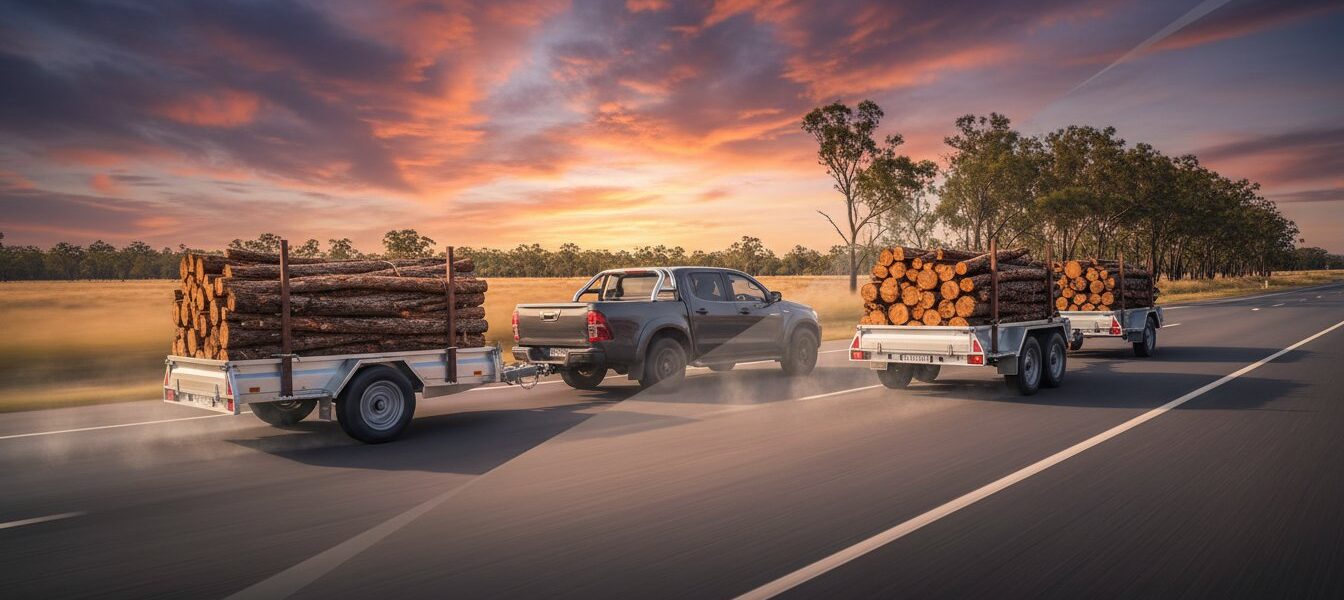
You’re hauling a heavy load of timber at 100km/h when a passing truck sends your trailer into a white-knuckle sway. It’s a common stress for Australian drivers who realize their current gear is reaching its physical limit. If you’re dealing with frequent tyre wear or feeling anxious about your legal weight limits, you aren’t alone. We agree that while a 6×4 or 7×4 single axle is great for nimble jobs, it isn’t built for every task. This guide identifies the exact performance, safety, and legal triggers that signal when to upgrade from single axle to tandem to ensure your setup remains reliable and compliant.
Moving to a dual axle is a strategic choice for better road manners and safety redundancy. We’ll show you why a second axle is typically added once a trailer reaches approximately 2,000kg loaded weight. You’ll learn about the National Construction Standards under VSB 1 and why trailers exceeding 2,000kg GTM require brakes on all wheels and a breakaway system. We also preview how hardware like rocker roller spring sets and electric drum brakes can improve stability. From avoiding insurance liability to gaining confidence with heavier equipment, you’ll get the expert advice needed to make the right move for your towing needs.
Key Takeaways
- Identify the load-bearing differences between 39mm round axles and heavy-duty square options to determine if your current hardware is reaching its physical limit.
- Recognize the legal and safety triggers for when to upgrade from single axle to tandem, focusing on the critical 750kg and 2,000kg braking thresholds.
- Understand how a dual axle setup improves tracking and reduces trailer sway during high-speed highway travel or when passing heavy vehicles.
- Compare technical suspension requirements, including the performance benefits of rocker roller spring sets over standard slipper springs for dual axle trailers.
- Evaluate the long-term investment value and durability of tandem trailers in high-use environments like construction and agriculture.
Identifying the Physical Limits of Single Axle Trailers
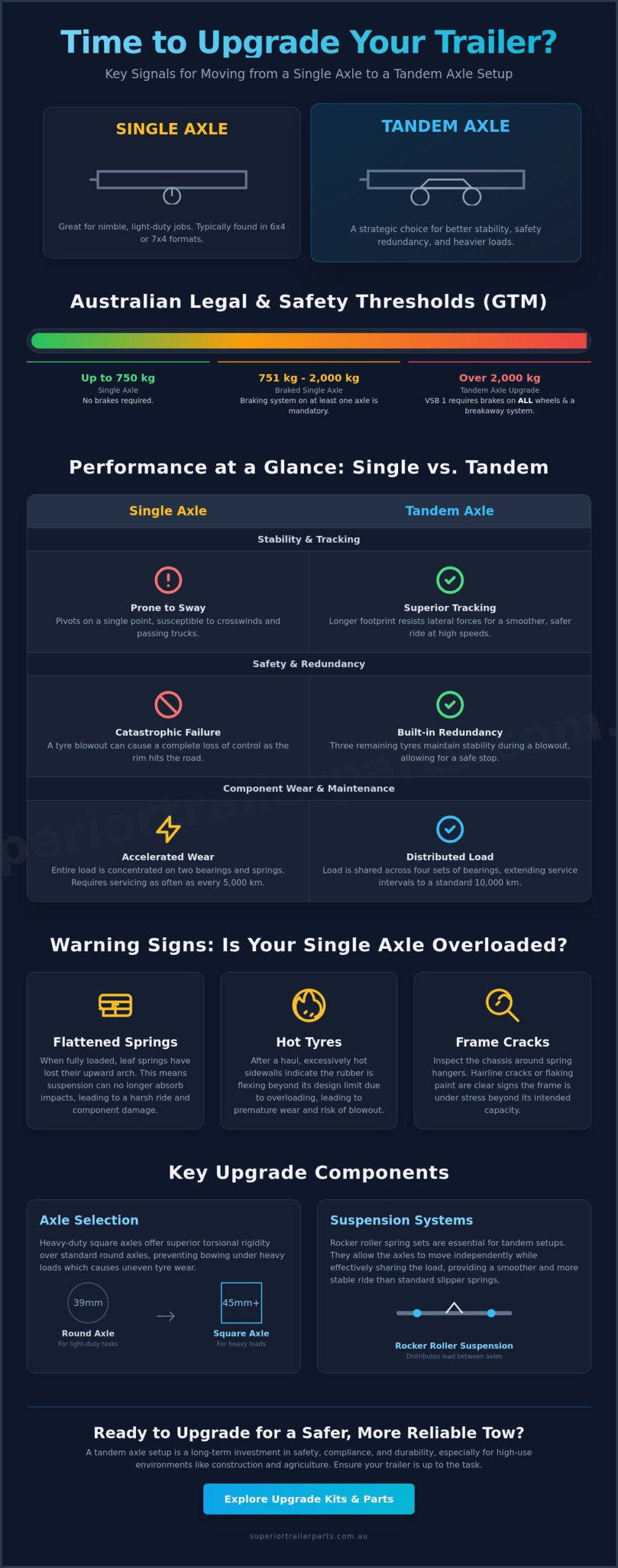
A single axle trailer is defined by its simple configuration of one axle and two wheels. These units are the backbone of domestic hauling across Australia, typically found in 6×4 or 7×4 box trailer formats. Most unbraked single axle trailers are rated for a Gross Trailer Mass (GTM) of 750kg. Once you add mechanical or electric brakes, high-quality 39mm round axles or 45mm square axles can push this capacity toward 1,600kg. However, reaching these upper limits frequently places immense mechanical strain on a single point of contact with the road. Understanding these physical boundaries helps you decide when to upgrade from single axle to tandem before a component failure occurs on the highway.
Standard 39mm round axles are engineered for light-duty tasks like tip runs or moving small furniture. While they’re cost-effective, they lack the torsional rigidity of 40mm or 50mm square options. Under heavy loads, a round axle can begin to bow. This flex changes the camber of your wheels, leading to rapid wear on the inside edges of your tyres. Various trailer designs prioritize different load distributions, but a single axle setup always concentrates the entire payload weight and road shock into two sets of bearings. On rough Australian backroads, this often results in the “bounce” factor. Without the load-sharing capability of a second axle, an unladen or lightly loaded single axle trailer will skip over corrugations, reducing tyre contact and braking effectiveness.
Signs Your Payload Has Outgrown Your Axle
- Spring Compression: Check your leaf springs when the trailer is fully loaded. If the leaves have flattened out or lost their upward arch, the suspension can no longer absorb road impact.
- Tyre Temperature: After a long haul, safely feel the tyre sidewalls. Excessive heat indicates the rubber is flexing beyond its design limit due to over-loading on a single pair of tyres.
- Structural Fatigue: Inspect the area around the spring hangers. Light-duty frames often show hairline cracks or paint flaking when the weight exceeds the chassis’s intended capacity.
Maintenance Cycles and Component Wear
A single axle hauling 1,500kg works twice as hard as a tandem setup carrying the same load. This concentration of weight accelerates the service life of your bearings and seals. You’ll find yourself repacking grease or replacing hubs every 5,000km instead of the standard 10,000km interval. Consistently running near the limit also fatigues the leaf spring steel, leading to a permanent sag that affects towing height and safety. When the annual cost of replacing tyres, bearings, and springs exceeds the price of a mid-range tandem suspension kit, the mechanical evidence clearly signals when to upgrade from single axle to tandem for long-term reliability. If your monthly maintenance log shows recurring bearing failures or uneven tyre wear despite correct alignment, the physical limits of your single axle setup have been reached.
Stability and Safety: Single Axle vs. Tandem Performance
A tandem axle setup significantly changes how your load behaves at 100km/h on the freeway. The primary safety advantage is the reduction of the “tail wagging the dog” effect. When analyzing single vs. dual-axle trailer performance, the tracking ability of a tandem is physically superior. A single axle trailer pivots on a single central point. This makes it easy to maneuver by hand in a driveway but prone to lateral swaying when you pick up speed. In contrast, a tandem setup provides a longer footprint on the road. This geometric advantage resists the vacuum effect created by passing road trains or sudden gusts of crosswind.
Safety redundancy is another critical factor for Australian drivers. A high-speed blowout on a single axle trailer is often catastrophic because the rim immediately strikes the bitumen, which can lead to a complete loss of control. On a tandem trailer, you have three remaining contact points to help maintain a straight line while you brake. This safety net is a primary reason why many owners decide when to upgrade from single axle to tandem for long-distance interstate travel. While a dual axle trailer is harder to pivot by hand, the trade-off in highway manners is worth the extra effort in the yard.
Managing Trailer Sway and Highway Manners
Two axles naturally resist lateral movement because the tyres must scrub against the road surface to move sideways. This inherent friction keeps the trailer following the tow vehicle’s path more accurately. Using a weight distribution hitch with a tandem setup further stabilizes the rig by spreading the tongue weight across all axles. It’s a much more forgiving configuration if your load isn’t perfectly balanced, as the second axle helps compensate for minor weight shifts during transit.
The Redundancy Factor in Remote Areas
Four contact points provide better flotation over soft ground and deep potholes common on rural tracks. If you suffer a tyre failure in a remote area, a tandem setup can often be limped slowly to a safer location for a change. This reliability is why dual axles are the standard for heavy-duty box trailers used by professional trades and farmers. If you’re ready to improve your towing stability, you can browse our range of genuine trailer parts to start your upgrade project.
Weight Ratings and Australian Towing Regulations
Compliance with Australian Design Rules (ADR) is not optional. When you’re deciding when to upgrade from single axle to tandem, legal weight limits are often the deciding factor. You must understand two key figures: Aggregate Trailer Mass (ATM) and Gross Trailer Mass (GTM). ATM is the total weight of the trailer plus its maximum load when unhitched. GTM is the weight transmitted to the ground by the trailer axles when hitched to your vehicle. These ratings determine your legal payload and the specific safety hardware required by law.
In Australia, any trailer with a GTM exceeding 750kg must have a functional braking system. Most single axle box trailers are sold unbraked to keep costs down, limiting them to that 750kg ceiling. If your payload consistently pushes you toward or over this limit, you’re operating outside legal safety margins. Upgrading to a tandem setup is the standard path to increasing your ATM safely. Operating an overloaded or non-compliant trailer can void your insurance policy. In the event of an accident, being over the legal weight limits can leave you personally liable for all damages.
When the Law Mandates a Tandem Setup
The law effectively mandates a tandem setup once your requirements exceed the physical capacity of a single axle. While some heavy-duty single axles can be rated up to 1,600kg, most manufacturers switch to dual axles for anything over 2,000kg ATM. Under VSB 1 version 6, trailers with a GTM exceeding 2,000kg require brakes on all wheels. They also must be fitted with a breakaway system. This system automatically applies the trailer brakes if it becomes uncoupled while in motion. Use a weighbridge to check your actual load. If you’re over your plate’s ATM, you’re risking heavy fines and safety failures.
Braking Requirements for Dual Axle Conversions
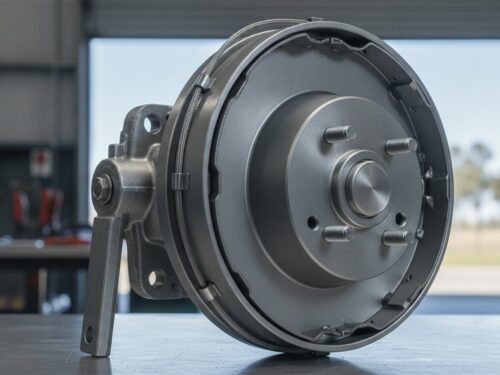
Upgrading to a tandem setup requires a more sophisticated braking strategy. For trailers up to 2,000kg GTM, mechanical override brakes are acceptable. However, for tandem setups hauling heavier machinery, 10-inch electric drum brakes are the industry standard. They provide better control and allow the driver to adjust braking force from the cab. When performing a conversion, you’ll need high-quality brakes and calipers that meet ADR standards. Ensure you use galvanised U-bolts and heavy-duty hangers to secure the new assembly. This hardware ensures your braking forces are transferred safely to the chassis without shearing or shifting under load.
Technical Requirements for a Tandem Axle Upgrade
A successful conversion requires more than just welding a second axle to the frame. You need a coordinated system of components designed to work together under increased stress. This includes two axles, four hubs, four wheels, and a tandem-specific suspension system. Using genuine trailer parts is the only way to ensure your modified trailer meets Australian Design Rules (ADR) and maintains structural integrity on the road. When you decide when to upgrade from single axle to tandem, you must prioritize the compatibility of these parts to avoid premature fatigue in the chassis or suspension hangers.
Axle spacing and positioning are critical for towing safety. If the axles are too far forward, the trailer will sway; if they’re too far back, the tow ball mass will exceed your vehicle’s limit. You must also ensure the new axle group is centered correctly to keep the trailer tracking straight. Professional builders often reinforce the spring hanger area with additional steel plate to distribute the load across a larger section of the chassis rail. This prevents the frame from twisting or cracking under the increased leverage of a dual axle setup.
Selecting Axles and Rocker Roller Sets
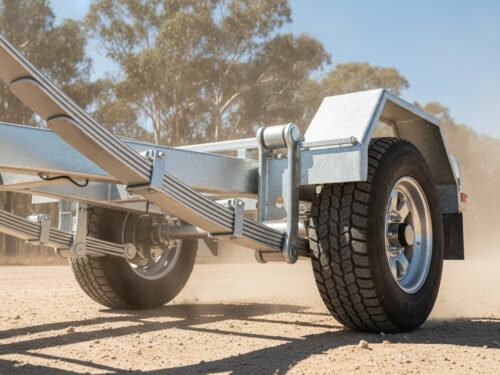
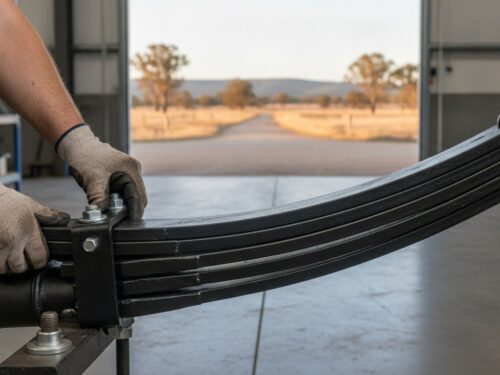
For most tandem upgrades, 45mm square axles are the standard choice for 2,000kg to 2,800kg GTM ratings. If you’re building a plant trailer for heavy machinery, 50mm square axles provide superior strength and larger bearings. While slipper springs are common on light trailers, rocker roller suspension is the better choice for tandems because it allows for load sharing. This system uses a central rocker arm to distribute weight evenly between the front and rear axles when driving over curbs or uneven terrain. To calculate the correct axle position for a tandem conversion, locate the center of the tandem group approximately 25mm to 50mm behind the trailer bed’s center point for every 300mm of load floor length.
Upgrading Chassis and Couplings
You must assess if your existing chassis can handle the new weight rating. A frame built for a 750kg single axle often uses 50x50mm RHS, which is insufficient for a 2,000kg tandem load. You’ll likely need to reinforce the drawbar with 75x50mm or 100x50mm steel to prevent flexing. Your coupling also needs an upgrade. Moving from a basic 2-hole fixed coupling to a 4-hole override coupling is a standard requirement for trailers in the 750kg to 2,000kg range. If you’re planning a heavy-duty build, view our range of heavy-duty axles to find the right fit for your project. This ensures your hardware matches the increased ATM and provides the reliability needed for professional use.
Investment Value: When to Switch to a Dual Axle Setup
Cost of Modification vs. Buying New
A DIY upgrade requires a significant investment in components. You’ll need to budget for two axles, a rocker roller spring set, and a complete braking system. When you factor in the labour for welding and ADR-compliant engineering, you must weigh this against the trade-in value of your current box trailer. If your existing chassis is galvanised and structurally sound, a conversion can be cost-effective. However, if the frame shows signs of fatigue, buying a new tandem is the safer route. We encourage you to contact Superior Trailer Parts for expert advice on parts compatibility before you start cutting steel.
How Superior Trailer Parts Supports Your Upgrade
We provide the heavy-duty components needed to make your upgrade successful. As an Australian Owned and Operated business, we understand the harsh conditions your trailer must endure. We offer Australia Wide shipping on all our genuine parts, from 50mm square axles to LED submersible tail lights. This ensures you get high-quality hardware delivered directly to your workshop or job site. Our focus is on providing reliable solutions and competitive pricing for every trailer owner. Get the job done right with parts that are built for the long haul. Browse our range today and secure the stability your load deserves.
Secure Your Load for the Long Haul
Determining when to upgrade from single axle to tandem is a matter of safety and legal compliance. If your payloads consistently push past the 750kg unbraked threshold or you’re experiencing excessive tyre heat on a single axle, it’s time to move to a dual configuration. A tandem setup provides the stability needed for highway speeds and the mechanical redundancy required for remote Australian travel. You’ll gain better tracking, reduced sway, and the peace of mind that comes with meeting the 2,000kg GTM braking requirements.
Superior Trailer Parts is Australian Owned and Operated; we understand the durability needed for local conditions. We offer nationwide shipping on all heavy-duty components, from 50mm square axles to complete rocker roller sets. If you’re unsure about axle positioning or chassis reinforcement, our team provides expert technical advice for DIY builders. View our range of heavy-duty tandem axle components and trailers to start your upgrade. Build a setup that handles the weight and keeps you safe on the road.
Frequently Asked Questions
Is a tandem axle trailer harder to reverse than a single axle?
A tandem axle trailer is generally more difficult to reverse because the dual wheels resist the pivoting motion. While a single axle trailer reacts quickly to steering inputs, a tandem setup requires a larger turning circle. You’ll need to make more gradual steering adjustments to avoid scrubbing the tyres excessively during tight maneuvers in suburban driveways or job sites.
Do I need a different license to tow a tandem axle trailer in Australia?
You don’t need a special license to tow a tandem trailer if the Gross Combination Mass (GCM) remains within your standard car license limits. In most Australian states, a C-class license allows you to drive vehicles up to 4.5 tonnes GVM. Always verify that your tow vehicle’s rated capacity matches the Aggregate Trailer Mass (ATM) of your new tandem setup to stay legal.
Can I convert my existing 7×4 single axle box trailer to a tandem?
Converting a 7×4 single axle to a tandem is possible but often requires significant structural modification. You must ensure the existing chassis rails can handle the increased stress of a dual axle group and the higher ATM. Given the cost of two new axles, a rocker roller kit, and brake hardware, it’s often more practical to trade in your single axle for a purpose-built tandem unit.
What is the maximum weight a single axle trailer can legally carry?
The legal limit for an unbraked single axle trailer in Australia is 750kg GTM. If you use a heavy-duty 45mm square axle with electric brakes, you can legally carry up to 1,600kg on a single axle. Knowing when to upgrade from single axle to tandem depends on whether your payload requirements regularly exceed these single-point load capacities or if you need better highway stability.
Why do tandem trailers use rocker roller suspension instead of slipper springs?
Rocker roller suspension is preferred for tandems because it allows for superior load sharing between the front and rear axles. Unlike slipper springs, which act independently, the rocker arm ensures that weight is distributed evenly even when one wheel hits a pothole. This prevents one axle from being momentarily overloaded, which is a common cause of spring fatigue and failure on rough roads.
Will upgrading to a tandem axle significantly increase my fuel consumption?
Upgrading to a tandem axle causes a minor increase in fuel consumption due to the extra weight and rolling resistance of four tyres. However, the impact is usually less than 5% compared to a single axle carrying the same weight. The aerodynamics of your load and your driving speed are far more significant factors in your overall fuel economy than the number of axles.
Are electric brakes required on all tandem axle trailers?
Electric brakes aren’t mandatory for all tandems, but they’re required if the GTM exceeds 2,000kg. For trailers between 750kg and 2,000kg GTM, mechanical override brakes are legally sufficient. If you’re building a tandem for heavy plant or machinery, electric brakes provide better control and are necessary to meet ADR standards for required breakaway systems.
How do I determine the correct axle position for a dual axle setup?
To find the correct axle position, locate the center point of your tandem group slightly behind the center of the trailer floor. A common engineering rule is to move the center of the axles back by 25mm for every 300mm of floor length. This ensures you maintain approximately 10% of the total weight on the tow ball, which is essential for preventing trailer sway at highway speeds.