Choosing the wrong axle specification isn’t just a minor mistake; it’s a safety risk that can leave your trailer stranded on the side of the road. You know that getting the technical details right is the difference between a reliable build and an expensive mechanical failure. This article identifies the 45mm square axle specifications you need to confirm the exact load capacity and bearing profile for your equipment. We’ll break down the differences between Slimline and Parallel fitments, explain how to measure for a perfect replacement, and clarify the weight limits for single and tandem setups.
Most 45mm square axles are rated for a capacity between 1400kg and 1500kg. However, the specific bearing profile you choose is what ensures long-term durability under heavy loads. Whether you’re following the standards of VSB 1 Revision 6 or replacing a damaged beam, you need a solution that fits the first time. We’ll look at the technical requirements for ‘Slimline’ bearings and how to ensure your new axle aligns with your trailer’s Gross Trailer Mass (GTM) for total compliance and safety on Australian roads.
Key Takeaways
- Confirm your trailer load capacity, as 45mm square axles typically support ratings between 1400kg and 1600kg.
- Use the correct 45mm square axle specifications to choose between Slimline and Parallel bearing profiles based on your weight requirements.
- Select a galvanised finish for marine environments or natural steel for standard box trailers to ensure long-term durability.
- Measure the hub-face-to-hub-face distance accurately to guarantee your replacement axle fits the first time.
- Pair your axle with compatible slipper springs and galvanised U-bolts to maintain suspension performance.
Load Ratings and Capacity of 45mm Square Axles
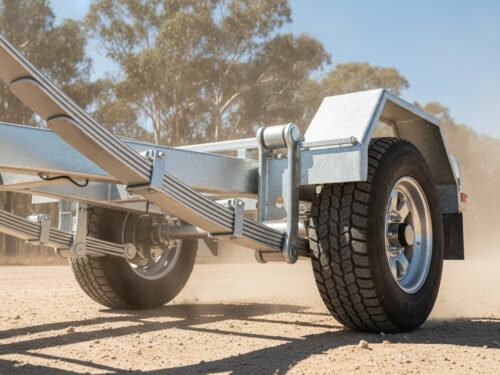
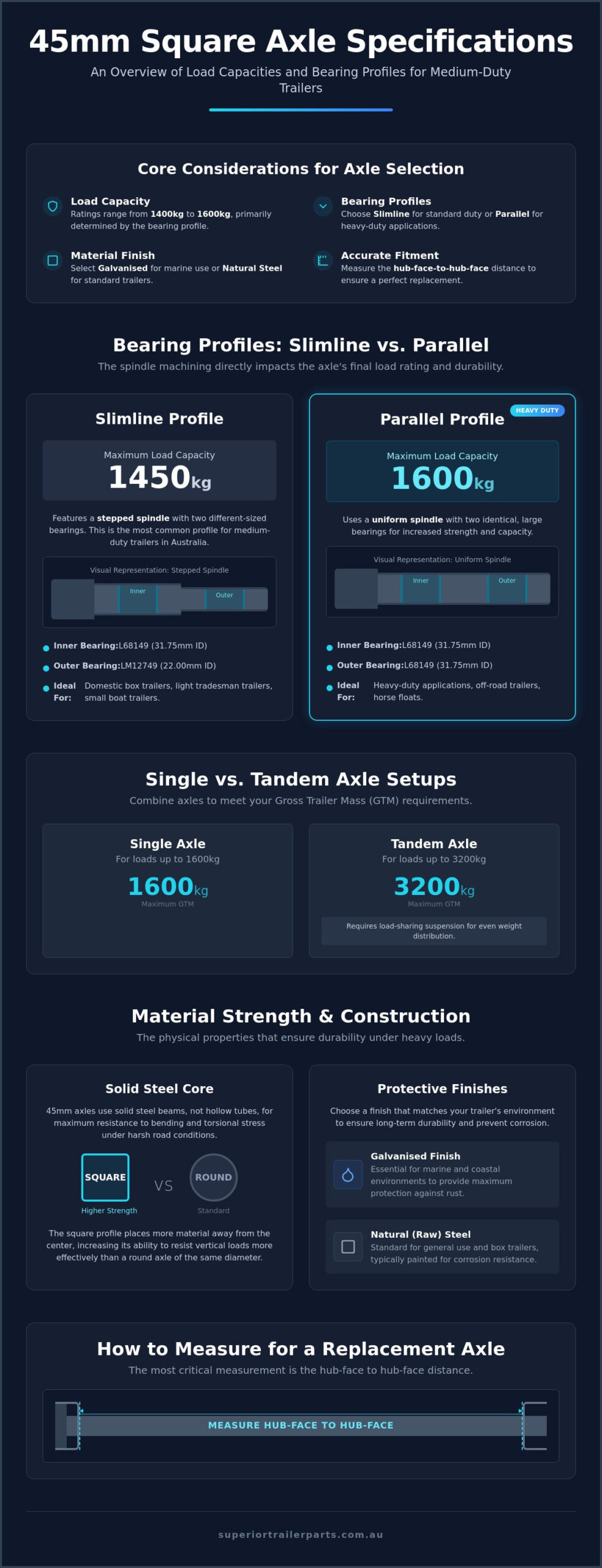
The 45mm square axle is the industry standard for medium-duty Australian trailers. It provides a reliable balance between weight and strength. Standard load ratings for these axles typically range from 1400kg to 1600kg per axle. The final capacity depends heavily on the bearing profile and the machining of the spindle. For example, a 45mm square axle with Slimline bearings is usually rated at 1400kg or 1450kg. Upgrading to Parallel bearings increases that capacity to 1600kg. This makes the 45mm profile a versatile choice for different types of trailers, from workhorse box trailers to horse floats. You’ll find these axles used extensively in both domestic and commercial applications because they offer a significant step up from 39mm or 40mm alternatives.
Single Axle vs Tandem Load Distribution
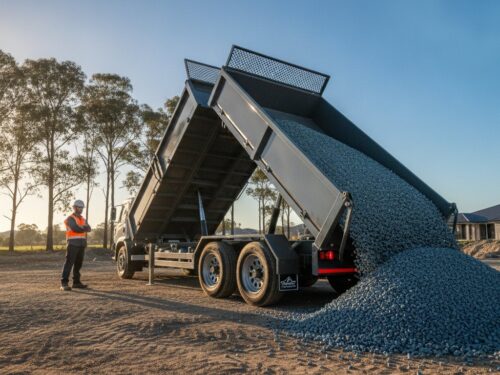
Calculating your Gross Vehicle Mass (GVM) starts with the axle count. A single axle setup is effective for loads up to 1600kg. If you require higher capacities, a tandem setup using two 45mm beams can support a GVM of up to 3200kg. It’s vital to use load-sharing suspension in tandem configurations. This ensures weight is distributed evenly across both axles, even on uneven terrain. Without load-sharing, one axle may momentarily carry the entire load, leading to structural failure or a blown tyre. Legal requirements in Australia dictate that any trailer with a GTM over 750kg must have brakes. For 45mm axles, this usually means fitting 9-inch mechanical or 10-inch electric drum brakes. If you are building welded galvanised heavy duty dual axle tandem trailers, ensuring your axles are rated for the total GTM is a legal necessity under VSB 1.
Material Strength and Steel Quality
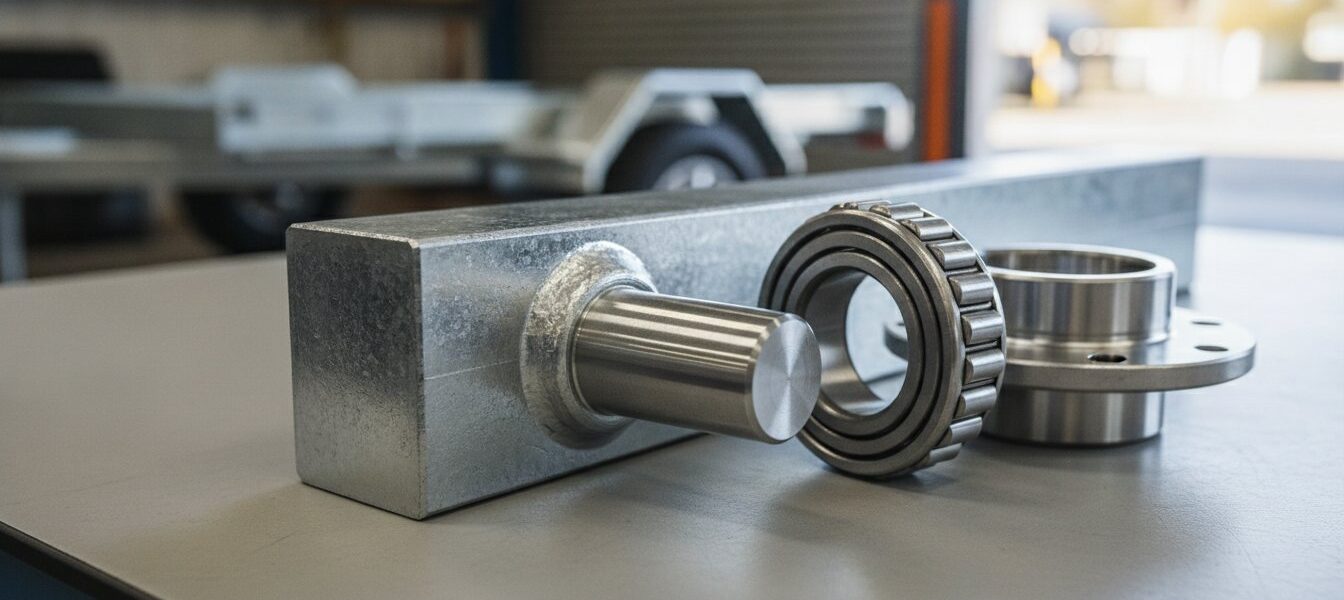
Superior strength comes from the use of high-grade solid steel. Unlike hollow tube axles, 45mm solid square beams offer maximum resistance to bending and torsional stress. The square profile has a distinct structural advantage over round axles of the same diameter. A square beam places more material further from the center of the axle. This increased “second moment of area” allows the axle to resist vertical loads more effectively. The physical reason for the higher 1600kg rating on Parallel axles is the spindle thickness. While a Slimline spindle steps down to a smaller outer bearing, a Parallel spindle maintains a consistent, larger diameter for both bearings. This keeps more steel on the spindle, reducing the risk of bending at the outer edge. This solid steel construction is essential for heavy towing where road vibrations and shock loads are constant. The 45mm solid steel beam is designed to endure harsh Australian road conditions without bowing. Choosing the right 45mm square axle specifications ensures your trailer remains rigid under pressure. Always verify the steel grade with your supplier to confirm it meets the requirements for your specific application.
Bearing Profiles: Slimline vs Parallel Machining
The physical strength of the steel beam is only half of the equation. While the 45mm solid steel provides the structural foundation, the spindle machining determines the final load rating. When reviewing 45mm square axle specifications, you must choose between Slimline and Parallel bearing profiles. This decision directly impacts the maximum Gross Trailer Mass (GTM) your trailer can legally and safely carry. Slimline machining is the Australian standard for medium-duty trailers, while Parallel machining is the preferred choice for heavy-duty or off-road applications. Precision in these machining tolerances is vital. Even a fraction of a millimetre of error can lead to bearing seat wear, excessive heat, and eventual spindle failure.
Slimline Bearing Specifications
Slimline bearings, frequently referred to as Ford bearings, are the most common fitment for 45mm square axles. This configuration uses two different bearing sizes on the spindle to manage load and rotational stability. The setup typically includes:
- Inner Bearing: L68149 (31.75mm ID) with L68111-L68110 race.
- Outer Bearing: LM12749 (22.00mm ID) with LM12710-LM12711 race.
Parallel Bearing Advantages for Heavy Loads
Parallel machining increases the axle capacity to 1600kg by using two identical large bearings. Instead of stepping the spindle down to a smaller outer bearing, the diameter remains consistent at 31.75mm for both positions. This setup uses two L68149 inner bearings. As a leading axle manufacturer would confirm, increasing the surface area of the spindle significantly improves load distribution and heat dissipation. This makes Parallel axles ideal for trailers that endure constant heavy use or harsh off-road conditions. The thicker spindle is less prone to bending under shock loads, which is a common issue when traversing corrugated roads or construction sites. If you are building a trailer for long-distance towing, you can view the range of 45mm square axles to see which bearing profile matches your requirements. Keep in mind that Parallel axles require specific hubs designed to house two large bearing races, so you cannot simply swap bearings on a Slimline-machined spindle.
Heat is the primary enemy of trailer bearings. In a Parallel setup, the larger volume of grease and the increased metal-to-metal contact area help pull heat away from the spindle more efficiently than a Slimline setup. This reduces the risk of grease breakdown and bearing seizure during extended highway travel. When selecting your axle, always match the bearing profile to the intended environment and total weight to ensure the longevity of your trailer’s running gear.
Material Finishes for Australian Environments
Choosing the right finish for your trailer axle is just as important as selecting the correct load rating. Australian conditions are harsh. Dust, salt, and humidity all contribute to metal fatigue and surface rust over time. When you’re reviewing 45mm square axle specifications, you’ll generally choose between a natural steel finish and a hot-dipped galvanised coating. This choice should be dictated by where you plan to tow. A utility trailer used in central Australia has different requirements than a boat trailer launching into saltwater in Queensland. Selecting the wrong finish for your environment leads to premature corrosion and potential structural failure.
Natural Steel Axles for Utility Trailers
Natural steel is the standard choice for trailers that operate primarily on dry land. It’s a cost-effective material for builders who want durability without the higher price point of specialised coatings. These axles are often supplied “bare,” allowing you to weld suspension components or spring seats directly to the beam. Once the trailer is assembled, apply a high-quality chassis paint or cold-galvanising spray to protect the surface from basic oxidation. This finish is perfectly suited for heavy duty single axle box trailers used for gardening, trade work, or general hauling. Since these trailers rarely encounter corrosive salt spray, a simple painted finish provides adequate protection for years of reliable service.
Galvanised Axles for Marine and Coastal Use
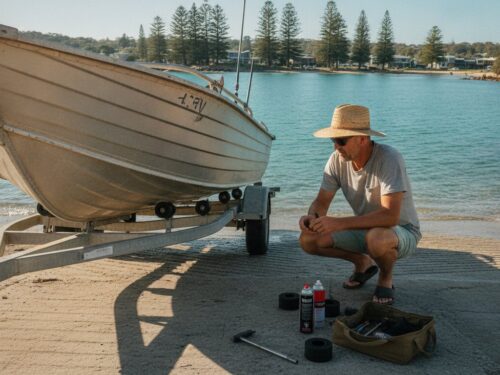
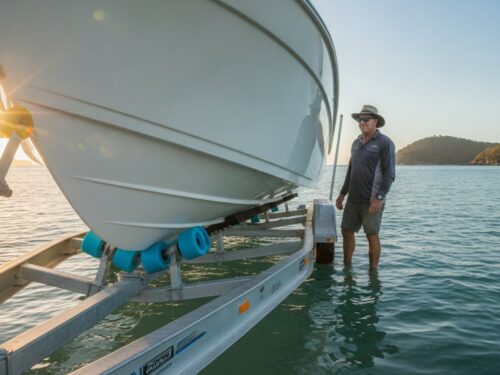
If your trailer will ever touch saltwater, a galvanised finish is mandatory. The hot-dipped galvanisation process involves submerging the entire 45mm solid steel beam into molten zinc. This creates a metallurgical bond that protects the steel at a molecular level. Unlike paint, which can chip and allow rust to spread underneath, galvanising provides sacrificial protection that lasts much longer. This is a critical requirement for boat trailer parts that are submerged during every launch. It’s also a wise investment for trailers stored in coastal areas where salt-laden air accelerates corrosion on bare steel. To maintain this layer, rinse your axle with fresh water after every trip to the boat ramp. Avoid using abrasive cleaners that could thin the zinc coating. By selecting a galvanised beam, you ensure that your 45mm square axle specifications include the resilience needed for the toughest marine environments.
How to Measure a 45mm Square Axle for Replacement
Ordering a replacement based on guesswork leads to expensive delays and incorrect fitment. You must provide exact measurements to ensure your new beam aligns with your trailer’s chassis and suspension. While the 45mm square axle specifications define the beam’s thickness and capacity, the physical dimensions determine the trailer’s track width and wheel clearance. There are two primary measurements you must record before placing an order: the hub-face-to-hub-face distance and the spring centre positions. Use a steel tape measure for accuracy and record all dimensions in millimetres.
Measuring Hub Face to Hub Face
The hub-face-to-hub-face (HF-HF) measurement is the most critical dimension for wheel clearance. This distance determines how far the wheels sit from the trailer sides. Follow this 3-step process for an accurate reading:
- Remove the wheels: You cannot get an accurate measurement with tyres in the way. Jack up the trailer and remove both wheels.
- Identify the hub face: This is the flat surface of the hub where the wheel studs emerge. It is the part that sits flush against the wheel rim.
- Measure the span: Hook your tape measure on the outside of one hub face and pull it across to the opposite hub face.
Never measure from the back of the hubs or the brake backing plates. Measuring with wheels attached is a common mistake that leads to inaccuracies of up to 20mm. An incorrect HF-HF measurement will result in tyres rubbing against the trailer frame or mudguards. If you have already removed your old axle, you can also measure “tip-to-tip” to find the total length of the steel beam including the threaded spindles.
Determining Spring Centre Positions
Spring centres define where the axle attaches to your suspension system. If these are off-centre, your trailer will not track straight. Measure from the centre of one spring seat to the centre of the other. Most 45mm axles use welded spring seats to prevent the axle from rotating during braking. Ensure these seats are perfectly symmetrical. If the distance between your spring centres is 1200mm, the distance from each seat to the corresponding hub face must be identical. This symmetry prevents uneven tyre wear and ensures the trailer follows your vehicle correctly. While you have the axle removed, inspect your u-bolts for signs of stretching or thread damage. Stretched bolts lose their clamping force and should be replaced whenever a new axle is installed. Once you have these dimensions ready, you can order a replacement 45mm square axle that fits your trailer perfectly without the need for onsite modifications.
Precision at this stage saves hours of frustration during installation. Double-check your measurements twice. A difference of 5mm might seem small, but it can prevent a brake drum from clearing a chassis rail or stop a spring bolt from aligning. Provide these verified dimensions to your supplier to guarantee a professional result.
Selecting Compatible Components for 45mm Axles
An axle is only as strong as the hardware that holds it to the trailer. Choosing the right 45mm square axle specifications is the first step; however, you must select compatible components to build a safe system. Mixing heavy-duty axles with light-duty springs creates a weak point that leads to suspension failure. It’s a system. Every part, from the U-bolts to the brake drums, must be rated to handle the same Gross Trailer Mass (GTM) as the axle beam itself. Mismatched hardware compromises safety and can lead to legal compliance issues under Australian standards.
Matching Leaf Springs and U-Bolts
A 45mm square beam typically pairs with 45mm or 60mm wide leaf springs. For a standard 1400kg single axle setup, a 5-leaf or 6-leaf slipper spring is a common choice. Slipper springs are simpler and cost-effective for utility trailers. If you need better shock absorption for long-haul towing, eye-to-eye springs are the better option. You must use galvanised U-bolts to secure the square beam to the spring pack. Square U-bolts are specifically designed to wrap around the 45mm profile. This provides a flat clamping surface that prevents the axle from shifting during travel. Always check that your u-bolts match the load requirements; a 1/2-inch bolt is the standard for this axle size. Ensure the nuts are torqued correctly to maintain a rigid connection between the axle and the suspension.
Braking System Compatibility
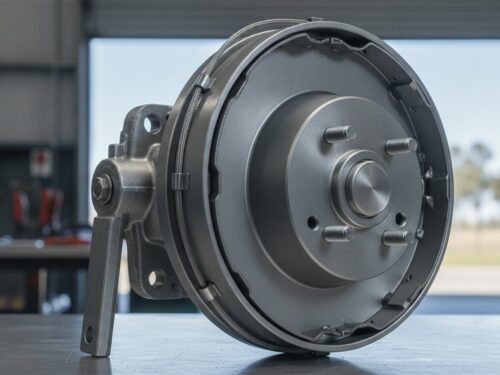
Your choice of braking system depends on the spindle machining and the trailer’s total weight. If your axle has Slimline machining, you must use hubs and drums designed for Slimline bearings. Trailers with a GTM over 750kg require brakes by law. You can fit 9-inch mechanical drum brakes for basic builds or 10-inch electric drum brakes for better control. These systems require a brake flange to be welded to the 45mm beam. This flange provides the mounting point for the brake backing plate. It’s vital that the flange is welded straight. An angled flange causes the brake shoes to wear unevenly and reduces stopping power. Verify that your 45mm square axle specifications include the correct flange position for your chosen braking kit.
Building a reliable trailer requires high-quality parts that work together. Superior Trailer Parts offers nationwide delivery for all necessary axle components, including bare beams, springs, and braking kits. Buying your hardware as a matched set ensures that the U-bolts fit the axle and the bearings fit the spindle. This eliminates the risk of ordering incompatible parts and keeps your project on track. Don’t compromise on safety by using mismatched hardware on a high-capacity 45mm square axle. Focus on durability and fitment to ensure your trailer handles the road without issue.
Secure Your Build with Precision Axle Selection
Choosing the right hardware is a critical step in ensuring trailer safety and longevity. You now have the details needed to distinguish between Slimline and Parallel bearing profiles and the importance of matching your axle finish to the operating environment. Accurate measurements of the hub face and spring centres remain the only way to avoid fitment issues during installation. By following these 45mm square axle specifications, you ensure your trailer meets Australian standards and handles the stress of heavy towing without structural failure. Superior Trailer Parts provides the technical expertise required for custom trailer builds and maintains a deep stock of high-quality components. We are Australian-owned and operated, offering nationwide shipping on all trailer parts to keep your project on schedule. Browse our range of 45mm square axles and components to find the right fit for your next build. Get your trailer back on the road with total confidence in your equipment.
Frequently Asked Questions
What is the maximum load rating for a 45mm square axle?
The maximum load rating for a 45mm square axle ranges from 1400kg to 1600kg. A Slimline bearing profile typically caps the rating at 1450kg, while a Parallel bearing profile increases the capacity to 1600kg. These 45mm square axle specifications are determined by the manufacturer based on the spindle diameter and material strength. Always verify that your chosen rating matches your trailer’s Gross Vehicle Mass to stay within legal safety limits.
Can I use Slimline bearings on a 45mm square axle?
Yes, Slimline bearings are the standard fitment for most 45mm square axles in Australia. This setup uses a larger inner bearing and a smaller outer bearing to manage rotational load. It’s a reliable choice for domestic box trailers and light tradesman trailers. Because Slimline parts are widely available at almost any automotive store, they’re easy to replace if you have a mechanical issue while travelling.
What is the difference between natural and galvanised 45mm axles?
Natural steel axles are bare metal and require painting, while galvanised axles are hot-dipped in zinc for superior corrosion resistance. Natural steel is cost-effective for utility trailers that stay in dry environments. Galvanised finishes are essential for boat trailers or jet ski trailers that enter saltwater. The zinc coating provides a metallurgical bond that stops rust from compromising the 45mm solid steel beam over time.
How do I measure my trailer axle for a replacement?
Measure the distance between the two hub faces for the most accurate replacement. This hub-face-to-hub-face dimension determines your trailer’s track width and ensures wheel clearance. You should also measure the distance between the spring centres to ensure the new axle aligns with your existing suspension. Taking these measurements with the wheels removed prevents common errors that can lead to ordering the wrong size.
Do 45mm square axles come with brake flanges welded?
Many 45mm square axles are supplied with brake flanges already welded to the beam. These flanges are necessary mounting points for 9-inch mechanical or 10-inch electric drum brakes. If you’re building a trailer with a GTM over 750kg, you’ll need these flanges to install a legal braking system. Always confirm with your supplier if the flanges are included or if they need to be positioned for your specific brake kit.
What size U-bolts do I need for a 45mm square axle?
You need square-profile U-bolts designed specifically for a 45mm beam. Most setups use 1/2-inch thread galvanised U-bolts to provide the necessary clamping force. These bolts must be long enough to wrap around the axle, the leaf spring pack, and the base plate. Using the correct size ensures the axle doesn’t shift or rotate under heavy braking loads, which is vital for maintaining suspension integrity.
Is a 45mm square axle better than a 40mm square axle?
Can I use 45mm square axles on a tandem trailer?
You can use 45mm square axles on a tandem trailer to achieve a total GTM of up to 3200kg. This configuration requires two identical axles and a load-sharing suspension system to distribute weight evenly. Using 45mm square axle specifications for both beams ensures your trailer remains stable and compliant with Australian safety standards. It’s a versatile setup for heavy hauling where a single axle isn’t sufficient.