A single 5mm measurement error during the axle selection process can render a 2000kg trailer build non-compliant and unsafe for Australian roads. You likely understand that building a heavy-duty trailer requires components that handle the harsh Australian climate without failing under pressure. It’s frustrating when technical confusion between axle ratings and trailer ATM leads to costly project delays. This article explains why the 50mm square axle 2t capacity remains the industry standard for reliability and how to select the exact specifications for your specific build.
We provide the technical details needed to identify the correct axle for a 2000kg load while comparing the structural benefits of square versus round steel. You’ll learn how to measure axle lengths with precision to avoid common fitment issues. We also cover essential information on ADR compliance and help you decide if electric or hydraulic brakes suit your marine or road-going requirements. This engineering overview delivers the expert advice you need to ensure your trailer is durable, legal, and ready for work.
Key Takeaways
- Understand why the 50mm square axle 2t capacity is the industry standard for heavy-duty Australian trailers and tandem setups.
- Discover why square steel profiles provide superior torsional rigidity and resist twisting under heavy braking compared to round alternatives.
- Select the correct configuration and finish for your build, including hot-dipped galvanised options for harsh marine environments.
- Learn the precise steps for measuring Hub Face and Tip to Tip lengths to guarantee a perfect axle fit for your trailer.
- Establish a reliable maintenance routine to identify early signs of axle fatigue and ensure long-term structural integrity.
Understanding the 50mm Square Axle and 2-Tonne Capacity
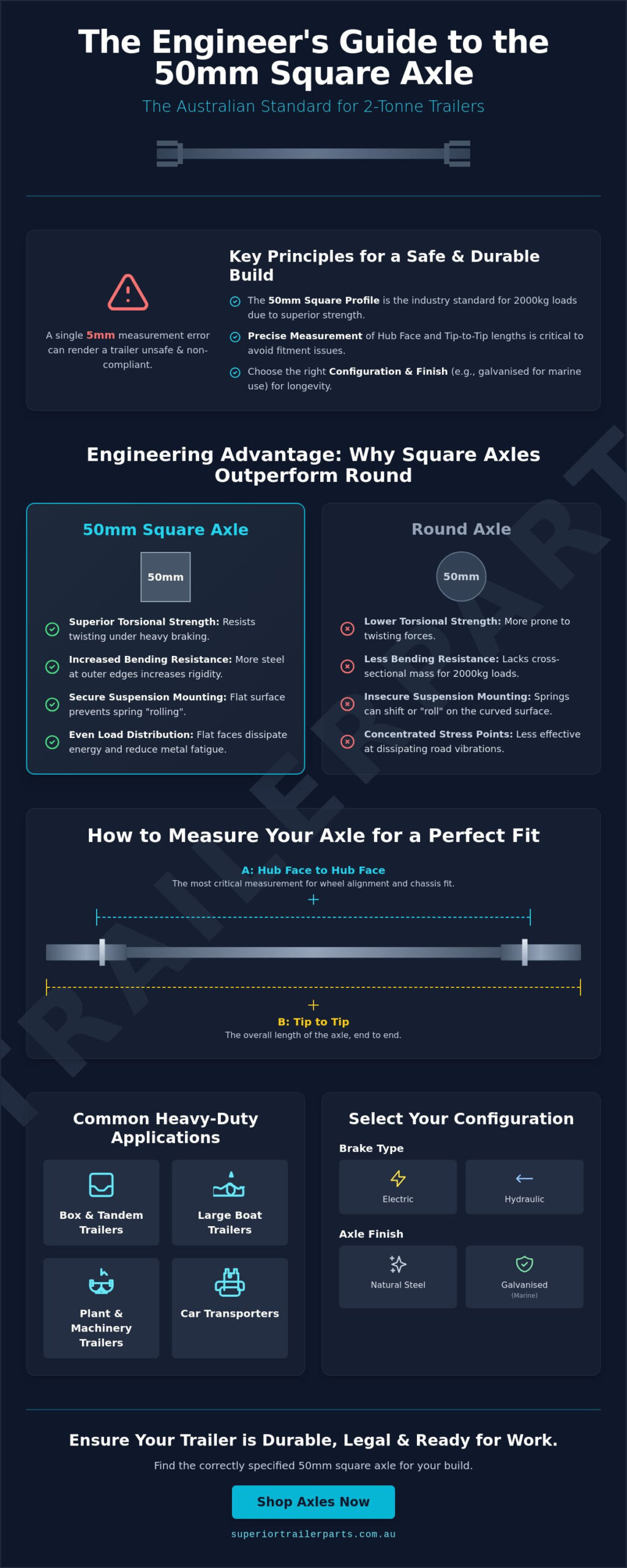
The 50mm square axle 2t capacity is the heavy-duty benchmark for Australian trailers. It’s a solid steel component designed to withstand the rigours of local road conditions and demanding workloads. This specific Axle size is preferred over round alternatives because the square profile offers increased resistance to bending and torsion. When you’re hauling 2,000kg, structural integrity isn’t optional. It’s a requirement for safety and longevity.
We manufacture these axles using high-tensile steel, typically K1045 grade, to ensure they don’t deform under pressure. For those operating near the coast or launching watercraft, galvanised finishes provide essential protection. This coating prevents the oxidation that compromises structural steel in salt-water environments. Selecting a 50mm square axle 2t capacity ensures your trailer meets the Australian Design Rules (ADR) for heavy trailers. These rules, specifically VSB1, dictate that any trailer with a Gross Trailer Mass (GTM) over 750kg must have components rated for the specific load. For a 2,000kg single-axle setup, the 50mm square bar is the standard choice to remain compliant and safe.
The Role of Axle Rating in Trailer Safety
Exceeding your axle’s rated capacity leads to catastrophic failure on Australian roads. When an axle is overloaded, it loses its ability to track straight, causing excessive tyre wear and unpredictable handling. In extreme cases, the steel can snap at the bearing journal, leading to a total loss of control. You must always align your axle rating with your Gross Trailer Mass (GTM) to maintain a safety margin. The 2t rating is the maximum static load capacity per axle pair.
Common Applications for 2-Tonne Square Axles
These axles are the go-to solution for several demanding trailer types. You’ll find them on heavy-duty box trailers and tandem car transporters where weight distribution is critical. They’re also essential for large boat trailers that require marine-grade corrosion resistance and high load ratings for heavy hulls. Additionally, agricultural operators use them for plant trailers to transport machinery like mini-excavators or scissor lifts. These applications demand a “get-the-job-done” component that won’t fail when the terrain gets rough.
Engineering Advantages: Why Square Axles Outperform Round Alternatives
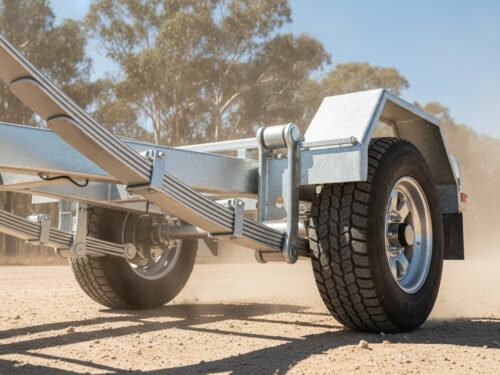
Choosing a 50mm square axle 2t capacity beam provides a structural advantage over round alternatives. A square profile places more steel at the outer edges of the cross-section. This geometry increases the moment of inertia, making the beam significantly harder to bend. Round axles of the same diameter often lack the cross-sectional mass required for heavy 2,000kg loads. The flat surfaces also simplify the manufacturing process. Stub axles can be aligned more accurately against the flat faces of the beam. This ensures the wheels run true and reduces tyre wear over long distances.
Torsional Strength and Load Distribution
Square axles excel at resisting torsion. When you apply heavy braking to a 2-tonne trailer, the axle experiences high rotational torque. A square beam resists this twisting force more effectively than a round tube. This rigidity prevents the axle from bowing or warping under extreme stress. Road vibrations also impact the longevity of your trailer. The flat faces of a square beam dissipate energy more evenly across the steel. This reduces the risk of metal fatigue during long hauls on corrugated roads. For 2-tonne applications, the extra mass of a 50mm square beam is essential. It ensures the trailer remains stable even when meeting Federal Axle Weight Standards during interstate transport. The 50mm thickness provides a 25% increase in surface area for load distribution compared to smaller 45mm alternatives.
Compatibility with Heavy-Duty Suspension
The weld surface area is another key benefit. A square profile offers four distinct weld points with maximum surface contact for the stub axle. This prevents the stub from shifting or snapping under vertical load. If you need a beam that won’t quit, browse our range of heavy-duty axles to find the right fit for your build.
Selecting the Right Configuration for Your 2t Axle
Choosing the right 50mm square axle 2t capacity configuration depends on your trailer’s purpose and the environment it’ll face. You first need to decide on the axle profile. Straight axles are the standard choice for most utility trailers. If you need a lower deck height for easier loading, a drop axle moves the hub center above the axle beam. Overlay axles are also available for specific clearance needs. Each choice impacts how your trailer tracks and handles on the road. Don’t guess which one fits your frame; measure your spring centers and hub face requirements accurately before ordering.
Environmental factors dictate your finish. Natural steel is a functional choice for dry, inland use where moisture is minimal. For anything involving water, specifically marine applications, hot-dipped galvanised finishes are essential. Galvanising provides a thick protective layer that prevents the structural integrity of the steel from being compromised by salt and oxidation. It’s a small investment that adds years to the life of your equipment. Check our full range of axles to find the right finish for your build.
Braked vs. Unbraked Axle Requirements
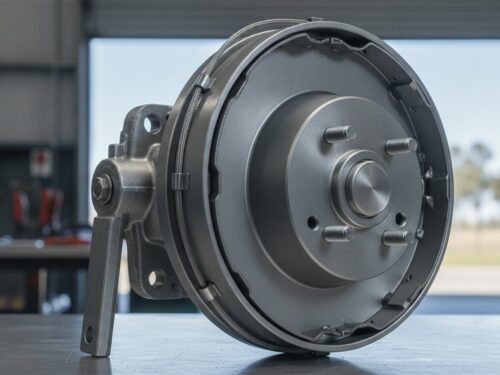
ADR Rule 38 requires all trailers with an ATM over 750kg to have functional braking systems. Since a 50mm square axle 2t capacity is designed for heavy loads, you cannot run this setup unbraked. For a 2000kg rating, 10 inch electric drum brakes are the industry standard. They allow the driver to adjust braking force from the cab using a controller. Hydraulic disc brakes are an alternative, often preferred for boat trailers because they’re easier to rinse after salt exposure. If your total trailer weight exceeds 2000kg, you must move to a tandem axle setup with brakes on all wheels to remain compliant.
Stub Axle and Bearing Compatibility
Bearing choice is critical for longevity. While “Slimline” bearings are common on lighter trailers, they aren’t suitable for 2t ratings. You must use “Parallel” bearings. This configuration utilizes two large, identical bearings on the stub axle. This increases the load-bearing surface area, allowing the assembly to handle 2000kg without overheating or premature wear. When inspecting your axle, use this checklist for the stub axle weld:
- Verify a 360-degree consistent weld bead around the stub.
- Check for deep penetration into the 50mm square tube.
- Ensure there’s no visible undercut or porosity in the weld.
- Confirm the stub is perfectly aligned with the beam to prevent tyre scrubbing.
Superior Trailer Parts focuses on high-quality welds because a failure at 100km/h isn’t an option. We are Australian Owned and Operated, ensuring our gear meets the demands of local conditions. Our components are built for those who value durability over marketing fluff.
How to Measure Your 50mm Square Axle for a Perfect Fit
Precision is mandatory when measuring a 50mm square axle 2t capacity. Because these axles support 2,000kg of gross trailer weight, a measurement error of even 10mm can lead to uneven tyre wear or catastrophic suspension failure. Don’t rely on rough estimates. Grab a steel tape measure and a second person to hold the other end for the most accurate results.
- Step 1: Determine the Hub Face to Hub Face (HF-HF) measurement. This is the distance between the two flat surfaces where the wheel rims sit against the hubs. It defines your trailer track width.
- Step 2: Measure the Tip to Tip (T-T) length. This is the total length of the axle from the very end of one threaded stub to the other. Use this figure when ordering bare axles without hubs fitted.
- Step 3: Calculate the spring centre distance. Measure from the centre of one spring to the centre of the other. For a 50mm square axle 2t capacity, this alignment must be perfect to prevent the leaf springs from twisting or binding during travel.
- Step 4: Verify the wheel offset. Check if your wheels are positive, negative, or zero offset. This affects how much of the tyre sits inside or outside the hub face.
- Step 5: Identify the required stud pattern. Common Australian patterns include Ford (5 studs at 114.3mm PCD), HQ (5 studs at 120.65mm PCD), or Landcruiser 6-stud (139.7mm PCD).
Understanding Hub Face vs. Tip to Tip
Hub Face is the most critical measurement for wheel clearance. It’s the surface where the wheel actually meets the hub. If you change from drum brakes to disc brakes, your HF-HF measurement often changes because disc rotors have different thicknesses than drum faces. Tip to Tip includes the threaded portion of the stub axle. Always specify which measurement you’re providing when placing an order to avoid receiving an axle that’s too short for your chassis.
Critical Clearances for Heavy Loads
Heavy-duty trailers carrying 2,000kg require significant clearance for suspension movement. Aim for a minimum gap of 50mm between the tyre sidewall and the trailer chassis. Under full load, leaf springs flatten out and components flex. If you don’t calculate this gap correctly, you’ll experience “guard rub,” which destroys tyres and damages the trailer frame. Calculate your required HF-HF by adding your chassis width to twice the clearance and accounting for your wheel offset. This ensures the 50mm square axle 2t capacity performs safely under maximum compression.
Get the right components for your next project. Browse our selection of heavy-duty trailer axles today.
Maintenance and Safety Standards for Heavy-Duty Axles
Maintaining a 50mm square axle 2t capacity requires a disciplined approach. Heavy-duty trailer axles face extreme stress under full loads, especially on corrugated Australian roads. You must inspect your setup every 5,000 kilometres or annually, whichever comes first. Use a straight edge to check the beam for bowing. A bent axle is a clear sign of consistent overloading or a severe impact. You should also look for hairline cracks near the spring seats or weld points. These are critical failure points that compromise the structural integrity of your trailer.
Superior Trailer Parts provides ADR-compliant components that meet strict Australian safety standards. This ensures your build remains legal and safe on the road. Using a 50mm square axle 2t capacity setup provides the strength needed for heavy hauling, but it isn’t a “set and forget” component. Regular checks prevent minor issues from turning into catastrophic failures. Always verify that your U-bolts remain tight and that the axle hasn’t shifted on the leaf springs.
Bearing and Seal Maintenance
Bearing failure is a leading cause of roadside breakdowns. You should use marine-grade seals for boat trailers to prevent water ingress. These seals feature a double-lip design and a stainless steel spring to maintain a tight grip on the axle journal. Inspect bearing races for pitting, which appears as small craters on the metal surface. Look for blue or black heat discoloration. These marks suggest lubrication failure or excessive friction. When reassembling, tighten the axle nut until the hub binds, then back it off 1/6th of a turn. This creates the necessary end-play for thermal expansion during long hauls.
Corrosion Protection and Longevity
Corrosion destroys structural integrity over time. Hot-dipped galvanising is the industry standard for 2t axles because it provides a metallurgical bond. This process protects the steel inside and out. Cold-gal spray is only a surface-level coating. It won’t withstand the rigours of heavy-duty applications or constant stone pecking. If you use your trailer for boat launching, salt-water is your primary enemy. Always wash down your axles with fresh water immediately after salt-water immersion. Focus on the areas behind the hubs and around the spring hangers where salt crystals build up. This simple step extends the life of your components by years. Contact our expert team for technical support on your next build.
Equip Your Trailer for Heavy-Duty Performance
Selecting a 50mm square axle 2t capacity is a critical decision for any high-load trailer build. Engineering standards indicate that square profiles provide superior resistance to bending compared to round alternatives of the same diameter. You now understand how to calculate your hub-to-hub dimensions accurately and why regular bearing inspections prevent costly roadside failures. These components are built to withstand the rigours of the Australian landscape while maintaining a strict 2,000kg load rating.
Superior Trailer Parts is Australian Owned and Operated; we understand the harsh demands of local conditions. We provide expert technical advice for DIY enthusiasts and trade professionals to ensure your configuration is safe and compliant. Our team handles nationwide shipping on all heavy-duty components to get your trailer back on the road without delay. We focus on providing genuine parts that deliver long-term reliability and strength.
View our range of heavy-duty 50mm square axles and secure the right hardware for your next project. It’s time to build a trailer that’s as hardworking as you are.
Frequently Asked Questions
Can I use a 50mm square axle on a single axle trailer rated for 2 tonnes?
Yes, a 50mm square axle is the industry standard for 2,000kg ATM single axle setups. It provides the necessary cross-sectional strength to support the load without excessive flexing. You must ensure your springs and hubs also meet the 2t rating to maintain system integrity. Using a 50mm beam ensures the trailer remains stable under full load conditions on rough Australian roads.
What is the difference between a 45mm and a 50mm square axle?
The primary difference is the load rating and material volume. A 45mm square axle typically supports up to 1,450kg, while a 50mm square axle 2t capacity unit handles 2,000kg. The 5mm increase in width adds approximately 23% more steel, significantly increasing the beam’s resistance to bending under heavy loads. Choosing the 50mm option provides a higher safety margin for heavy-duty applications.
Do I need electric brakes for a 2t capacity axle?
Yes, Australian Design Rules (ADR) 38/05 requires all trailers with a GTM over 2,000kg to have brakes on all wheels. For a single axle rated at 2 tonnes, 10 inch or 12 inch electric brakes are the most common choice. These systems provide independent control from the tow vehicle cabin, ensuring safe stopping distances. It’s a legal requirement that keeps you and other road users safe.
What bearings are standard for a 50mm square 2-tonne axle?
A 50mm square axle 2t capacity unit typically uses a heavy-duty bearing set, often referred to as a 2-tonne or 30210/30206 combination. The inner bearing is significantly larger than standard Slimline sets to handle the increased vertical force. Always use high-quality Japanese bearings to ensure longevity. We provide expert advice on bearing maintenance to keep your trailer moving without unexpected downtime or mechanical failure.
How do I know if my axle is ADR compliant?
ADR compliance is verified through the manufacturer’s engineering certification and load rating stamps. A compliant axle must meet the VSB1 (Vehicle Standards Bulletin 1) requirements for strength and safety. We ensure all our 50mm square axles are manufactured to these national standards. This commitment to quality is what you expect from an Australian Owned and Operated specialist focused on durability and performance.
Can a 50mm square axle be shortened or modified?
You can shorten an axle, but it requires professional machining and welding. The spindle must be removed, the beam cut to the correct length, and the spindle re-inserted and welded using a V-groove technique. Incorrect welding can lead to structural failure, so we recommend ordering a custom-length axle built to your exact specifications. This ensures the structural integrity of the 2,000kg rating remains intact for heavy use.
Why should I choose a galvanised axle over a painted one?
Hot-dipped galvanised axles provide superior corrosion resistance, especially in coastal or marine environments. The zinc coating bonds with the steel to prevent rust for up to 25 years in standard conditions. Painted axles are cheaper but require frequent maintenance to prevent surface oxidation from road debris and moisture. For trailers exposed to salt water or harsh weather, galvanisation is the only reliable choice for long-term durability.
What U-bolt size do I need for a 50mm square axle?
You need 50mm square U-bolts, typically with a 1/2 inch or 5/8 inch thread diameter for 2t applications. Ensure the internal width is exactly 50mm to fit the axle beam securely. Using the wrong size can cause the axle to shift, leading to dangerous trailer sway. Superior Trailer Parts provides expert advice and shipping Australia Wide for all heavy-duty mounting hardware to get your project finished correctly.