Your trailer’s roadworthiness isn’t determined by the thickness of your chain, but by the legality of your smallest shackle. One non-compliant component can turn a secure setup into a legal and safety liability. Understanding the trailer safety chain regulations australia mandates is essential for anyone towing heavy loads. Confusion over conflicting state versus national advice is a common problem, but staying informed is the only way to avoid heavy fines and equipment failure.
You will master the legal requirements for trailer safety chains to ensure your setup is compliant, secure, and roadworthy. This practical overview provides the clarity you need to move forward with confidence. We cover the specific ADR 62/02 requirements and the correct way to identify correctly stamped chains. We also address the strict rules regarding welding chains to the drawbar versus using rated shackles. This knowledge ensures your trailer attachment system is built for durability and total compliance with national standards.
Key Takeaways
- Identify how trailer safety chain regulations australia apply to your setup under ADR 62/02 for trailers up to 3.5 tonnes ATM.
- Match your chain strength to your trailer’s Aggregate Trailer Mass to maintain legal compliance and road safety.
- Determine the legal requirements for attaching chains, including the specific rules for welding versus using rated shackles.
- Apply practical fitting techniques like crossing dual chains to catch the drawbar if a coupling failure occurs.
- Source hardware designed for Australian conditions to ensure every component of your towing system meets national standards.
Understanding Australian Safety Chain Standards and Legal Frameworks
Adhering to trailer safety chain regulations australia is a fundamental requirement for anyone operating towed equipment on public roads. These rules exist to ensure heavy loads remain attached to the towing vehicle during a mechanical failure. The primary framework for these requirements is the Vehicle Standard (Australian Design Rule 62/02 – Mechanical Connections Between Vehicles) 2007. This national standard dictates the design and strength of all couplings and parts used in towing setups. It covers everything from the tow ball to the specific chain links used to secure the drawbar.
Safety chains are mandatory for all trailers with an Aggregate Trailer Mass (ATM) up to 3.5 tonnes. If you operate a trailer exceeding this 3.5-tonne threshold, the regulations shift to require specific steel cable or high-tensile chain systems designed for extreme loads. The primary purpose of the chain is simple. It provides a failsafe connection if the primary coupling fails or becomes detached. This prevents the trailer from wandering into oncoming traffic or leaving the road entirely. Compliance isn’t just about avoiding a fine; it’s about preventing catastrophic accidents through proven hardware standards.
The Role of AS 4177.4 in Trailer Safety
AS 4177.4 is the national standard for trailer safety chains up to 3.5t ATM. This standard defines the specific manufacturing and testing protocols that a chain must undergo before it hits the market. It isn’t enough for a chain to look strong. It must demonstrate precise tensile strength and elongation properties. These towing hitch components are engineered to absorb the sudden shock of a trailer dropping onto the chains without snapping. A compliant chain will typically feature stamps at regular intervals to indicate its rating and origin.
National vs State Regulations: What You Need to Know
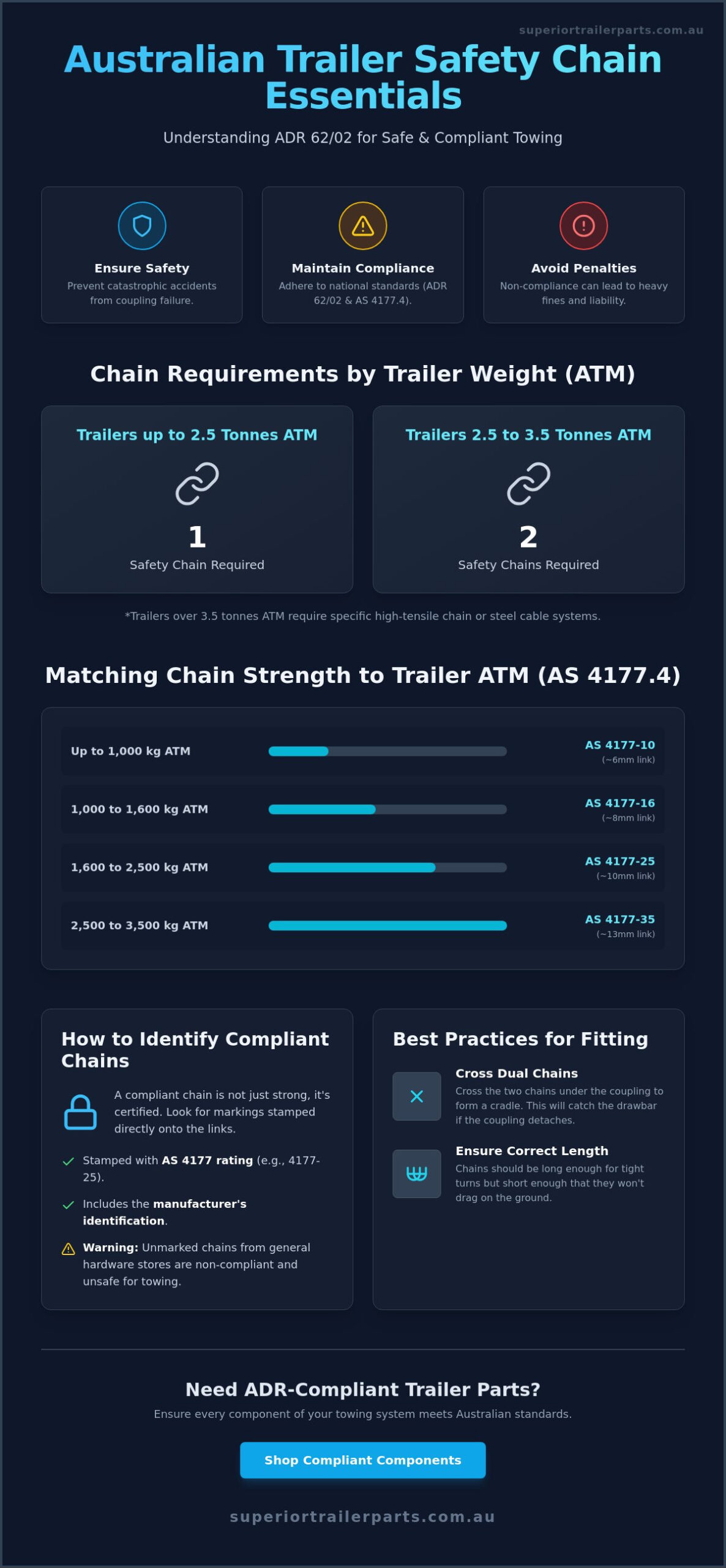
Consistency across state lines is the foundation of Australian road safety. While the Australian Design Rules (ADRs) provide the national technical specifications, individual state authorities handle the day-to-day enforcement of these rules. Following national standards ensures your trailer remains legal whether you are in Queensland or Western Australia. The Aggregate Trailer Mass (ATM) is the critical figure in determining your specific legal requirements. For instance, trailers up to 2.5 tonnes ATM require at least one compliant safety chain. Once the trailer’s ATM exceeds 2.5 tonnes, the law requires the fitment of two safety chains. Understanding your trailer’s weight is the first step toward achieving full compliance.
Safety Chain Ratings: Matching Chain Strength to Trailer ATM
Selecting a chain based on appearance is a dangerous mistake. Under trailer safety chain regulations australia, the breaking strain of your safety chain must exceed the Aggregate Trailer Mass (ATM) of your fully loaded trailer. This means a 2,000kg ATM trailer cannot legally use a chain rated for only 1,600kg. You must verify the capacity before installation. Using undersized hardware is a primary cause of road failure and will result in heavy fines during a roadside inspection.
Use the following breakdown to match your trailer’s ATM to the correct chain rating:
- ATM up to 1,000kg: Requires AS 4177-10 (typically 6mm link diameter).
- ATM 1,000kg to 1,600kg: Requires AS 4177-16 (typically 8mm link diameter).
- ATM 1,600kg to 2,500kg: Requires AS 4177-25 (typically 10mm link diameter).
- ATM 2,500kg to 3,500kg: Requires AS 4177-35 (typically 13mm link diameter).
Required Stamping and Identification Markers
Legitimacy is found in the steel. A compliant safety chain is stamped at regular intervals, typically between every 150mm and 500mm. These stamps must include the manufacturer’s identification and the AS 4177 rating. If a chain is unbranded or purchased from a general hardware store without these markings, it is a liability. Non-compliant chains often lack the necessary ductility to stretch under load. This leads to immediate snapping during a coupling failure. Always check that the stamp matches the ATM of your tandem axle trailers or single axle setups before hitting the road.
ATM Categories and Chain Configuration
The number of chains you need depends entirely on weight. Trailers under 2,500kg ATM can operate with a single safety chain, provided it meets the strength requirements for that specific load. Once you cross into the 2,500kg to 3,500kg range, dual chains become mandatory. These dual chains must be attached to either side of the drawbar to provide balanced support. For trailers exceeding 3,500kg, the hardware requirements shift significantly. These heavy-duty setups require short-link lifting chains with a minimum 800 MPa breaking stress. If you are building a heavy-duty setup, ensure you source quality trailer parts that meet these specific industrial standards. For dual chain setups, the attachment points must be as near as practicable to the coupling. This configuration is designed to prevent the drawbar from hitting the ground if the primary connection fails.
Legal Attachment Methods: Welding, Shackles, and Hammerlocks
Compliance isn’t just about the chain itself; it’s about how that chain is secured. Under trailer safety chain regulations australia, chains must be permanently fixed to the trailer drawbar. You cannot simply use a standard bolt and nut. The attachment point must withstand the same forces as the chain. If your coupling fails, the attachment point is the only thing standing between a controlled stop and a runaway trailer. Chain length is also critical. It should be long enough to allow full turning circles but short enough to prevent the drawbar from digging into the road surface. This creates a “cradle” effect that supports the drawbar during a failure.
Welding Chains to the Drawbar
Welding is the standard method for trailers up to 3.5 tonnes ATM. However, you must follow the “50% Rule” to stay legal. This means the weld must extend around at least half the circumference of the link being attached. The adjoining link must remain completely free to move. If you weld too much of the chain, you create a brittle point that will snap under tension. Structural welding like this should be performed by a professional to ensure the weld penetrates the drawbar correctly without weakening the surrounding steel. For trailers exceeding 3.5 tonnes ATM, welding chains to the drawbar is strictly prohibited.
Rated Shackles and Hammerlocks
When connecting the chain to the tow vehicle, you must use rated hardware. Shackles must be marked with a Work Load Limit (WLL) and comply with AS 2741. Look for yellow-pin or high-tensile rated shackles rather than stainless steel or unrated hardware. The shackle’s break load limit must be at least 1.5 times the trailer’s ATM. While shackles are common at the vehicle end, they aren’t permitted for attaching the chain to the drawbar on trailers under 3.5 tonnes.
Hammerlocks are the preferred method for creating a permanent, high-strength mechanical connection. A hammerlock consists of two halves joined by a pin and sleeve. Once installed, it cannot vibrate loose like a threaded shackle pin. This makes it an ideal choice for securing chains to heavy-duty couplings and parts. Using a hammerlock removes the risk of human error, such as forgetting to tighten a shackle pin or failing to use a safety wire. It provides a permanent solution that satisfies the requirement for a fixed attachment point on the trailer side.
Best Practices for Fitting and Maintaining Safety Chains
Proper installation is as vital as the hardware itself. Even the highest-rated chain fails if it drags on the road or tangles with other components. Adhering to trailer safety chain regulations australia requires more than just selecting the right link size. You must ensure the entire setup allows for full articulation without allowing the drawbar to hit the bitumen. Perform a visual check while the trailer is hitched. Incorrectly fitted chains often interfere with electrical plugs and braking cables. This leads to intermittent light failure or accidental brake engagement. Secure your chains so they remain functional throughout the full range of movement of your towing hitch.
The “Cradle” Effect: Why Crossing Chains Matters
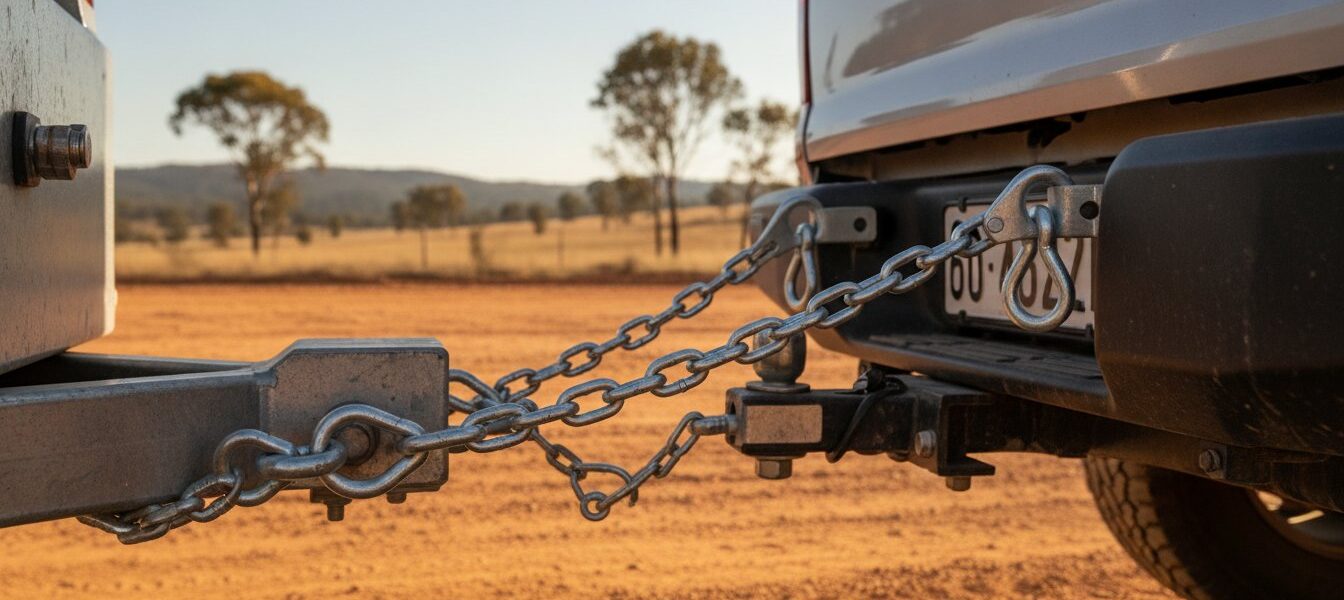
Crossing your dual safety chains is a critical safety measure. This configuration creates a physical cradle underneath the trailer drawbar. If the coupling detaches from the tow ball, the crossed chains catch the drawbar before it digs into the road surface. This prevents the trailer from “diving.” A diving trailer can flip or cause the tow vehicle to lose control instantly. Crossing the chains also helps keep the trailer tracking behind the vehicle during a disconnect event. It provides a small window of time to bring the combination to a controlled stop. Maintain enough slack for sharp turns, but keep the chains high enough to avoid ground contact.
Inspection and Replacement Checklist
Hardware degrades over time. Road salt, moisture, and physical friction eventually wear down steel links. Inspect your chains for rust pitting, stretching, or thinning at the contact points. Look specifically at the points where links rub against each other. This is where friction wear is most aggressive. If you notice the links have become shiny or flat on one side, measure the thickness. Elongation is another sign the chain has been stressed beyond its limit. Check your rated shackles for deformed pins or stripped threads. If a shackle pin is difficult to turn by hand, the housing may be warped. Any chain showing more than 10% wear on any link must be replaced immediately. Regular inspection is the only way to ensure ongoing roadworthiness. For more information on maintaining your setup, consult our resource on essential trailer parts.
If you find signs of wear, replace your components immediately with high-quality trailer parts designed for Australian conditions.
Sourcing ADR-Compliant Safety Components in Australia
Securing your load requires more than just meeting the bare minimum. While many retailers offer generic hardware, these parts often lack the verified certification needed to satisfy trailer safety chain regulations australia. Superior Trailer Parts provides heavy-duty hardware specifically engineered for the harsh conditions of the Australian transport sector. We stock a comprehensive range of rated chains, shackles, and hammerlocks that meet or exceed national standards. Accessing these components is straightforward. Our nationwide shipping ensures that professional fleet managers and individual users can source reliable parts regardless of their location.
Why Quality Hardware Prevents Compliance Failures
Finding the Right Parts for Your Trailer
Selecting the correct safety chain starts with knowing your trailer’s capacity. You should first determine your Aggregate Trailer Mass (ATM) by looking at your specifications. The choice of axles and braking systems often dictates this weight limit. Once you have this figure, you can select the appropriate chain diameter and shackle rating. You can browse our full range of trailer parts to find the specific hardware required for your next build or repair. If you have specific compliance questions or need help navigating technical requirements, please contact us. Our team provides the direct, practical advice you need to keep your trailer secure and legal on every journey.
Secure Your Load with Certified Safety Components
Maintaining compliance with trailer safety chain regulations australia is a continuous responsibility. You now understand how to match chain strength to your trailer’s ATM and the specific legal requirements for attachment. Whether you are welding to the drawbar or using rated hammerlocks, using certified hardware is the only way to ensure roadworthiness. Regular inspections for link wear and shackle deformation prevent mechanical failures before they occur on the road.
Superior Trailer Parts has been Australian-owned and operated since 2014. We are specialists in ADR-compliant trailer manufacturing and provide a comprehensive range of rated safety components. Our team understands the harsh conditions your equipment must endure. We offer nationwide shipping to ensure you have access to the right hardware regardless of your location. Don’t risk your safety or legal standing with unrated components from general retailers.
Shop ADR-Compliant Trailer Parts and Safety Hardware to upgrade your setup today. Build a secure and legal towing system with confidence.
Frequently Asked Questions
Do I need one or two safety chains on my trailer?
You need at least one safety chain for trailers with an Aggregate Trailer Mass (ATM) up to 2.5 tonnes. If your trailer’s ATM is between 2.5 and 3.5 tonnes, the law requires you to fit two safety chains. These chains must be attached to either side of the drawbar to provide balanced support. Always check your trailer’s compliance plate to confirm its mass before selecting your hardware.
Can I weld my own safety chains to the trailer drawbar?
You can weld safety chains to the drawbar on trailers up to 3.5 tonnes ATM. The weld must cover at least 50% of the link’s circumference to meet legal standards. It’s vital that the adjacent link remains free to move for full articulation. If your trailer exceeds 3.5 tonnes, welding is strictly prohibited. Professional welding is recommended to ensure the structural integrity of the connection point.
What markings should I look for on a legal safety chain?
Look for the manufacturer’s identification and the AS 4177 rating stamp on the chain links. These markings should appear at regular intervals between 150mm and 500mm. This identification confirms the chain meets the specific tensile strength and elongation standards required by law. Unbranded chains found in general hardware stores often lack these markings and don’t comply with trailer safety chain regulations australia.
Are D-shackles legal for towing in Australia?
D-shackles are legal for towing if they comply with Australian Standard AS 2741. The shackle must be marked with its Work Load Limit (WLL) and the manufacturer’s name. It’s important that the shackle’s breaking load is at least 1.5 times the trailer’s ATM. Avoid using unrated shackles, as they aren’t designed to withstand the sudden forces of a trailer disconnect. Yellow pin shackles are a common indicator of a rated component.
How long should my trailer safety chains be?
Your safety chains should be short enough to prevent the drawbar from hitting the ground during a failure. They must also be long enough to allow the vehicle to complete sharp turns without binding or pulling. Achieving this balance creates a “cradle” effect when dual chains are crossed. Test the length while the trailer is hitched to ensure it doesn’t drag on the bitumen during normal travel.
Can I use a stainless steel chain for my boat trailer?
You shouldn’t use standard stainless steel chains as safety chains because they often lack the required AS 4177 rating. While stainless steel offers corrosion resistance, it’s frequently more brittle than galvanized high-tensile steel. This makes it prone to snapping under sudden shock loads. Always prioritize the load rating and Australian Standards over aesthetic concerns for your safety connections to ensure the trailer remains secure.
What is a hammerlock and when should I use one?
A hammerlock is a high-strength mechanical coupling link used to permanently connect safety chains to rated attachment points. It consists of two halves joined by a pin and sleeve. Use a hammerlock when you want a permanent connection that can’t vibrate loose like a threaded shackle pin. They are an excellent solution for securing heavy-duty chains to your trailer’s coupling system and are widely used in the transport industry.
Do safety chain regulations differ between states like QLD and NSW?
Technical trailer safety chain regulations australia are consistent across all states because they are governed by national Australian Design Rules. While state authorities handle enforcement and roadside inspections, the hardware requirements remain the same nationwide. Following the national ADR 62/02 standards ensures your trailer is legal in every jurisdiction. This consistency allows you to tow across state borders without needing to modify your safety equipment for different regions.