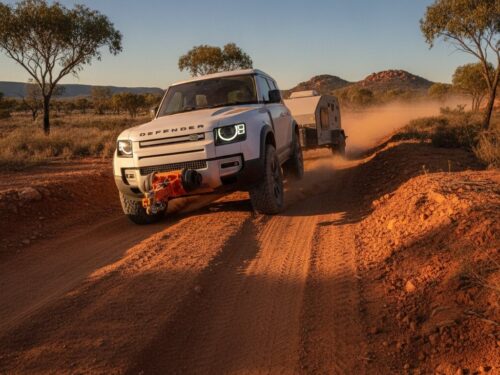
What if your standard 50mm tow ball is the weakest link in your entire off-road setup? It’s a risk many drivers don’t consider until they’re stuck on a rutted track with a binding coupling. You need a connection that handles extreme vertical and horizontal angles without failing. Finding the best off road hitch for camper trailer use is about ensuring your gear survives the Australian outback. You want equipment that’s as hardworking and resilient as your vehicle.
We understand the frustration of trying to hitch up on unlevel ground or the fear of a mechanical failure in a remote region. Discover how to choose a reliable off-road coupling that handles extreme articulation and ensures your camper trailer survives the harshest Australian tracks. This article examines the technical differences between poly block and articulating pin hitches. We’ll explain why 360-degree rotation is essential and provide a practical framework for selecting a hitch that meets ADR 62/02 standards. Choose a hitch that prioritizes durability and performance to ensure your equipment lasts as long as your trailer.
Key Takeaways
- Understand why standard 50mm tow balls bind on uneven terrain and how this leads to mechanical failure.
- Identify essential features like high-range articulation and integrated dust seals that protect internal components from outback grit.
- Compare poly block and universal joint designs to determine the best off road hitch for camper trailer stability and flexibility.
- Learn a routine maintenance schedule for inspecting mounting bolts and internal bushes to ensure safety in remote locations.
- Select hardware based on your trailer’s Aggregate Trailer Mass (ATM) and drawbar height for optimal towing performance.
Why Standard Tow Balls Fail in Off-Road Conditions
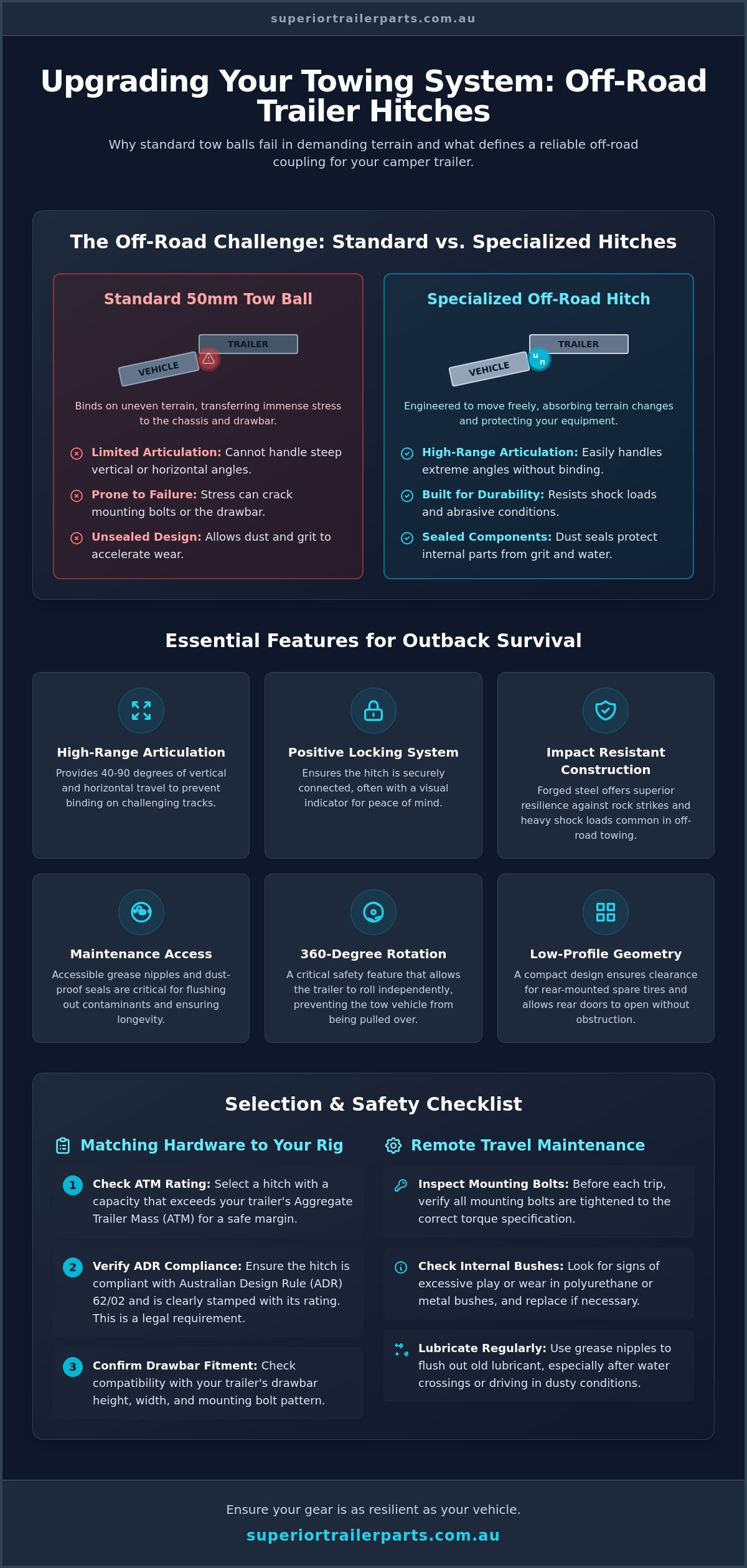
Standard 50mm tow balls serve a specific purpose. They are designed for bitumen roads where vertical and horizontal angles remain relatively constant. On a flat highway, a standard tow hitch performs reliably because the socket rarely encounters the physical limits of the ball’s neck. Off-road conditions change this dynamic entirely. Standard equipment simply cannot cope with the extreme terrain found on Australian tracks.
When you enter a deep washout or climb a steep embankment, the trailer and vehicle move on different planes. A standard coupling quickly runs out of travel. Once the edge of the coupling hits the tow ball’s stem, the joint “binds.” This creates a rigid connection where there should be flexibility. Instead of the hitch absorbing the movement, the force is transferred directly into the tow bar and the trailer drawbar. This immense pressure can cause structural cracks or even total failure of the mounting bolts. Selecting the best off road hitch for camper trailer use ensures your setup can articulate without causing mechanical damage.
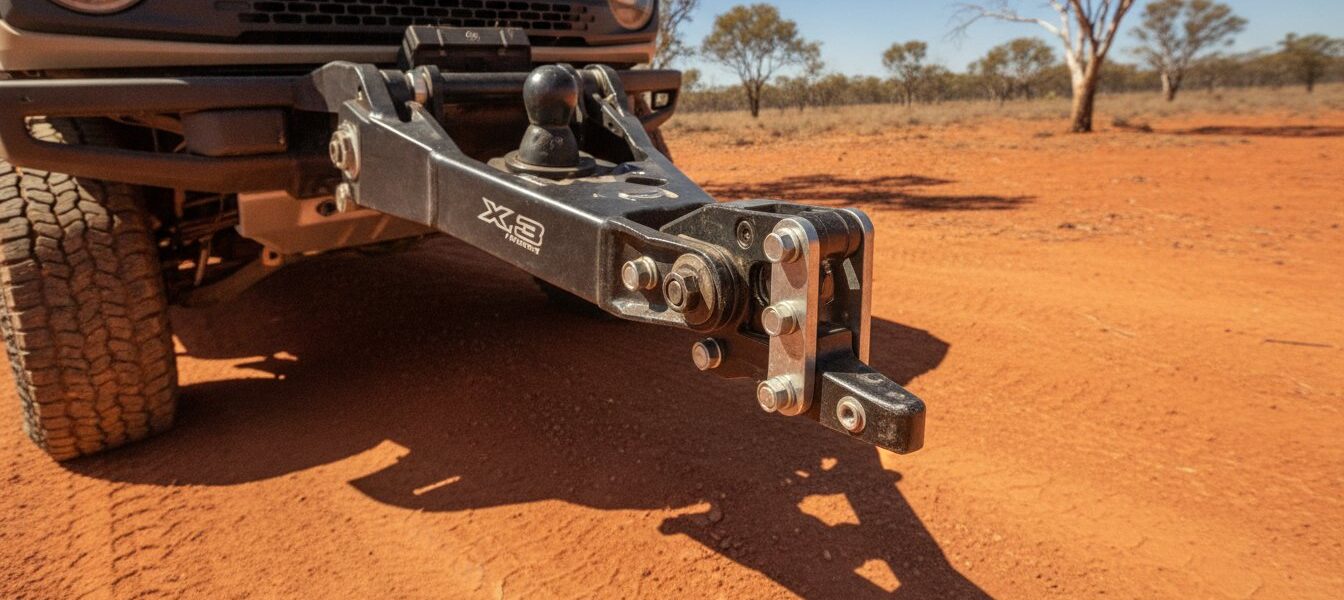
A dedicated off-road hitch allows for vertical and horizontal movement without restriction. These specialized couplings and parts are engineered to handle the high-stress environments of the outback. They provide the necessary clearance to prevent binding, protecting your vehicle’s chassis from unnecessary leverage.
The Problem with Limited Articulation
Limited articulation is a safety hazard on uneven tracks. As the towing vehicle descends a steep incline while the trailer is still on level ground, the coupling is forced to its vertical limit. In extreme cases, the upward pressure can force the coupling to pop off the ball. Dust and grit also play a role. Standard ball housings aren’t sealed. Fine sand enters the housing and acts like sandpaper, grinding down the metal surfaces. This wear creates excessive play in the hitch, making the trailer unstable and prone to detaching during remote travel.
Understanding 360-Degree Rotation
Safety in a rollover scenario is a critical factor for off-road setups. If your trailer tips on a narrow track, a fixed coupling will act as a lever. It will attempt to flip your vehicle along with the trailer. A hitch with 360-degree rotation allows the trailer to roll independently. This prevents the vehicle from being dragged over, potentially saving lives and preventing total vehicle loss. While standard fixed couplings are suitable for light duties, serious off-road work requires full-rotation units. Finding the best off road hitch for camper trailer safety means prioritizing this independent movement to keep your vehicle rubber-side down.
Essential Features of a Reliable Off-Road Coupling
Selecting the best off road hitch for camper trailer setups requires looking beyond basic towing capacity. You need a component that manages extreme vibration and constant grit while remaining functional. A high-quality off-road trailer hitch overview reveals that articulation is only the starting point. Durability and ease of maintenance are what keep a trailer attached on a corrugated track. Look for these specific features when evaluating hardware.
- High-Range Articulation: Aim for units providing between 40 and 90 degrees of vertical and horizontal travel. This range prevents the binding issues that cause structural damage.
- Maintenance Access: Dust-proof seals are critical for longevity. Easily accessible grease nipples allow you to flush out contaminated lubricant after water crossings or dusty stretches.
- Low-Profile Geometry: Many 4WD vehicles feature rear-mounted spare tires. A low-profile hitch design ensures you can open the rear door without the spare hitting the coupling.
- Positive Locking: Automatic locking mechanisms are preferred. These should include a visual indicator that confirms the hitch is fully seated and secure.
- Impact Resistance: Forged steel construction offers the best resilience against rock strikes and heavy shock loads.
If you’re upgrading your current rig, browsing a professional range of couplings and parts will help you identify which hardware fits your specific drawbar configuration.
ADR Compliance and Safety Ratings
Australian Design Rule (ADR) 62/02 is the mandatory standard for all trailer couplings. It’s a legal requirement. Every compliant hitch must have its D-Value or Aggregate Trailer Mass (ATM) rating clearly stamped on the body. This rating tells you the maximum load the component is engineered to handle safely. Using non-compliant imported hitches exposes you to legal liability and potential insurance claim denials. Always verify the rating before installation. It’s a simple check that ensures your setup remains legal on any road.
Ease of Connection on Uneven Ground
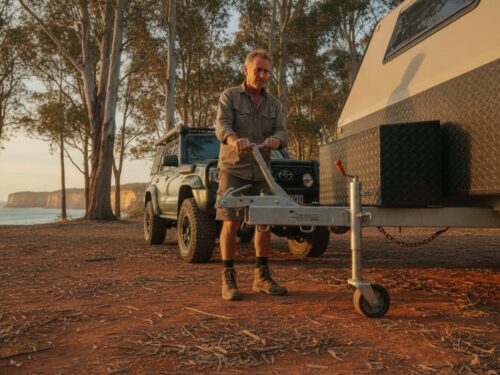
Standard hitches are notoriously difficult to align when your vehicle and trailer aren’t on the same level. Off-road couplings often feature tapered entry points or “funnel” designs that guide the hitch into position. This is vital for solo travelers. To make the process smoother, use a high-quality jockey wheel to fine-tune the height. A sturdy wheel prevents the trailer from shifting as you lower the coupling onto the vehicle. Proper alignment reduces the risk of damaging the hitch mechanism or your vehicle’s bumper during the hook-up process.
Comparing Poly Block Couplings and Articulating Hitches
Choosing the best off road hitch for camper trailer use often comes down to two primary designs: the poly block and the articulating universal joint. Both styles offer significant improvements over the standard tow balls discussed previously. However, they serve different operational needs based on your typical terrain and budget. Poly block hitches rely on a dense polyurethane bush to provide multi-axis movement. This design is fundamentally simple. In contrast, articulating hitches use a mechanical universal joint to achieve maximum flexibility across all planes.
Safety standards remain the baseline for any selection. While Australian tracks have specific demands, looking at international benchmarks like the federal safety requirements for towing helps illustrate why robust coupling mechanisms are non-negotiable. These regulations emphasize that every part of the coupling system must be strong enough to prevent accidental separation under extreme loads. Whether you choose a bush-based or joint-based system, the hardware must be rated for the forces it will encounter in remote areas.
The Case for Poly Block Couplings
Poly Block Off-Road Couplings are a cost-effective and nearly bulletproof option. Their simplicity is their greatest strength. With fewer moving parts, there is less that can fail when you are deep in the bulldust. You don’t have to worry about complex internal springs or locking pins seizing up from fine sand. For many remote travelers, the reliability of a simple bush system outweighs the convenience of more expensive alternatives. It is a utilitarian choice that prioritizes longevity over marketing flash.
When to Choose Articulating Universal Hitches
If your route includes extreme rock crawling, an articulating hitch is often necessary. These units can handle up to 90 degrees of vertical articulation, which is vital for deep ruts and washouts. They are also highly suited for trailers with a heavy ATM exceeding 3000kg. While the purchase price is higher, the ease of solo connection and the extreme range of motion provide a distinct advantage for technical off-roading. You are paying for a higher level of engineering that simplifies the towing experience in difficult environments.
Maintenance and Safety Requirements for Remote Travel
Remote tracks punish hardware. Even the best off road hitch for camper trailer use will degrade without a strict inspection routine. Start by examining the mounting bolts. High-tensile bolts can stretch under the constant shock loads of corrugated roads. If a bolt looks “necked” or the threads appear elongated, replace the entire set immediately. Use a torque wrench to ensure they meet the manufacturer’s specifications. Loose bolts lead to vibration, which eventually causes the mounting holes to flog out.
Check for excessive “play” in the coupling. Lift the trailer drawbar while it is hitched to the vehicle. If you feel or hear a knock, the internal bushes or universal joints are likely worn. This movement increases shock loading on the entire rig. Ensure your safety chains are rated correctly for your Aggregate Trailer Mass (ATM). The chain links and shackles must match the coupling’s capacity to remain legal under Australian Design Rules. Safety chains are your final fail-safe, so don’t ignore signs of rust or worn links.
Grit is the enemy of moving parts. A seized handbrake mechanism is a common failure in dusty regions. Test the lever frequently to ensure it operates smoothly and releases fully. If the mechanism feels gritty, flush it with fresh water and apply a dry-film lubricant that won’t attract sand. A reliable handbrake is essential for safe unhitching on any incline.
Lubrication and Dust Management
Traditional grease is a magnet for abrasive bulldust. While articulating joints require lubrication, over-greasing creates a grinding paste that accelerates wear. Use a protective cover when unhitched to keep the hitch body clear of debris. After beach driving, salt spray will corrode internal springs and pins within hours. Wash the coupling thoroughly with high-pressure fresh water to prevent rust from seizing the locking mechanism. This simple step extends the life of your hardware significantly.
Inspecting Your Trailer Hardware
Hitch performance is directly tied to your trailer’s foundation. A bent axle or worn suspension bushes can cause the trailer to “dog-track,” putting sideways pressure on the coupling. Inspect the drawbar for hairline cracks in the paint, which often signal metal fatigue near the hitch mount. To check for ovalisation, remove the main pin and inspect the holes for an elongated or “egg” shape that indicates the metal has stretched under load. For reliable replacement components, view our full range of heavy-duty couplings and parts designed for harsh conditions.
Selecting the Right Hardware for Your Camper Trailer
The hitch is only one component of a functional towing system. You must match the coupling rating to your trailer’s Aggregate Trailer Mass (ATM) to remain legal and safe. If your trailer weighs 2,500kg when fully loaded, a coupling rated for 2,000kg is a liability. It will fail under the stress of off-road articulation. Always check the rating stamped on the hardware before finalizing your purchase. This ensures the component is engineered for the specific loads it will encounter on remote tracks.
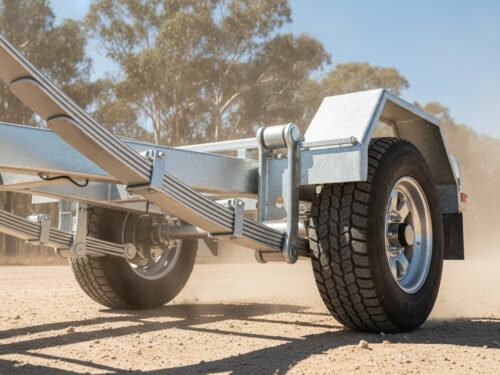
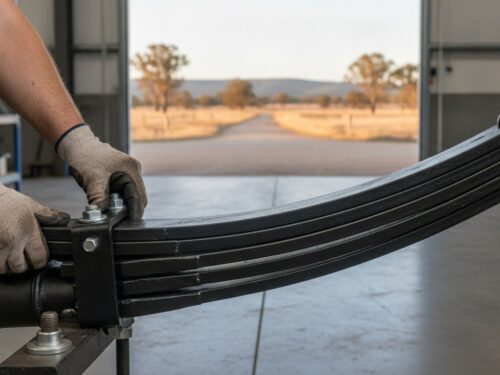
Consider the geometry of your towing vehicle. The height of your tow bar relative to the trailer drawbar determines the towing angle. An uneven setup causes “nose-diving” or “tail-dragging,” which negatively impacts braking and steering. The best off road hitch for camper trailer stability requires synergy with your suspension system. Integrate your hitch choice with heavy-duty leaf springs to ensure a balanced ride. A high-articulation hitch paired with inadequate springs leads to excessive pitching on rough terrain. Ensure all components meet Australian safety standards to maintain structural integrity during extreme travel.
Customising Your Off-Road Setup
Secure mounting is a priority for any off-road build. Use galvanised U-bolts to fix axles and springs firmly to the chassis. These bolts resist corrosion and prevent the suspension from shifting during high-impact rock crawling. Balance your tongue weight carefully to improve stability on corrugated roads. Aim for approximately 10% of the total trailer weight on the hitch. Professional advice is essential for heavy-duty builds to ensure your axle, springs, and coupling work as a unified system.
Next Steps for Your Build
Transitioning from a standard ball to an articulating system is a practical upgrade for any serious traveler. This process involves removing the old coupling and verifying that the mounting holes on the drawbar match the new unit’s pattern. If the holes don’t align, you may need a qualified fabricator to modify the drawbar mounting plate. For technical support on Australian towing requirements or to find reliable hardware, contact Superior Trailer Parts. Our team provides the expert knowledge and durable components needed to survive the harshest outback conditions.
Secure Your Setup for the Track Ahead
A successful off-road adventure depends on the reliability of your mechanical connections. You now understand that standard tow balls lack the articulation required for uneven terrain and that ADR compliance is a non-negotiable safety requirement. Whether you choose a poly block or an articulating joint, the best off road hitch for camper trailer use is one that matches your trailer’s ATM and receives regular maintenance. Checking for bolt fatigue and keeping joints clear of abrasive grit will ensure your hardware survives the most demanding environments.
Superior Trailer Parts is an Australian-owned and operated specialist providing high-quality components designed for harsh conditions. We offer nationwide shipping across Australia to get your parts delivered wherever you’re based. Protect your investment and your safety by choosing gear that’s built for the outback and backed by technical expertise. Browse our range of ADR-compliant off-road couplings today. Prepare your trailer for the toughest conditions with hardware you can trust on every track.
Frequently Asked Questions
Do I need to change my tow ball to use an off-road hitch?
Most off-road hitches require you to remove the standard 50mm tow ball. You’ll install a specialized pin or receiver that matches the coupling’s unique design. This change is necessary to achieve the articulation required for uneven terrain. Always verify that your tow bar’s tongue is compatible with the new hardware before you begin the installation process.
Are off-road hitches legal for use on highways and sealed roads?
Off-road hitches are fully legal for highway use across Australia if they meet ADR 62/02 standards. You must ensure the coupling’s ATM rating equals or exceeds your trailer’s actual weight. Check that your safety chains and shackles also meet the legal requirements for your specific trailer class. This ensures your rig remains compliant on any road surface.
How much articulation do I actually need for a standard camper trailer?
A standard setup needs approximately 40 degrees of vertical articulation to handle steep washouts. Horizontal movement should reach 90 degrees to prevent binding during tight turns on narrow tracks. Finding the best off road hitch for camper trailer use means selecting hardware that exceeds these minimums. Proper articulation protects your vehicle’s chassis from the leverage forces created by the trailer’s weight.
Can I install an off-road coupling myself or do I need a mechanic?
You can install a bolt-on coupling yourself if the mounting holes on your drawbar align perfectly. Use new high-tensile bolts and a torque wrench to meet manufacturer specifications. If the drawbar requires drilling or welding for a new mounting plate, consult a qualified fabricator. This ensures the structural integrity of the connection remains intact for remote travel.
What is the difference between a Poly Block and a DO35 hitch?
A Poly Block coupling uses a polyurethane bush to allow multi-axis movement through material flexibility. The DO35 is a mechanical articulating hitch that uses a universal joint and a drop-on pin system. While the Poly Block is simpler and provides a quieter ride, the DO35 offers a greater range of vertical articulation and faster connection on uneven ground.
Why does my off-road hitch make a clunking noise when I drive?
Clunking usually signals excessive play within the hitch mechanism or loose mounting hardware. Inspect the internal bushes for wear and ensure the main pivot pin is not flogged out. Check that your mounting bolts are torqued correctly. If the noise persists after you apply fresh lubricant, the internal components likely need replacement to prevent further mechanical damage.
How do I know if my off-road hitch is ADR compliant?
Check the body of the coupling for a stamped identification plate or etched markings. It must state compliance with ADR 62/02. The plate should also display the manufacturer’s name, the model, and the maximum rated capacity. If these markings are missing or illegible, the hitch is not legal for use on Australian public roads and may void your insurance.
Can I use weight distribution hitches with an off-road coupling?
Weight distribution hitches are only compatible with specific off-road couplings. Many articulating hitches cannot handle the vertical tension created by distribution bars. Check the manufacturer’s specifications for both the hitch and the distribution system before use. Using incompatible hardware risks snapping the coupling or damaging the trailer drawbar under load.