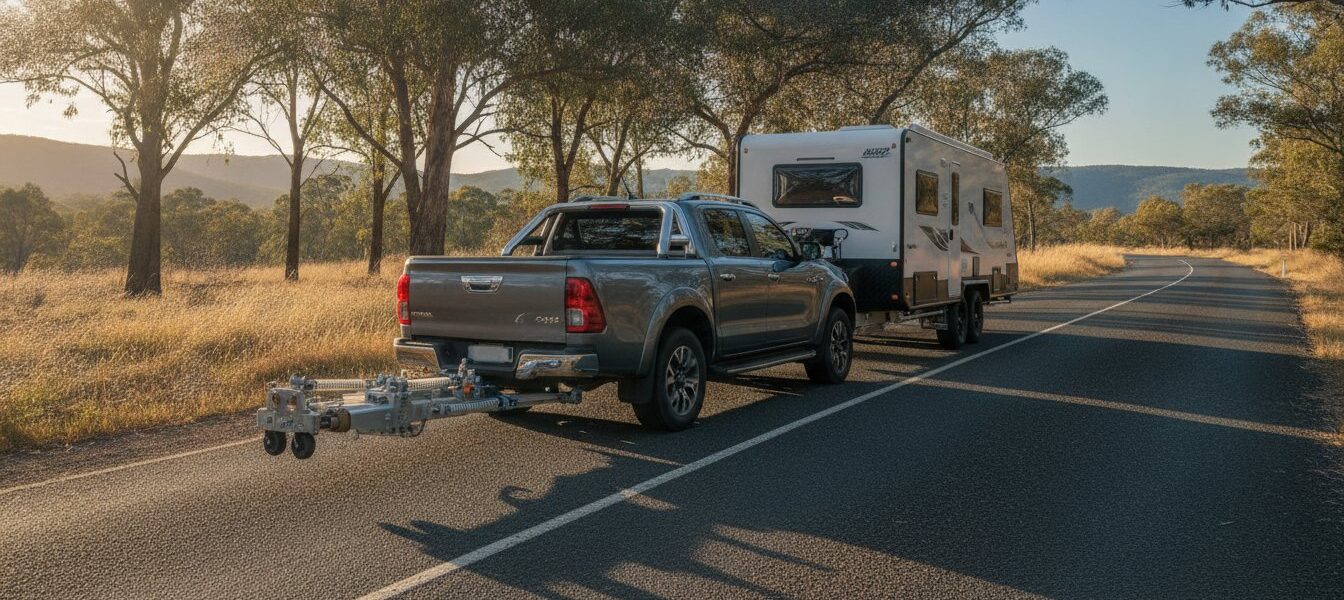
A weight distribution hitch is not a fix-all for an overloaded trailer. It is a precision tool designed to restore steering geometry and braking efficiency to your tow vehicle. If you’ve ever felt your front wheels go light or watched your rear suspension sag under load, you’re dealing with a fundamental balance problem. This caravan weight distribution hitch review examines how the right hardware can correct these issues and keep your setup stable at highway speeds.
You know that a sagging rear end isn’t just an eyesore. It compromises your steering and increases your stopping distance. We’ll show you how to evaluate different hitch capacities to ensure your rig meets Australian safety standards and remains compliant on the road. You will discover the technical specifications that matter for your specific ATM and ball weight requirements. This article provides a clear look at the hardware needed to maintain a level towing platform and gain confidence during long-distance travel. We focus on practical solutions that improve your vehicle’s response and ensure your equipment can handle the harsh conditions of the Australian landscape.
Key Takeaways
- Understand how a weight distribution hitch acts as a leverage system to restore steering control and braking efficiency to your tow vehicle.
- Use this caravan weight distribution hitch review to separate physics from myths, specifically regarding how load transfers across the vehicle and caravan axles.
- Evaluate the mechanical differences between Round Bar and Trunnion Bar systems to determine which setup suits your chassis clearance.
- Learn why matching spring bar ratings to actual tow ball weight is critical for maintaining a level and stable towing platform.
- Identify the importance of selecting high-quality, Australian-tested hardware designed to endure harsh regional road conditions.
Understanding Weight Distribution Hitches for Australian Towing
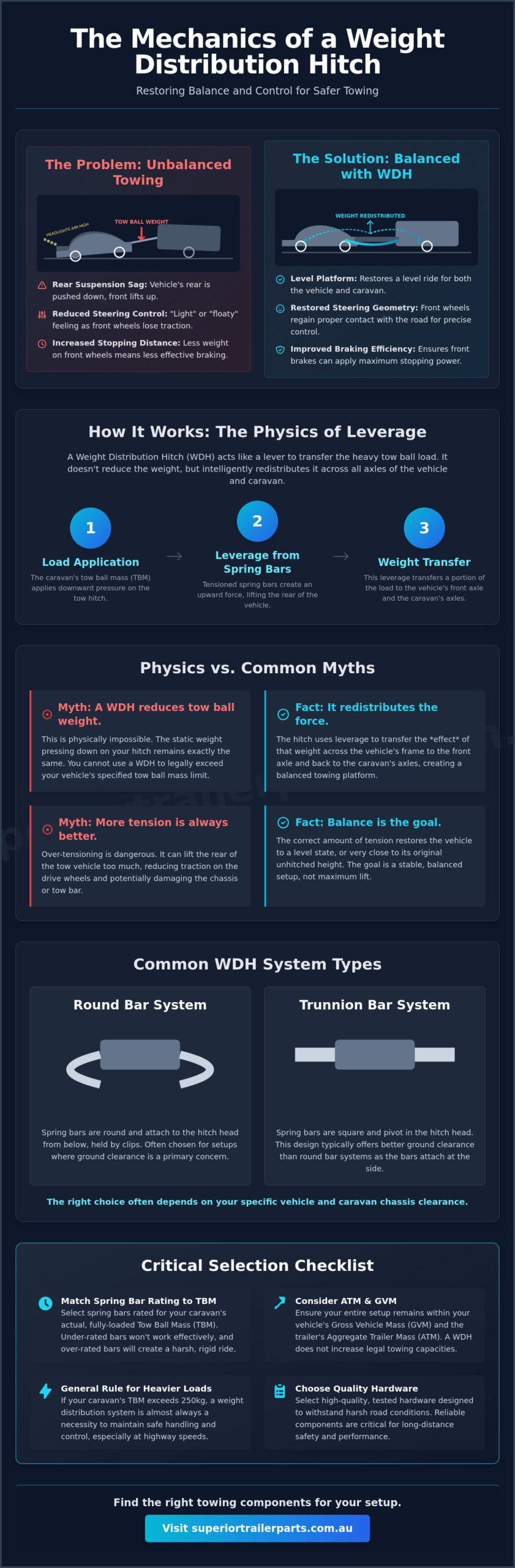
A weight distribution hitch is a mechanical leverage system designed to correct the balance of a towing vehicle. It is not a tool to increase your vehicle’s legal towing capacity. When you connect a heavy caravan to a standard tow ball, the weight of the drawbar pushes the rear of the vehicle down. This creates a seesaw effect where the rear axle acts as a pivot point, causing the front of the vehicle to lift. This caravan weight distribution hitch review examines how the right hardware counteracts this lift to keep your setup stable and safe.
You might hear the terms “load levelling” and “weight distribution” used interchangeably. While they describe the same equipment, the terminology matters. Levelling simply refers to making the vehicle look flat. Weight distribution describes the actual physical transfer of force. A weight-distributing hitch uses heavy duty spring bars to apply leverage. This tension shifts a portion of the tow ball download from the rear axle toward the front axle and back to the caravan axles. Standard caravan parts and couplings are built to secure the connection, but they cannot manage this weight transfer on their own.
The Role of Leverage in Towing Safety
The tow ball acts as a fulcrum between your vehicle axles. Without a distribution system, a high tow ball mass (TBM) forces the rear suspension to compress. This “unweights” the front tyres, which are the most critical components for steering and braking. You’ll recognize the symptoms of a poor setup by a light, floaty feeling in the steering wheel or “porpoising” where the vehicle bounces over road undulations. If your caravan’s tow ball mass exceeds 250kg, a distribution system is almost always a necessity to maintain control. Proper leverage ensures the vehicle remains level, preventing the rear-end sag that compromises handling.
Restoring Steering Geometry and Braking Performance
How Weight Distribution Hitches Function: Physics vs. Common Myths
A common misconception in the towing industry is that a weight distribution hitch reduces your actual tow ball download. This is physically impossible. The static weight pressing down on your hitch remains exactly the same whether you use spring bars or not. In this caravan weight distribution hitch review, we focus on how these systems redistribute that force rather than eliminating it. You are effectively using leverage to trick the vehicle into carrying the load across both axles instead of just the rear. This process creates a more balanced platform, but it does not change the trailer’s physical mass.
The system works by applying torque to the connection point. When you tension the spring bars, they act like handles on a wheelbarrow. They lift the rear of the vehicle and transfer that weight forward to the front wheels and backward to the caravan’s axles. This transfer is vital for stability. However, many users believe that more tension always equals better performance. This is a dangerous mistake. Over-tensioning can lift the rear wheels too much, reducing traction on the drive axle and compromising the structural integrity of your tow bar. Balance is the goal, not maximum lift.
The Truth About Tow Ball Weight
The static weight on your ball is a constant. If your caravan has a 300kg tow ball mass (TBM), that 300kg is still present at the coupling. A distribution system simply changes how the vehicle reacts to that weight. It is critical to understand that you cannot use a distribution system to compensate for an inherently overloaded trailer. If your trailer exceeds the vehicle’s maximum TBM or Aggregate Trailer Mass (ATM), the setup is illegal and unsafe. Always weigh your setup on a level surface before adjusting your bars. If you find your current hardware is under-rated, consider upgrading to high-quality couplings and parts designed for heavy duty applications.
Chassis Stress and Structural Integrity
Not every vehicle is designed to handle the stresses of a distribution system. Some modern 4WDs and SUVs have monocoque chassis or specific tow bar designs that cannot withstand the torque applied by high-tension spring bars. Using a system on an incompatible vehicle can lead to chassis peaking. This occurs when the frame actually bends or cracks under the strain of the leverage. Always consult your vehicle’s owner manual before fitting these components. Look for specific warnings regarding weight distribution or tow bar torque limits. Ignoring these manufacturer guidelines can void your warranty and lead to catastrophic structural failure during highway travel. Sturdiness and resilience are key, but only when the vehicle frame is built to support the load path.
- Check your vehicle manual for WDH compatibility before installation.
- Never exceed the maximum tow ball download specified by the manufacturer.
- Ensure spring bars are rated for your specific tow ball weight, not the total trailer mass.
- Inspect the tow bar mounting bolts regularly for signs of stress or loosening.
Reviewing the Different Types of Weight Distribution Systems
Selecting the right hardware requires a clear understanding of the mechanical differences between available designs. Most setups on the market fall into two categories: Round Bar and Trunnion Bar systems. This caravan weight distribution hitch review highlights that your choice should be dictated by your caravan’s A-frame configuration and the ground clearance of your tow vehicle. Both systems serve the same purpose of weight transfer, but their physical footprints differ significantly. You need a system that fits your specific chassis while providing enough clearance for the tracks you intend to travel.
Round Bar Systems: The Versatile Choice
Round bar systems are a traditional solution for many Australian caravans. In this design, the spring bars feature a curved end that hooks into the bottom of the hitch head. They are highly effective for standard A-frame trailers where the coupling is mounted on top of the frame. Because the bars exit from the bottom of the head, they provide plenty of space for top-mounted accessories like stone guards or toolboxes. However, this downward orientation reduces ground clearance. If you frequently travel on undulating terrain or have a steep driveway, these bars may strike the ground. They are generally available in weight ratings up to 360kg, making them suitable for a wide range of medium to heavy caravans.
Trunnion Bar Systems: Maximum Clearance and Capacity
Trunnion bar systems offer a more compact profile. The bars are rectangular and mount horizontally into the middle of the hitch head, sitting flush with the assembly. This design is the preferred choice for modern, low-profile tow vehicles and caravans with underslung A-frames. By keeping the bars higher up, you gain valuable ground clearance for off-road tracks or speed humps. Trunnion systems are often engineered for higher weight capacities, frequently handling ball weights exceeding 370kg with ease. They provide a sturdy, resilient connection that is less prone to interference with the trailer frame during tight turns. This makes them a reliable choice for heavy duty setups where performance and clearance are non-negotiable.
- Round Bar: Best for top-mounted couplings and standard highway use.
- Trunnion Bar: Ideal for low-clearance vehicles and heavy duty weight requirements.
- Maintenance: Both styles require regular greasing of the bar ends to prevent metal-on-metal wear.
- Adjustment: Trunnion bars are often easier to snap into place using a lift handle, while round bars may require more vertical maneuvering during setup.
Regardless of the style you choose, ensure the components are Australian-tested. Using high-quality trailer parts ensures your setup remains compliant and can endure the vibration and heat of long-haul travel. Always match the bar rating to your actual measured tow ball weight to avoid over-tensioning the system or damaging your vehicle’s chassis through excessive leverage.
Critical Selection Criteria: How to Evaluate Your Setup
Evaluating your setup requires more than just picking a brand from a shelf. You must start with hard data. Many owners make the mistake of buying a hitch based on their caravan’s total weight. This is incorrect. You must match your spring bars to your actual Tow Ball Weight (TBW). If you buy a heavy duty hitch for a light caravan, the bars will be too stiff. This prevents the suspension from working and can lead to cracked A-frames or chassis damage. A proper caravan weight distribution hitch review should always emphasize the importance of using a dedicated ball weight scale before making a purchase.
Calculating Your Requirements
Understanding the difference between Aggregate Trailer Mass (ATM) and Gross Trailer Mass (GTM) is essential. ATM is the total weight of your caravan when it is not hitched to a vehicle. GTM is the weight transmitted to the ground through the caravan’s tyres when it is hitched. The difference between these two figures is your tow ball weight. Always weigh your caravan when it is fully loaded for a trip, including water tanks and gas bottles. A setup that is balanced when empty will behave differently once you pack for a two-week holiday. Buying hardware based on “dry weight” often leads to an under-rated and unsafe configuration.
Before finalizing your choice, check your tow bar’s rating plate. It must be explicitly marked as “Weight Distribution Compatible.” Not all tow bars can handle the torque applied by spring bars. Similarly, ensure your caravan’s A-frame has enough space to mount the hitch brackets. Some frames are crowded with batteries, gas bottles, or spare tyres, which can interfere with the bracket placement. If the brackets don’t fit securely, the system cannot function as intended. You should also assess whether you need integrated sway control. Systems with built-in friction dampening are often more efficient than adding standalone friction units later.
Setup and Fine-Tuning for Stability
Achieving a safe towing configuration requires a level plane where both the vehicle and the caravan sit parallel to the road surface. Start by measuring the height from the ground to the top of your vehicle’s wheel arches while uncoupled. Once the caravan is hitched and the bars are tensioned, measure again. The goal is to return the front wheel arch to its original height, or within a few millimetres of it. You can adjust the tension by changing the number of chain links or by adjusting the tilt of the hitch head. Tilting the head back allows the bars to sit at a sharper angle, providing more leverage without over-stressing the components. This fine-tuning ensures that your steering remains responsive and your braking stays balanced.
Ensure your setup is built for the long haul by selecting professional-grade Weight Distribution Hitches that meet Australian standards.
Sourcing Reliable Towing Components and Expert Support
Professional advice is essential when you are selecting critical safety components. Every vehicle and caravan combination has unique requirements based on chassis design and weight distribution. Making an uneducated guess can lead to mechanical failure or legal non-compliance. Superior Trailer Parts provides a range of Weight Distribution Hitches designed to meet these rigorous standards. Our team understands the specific challenges of the Australian landscape and helps you find a solution that fits your rig perfectly.
Quality Hardware for Australian Roads
Durability is the primary requirement for any component used in heavy duty towing. You need hardware that can withstand the constant torque and leverage required for effective weight transfer. A complete system upgrade often involves more than just a hitch. We stock a wide variety of couplings and parts to ensure every connection point is sturdy and resilient. As an Australian-owned business, we prioritize regional dependability. We stand behind the products we provide because we know the harsh conditions they must endure. Our expertise ensures you get hardware that lasts, rather than a temporary fix.
Expert Guidance and Nationwide Shipping
Getting the right parts shouldn’t be a hassle. Superior Trailer Parts supports customers across the country with efficient service and technical knowledge. You can browse our selection of caravan parts online and have them delivered directly to your door. This accessibility ensures that fleet managers and individual users can find immediate solutions to their towing problems. If you are unsure about your specific requirements, our specialists are ready to assist. We move quickly from identifying your needs to providing a practical, results-oriented solution. Contact us today for expert advice on your weight distribution needs and ensure your setup is safe for the road ahead.
Secure Your Setup for the Road Ahead
Safe towing requires a commitment to mechanical balance and structural integrity. This caravan weight distribution hitch review has highlighted that success depends on matching your spring bars to your actual tow ball weight rather than your total trailer mass. You now understand that these systems are precision leverage tools designed to restore steering and braking performance. Using high-quality hardware ensures your rig remains level and compliant with Australian standards regardless of the terrain.
Superior Trailer Parts is a long-standing, Australian owned and operated business. We provide nationwide shipping on all trailer and caravan components; ensuring you have access to the right gear wherever you are located. Our team offers expert technical support for complex towing setups to help you achieve a reliable and safe configuration. We stand behind every product we sell because we know the demands of the Australian landscape.
View our range of Weight Distribution Hitches and Caravan Parts to find the right solution for your vehicle. Proper preparation is the foundation of every successful trip. Get your setup right and enjoy the confidence of a stable, balanced tow.
Frequently Asked Questions
Do I really need a weight distribution hitch for my caravan?
You need a hitch if your tow ball mass (TBM) exceeds 250kg or causes the rear of your vehicle to sag significantly. While not a legal requirement for every setup, it is a necessary tool for restoring steering control and braking response on heavy rigs. If your TBM is under 150kg, you generally won’t require one. A squat test is the best way to determine if your specific vehicle requires mechanical assistance.
Can a weight distribution hitch stop caravan sway?
A standard weight distribution hitch does not stop sway; it only levels the vehicle. While a level setup improves overall stability, you need a system with integrated friction dampening or a standalone sway control unit to actively manage lateral movement. Don’t rely on weight transfer alone to fix a caravan that is prone to swaying at high speeds. This caravan weight distribution hitch review focuses on balance, which is only one part of the safety equation.
Is it true that weight distribution hitches can damage my car chassis?
Yes, damage can occur if you use high-tension bars on a vehicle chassis not designed for the torque. Some modern SUVs with monocoque frames have specific restrictions against these systems because the leverage can cause the frame to bend or “peak.” Always check your vehicle owner’s manual and the tow bar rating plate to ensure compatibility before installation. Using the wrong hardware can lead to permanent structural failure.
How do I know what size weight distribution hitch I need?
Select a hitch based on your actual, measured tow ball weight (TBW) when the caravan is fully loaded. Buying by the caravan’s total mass is a mistake that leads to incorrect bar tension. Match the spring bar rating to the static weight on the ball to avoid an overly stiff or under-rated setup. Common ratings include 180kg, 270kg, and 370kg capacities to suit different caravan sizes.
Should I remove the weight distribution bars when reversing?
You should remove or loosen the bars when performing tight reversing manoeuvres or navigating steep driveways. High-angle turns can cause the bars to bind or strike the trailer frame, leading to bent components or broken brackets. It’s a simple step that prevents unnecessary mechanical stress on your hitch assembly and the caravan A-frame. Reinstall the bars once you are back on level ground and ready for highway travel.
Can I use a weight distribution hitch with an off-road coupling?
You can use these systems with some off-road couplings, but clearance is often an issue. Poly block or articulated couplings require specific hitch heads that don’t interfere with the coupling’s range of motion. Always verify that your chosen hardware matches the physical dimensions of your off-road setup. Some specialized brackets are designed to clear stone guards and other off-road accessories commonly found on modern adventure trailers.
How much tension should be on the spring bars?
Apply enough tension to return the front wheel arch height to within a few millimetres of its unladen measurement. You aren’t trying to lift the rear of the car as high as possible; you are aiming for a level plane. This ensures the front tyres maintain a full contact patch for safe steering and braking performance. Over-tensioning can reduce traction on your rear drive wheels and compromise vehicle control.
Does a weight distribution hitch increase my towing capacity?
No, a weight distribution hitch never increases your vehicle’s legal towing capacity or maximum tow ball download. It is a tool for balance and handling, not a way to bypass manufacturer limits. Operating above your vehicle’s GVM or ATM ratings is illegal and voids your insurance regardless of the hitch you use. Always stay within the plate ratings found on your tow bar and caravan chassis.