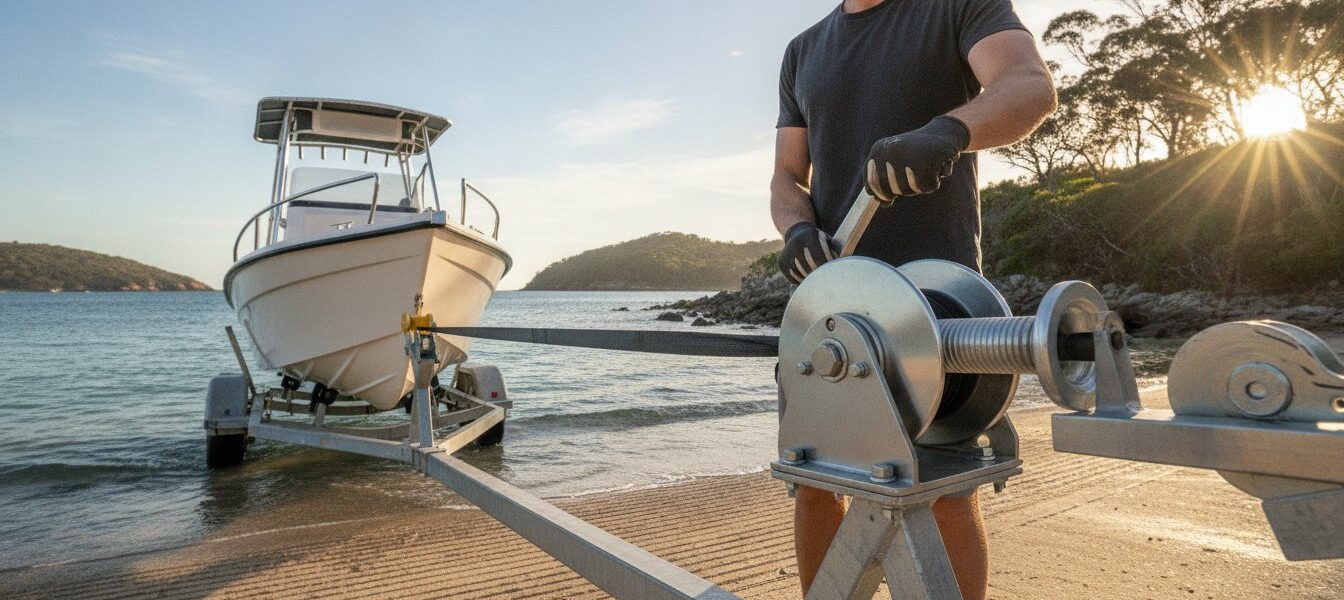
You’re at a steep, slippery ramp with the tide dropping fast. You start cranking, but the winch handle slips or the gears groan under the load. This is a dangerous reality for many boat owners when their hardware isn’t fit for purpose. Saltwater corrosion and under-specced components are the primary enemies of a smooth recovery. Understanding how to choose a manual boat winch is about more than just picking a brand. It’s about managing friction and mechanical advantage to ensure your vessel stays secure.
Recovering your boat shouldn’t be a test of physical endurance. We agree that your trailer hardware must be reliable and easy to operate. You’ll learn how to select a reliable manual boat winch by matching capacity, gear ratios, and materials to your specific vessel and towing needs. We cover the 1.5x weight capacity rule, the safety benefits of brake winches, and why stainless steel components are essential for Australian conditions. This approach ensures your recovery is effortless and your equipment lasts in harsh marine environments.
Key Takeaways
- Calculate the required load rating by balancing vessel weight against trailer friction from rollers or bunks.
- Master how to choose a manual boat winch by selecting gear ratios that offer sufficient mechanical advantage for your recovery conditions.
- Evaluate material finishes like stainless steel and galvanised coatings to protect your hardware against harsh saltwater corrosion.
- Choose between synthetic webbing and steel wire cable based on your specific strength and flexibility requirements.
- Ensure operational safety through correct mounting techniques and precise line alignment to prevent binding during use.
Understanding the Role of a Manual Boat Winch
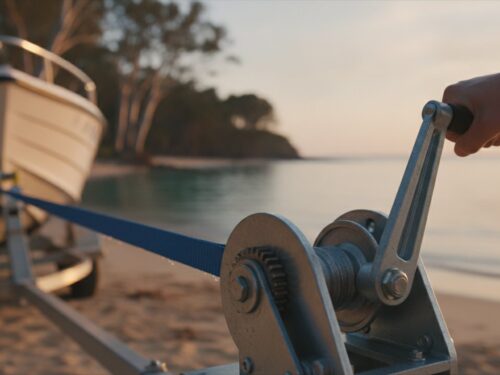
A manual boat winch is a mechanical force multiplier designed for vessel recovery. It translates circular motion from a handle into linear pulling force on a cable or strap. To understand What is a Winch?, you must look at its four primary components. The drum stores the line; the ratchet prevents accidental backsliding; the gear set provides the mechanical advantage; and the handle serves as your interface. These parts work together to move heavy loads with manageable human input. Each component must be built to withstand high tension and environmental stress.
Learning how to choose a manual boat winch involves balancing mechanical power with physical effort. Manual winches remain the industry standard for most boat owners because they offer extreme reliability. Unlike complex electronic systems, a hand-cranked winch has fewer failure points. This simplicity is vital when you’re at a remote boat ramp far from technical support. However, the trade-off is clear. You provide the power. Choosing the wrong gear ratio or capacity makes recovery a grueling task rather than a routine procedure. Proper selection ensures the winch does the heavy lifting, not your back.
Manual vs. Electric: Why Stick to Hand-Cranked?
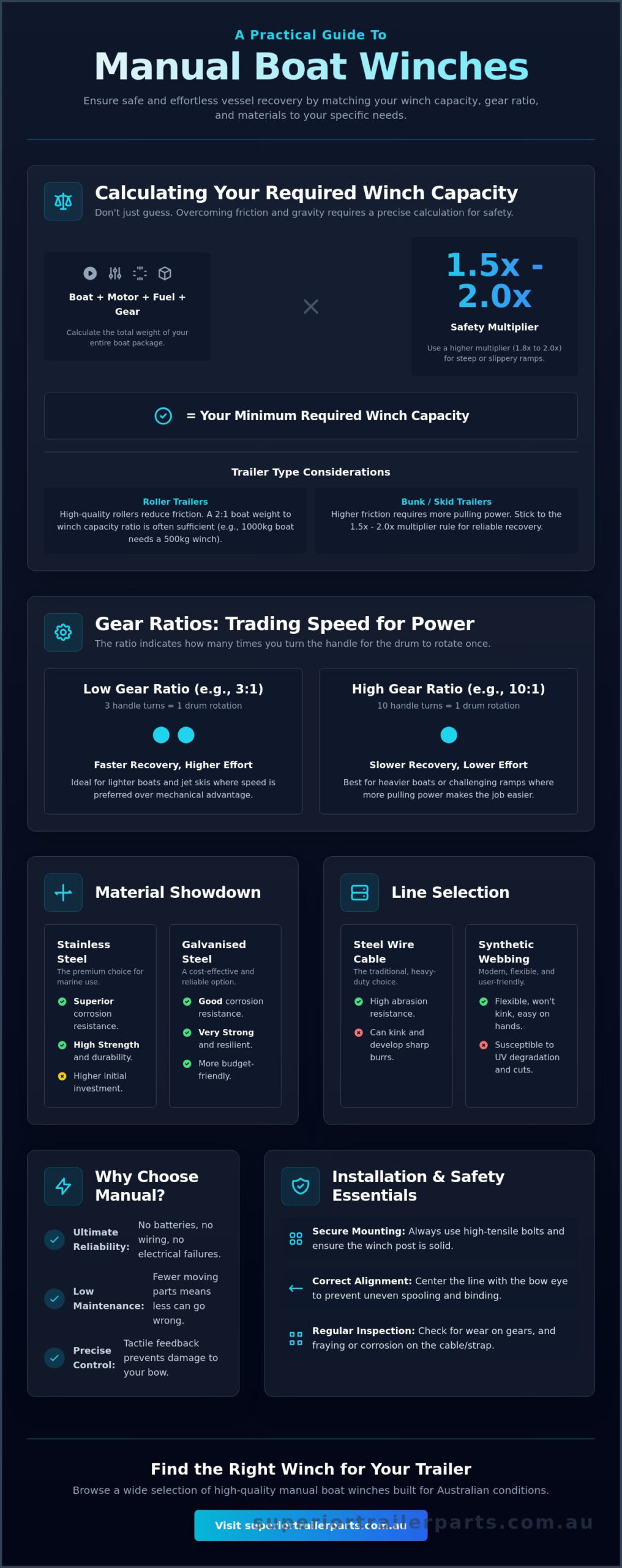
Manual winches don’t require battery power or heavy-gauge wiring. This makes them ideal for remote Australian coastal areas where electrical failure can strand you. They require significantly lower maintenance than electric motors. You also gain precise control during the final inches of bow-to-roller contact. This tactile feedback allows you to feel the tension, preventing over-tightening or damage to the bow eye. For many, the peace of mind that comes with a tool that works every time, regardless of battery health, is the deciding factor.
Common Applications for Manual Winches
Most boat trailer parts are designed for specific load types. Manual winches are standard for tinnies and mid-sized fiberglass vessels under six meters. Since 67% of boats in Australia fit this size category, hand-cranked models remain the dominant choice for the majority of registered boaters. They’re also essential for jet ski trailers where light-duty, high-speed recovery is required. Beyond marine use, these winches secure varied cargo on multi-purpose trailers. Knowing how to choose a manual boat winch correctly allows you to adapt the hardware to different trailer setups and ramp conditions across the country.
Calculating Required Winch Capacity and Load Ratings
Selecting the right rating is the most critical step when learning how to choose a manual boat winch. You aren’t just moving a static weight; you’re overcoming friction and gravity simultaneously. While some international guides suggest a winch capacity ratio of 2:1, Australian conditions often require a more conservative approach. A reliable rule of thumb for local ramps is to select a winch with a capacity between 1.5 and 2 times the total weight of your boat package. This package must include the hull, motor, full fuel tanks, and all onboard gear. If you frequently use steep or slippery ramps, aim for the higher end of that scale, specifically an 1.8x to 2x capacity margin.
It’s vital to distinguish between “dead lift” and “rolling load” weight. A winch rated for 500kg can lift that weight vertically, but it can pull significantly more if the boat is on a trailer with functional rollers. However, you should never rely on the maximum theoretical rolling load. Mechanical efficiency drops as the winch drum fills with line, and environmental factors like wind or current can increase the resistance. Operating at the limit of your hardware leads to premature gear wear and potential cable failure. Always build in a safety margin to handle the unexpected.
The 2-to-1 Rule for Roller Trailers
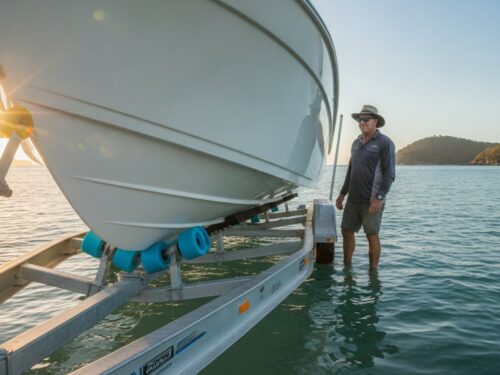
Trailers equipped with high-quality rollers significantly reduce the effort required for recovery. A 1000kg boat on a well-maintained roller trailer typically only requires a 500kg rated winch. This is because wobble rollers and keel rollers minimize surface friction, allowing the vessel to glide onto the trailer. If your trailer uses fixed keel rollers instead of a full wobble roller bank, the friction will be higher, and you’ll need a winch with a greater mechanical advantage. Check your hardware regularly; seized rollers turn a rolling load back into a high-friction drag. For more details on maintaining these components, see this resource on boat trailer rollers australia.
Accounting for Bunk Friction and Ramp Incline
Bunk trailers change the calculation entirely. Carpeted bunks create massive surface drag, especially when dry. If your trailer uses bunks, you’ll need a higher capacity winch than a roller-based equivalent to overcome this initial “stick.” Additionally, steep coastal boat ramps impose a “gravity tax” on your equipment. On a 15-degree incline, the effective load on your winch increases significantly compared to a flat surface. Recovering a boat that has taken on water or is heavily loaded with fish and ice further stresses the system. If you’re unsure about your trailer’s current setup, check our range of boat trailer parts to ensure your hardware matches your vessel’s weight and your local ramp conditions.
Gear Ratios and Mechanical Advantage Explained
Gear ratio is the fundamental metric of a winch’s performance. It defines how many times you must rotate the handle to complete one full revolution of the drum. For example, a 5:1 ratio means you turn the handle five times to move the drum once. This mechanical advantage allows you to move heavy loads that would be impossible to pull by hand. When you’re deciding how to choose a manual boat winch, you’re essentially choosing how much physical effort you’re willing to trade for time spent at the ramp.
A 1:1 ratio provides direct drive. This is useful for rapid line retrieval when there’s no load on the cable, such as winding in the strap after the boat is launched. However, as the vessel’s weight hits the trailer, you need higher reduction ratios like 10:1 or 15:1 for heavy offshore boats. These high ratios make the boat feel lighter during the pull. You’re effectively trading distance for power. You crank more, but you apply less physical force. This mechanical math is vital for safe recovery, especially on the steep ramps mentioned previously where gravity increases the effective load.
Single-Speed vs. Dual-Speed Winches
Single-speed winches are the standard for light tinnies and jet ski trailers. A 3:1 or 5:1 ratio is usually sufficient for these lighter loads. They’re simple, durable, and fast. Dual-speed winches offer more versatility for larger vessels. They feature two separate gear sets. You use the high gear for taking up slack quickly. You then switch to the low gear for the final, heavy pull up the trailer. Always ensure the ratchet is engaged before switching gears. Don’t attempt to shift gears while the line is under full tension without a secondary safety measure in place.
Selecting the Right Ratio for Your Strength
The right ratio depends on your physical capability and the boat’s total weight. A longer handle increases your leverage, making the cranking easier. However, a handle that’s too long might hit the trailer frame or the boat’s bow during operation. It’s a balance of fit and function. More gears aren’t always better for every user. On a light-duty trailer, a multi-speed winch adds unnecessary weight and more maintenance points. Stick to a high-quality single-speed model if your boat is under 500kg. For anything heavier, the mechanical advantage of a dual-speed system is a necessary investment in your safety. Check our range of boat trailer parts to find a winch with a gear set that matches your specific recovery needs.
Material Selection for Harsh Australian Environments
Australia’s coastline presents one of the most corrosive environments on earth. Salt spray and high humidity destroy inferior hardware in a single season. Learning how to choose a manual boat winch requires a deep dive into the metallurgy and synthetic materials used in their construction. You need components that resist oxidation while maintaining structural integrity under heavy tension. Choosing the wrong finish leads to seized gears and snapped lines during recovery. In high-salinity coastal areas, the presence of chloride ions accelerates metal fatigue, making material choice your primary defense against equipment failure.
Winch Straps vs. Steel Cables
Webbing straps are the modern standard for safety and ease of use. They don’t store significant kinetic energy, meaning they won’t lash back dangerously if they fail. Straps also wind flat onto the drum. This prevents the stacking and “bird-nesting” issues that plague steel wire cables. However, the Australian sun is a major factor. You must verify that any webbing is UV-stabilised to prevent the fibers from becoming brittle over time. For owners of heavier vessels, synthetic ropes like Dyneema provide a high-strength, lightweight alternative. These ropes offer the breaking strain of steel without the risk of splinters or rust. They are the preferred choice for those seeking maximum durability in tropical or coastal regions.
Finishes That Fight Corrosion
Standard zinc plating is often marketed as “corrosion resistant,” but it fails quickly in saltwater. It’s a thin coating that offers little protection against the constant cycle of wetting and drying. Hot-dip galvanising is the baseline for any reliable marine winch. This process involves dipping the steel into molten zinc, creating a thick, bonded layer that survives years of exposure. For the best results, ensure the internal components like ratchets and springs are made from stainless steel. These parts are the most likely to seize if they begin to oxidise. Powder-coated finishes look professional but can be problematic. A single chip from a stone or a tool allows saltwater to get under the coating, causing the steel to rot invisibly.
Fasteners also play a critical role in longevity. If you use standard steel bolts to mount a galvanised winch, you invite galvanic corrosion, which weakens the connection to the trailer. Always match your fasteners to the winch material to maintain a unified defense against the salt. If your current setup is showing signs of rust or the strap is beginning to fray, it’s time to upgrade your hardware. You can find high-quality boat trailer parts that are built to withstand the rigours of the Australian coast.
Installation and Maintenance for Long-Term Reliability
Proper Mounting and Alignment
Mount the winch so the height aligns perfectly with the boat’s bow eye. If the angle is too steep or too shallow, you increase friction and risk damaging the trailer rollers. Use high-tensile bolts and heavy-duty washers to secure the base to the winch post. Ensure the mounting surface is flat and free of debris. If you need replacement mounting hardware or other trailer parts, choose components with a high corrosion resistance rating. Check the bolts for tightness after the first few recoveries. Vibration from road travel can loosen fasteners over time. A loose winch is a liability during a high-tension recovery.
Routine Maintenance and Lubrication
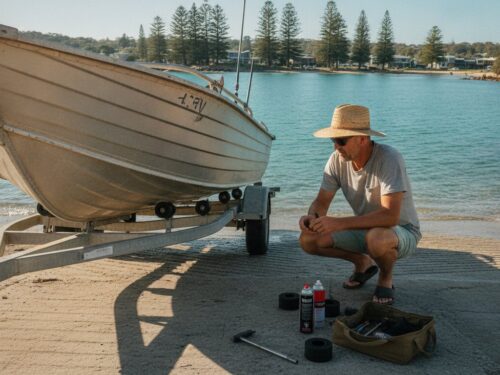
Saltwater dries into abrasive crystals that grind down metal gears. Apply a marine-grade lubricant that resists water washout to all moving parts every three months. Avoid standard greases that attract sand and grit. Inspect your webbing straps for fraying or signs of UV degradation. The Australian sun weakens synthetic fibers, reducing the strap’s effective breaking strain. Look for “fuzzing” on the edges of the strap as a sign of wear. Rinse the entire winch assembly with fresh water after every trip to the ramp. This simple step significantly extends the life of the galvanised finish and internal springs. Regular cleaning prevents the buildup of salt that leads to seized components.
The ratchet pawl is the most critical safety component on your winch. It’s the only thing preventing the handle from spinning out of control under load. Test the pawl for positive engagement before every launch and recovery. Listen for a sharp, clear “click” as you crank. If the spring is weak or the pawl is rounded, replace it immediately. A failing ratchet pawl turns a routine recovery into a dangerous mechanical failure. When learning how to choose a manual boat winch, prioritize a robust, easily accessible ratchet mechanism. Never rely solely on the winch to secure the boat during transit. Always use a secondary safety chain or tie-down strap to take the load off the winch gears while on the road.
Ensure a Reliable Recovery Every Time
We are a proudly Australian-owned and operated specialist dedicated to the transport and marine sectors. Our team provides expert technical support for marine fitments to ensure you get the correct fitment for your specific vessel. We offer nationwide shipping on all trailer components, delivering reliable solutions directly to your door. Browse our range of heavy-duty manual boat winches to upgrade your trailer hardware today. Reliable equipment gives you the confidence to explore more of our coastal waters. Safe boating starts with hardware you can trust at the ramp.
Frequently Asked Questions
What is the difference between a 1:1 and a 5:1 gear ratio on a boat winch?
A 1:1 ratio provides one drum rotation for every handle turn, while a 5:1 ratio requires five handle turns for one drum rotation. The 1:1 setting is for winding in slack line quickly without any load. The 5:1 setting provides the mechanical advantage needed to pull the boat’s weight onto the trailer. Understanding these differences is a core part of how to choose a manual boat winch that suits your physical strength and vessel size.
How do I know if my boat winch strap needs replacing?
Replace your winch strap if you see visible fraying, heavy “fuzzing” on the edges, or significant colour fading from UV exposure. These signs indicate the synthetic fibers have weakened over time. A compromised strap can snap under tension, leading to property damage or serious injury. Inspect the full length of the webbing every few months to ensure the structural integrity remains intact for safe recoveries.
Can I use a manual winch for a boat that weighs over 2000kg?
You can use a manual winch for boats over 2000kg, but it requires a high-ratio multi-speed design. A 10:1 or 15:1 ratio makes the physical effort manageable for such a heavy load. However, the recovery process will be slow because you must turn the handle many times to move the boat a short distance. Most owners of vessels this size eventually prefer electric winches, though a heavy-duty manual model remains a reliable backup.
Is stainless steel better than galvanised steel for a boat winch?
Stainless steel offers superior corrosion resistance in saltwater but often comes at a higher price point than hot-dip galvanised steel. Galvanised winches are the industry standard and provide excellent protection if rinsed with fresh water after every use. For most Australian boaters, a high-quality galvanised winch with stainless steel internal springs and pawls provides the best balance of longevity and practical value.
How much line or strap should I keep on my winch drum?
Keep enough line on the drum to reach your boat’s bow eye at the furthest point of the ramp, plus at least three safety wraps. Do not overfill the drum beyond its rated capacity. An overfilled winch drum reduces mechanical efficiency and can cause the line to bind against the frame. Proper line management ensures the strap winds flat and maintains consistent tension during the entire recovery process.
What is a ‘brake winch’ and do I need one for my boat trailer?
A brake winch features an internal friction mechanism that automatically holds the boat in place if you release the handle. This prevents the boat from sliding back down the trailer accidentally during a pull. It is a critical safety feature for heavier vessels or when using steep ramps. If you are learning how to choose a manual boat winch for a boat over 500kg, a brake winch is highly recommended for operational safety.
Can I convert my manual winch to an electric one later?
Converting a manual winch to an electric one is usually not practical because the two systems use different internal structures. Manual winches aren’t designed to handle the high-speed torque and heat generated by electric motors. The mounting points and gear housings also differ significantly. If you decide you need electric power, it is safer and more efficient to replace the entire manual unit with a purpose-built electric winch system.
Why is my winch handle getting harder to turn even with a light load?
Increased resistance usually points to salt crystal buildup or a lack of internal lubrication. Saltwater penetrates the gear sets and dries into hard deposits that hinder smooth movement. It can also indicate that the internal bushings are worn or that the winch frame has bent, causing gear misalignment. Clean the unit thoroughly and apply a fresh coat of marine-grade grease to the teeth and pivot points to restore operation.