A premium brand name is no substitute for heavy-duty engineering when you are hundreds of kilometers from the nearest workshop. Many travelers overspend on complex systems they cannot repair in the scrub, driven by the fear of a catastrophic failure on corrugated roads. Selecting the right off road caravan suspension kits requires a balance of strength, fit, and long-term serviceability. You need a caravan that tracks straight on dirt and doesn’t shake its own internal fittings to pieces. We will show you how to choose a high-performance system that survives harsh Australian conditions while maintaining mechanical simplicity. This reference breaks down the practical differences between independent trailing arms and reliable leaf spring setups. It also covers why matching your axles and couplings to your spring rate is the only way to ensure peace of mind during remote travel. By the end, you will understand how to build a resilient foundation for your trailer that complies with Australian standards and protects your investment on every track.
Key Takeaways
- Identify why ground clearance and vibration management are the two most critical factors for surviving remote outback tracks.
- Compare the benefits of independent trailing arms against the rugged simplicity of multi-leaf off road caravan suspension kits.
- Specify the right hardware for your build, from heavy-duty square axles to poly block couplings designed for maximum articulation.
- Establish a practical maintenance schedule for checking galvanised U-bolts and spring arches to avoid breakdowns in high-risk areas.
Requirements for Off Road Caravan Suspension
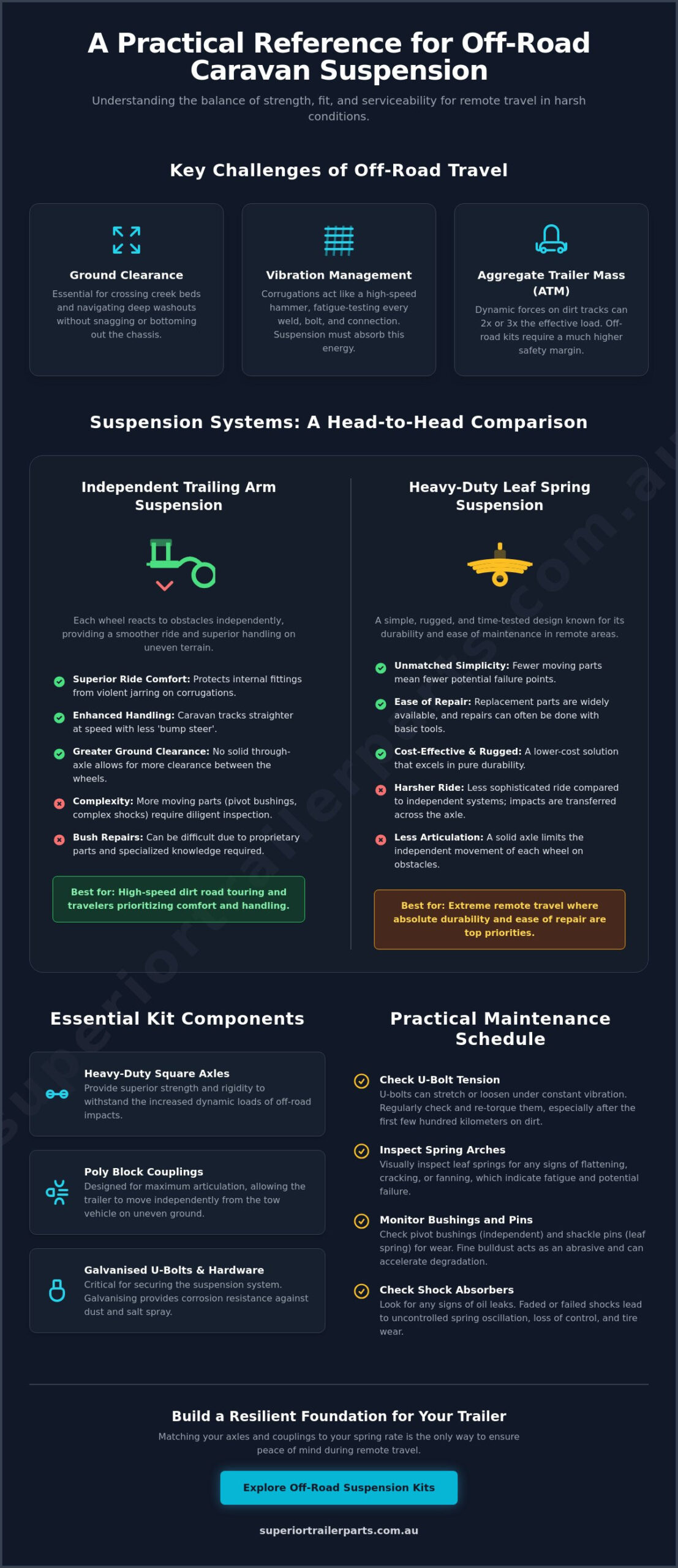
Off-road travel in Australia is a mechanical endurance test. Unlike highway towing, venturing onto unsealed tracks subjects your trailer to constant physical stress. Choosing effective off road caravan suspension kits isn’t about luxury; it’s about structural survival. The primary job of these systems is to isolate the caravan body from the violent energy of the road surface. If the suspension fails to absorb this energy, the chassis or the internal cabinetry will eventually give way.
A functional off-road setup must provide increased ground clearance. This is vital when crossing creek beds or navigating deep washouts where a standard low-slung chassis would bottom out or snag. Beyond clearance, load distribution is a major factor. Carrying extra diesel, water tanks, and recovery gear shifts the center of gravity and increases the static load on the leaf springs. Components must also resist dust ingress and salt-spray corrosion. Fine bulldust acts as an abrasive, wearing down bushings and seals, while coastal environments quickly degrade unprotected steel.
The Impact of Corrugations on Caravan Components
Corrugations act like a high-speed hammer. They fatigue-test every weld, bolt, and electrical connection in the caravan. Standard on-road vehicle suspension systems are designed for occasional bumps, but they lack the dampening required for relentless dirt tracks. This vibration generates immense heat. Standard shock absorbers often fade or fail completely when the internal oil thins under extreme temperatures. Without adequate dampening, the springs continue to oscillate. This leads to a loss of tow vehicle control and accelerated wear on the trailer tires.
Weight Ratings and ATM Considerations
Calculate your Aggregate Trailer Mass (ATM) before selecting any components. ATM is the total weight of the trailer when it’s fully loaded and not coupled to the towing vehicle. Off-road kits require a higher safety margin than on-road equivalents. Dynamic forces on a dirt track can double or triple the effective load on the axles. A trailer rated at 2,000kg for the highway might require 2,500kg rated components to handle the impacts of off-road use safely. Over-specifying your off road caravan suspension kits ensures the hardware isn’t operating at its absolute limit. This reduces the risk of fatigue-related failure when you are far from a workshop.
Independent vs Leaf Spring Off Road Systems
Choosing between independent and leaf spring systems is the first major decision for any build. Both options serve a specific purpose. Independent suspension is often the preferred choice for high-speed dirt road touring. It allows each wheel to react to obstacles without affecting the opposite side. This reduces the ‘bump steer’ effect and keeps the caravan tracking straight behind your vehicle. Because there is no solid through-axle, you gain significant ground clearance between the wheels. This design aligns with fundamental Off-Road Suspension Design Principles that prioritize wheel articulation and chassis stability.
Benefits of Independent Off-Road Suspension
Independent systems excel on uneven terrain. When one wheel hits a washout or a rock, the impact isn’t transferred across the trailer. This results in a much smoother ride for the caravan body. It protects your internal appliances and cabinetry from the violent jarring common on corrugated tracks. These off road caravan suspension kits offer superior handling at speed. The reduced unsprung weight allows the suspension to react faster to surface changes. It’s a high-performance solution for travelers who spend significant time on unsealed roads and want the best possible towing experience.
The Case for Heavy-Duty Leaf Springs
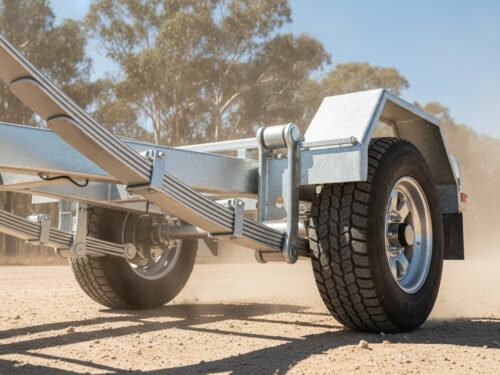
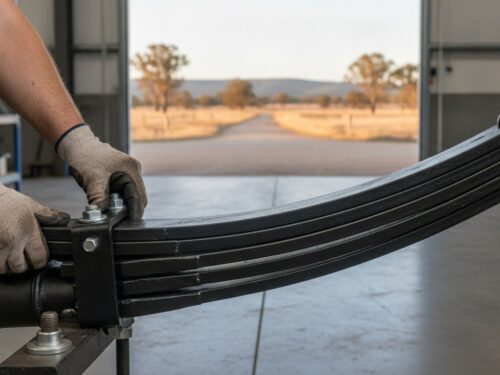
Leaf spring systems offer a different set of advantages. They’ve been the backbone of the Australian transport industry for decades. Multi-leaf setups like 5 leaf eye to eye springs or Rocker Roller sets provide unmatched simplicity. If a leaf breaks in a remote town, a local mechanic can usually source a replacement or perform a temporary repair. You don’t need specialized proprietary parts to get back on the road. These off road caravan suspension kits are cost-effective and extremely rugged. They lack the sophisticated ride of independent arms, but they excel in pure durability and ease of maintenance.
Maintenance requirements vary significantly between the two. Independent systems have more moving parts. You must inspect pivot bushings, shock absorbers, and alignment settings regularly. Leaf springs are more ‘set and forget,’ though you must still monitor your U-bolts and shackle pins. Decide based on your destination. If you plan on tackling the Gibb River Road every season, the ride quality of independent suspension might save your caravan’s interior. If you are on a budget and prioritize field-repairability, a heavy-duty leaf system is a sensible investment. Ensure you pair your springs with correctly rated axles to maintain a reliable setup.
Essential Components of a Reliable Off Road Kit
A suspension system is more than just a set of springs or arms. It’s a cohesive assembly where every part must handle the same level of abuse. When you evaluate off road caravan suspension kits, you must look beyond the spring rate. True reliability comes from the synergy between the axle, the coupling, and the braking hardware. If one component is under-specified, the entire system is at risk of failure on remote tracks. High-quality fasteners and heavy-duty components ensure that your trailer maintains its geometry when the terrain gets rough.
Upgrading to 45mm or 50mm Square Axles
The axle is the literal backbone of your trailer. Standard 39mm round axles are designed for sealed roads and light loads. They lack the structural rigidity required for corrugated dirt tracks. For any serious off-road build, upgrading to 45mm or 50mm square axles is a practical necessity. Square axles offer significantly better resistance to bending and torsional stress compared to round alternatives. This extra steel provides the strength needed to support the caravan’s weight during high-impact events like hitting a washout. Always ensure your hubs and bearings are rated to match the axle’s capacity. Using a heavy-duty axle with undersized bearings creates a predictable point of failure that can leave you stranded.
Off-Road Couplings and Braking
Standard ball couplings are limited by their range of motion. On steep tracks or during creek crossings, the angle between the tow vehicle and the caravan can exceed the physical limits of a traditional hitch. This leads to binding or even hitch failure. Poly block off-road couplings solve this by providing 360-degree rotation and high levels of vertical and horizontal articulation. They allow the trailer to move independently of the tow vehicle without putting stress on the drawbar.
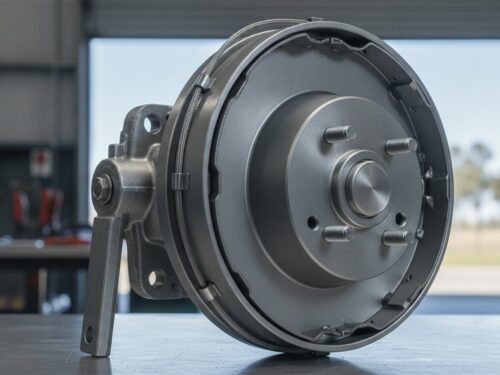
Stopping power is equally critical. Off-road descents generate significant heat in the braking system. 10-inch electric drum brakes are the industry standard for reliable performance in these conditions. They provide consistent stopping power and are relatively easy to service in the field. Verify that your braking setup and all associated hardware are ADR compliant to ensure safety and legal operation on Australian roads. You can find a range of suitable components in our caravan parts selection to complete your build.
Finally, don’t overlook the hardware that holds everything together. Vibration is the primary enemy of off road caravan suspension kits. It works to loosen nuts and shift components out of alignment. Use high-tensile, galvanised U-bolts and nyloc nuts to secure your axles to the springs. These fasteners must be checked for tension regularly, especially after the first few hundred kilometers of a trip. A loose U-bolt allows the axle to shift, which can snap the center bolt and lead to a total loss of control. Investing in quality hardware at the start prevents expensive repairs in the scrub.
Maintenance and Bush Repair Readiness
Maintaining off road caravan suspension kits is a safety requirement. Harsh corrugations and bulldust will find the weak point in any system. You must be prepared to perform inspections and basic repairs yourself. Don’t rely on city-based workshops when you’re in the outback. A proactive approach prevents small issues from becoming trip-ending disasters. Regular checks ensure your caravan stays on the track and protects your chassis from unnecessary stress.
Check your galvanised U-bolts for tension after the first 500km of any trip. Vibration causes these fasteners to stretch or settle. If they lose tension, the axle can shift. This leads to a catastrophic loss of control or a snapped center bolt. Inspect your leaf springs after every heavy trip. Look for cracks in the metal or arches that have flattened out. Grease all moving parts every 5,000km. This includes shackle pins and rockers. Regular lubrication reduces friction and prevents the metal-on-metal wear that leads to component failure.
Inspecting Bearings and Seals
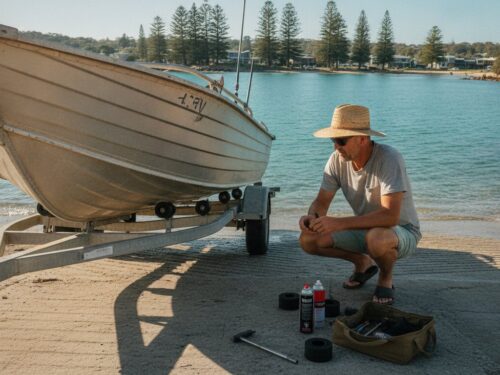
Dust and water are the primary enemies of caravan wheel bearings. Fine bulldust can penetrate even the best seals and turn your grease into an abrasive paste. Check for play in the wheels by jacking up the caravan and shaking the tire. Look for signs of grease leakage on the inside of the hub. Learn how to service your trailer’s wheel bearings before you depart. This skill is vital for remote travel and allows you to catch bearing wear before it causes an axle-damaging seize.
Emergency Bush Repair Kit Essentials
A reliable ‘bush kit’ is your insurance policy. It should contain parts specific to your off road caravan suspension kits. Include spare shackle bolts and nyloc nuts. Carry a spare leaf for your spring pack and a complete set of inner and outer bearings with seals. Don’t forget split pins and a tub of high-temperature bearing grease. These small items are often the hardest to find in remote areas.
Carry a high-quality jack capable of lifting your fully loaded caravan on soft ground. You also need the correct tools for tightening large axle nuts and U-bolts. A basic socket set is rarely sufficient for the torque required. Ensure you have heavy-duty spanners or a dedicated torque wrench for the larger fasteners. Stock your emergency kit with reliable off-road trailer parts before you head into the scrub to ensure you’re never stranded by a minor mechanical failure.
Selecting Your Off Road Suspension Solution
Selecting the right off road caravan suspension kits is a process of matching hardware to your specific travel goals. You don’t always need the most complex system on the market. You need a system that works for your destination. A balanced build prioritizes reliability and safety over marketing rhetoric. It’s better to have a simple, rugged setup than a complex one you can’t maintain in the field. Every decision should focus on the physical attributes of the gear, including strength, fit, and longevity.
Defining Your Travel Profile
Balance your budget across the entire trailer foundation. Don’t spend everything on a premium suspension brand and then cut corners on axles or brakes. A high-performance kit is only as good as its weakest link. Allocate funds for ADR-compliant couplings and heavy-duty U-bolts. Consult with a specialist to verify component compatibility. They can confirm that your hubs, bearings, and axles work together as a single, efficient unit. This prevents the frustration of ordering parts that don’t fit your specific chassis dimensions.
Sourcing Quality Caravan Parts
Buy from Australian-owned businesses that understand our local environment. Our tracks are unique and require hardware designed for high-frequency vibrations and extreme heat. Ensure all your caravan parts meet Australian Design Rules. This is a non-negotiable safety standard. It also protects you from insurance complications in the event of a failure. Choose a supplier that offers national shipping. This ensures future parts availability no matter where your travels take you.
Build a system that gives you confidence in remote areas. Contact our expert team for advice on assembling custom off road caravan suspension kits. We can help you select the right combination of springs, axles, and brakes for your specific trailer type. Investing in a durable foundation today prevents expensive mechanical failures tomorrow. Get the engineering right from the start and enjoy peace of mind on every track.
Securing Your Trailer for the Tracks Ahead
A successful outback trip depends on the structural integrity of your trailer’s foundation. Selecting effective off road caravan suspension kits involves more than just choosing a spring rate. You must ensure that your axles, couplings, and brakes work as a synchronized system capable of handling relentless corrugations. Prioritize components that offer a balance between high-performance dampening and mechanical simplicity. This approach ensures you can perform essential bush repairs when you are far from a professional workshop. Regular maintenance of U-bolts and bearings remains the best defense against mechanical failure on unsealed roads.
As an Australian-owned and operated specialist, we provide the rugged hardware needed for these demanding environments. We offer nationwide shipping across Australia and provide expert technical support for DIY builders looking to upgrade their setups. Browse our range of heavy-duty caravan parts and suspension components to find reliable solutions for your next build. Investing in quality engineering today protects your caravan and ensures a safer journey through the scrub. Get your trailer ready for the red dirt with confidence.
Frequently Asked Questions
What is the best suspension for an off-road caravan?
The best suspension depends on your specific balance of ride quality and repairability. Independent trailing arm systems offer superior dampening for corrugations and better ground clearance. However, heavy-duty leaf spring systems provide unmatched simplicity and are easier to repair in remote areas. Choose a system that matches your travel profile and Aggregate Trailer Mass (ATM) to ensure the hardware isn’t operating at its physical limit.
Can I upgrade my existing caravan suspension to an off-road kit?
Yes, you can upgrade most caravans, but you must ensure the chassis is structurally capable of handling the increased stress. Upgrading to off road caravan suspension kits often requires reinforcing the mounting points and upgrading to larger axles, such as 50mm square units. Consult a specialist to verify that the new components comply with Australian Design Rules and won’t compromise the trailer’s center of gravity or overall stability.
How often should I service my off-road caravan suspension?
Service your suspension every 5,000km or after every major off-road trip. This includes greasing shackle pins, rockers, and pivot points to prevent abrasive dust from wearing down the metal. Inspect shock absorbers for leaks and check all fasteners for correct torque settings. If you’ve been traveling on corrugated roads, perform a visual inspection daily to catch loose bolts or cracked springs before they cause a catastrophic failure.
Do I need independent suspension for the Gibb River Road?
You don’t strictly need independent suspension, but it significantly reduces the vibration damage to your caravan body. The Gibb River Road is famous for relentless corrugations that can shake standard leaf springs to pieces. Independent systems allow each wheel to react separately, keeping the trailer more stable. If you use leaf springs, ensure they are heavy-duty eye-to-eye or rocker roller sets and reduce your speed to manage the impact.
What is the difference between eye-to-eye and slipper springs for off-road use?
Eye-to-eye springs are secured at both ends with pins and bushings, while slipper springs have one end that slides freely. For off-road use, eye-to-eye springs are the standard because they provide better axle control and won’t bounce out of their hangers on rough terrain. Slipper springs are generally reserved for light-duty on-road trailers. High-performance off road caravan suspension kits almost exclusively utilize eye-to-eye or independent designs for maximum reliability.
How much ground clearance does an off-road caravan need?
Aim for a minimum of 300mm to 500mm of clearance from the lowest point of the chassis or axle. The specific requirement depends on the length of your trailer and the severity of the terrain you intend to tackle. Longer caravans need more clearance to prevent the rear end from dragging during creek crossings or steep washouts. Removing the through-axle by installing independent suspension is the most effective way to gain center clearance.
Is electric braking better than mechanical for off-road towing?
Electric brakes are superior because they allow you to adjust braking force directly from the tow vehicle cabin. This is essential when descending steep, loose tracks where you need to prevent the caravan from pushing the car. 10-inch electric drum brakes are the industry standard for off-road trailers. They provide consistent stopping power and handle the heat generated during long descents much better than basic mechanical override systems.
Why do U-bolts need to be checked frequently on dirt roads?
High-frequency vibrations on dirt roads can cause U-bolts to settle or stretch, leading to a loss of clamping force. If the U-bolts loosen, the axle can shift on the spring, which often snaps the center bolt and ruins the trailer’s alignment. Check your galvanised U-bolts after the first 500km of dirt and then weekly during your trip. Use a torque wrench to ensure they stay within the manufacturer’s specifications to prevent axle displacement.