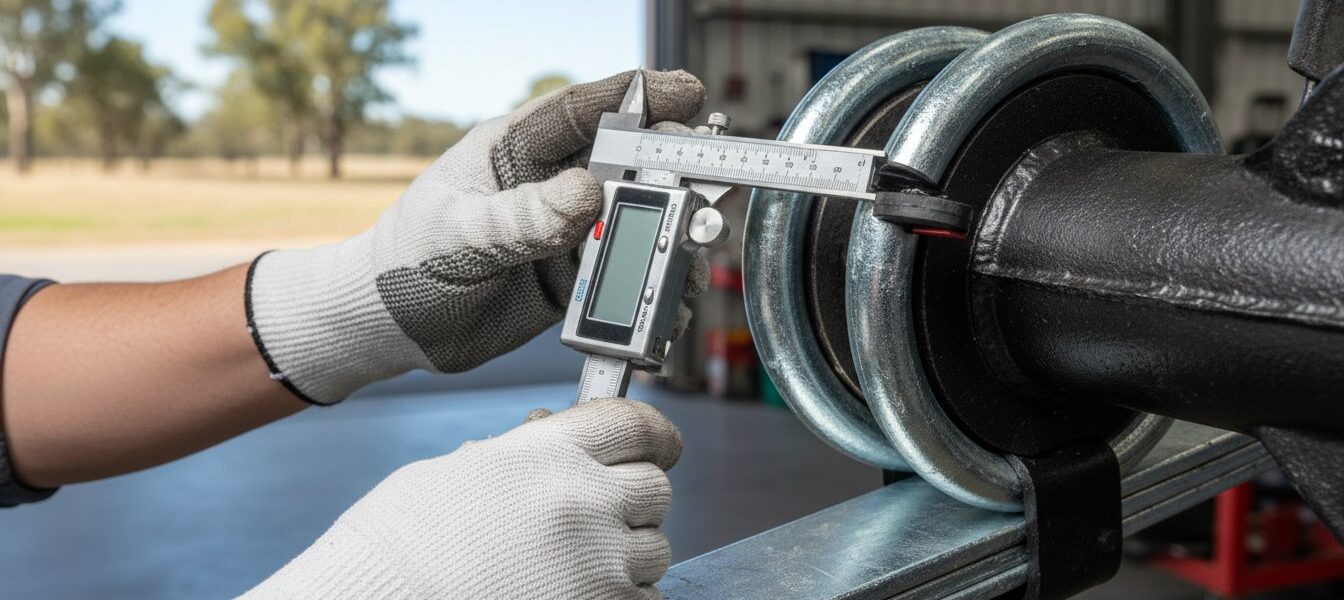
Industry data indicates that 15% of trailer-related breakdowns involve loose or corroded axle hardware. This statistic proves that securing your suspension isn’t just about convenience; it’s a critical safety requirement. Many operators struggle with ordering parts that are too narrow for the axle or have insufficient thread for the spring pack. Learning how to measure trailer u-bolts with precision eliminates these errors and keeps your gear moving.
It’s frustrating to stall a job because of a sizing mismatch between imperial and metric components. We’ll help you master the four essential measurements required to select the correct U-bolt for any trailer axle or suspension setup. This reference explains how to match hardware to 39mm, 40mm, or 45mm axles while applying the correct torque for Australian road conditions. You’ll gain the technical knowledge needed for a perfect fit on your first attempt.
Key Takeaways
- Identify the four critical dimensions-Rod Diameter, Internal Width, Internal Length, and Thread Length-to ensure a secure suspension clamp.
- Use this reference to learn how to measure trailer u-bolts with precision tools, ensuring a perfect fit for 39mm, 40mm, or 45mm axles.
- Calculate the correct bolt length based on your specific leaf spring stack to maintain proper thread engagement and road safety.
- Recognise why the tension-based “stretch” factor makes reusing old hardware dangerous and how new bolts preserve clamping force.
- Select galvanised U-bolts designed for harsh Australian conditions to ensure long-term durability against corrosion and salt spray.
Dimensions of a Trailer U-Bolt Explained
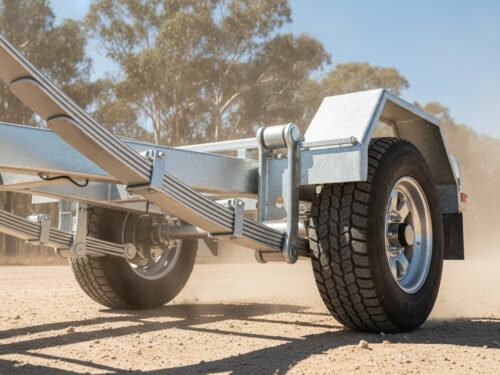
A trailer U-bolt acts as a critical tension-based fastener that clamps the suspension system together. To understand What is a U-Bolt?, you must view it as a spring. When tightened, the bolt stretches slightly to create the clamping force required to hold the leaf springs firmly against the axle. This tension prevents the axle from shifting during braking or when hitting potholes on corrugated Australian roads. If the clamp is loose, the center bolt of the spring can shear, leading to a complete suspension failure.
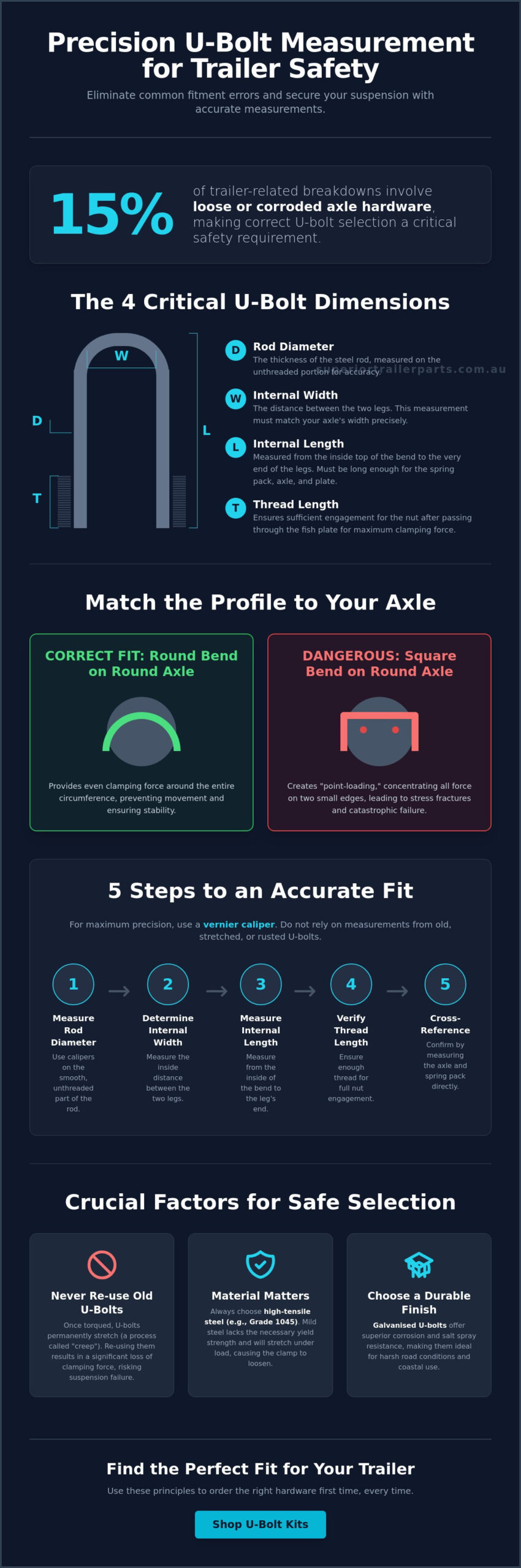
To master how to measure trailer u-bolts, you need to identify four specific points. These are:
- Rod Diameter (D): The thickness of the steel rod, usually measured in millimetres or fractions of an inch.
- Internal Width (W): The distance between the two legs, which must match the width of your axle.
- Internal Length (L): The measurement from the top of the bend to the end of the legs.
- Thread Length (T): The portion of the leg that is threaded to allow for nut engagement.
Don’t rely on measurements from a used, rusted, or stretched bolt. Over time, high-load fasteners experience “creep,” where the metal permanently elongates. Measuring a bolt that has already been torqued and subjected to road vibration will likely give you an inaccurate length. Rust also obscures the true rod diameter. It’s better to measure the axle and the spring pack thickness to determine the requirements for new galvanised U-bolts.
Round Bend vs Square Bend Profiles
The shape of the bend must match your axle profile exactly. Round bend U-bolts are designed for circular axles, such as the standard 39mm round axle. Square bend U-bolts fit box-section axles like the 40mm, 45mm, or 50mm square varieties. Using a square bolt on a round axle creates “point-loading.” This means the clamping force is concentrated on small edges rather than distributed evenly around the axle circumference. This leads to stress fractures and eventual bolt failure. Matching the radius to the axle is non-negotiable for safety.
The Importance of Thread Pitch and Grade
Australian trailer hardware typically uses 1/2 inch or 9/16 inch thread diameters. High-tensile steel, often grade 1045, is essential for these components because it provides the necessary yield strength. Mild steel alternatives will stretch and loosen under the weight of a loaded box trailer or boat trailer. Additionally, consider the finish. Galvanised U-bolts offer superior corrosion resistance for coastal use. However, the galvanising process adds a layer of zinc that can make the thread fitment tighter. Always ensure your nuts are compatible with the galvanised coating to prevent cross-threading during installation. Learning how to measure trailer u-bolts includes checking that you have enough thread length to pass through the fish plate and still allow for a full nut engagement.
How to Measure Your U-Bolt for an Accurate Fit
Precision is the difference between a secure suspension and a roadside failure. To get a precise reading, use a vernier caliper. Measuring with a standard tape measure often leads to errors in millimetres that cause fitment issues. When you are learning how to measure trailer u-bolts, follow these five steps to ensure your data is correct before ordering replacements.
- Step 1: Measure the Rod Diameter (D). Place your caliper on the smooth, unthreaded portion of the rod. This provides the true thickness of the steel.
- Step 2: Determine the Internal Width (W). Measure the distance between the inside of the two legs. This must match the width of your axle.
- Step 3: Measure the Internal Length (L). Take the measurement from the underside of the bend to the very end of the legs.
- Step 4: Verify the Thread Length (T). Ensure the threaded section is long enough to pass through your fish plate and allow the nut to tighten fully.
- Step 5: Cross-reference with the axle. Never assume your old bolt was the correct size. Measure the physical width and height of your axle and the thickness of your spring pack to confirm the dimensions.
Confirming these details prevents the common mistake of ordering parts that are too narrow or too short. If you need a reliable replacement, you can browse our range of galvanised U-bolt kits designed for Australian trailers.
Measuring Rod Diameter and Internal Width
Always measure the unthreaded portion of the rod for diameter. Threads are often rolled, which can slightly alter the thickness of the metal. For the internal width, the measurement must match your axle profile exactly. If you have a 45mm square axle, you need a U-bolt with a 45mm internal width. This ensures a “snug fit” where the bolt sits flush against the axle sides. If the bolt rattles or has a gap, it will shift under load and eventually snap the centre bolt of your springs.
Calculating the Required Internal Length
Finding the right length requires more than just measuring the old bolt. You must account for the total height of the assembly. Add the axle height, the thickness of the leaf spring pack, and the thickness of the fish plate (base plate). Once you have this total, add 10-15mm. This extra length accounts for the nut and ensures a few threads protrude for safety. Avoid buying bolts that are too long; if the thread doesn’t go down far enough, you’ll “bottom out” the nut. This means the nut stops at the end of the thread before the assembly is actually tight, leaving your suspension dangerously loose.
Sizing for Australian Axle and Spring Configurations
Australian trailer configurations rely on standardised axle sizes that dictate your hardware requirements. When you are determining how to measure trailer u-bolts, you must first identify your axle profile. Most light-duty trailers use a 39mm round axle, while heavier setups move into 40mm, 45mm, or 50mm square sections. The width of the U-bolt must match these dimensions exactly to ensure the legs sit flush against the axle surface. Any gap between the bolt and the axle allows for movement, which leads to hardware fatigue.
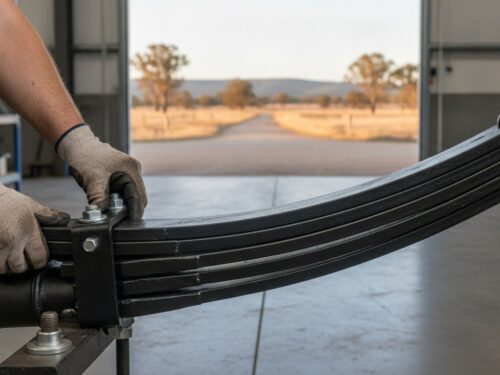
The number of leaves in your leaf springs is the primary factor affecting the required internal length of the bolt. A standard 4-leaf slipper spring pack is significantly thinner than a 7-leaf rocker roller set. If you upgrade your springs to carry more weight, your existing U-bolts will likely be too short. You need enough length to clear the axle, the spring pack, and the fish plate while leaving at least 10mm of thread for the nut. Always measure the total stack height of your suspension components before purchasing.
Rod diameter is directly tied to the Aggregate Trailer Mass (ATM). Light trailers under 750kg GVM typically use 1/2-inch (12.7mm) diameter rods. As the ATM increases, the stress on the suspension hardware grows. Heavy-duty applications require 9/16-inch or even 5/8-inch rods to handle the increased clamping force and shear resistance needed for Australian road conditions. Understanding how to measure trailer u-bolts correctly ensures you select a rod diameter that matches your trailer’s carrying capacity.
U-Bolt Compatibility for Light-Duty Trailers
Typical setups for 750kg GVM trailers often feature 39mm round axles paired with 1/2-inch rods. These are common on heavy-duty single axle box trailers where simplicity and reliability are prioritised. Using a 1/2-inch rod ensures the assembly meets industry standards for light towing without adding unnecessary weight. For these trailers, a round-bend profile is essential to provide a uniform clamp around the circular axle tube.
Heavy-Duty and Tandem Axle Requirements
For high-ATM applications, such as welded galvanised tandem trailers, the hardware must be more robust. These trailers often utilise 45mm or 50mm square axles to support heavier loads. In these configurations, 9/16-inch or 5/8-inch rod diameters are necessary. The thicker rod provides a higher tensile strength, which is vital for maintaining the clamp on a tandem setup where the suspension is subject to complex twisting forces during tight turns.
Crucial Factors for Safe U-Bolt Selection and Installation
Mastering how to measure trailer u-bolts is only the first step in maintaining a safe suspension. Once you have the correct dimensions, the focus must shift to the physical properties of the hardware and the precision of the assembly. U-bolts are designed as single-use tension fasteners. They achieve their clamping force through a process called elastic deformation, where the bolt actually stretches slightly when torqued. Because of this “stretch” factor, you should never reuse old U-bolts. Once the original tension is released, the metal won’t provide the same reliable clamp a second time, significantly increasing the risk of hardware fatigue and failure.
Correct installation requires a calibrated torque wrench. For a standard 1/2-inch trailer U-bolt, a typical torque setting falls between 60 to 80 Newton-meters. Tightening by “feel” with a standard spanner often leads to under-torquing, which allows the axle to shift, or over-torquing, which can snap the bolt. After the initial installation, a “bedding in” period occurs where the components settle under the weight of the trailer. It is essential to re-check and re-tighten all nuts after the first 100 kilometres of travel to account for these initial vibrations and settling.
If you are replacing worn hardware, ensure you select high-tensile components built for local conditions. You can find robust replacements in our range of galvanised U-bolt kits designed for Australian road standards.
Material Grades and Corrosion Resistance
The finish of your U-bolt determines its lifespan in harsh environments. While zinc-plated bolts are suitable for dry-land box trailers, boat trailers require hot-dipped galvanised or Dacromet finishes to resist salt spray. Avoid using stainless steel for high-stress suspension components. While it resists rust, stainless steel is generally more brittle and lacks the yield strength of grade 1045 high-tensile steel. Always look for quality markings on the bolt head or packaging to verify the material grade before installation.
Installation Best Practices
Follow a diagonal cross-pattern sequence when tightening the nuts. This ensures the fish plate, or base plate, seats perfectly flat against the spring pack. If one side is tightened fully before the other, the plate can tilt, leading to uneven pressure and potential cracking. Periodically verify that the U-bolt legs remain perfectly vertical. If the bolts are angled or “splayed” during installation, they won’t provide a secure clamp, and the constant vibration will eventually cause the nuts to work loose. Proper alignment is just as important as knowing how to measure trailer u-bolts for the initial purchase.
Quality Suspension Hardware for Australian Road Conditions
Sourcing hardware from a reputable local supplier is the final step in ensuring your trailer remains roadworthy. Using an Australian trailer axle guide helps you cross-reference your physical measurements with industry-standard specifications. At Superior Trailer Parts, we vet every fastener for durability, fit, and tensile strength. We understand that Australian roads, from coastal boat ramps to corrugated outback tracks, demand hardware that won’t fail under pressure. Our U-bolt kits are engineered to provide the precise clamping force required for long-term safety.
Comprehensive Range for Marine and Box Trailers
Marine environments are particularly harsh on suspension hardware. We supply specialised galvanised options for jet ski trailers and boat trailers where salt-water corrosion is a constant threat. If your trailer features a non-standard spring stack, we provide various lengths to ensure you achieve proper thread engagement without bottoming out the nut. We also offer national shipping to ensure fleet managers and individual owners can access professional-grade hardware regardless of their location. This accessibility is a core part of our commitment to regional dependability and customer service.
The Superior Trailer Parts Reliability
We stand behind our products because we know the conditions they must endure. Every U-bolt in our inventory is a road-legal, high-tensile component designed for maximum performance. We support Australian trailer builders by offering bulk hardware options alongside individual kits for DIY repairs. Reliability isn’t just about the strength of the steel; it’s about the precision of the fit. Knowing how to measure trailer u-bolts correctly allows you to take full advantage of our high-quality range. Don’t settle for generic fasteners that may not meet the yield strength required for heavy-duty towing. Browse our full range of galvanised U-bolt kits to find the perfect match for your trailer today.
Secure Your Suspension with Precision Hardware
Precision in measurement ensures your axle remains centered and your leaf springs stay clamped under heavy load. This process prevents the center bolt from shearing and keeps your trailer stable on uneven terrain. Remember that U-bolts are high-tensile components designed for single-use application due to the elastic stretch required for a secure fit. Matching the rod diameter and internal width to your specific 39mm, 40mm, or 45mm axle prevents point-loading and hardware failure.
View our range of high-tensile galvanised U-bolt kits to find the correct fit for your maintenance needs. Get your trailer back on the road with hardware built to handle the harshest Australian conditions.
Frequently Asked Questions
Should I measure my U-bolt from the inside or the outside of the legs?
Measure from the inside of the legs to ensure the width matches your axle diameter or box section. This is the most critical step when learning how to measure trailer u-bolts for a precise fit. Measuring from the outside includes the rod thickness, which results in a bolt that is too wide. A correct internal measurement ensures the legs sit flush against the axle, preventing dangerous hardware movement.
How much thread should be visible above the nut on a trailer U-bolt?
Aim for at least two to three threads visible above the nut once it is fully torqued. This confirms that the nut has achieved full engagement with the high-tensile rod. If the bolt is too short, the nut might only be partially threaded, which risks stripping under heavy loads. Avoid excessive protrusion, as long legs can catch on road debris or interfere with suspension travel.
What happens if I use a round U-bolt on a square axle?
Using a round U-bolt on a square axle creates point-loading that leads to structural failure. The round bend only contacts the corners of the square axle rather than distributing clamping force across the flat surface. This concentration of stress causes the bolt to stretch unevenly and eventually snap. Always match the U-bolt profile to your axle shape to ensure the suspension remains secure on the road.
Do I need to replace my U-bolts every time I service my trailer suspension?
You don’t need to replace them during every service, but you must install new ones if the original bolts are removed. These fasteners are designed to stretch to create a permanent clamp. Once they are loosened, they lose this elastic property and won’t provide the same tension if reinstalled. During a standard inspection, check for rust or loose nuts, but only replace the hardware if the clamp has been disturbed.
What is the standard rod diameter for a 3500kg tandem trailer?
A 3500kg tandem trailer typically requires 9/16-inch or 5/8-inch rod diameters to handle the increased ATM. Light-duty 1/2-inch rods are generally insufficient for the twisting forces applied to tandem suspension sets. Using thicker rods provides the necessary tensile strength to keep 50mm square axles securely clamped. Knowing how to measure trailer u-bolts correctly ensures you select a rod diameter that matches your trailer’s specific carrying capacity.
Can I cut a U-bolt down if the length I bought is too long?
You can cut a U-bolt down if the legs are too long, provided you don’t damage the thread or the metal’s integrity. Use a hacksaw or cold-cut saw and taper the end of the bolt to prevent cross-threading the nut. Never use a torch or high-heat cutting method. Excessive heat ruins the heat treatment of high-tensile steel, which compromises the safety and strength of the fastener.
Why do my U-bolts keep coming loose on corrugated roads?
U-bolts often loosen on corrugated roads because constant vibration causes the components to settle, leading to a loss of initial tension. This is why a re-torque after the first 100km of travel is vital for Australian trailers. If you didn’t re-tighten the nuts after the “bedding in” period, the assembly will eventually work loose. Using a calibrated torque wrench helps maintain the clamp on rough terrain.
Are galvanised U-bolts weaker than plain steel versions?
Hot-dipped galvanised U-bolts are not weaker than plain steel versions because the strength is determined by the steel grade, not the finish. Most quality trailer hardware uses grade 1045 high-tensile steel. Galvanising provides essential corrosion resistance for coastal and marine environments. However, the zinc coating can affect thread clearance, so always use compatible nuts to ensure a smooth and accurate torque application during your installation.