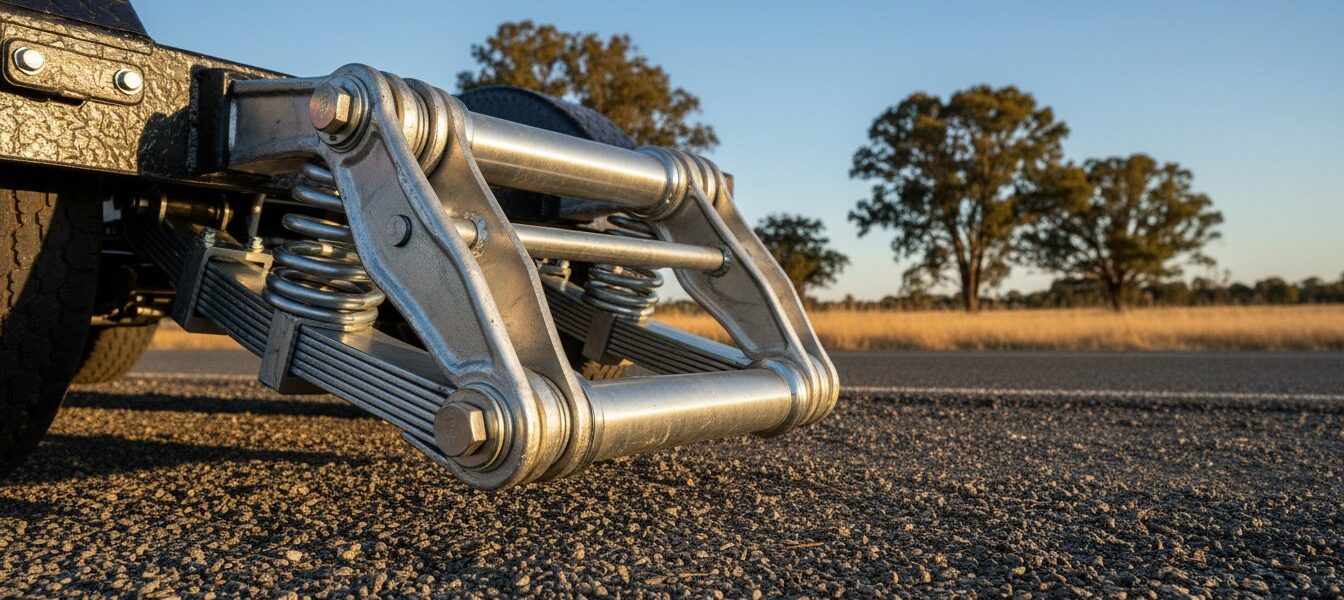
The loudest warning sign of a failing trailer suspension isn’t a breakdown; it’s the constant, grinding squeak echoing from your tandem axles. Many operators assume that a quick squirt of grease is sufficient, but neglecting the mechanical ovality of the rocker arm is the fastest way to compromise your trailer’s safety. You’ve likely noticed accelerated tyre wear or felt the vibration of a rough tow and wondered if your bushes or bolts are reaching their limit. It’s a common frustration for anyone hauling heavy loads across Australia’s demanding terrain.
Consistent rocker roller suspension maintenance is the only way to ensure your trailer remains compliant with the National Heavy Vehicle Inspection Manual standards. This article teaches you how to identify specific wear patterns, perform essential lubrication, and replace critical components before they lead to a roadside failure. You’ll gain the technical knowledge needed to achieve a quiet, smooth-towing trailer and the confidence that your setup is ready for any long-distance trip. We’ll examine the precision required for load-sharing systems and the steps to extend the lifespan of your hardware.
Key Takeaways
- Identify visual cues like “walking” axles and tilted rocker arms to catch wear before it leads to roadside failure.
- Implement a consistent rocker roller suspension maintenance schedule to eliminate mechanical squeaks and ensure reliable load distribution.
- Master safe jacking and support techniques specifically designed for tandem axle trailers during service.
- Link uneven tyre wear patterns directly to worn bushes or bent axles for faster troubleshooting and repair.
- Select galvanised replacement components to maximise the resilience and service life of your suspension in harsh environments.
Understanding Rocker Roller Suspension Mechanics
Rocker roller suspension is the standard configuration for heavy-duty tandem axle trailers across Australia. Unlike basic tandem setups, this system is a load-sharing design. It ensures that the weight of the trailer remains distributed evenly across all four wheels, even when traversing uneven terrain or steep driveways. Effective rocker roller suspension maintenance starts with understanding how these moving parts interact to protect your trailer’s structural integrity and your cargo.
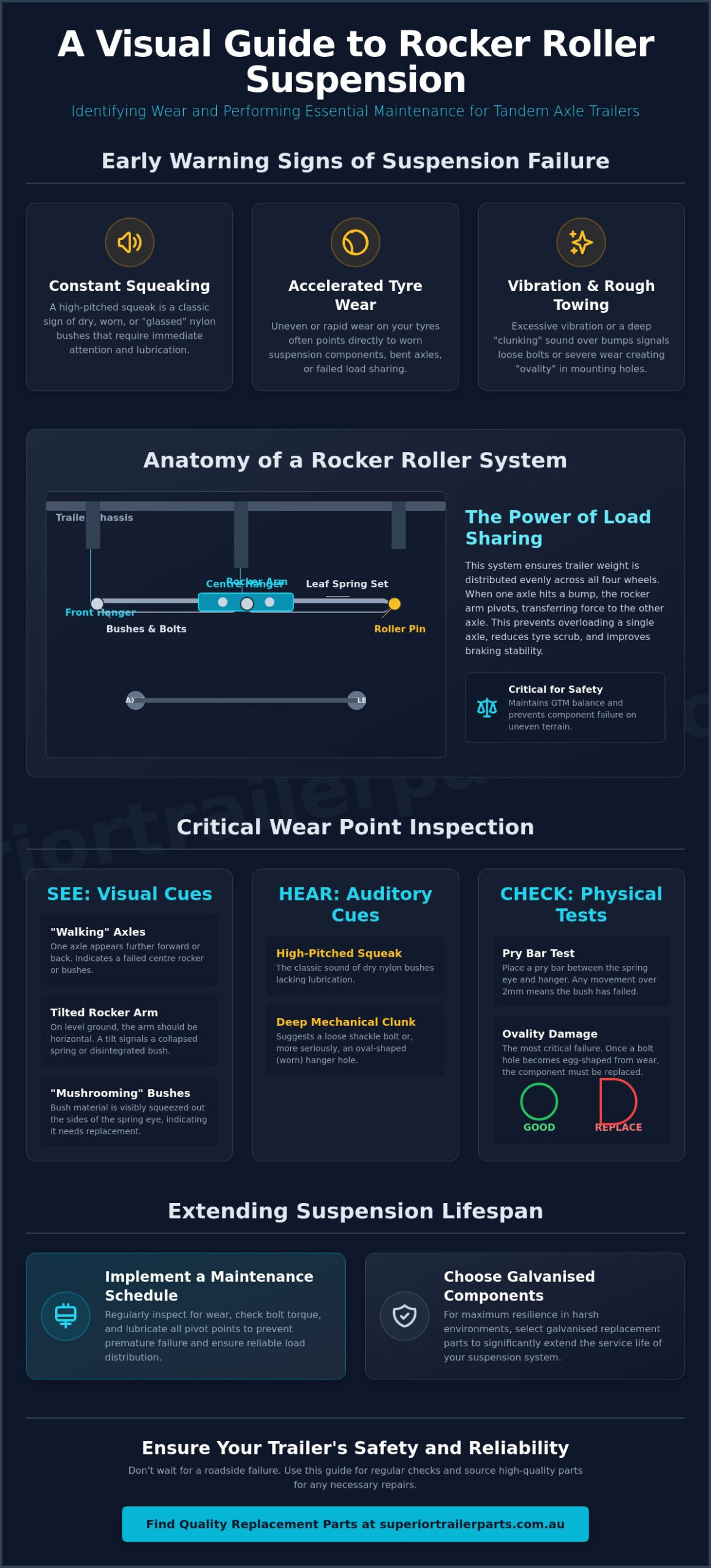
The system gets its name from two distinct mechanical actions. The rocker is a central arm that pivots on a centre hanger. When the front axle hits a bump, the rocker arm rotates to transfer a portion of that force to the rear axle. This prevents a single axle from bearing the entire weight of the load. The roller feature refers to the rear of the leaf spring. Instead of being fixed to a shackle, the spring end slides against a steel roller pin. This allows the leaf spring mechanics to function without binding, providing a smoother ride under heavy loads compared to traditional eye-to-eye springs.
The Role of Load Sharing in Tandem Axles
Load sharing is critical for maintaining the Gross Trailer Mass (GTM) balance. In an independent suspension system, one axle might momentarily carry the full weight of the trailer when crossing a kerb or pothole. This often leads to bent axles or snapped springs. The rocker roller system balances this weight across all four tyres constantly. This balance improves braking efficiency; it keeps all tyres in contact with the road to prevent premature wheel lock-up. It also significantly reduces tyre scrubbing, which is a common frustration on tandem trailers during tight turns.
Anatomy of a Rocker Roller Set
A standard set consists of several high-wear components that require regular inspection. The primary parts include:
- Centre Hanger: The heavy-duty bracket welded to the chassis that houses the rocker arm.
- Rocker Arm: The pivoting steel component that links the two springs.
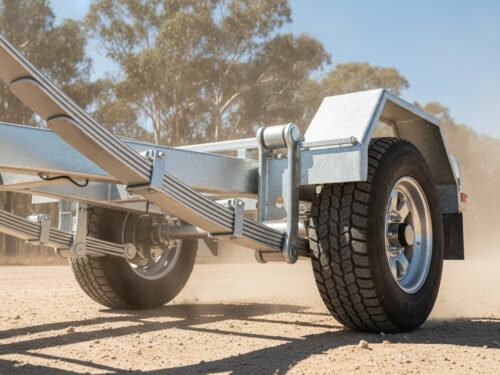
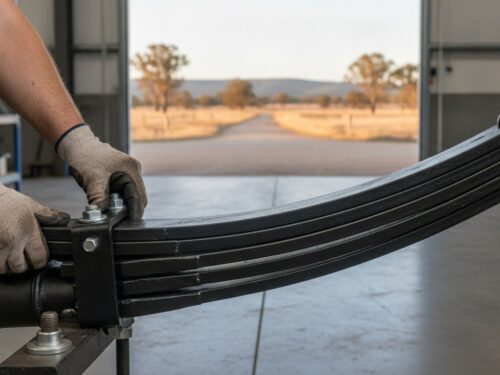
- Spring Leaves: Multi-leaf rocker roller spring sets designed for high-capacity hauling.
- Bushes and Bolts: These components reduce friction at pivot points and are the most common failure points.
Regular rocker roller suspension maintenance focuses on these pivot points. If the bushes fail, the steel bolts begin to wear directly into the rocker arm or hangers. This creates “ovality,” where round holes become egg-shaped. This damage is expensive to repair and compromises the safety of your trailer on the road.
Identifying Critical Wear Points in Tandem Suspensions
Detecting wear in a tandem system requires more than a casual glance. You need to look for “walking” axles, where one axle appears to sit further forward or back than the other. This usually signals that the centre rocker arm or the bushes have failed. On level ground, the rocker arm should sit horizontally. If it is tilted significantly, one spring has likely lost its tension or a bush has completely disintegrated. These visual indicators are the first step in effective rocker roller suspension maintenance.
Auditory cues are equally revealing. High-pitched squeaks are a classic sign of dry or “glassed” nylon bushes. Conversely, a deep mechanical clunk when hitting bumps suggests that a shackle bolt is loose or that the hole in the hanger has become oval. During your inspection, use a pry bar to check for play. Place the bar between the spring eye and the hanger; any movement beyond 2mm suggests the bush is no longer providing adequate cushioning. If the hole is no longer perfectly round, you have reached the limit of the component’s service life.
Safety is non-negotiable. While the National Heavy Vehicle Inspection Manual provides local guidelines, comparing these to international federal suspension system regulations highlights the universal requirement that any cracked, loose, or missing component is an immediate safety rejection. Australian standards specifically reject any suspension component that is bent, welded without approval, or damaged in a way that compromises its structural integrity.
Bushing and Pin Degradation
Nylon bushes are sacrificial components. They are designed to wear so your steel hangers don’t. Look for “mushrooming,” where the bush material is squeezed out the sides of the spring eye. Once the bush is gone, the shackle bolt will score the internal surface of the hanger. If you find deep grooves or “stepping” on a bolt during inspection, replace it immediately. A stepped bolt cannot be properly tightened and will eventually shear under the stress of a heavy load.
Spring and Rocker Arm Fatigue
Examine the rocker arm casting for hairline fractures, especially near the central pivot. A distinct sign of component fatigue is “fretting.” This is a fine, red or brown metallic dust that settles around bolt heads. It indicates that the bolt is moving within the hole, even if it feels tight. Also, check the roller path at the rear of the spring. The spring tail must slide freely over the roller pin. If the path is notched or the pin is seized, the spring cannot flex, leading to leaf fractures. If you notice flattened leaves, it is time to inspect new rocker roller spring sets to restore your trailer’s load-carrying capacity.
Essential Maintenance Procedures and Lubrication
Effective rocker roller suspension maintenance relies on a proactive schedule. For trailers used on sealed roads, a full inspection every 10,000 kilometres is standard. If you operate in off-road environments or near coastal areas, reduce this interval to 5,000 kilometres. Constant exposure to dust, salt, and water accelerates the degradation of moving parts. A documented log of these checks ensures you catch wear before it leads to a mechanical failure during a trip.
Safety is the priority when performing service. Always park on a level concrete surface and chock the wheels. Use a jack rated for the trailer’s aggregate mass and support the chassis with heavy-duty jack stands. Don’t rely solely on the jack while working underneath. Ensure the suspension is in a neutral, unloaded position. This allows you to inspect the pivot points without the tension of the trailer’s weight masking potential play in the bushes.
Clean all components before applying new lubricant. Use a wire brush to remove road grime and old, hardened grease from the nipples and roller pins. When reassembling or tightening shackle bolts, precision is required. Over-tightening crushes the bushes and prevents the rocker arm from pivoting. Under-tightening leads to vibration and bolt fatigue. Tighten the nut until it’s firm, then back it off slightly to ensure the component moves freely. This “free-play” is essential for the load-sharing mechanism to function correctly.
The Greasable Bolt Advantage
Greaseable shackle bolts are a significant upgrade for any tandem axle. These pins feature an internal channel and a grease nipple, allowing you to force lubricant directly into the friction zone between the bolt and the bush. Use a high-quality, waterproof lithium grease for general highway use. For heavy-duty applications, molybdenum disulphide grease provides superior load-bearing protection. If a nipple is blocked, replace it immediately. Forcing grease into a seized pin can rupture the bush or cause the lubricant to bypass the wear surface entirely.
Nylon vs. Brass Bushing Care
The choice of bushing material dictates your maintenance approach. Standard nylon bushes are often designed to run dry. However, in harsh conditions, they can become brittle and crack. Brass or bronze bushes are the professional choice for heavy-duty tandem trailers. These require regular greasing to prevent metal-on-metal galling. For boat trailer parts, waterproof grease is mandatory. It prevents saltwater from corroding the pins and seizing the rocker mechanism, which is a common cause of snapped springs in marine environments.
Troubleshooting Common Rocker Roller Issues
Troubleshooting requires connecting specific towing symptoms to mechanical failures. Uneven tyre wear is the most frequent indicator of neglect. If you notice the inner edges of your tyres wearing faster than the outer edges, your trailer likely has bent axles or collapsed bushes. Collapsed bushes allow the axle to shift out of its designated track, ruining the alignment. Effective rocker roller suspension maintenance addresses these issues before they result in a high-speed blowout or permanent axle damage.
Trailer swaying is another critical symptom. A tandem trailer that feels “loose” or wanders behind the tow vehicle often suffers from worn rocker arm pivot points. When the central rocker arm or its bushes wear down, the load-sharing mechanism loses its precision. This allows the axles to move independently in ways they shouldn’t, destabilising the entire load. If your trailer sways despite correct weight distribution, the suspension hardware is the primary suspect.
Bottoming out occurs when the trailer chassis strikes the axle over minor bumps. This is a clear sign that your rocker roller spring sets have lost their tension or “temper.” Springs eventually fatigue under constant heavy loads, resulting in a lower ride height and reduced shock absorption. If your trailer sits lower on one side, or if you see shiny metal marks on the underside of the chassis, the springs require immediate replacement to prevent structural cracking.
Correcting Alignment Problems
Worn bushes cause axles to move out of parallel. This “dog-tracking” forces the tyres to scrub against the road rather than rolling freely. Misalignment significantly reduces fuel economy and increases tyre heat, which leads to premature carcass failure. You can check this by measuring the distance between the front and rear wheel centres on both sides. If the measurements differ by more than 3mm, the suspension geometry is compromised. If your inspection reveals a bent axle or irreparable wear, select a replacement axle to restore your trailer’s alignment.
Noise Isolation and Resolution
Persistent squeaking is caused by dry friction at pivot points. Isolate the noise by having an assistant rock the trailer while you observe the rocker arms. For non-greasable systems, a dry PTFE lubricant can provide temporary relief, but persistent noise usually indicates the nylon bush has worn through. “Spring slap” occurs when the leaves shift laterally; check that the spring clips are tight and the leaves are aligned. Never assume that a quiet trailer is a safe one. Silent failures occur when hardened grease masks excessive play in a pivot point, making regular physical inspections mandatory.
Selecting Replacement Components for Reliability
Choosing the right hardware is the final step in effective rocker roller suspension maintenance. When a component fails the wear tests mentioned in previous sections, you must replace it with a part that matches your trailer’s ATM (Aggregate Trailer Mass). Light-duty sets are typically designed for smaller tandem builds, while heavy-duty configurations feature thicker rocker arms and increased leaf counts. Never mix components from different weight ratings on the same trailer, as this creates an imbalanced load-sharing effect.
Material selection determines how often you’ll be performing repairs. For trailers exposed to coastal air or salt, galvanised components are essential. The galvanising process provides a sacrificial zinc layer that prevents the base steel from corroding. When sourcing reliable rocker roller spring sets, verify the spring width. Most Australian systems use either 45mm or 60mm springs. Ensure your eye diameters match your shackle bolts exactly; even a 1mm discrepancy will lead to rapid bushing failure and mechanical noise.
Australian manufacturing standards are a primary trust signal. Components must comply with the relevant Australian Design Rules (ADRs) to ensure they can withstand the harsh vibrations of outback roads. Selecting parts that meet these standards ensures that the steel temper and casting quality are sufficient for heavy-duty towing. Using inferior, unrated hardware often leads to snapped hangers or sheared bolts under load.
Upgrading Your Suspension System
If you currently use a slipper spring setup on a tandem axle, upgrading to a rocker roller configuration is a sound investment. Rocker rollers provide superior weight distribution and reduced tyre wear. During this transition, consider installing greaseable shackle kits. These allow for easier rocker roller suspension maintenance by providing a direct path for lubricant to reach the bushes. Integrating high-quality trailer axles with your new suspension ensures the entire undercarriage is rated for your maximum payload.
Sourcing Quality Parts Nationally
Local expertise is invaluable when navigating the technical requirements of trailer builds. Australian road conditions are unique; parts designed for overseas markets often fail prematurely here. You can find a comprehensive range of trailer parts online that are engineered for local durability. This ensures you receive hardware that fits correctly and lasts longer. Ensure your trailer is road-ready. Contact Superior Trailer Parts for expert advice and national shipping on all suspension components.
Secure Your Trailer for the Long Haul
Maintaining a tandem axle setup requires a disciplined approach to mechanical inspection. By prioritising rocker roller suspension maintenance, you ensure your trailer remains compliant with safety standards and performs reliably under heavy loads. Focus on identifying bushing wear early and keeping all pivot points properly lubricated with the correct grease. Replacing fatigued springs and worn shackle bolts before a long trip prevents costly roadside repairs and protects your tyres from premature wear.
Superior Trailer Parts has been Australian owned and operated since 2014. We provide products engineered specifically for Australian safety standards to withstand our unique road conditions. We offer nationwide shipping on all trailer components to keep your equipment moving. Use high-quality, galvanised hardware to maximise the lifespan of your suspension system and maintain structural integrity.
Browse heavy-duty Rocker Roller Suspension Kits and find the exact components you need for a smooth tow.
Keep your equipment in peak condition and tow with confidence on every journey across the country.
Frequently Asked Questions
How often should I grease my rocker roller suspension?
Grease your suspension every 5,000 to 10,000 kilometres depending on your operating environment. Trailers used in off-road conditions or coastal areas require more frequent lubrication to combat dust and salt ingress. Always inspect the grease nipples during your pre-trip checks. Consistent rocker roller suspension maintenance ensures that the lubricant reaches the internal wear surfaces before the bushes become brittle or seized.
Why is my tandem trailer suspension squeaking so loudly?
High-pitched squeaking is typically caused by dry friction between the shackle bolts and the bushes. This occurs when nylon bushes become “glassed” or when greaseable pins are blocked. If the noise is a deep mechanical clunk, it indicates a more serious issue like loose hardware or ovality in the hangers. Isolate the noise by rocking the trailer and apply lubricant to the specific pivot point causing the sound.
Can I replace nylon bushes with brass bushes in my rocker roller?
You can upgrade to brass or bronze bushes to improve the durability of your tandem axle setup. Brass is the professional choice for heavy-duty applications because it resists crushing under high loads better than nylon. However, you must use greaseable shackle bolts with brass bushes. Metal-on-metal contact without constant lubrication will cause galling and rapid wear of the steel pins.
What are the signs that my trailer springs need replacing?
Look for sagging, flattened leaves, or visible cracks in the steel. Measure the ride height on both sides of the trailer while it is on level ground. If one side sits lower than the other, the spring tension has failed. Visible shiny marks on the underside of the chassis also indicate that the suspension is bottoming out and the springs can no longer support the GTM.
Do I need to replace all four springs if only one is sagging?
Replace your springs in pairs across the axle at a minimum to maintain balance. For tandem trailers, replacing all four springs is the best practice. A single new spring will have higher tension than the remaining old ones. This imbalance interferes with the load-sharing mechanism and causes the new spring to carry a disproportionate amount of the weight, leading to premature failure.
How do I know if my rocker arm is worn out?
Inspect the central pivot hole for “ovality,” where the hole becomes egg-shaped rather than perfectly round. Check the casting for hairline fractures, especially around the bolt holes. If you see fine red or brown dust, known as fretting, the bolt is moving within the arm. These are clear indicators that the component has reached the end of its service life and requires immediate replacement.
Is it safe to tow with a worn rocker roller bush?
Towing with a worn bush is dangerous and will lead to expensive structural damage. Once the bush disintegrates, the steel shackle bolt begins wearing directly into the rocker arm or hanger. This creates excessive play that can cause the bolt to shear or the axle to shift out of alignment. Maintaining a strict rocker roller suspension maintenance schedule prevents these components from reaching a point of total failure.
What is the difference between rocker roller and slipper suspension?
Rocker roller systems use a central pivoting arm to distribute weight evenly between both axles. This load-sharing capability is essential for tandem trailers to prevent axle overloading on uneven ground. Slipper suspension is a simpler design where the rear of the spring slides in a box. While slipper systems are common on single axles, they lack the sophisticated weight-balancing action required for heavy-duty tandem towing.