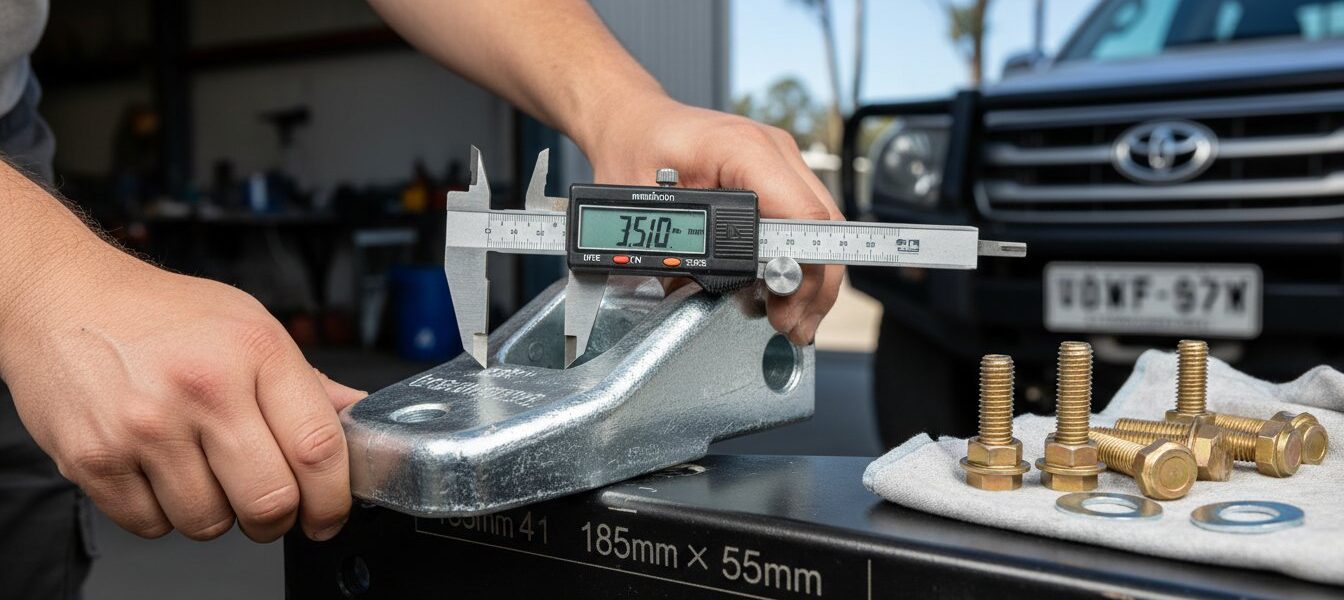
A single millimetre of error in your 4 hole coupling bolt pattern can render a heavy-duty trailer illegal and unsafe for the road. You likely expect a standard fit when upgrading your hardware, but finding your new coupling doesn’t line up with existing holes is a frustrating waste of time. It’s a common problem that stalls maintenance and compromises your safety on the highway.
This guide identifies the industry-standard dimensions for 4 hole trailer couplings and explains how to measure your drawbar for a perfect fit. We’ll confirm the common 185mm x 55mm standard while explaining how to verify your specific setup against ADR 62/02 requirements. Whether you need a 4 hole over-ride coupling or a poly block off-road coupling, you’ll gain the technical clarity needed to purchase a correctly rated component that bolts on without a struggle. We’ll walk through the specific centre-to-centre measurements required to ensure your trailer remains compliant and secure under heavy loads.
Key Takeaways
- Confirm the common 185mm x 55mm industry standard used for most braked trailers in Australia.
- Follow a precise process to measure your 4 hole coupling bolt pattern from the centre of each hole to ensure a secure fit.
- Identify the hardware specifications required for safety, including the use of Grade 8.8 high-tensile bolts and M12 fasteners.
- Select the appropriate coupling for your needs, ranging from standard 4 hole over-ride couplings to poly block off-road couplings for harsh conditions.
Standard 4 Hole Coupling Bolt Pattern Dimensions
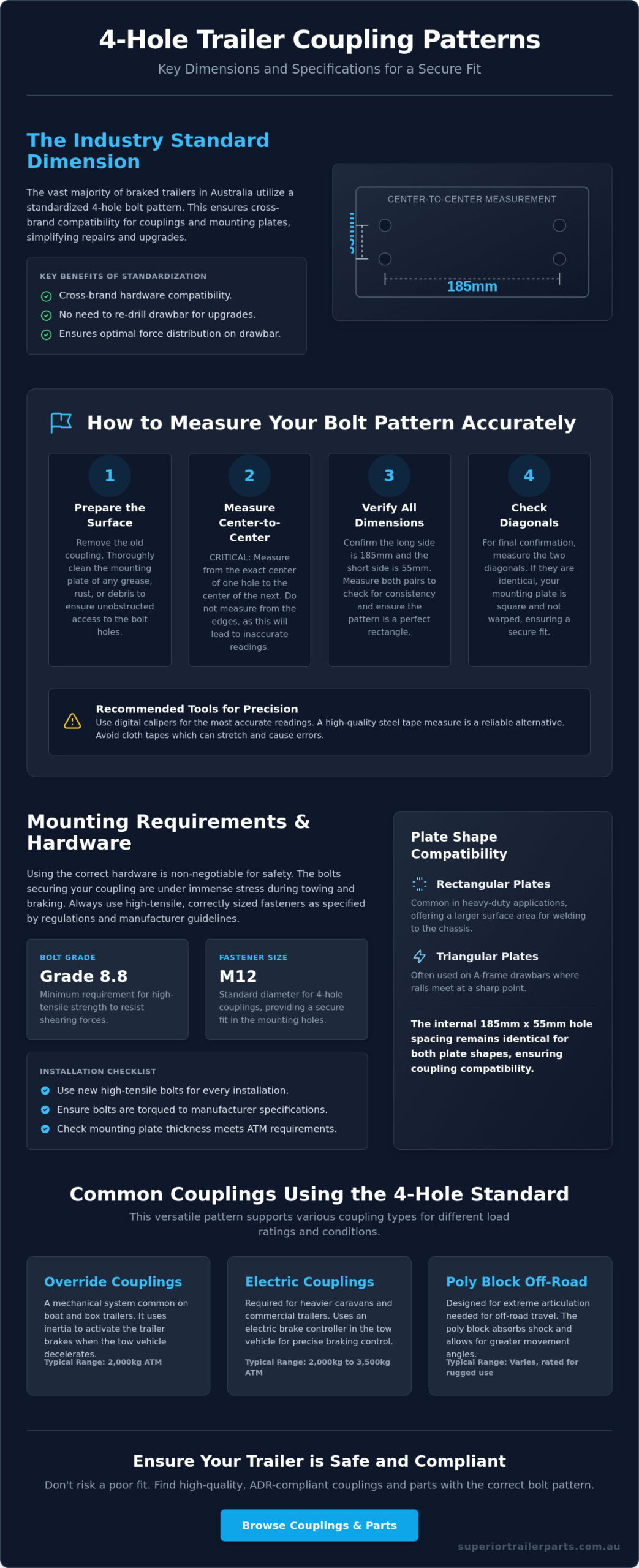
The 185mm x 55mm configuration is the benchmark for braked trailer hardware in Australia. This specific 4 hole coupling bolt pattern provides a stable foundation for trailers carrying significant weight. Most manufacturers adhere to these dimensions to ensure cross-brand compatibility. This standardisation is a major advantage for fleet operators and individual owners alike. It allows you to replace a worn hitch or upgrade your braking system without drilling new holes or modifying the drawbar structure. Using an industry standard means you aren’t locked into a single supplier for the life of your trailer.
When verifying your setup, always measure from the centre of one bolt hole to the centre of the next. Measuring from the inner or outer edges of the holes leads to inaccurate readings and fitment failure. The longitudinal distance (front to back) should be 185mm. The transverse distance (side to side) should be 55mm. This rectangular footprint is engineered to resist the shearing forces generated during heavy braking and towing. Precision is vital here. Even a few millimetres of deviation can prevent the high-tensile bolts from seating correctly against the mounting plate.
This pattern serves as the foundation for various hardware types. It is the go-to choice for mechanical override couplings used on boat trailers and box trailers. It is also the standard for electric couplings required for heavier caravans and commercial trailers. Having a single, reliable pattern across these different braking systems simplifies the maintenance process. You can switch from a mechanical system to an electric one using the same mounting points, provided the drawbar and mounting plate are rated for the load.
Why the 185mm x 55mm Spacing Matters
This spacing is not arbitrary. It is designed to align perfectly with standard weld-on coupling plates used on Australian A-frame drawbars. By spreading the four mounting points across this specific area, the coupling distributes towing and braking forces evenly. This reduces stress on individual fasteners and prevents the drawbar metal from fatiguing over time. This pattern is essential for any equipment rated between 2,000kg and 3,500kg, where structural integrity is non-negotiable. You can find compatible hardware in our range of trailer couplings and parts.
Triangular vs Rectangular Plate Patterns
The outer shape of your mounting plate might vary depending on your trailer’s design. Triangular plates are common on straight A-frame drawbars where the rails meet at a sharp point. Rectangular plates are often preferred for heavy-duty applications because they provide more surface area for welding to the chassis. Regardless of whether the plate is triangular or rectangular, the internal 185mm x 55mm hole spacing remains the same. This consistency ensures that a 4 hole over-ride coupling will fit securely on either plate type. Always check the thickness of the mounting plate to ensure it meets the requirements for your trailer’s Aggregate Trailer Mass (ATM).
How to Measure Your Trailer Coupling Bolt Pattern
Precision in measuring your 4 hole coupling bolt pattern is the difference between a secure fit and a dangerous mechanical failure. Start by parking your trailer on a level concrete surface. Chock the wheels to prevent any movement. You must remove the existing coupling to access the mounting plate properly. Dust, grease, or rust can obscure the hole edges; wipe the surface clean before you begin. Accurate measurements are impossible if you are trying to work around an old, grease-covered hitch.
Measurement must always be taken from the centre of one hole to the centre of the opposite hole. This is known as centre-to-centre measurement. If you measure from the inner or outer edges, your reading will be influenced by the diameter of the drill bit used. For a standard Australian setup, you are looking for a longitudinal distance of 185mm and a transverse distance of 55mm. If your measurements are off by more than a millimetre, double-check your technique before ordering new trailer couplings and parts. Small errors at this stage lead to significant alignment issues during installation.
Confirm the pattern by measuring all four sides. The two long sides should both hit the 185mm mark, while the two short sides must be exactly 55mm. It’s also a good practice to measure the diagonals. If the diagonal measurements are identical, your mounting plate is square. If they differ, the plate might be warped or the holes were drilled out of alignment. Identifying these issues now prevents you from forcing a new coupling onto a compromised surface, which can stress the bolts and lead to shearing under load.
Tools Required for Accurate Measurement
Digital callipers provide the most reliable readings. They allow you to zero the tool and lock in a precise millimetre measurement. If callipers aren’t available, a high-quality steel tape measure is a functional alternative. Avoid cloth tapes because they can stretch and distort. Use a fine-point marking pen to draw a crosshair over the centre of each hole if the plate surface is pitted or worn. This gives you a clear visual target for your measuring tool and ensures your 4 hole coupling bolt pattern is verified correctly.
Common Measurement Mistakes to Avoid
The most frequent error is measuring from the edge of the hole. Because most 4 hole patterns use 12mm or 13mm bolts, measuring from edge-to-edge results in a reading that deviates from the 185mm x 55mm standard. Another issue is ignoring previous damage. If the old coupling was loose, the holes might have become oval or ‘wallowed out’ over time. In these cases, you must identify the original centre point to ensure the new hardware seats correctly. Finally, check that the mounting plate is square. A warped or bent plate will prevent the new coupling from sitting flush, which compromises the integrity of the entire towing assembly.
Compatibility with Override and Electric Couplings
The 185mm x 55mm configuration is the standard for both override and electric braking systems in Australia. This shared footprint allows for significant versatility when choosing or upgrading your trailer hardware. Most override couplings, which rely on the physical momentum of the trailer to apply mechanical or hydraulic brakes, require the 4 hole coupling bolt pattern to maintain structural stability. The four-point attachment prevents the coupling body from pivoting or shifting during the intense push-pull forces generated when the trailer ‘overrides’ the tow vehicle’s braking. Without this secure four-bolt foundation, the sliding sleeve mechanism within the coupling can bind, leading to jerky braking or total mechanical failure.
Electric couplings for heavier loads, specifically those rated up to 3.5T, utilise this same 185mm x 55mm footprint. While electric hitches don’t require a sliding sleeve, they must manage immense vertical and horizontal stress. Standardisation between these two systems is a major benefit for owners. It means you can upgrade a trailer from mechanical brakes to a more sophisticated electric system without having to modify your drawbar. This interchangeability saves time and ensures that the structural integrity of the A-frame remains uncompromised by avoiding unnecessary drilling or welding during a system overhaul.
Always check the rating of the coupling against your trailer’s Aggregate Trailer Mass (ATM) before finalising a purchase. Just because a 4 hole over-ride coupling fits your bolt pattern doesn’t mean it’s rated for your specific load. A coupling designed for a 2,000kg trailer might look identical to one rated for 3,500kg, but the internal components and casting thickness will differ. It’s your responsibility to match the hardware’s load capacity with the trailer’s maximum weight. Using an under-rated coupling is a safety risk that can lead to hitch separation or insurance claim denials in the event of an accident.
Upgrading from 2 Hole or 3 Hole Systems
Light-duty unbraked trailers often use 2 hole or 3 hole fixed couplings. If you decide to add brakes to your trailer, you’ll likely need to move to a 4 hole pattern to support the new braking forces. You shouldn’t simply drill new holes into an existing light-duty mounting plate. These plates are typically thinner and weren’t designed for the stress of a braked system. Instead, cut off the old plate and weld on a new, heavy-duty 4 hole mounting plate. This ensures the 4 hole coupling bolt pattern is properly supported by sufficient steel thickness to handle the increased ATM.
Matching Couplings to Braking Systems
Selecting the right coupling depends entirely on your braking setup. Override couplings are necessary for trailers using mechanical or hydraulic drum brakes where the trailer’s own weight activates the system. Fixed 4 hole couplings are the standard for trailers equipped with electric brakes, as the braking force is managed by an in-car controller rather than physical movement at the hitch. For a deeper look at choosing the right hardware for your setup, browse our range of couplings and parts. Correct matching ensures your trailer stops safely and stays compliant with Australian road standards.
Mounting Requirements and Hardware Specifications
Selecting the right hardware for your 4 hole coupling bolt pattern is a critical safety step. You must use Grade 8.8 high-tensile bolts for all coupling installations. Standard mild steel bolts lack the shear strength required to manage the forces generated during heavy towing and sudden braking. Using inferior fasteners leads to bolt fatigue or sudden snapping, which risks hitch separation on the road. The industry standard for these patterns is typically an M12 or 1/2 inch bolt. Ensure the bolts are long enough to engage the full thread of the nut with at least two threads protruding, but not so long that they interfere with the coupling’s internal movement.
Structural integrity depends on the mounting plate as much as the bolts. Your coupling plate thickness must match the trailer’s Aggregate Trailer Mass (ATM). For trailers rated up to 3.5T, a minimum plate thickness of 8mm is required to prevent flexing or cracking under load. All installations must comply with Australian Design Rules (ADR) 62/02, which dictates the standards for mechanical connections between vehicles. Failure to meet these specifications doesn’t just compromise safety; it also makes the trailer unroadworthy and can void your insurance policy. If you’re building a new drawbar or upgrading an old one, browse our range of high-tensile trailer couplings and parts to ensure your hardware meets the necessary standards.
Bolting vs Welding the Coupling Plate
The coupling itself must always be bolted to the mounting plate. This ensures serviceability, allowing you to remove the hitch for maintenance or replacement without cutting into the drawbar. Conversely, the mounting plate must be professionally welded to the trailer A-frame. Use continuous fillet welds rather than tack welds to ensure maximum load distribution across the steel. Before fitting a new hitch, inspect the existing welds for hairline cracks, rust, or signs of metal fatigue. If the plate shows any warping or significant corrosion, replace it entirely to maintain a flat, secure mounting surface for the 4 hole coupling bolt pattern.
Torque Settings and Maintenance
Bolts only provide their rated strength when tightened to the correct torque. For an M12 Grade 8.8 bolt, this usually falls between 77Nm and 90Nm, depending on whether the thread is dry or lubricated. Refer to the manufacturer’s specific torque table to avoid over-tightening, which can stretch and weaken the bolt. Use nyloc nuts or spring washers to prevent the fasteners from backing off due to constant road vibration. Make it a habit to inspect bolt tension every 1,000km or before embarking on a long-distance trip. A quick check with a torque wrench ensures your connection remains secure throughout the life of the trailer.
Selecting High-Quality Couplings for Australian Trailers
Australian road conditions are notoriously unforgiving on towing hardware. A generic hitch might feature the correct 4 hole coupling bolt pattern, but material quality determines whether it survives the corrugations of the outback or the salt spray of a coastal boat ramp. You should prioritise a coupling with a hot-dipped galvanised or high-quality zinc-plated finish. These coatings provide essential corrosion resistance, preventing the locking mechanism from seizing over time. A seized hitch isn’t just a nuisance; it’s a safety hazard that can prevent the trailer from hitching or unhitching correctly. Don’t settle for painted finishes that chip and rust within a single season of use.
Your choice of hitch should also reflect your specific towing environment. If you frequently take your trailer off the bitumen, a standard ball coupling may not offer enough articulation. When the trailer and tow vehicle are at extreme angles, a standard hitch can bind and place immense stress on the drawbar. In these scenarios, consider a poly-block or multi-axis articulated coupling. These units often utilise the same 4 hole coupling bolt pattern as standard hitches but allow for 360-degree rotation and better vertical oscillation. This flexibility protects your equipment and ensures the trailer follows the tow vehicle smoothly over washouts and steep inclines.
Before purchasing, follow this quick selection checklist:
- Verify the ATM Rating: Ensure the coupling is rated for your trailer’s maximum loaded weight.
- Check Standards Compliance: Look for markings that indicate the hardware meets Australian Standards for towing safety.
- Assess the Finish: Choose galvanised bodies for boat trailers and zinc-plated for dry-land box trailers.
- Confirm the Pattern: Double-check that the 185mm x 55mm spacing matches your existing mounting plate.
Superior Hardware for Reliable Towing
We stock a range of couplings and parts designed to handle local conditions without fail. Our inventory includes 4 hole over-ride couplings for mechanical drum brakes and fixed hitches for electric systems. These components are engineered for durability, featuring heavy-duty castings and reliable locking pins. We focus on providing hardware that fleet managers and individual owners can trust for long-haul performance. Whether you’re hauling a heavy tandem box trailer or a single jet ski trailer, our hitches provide the secure connection you need for peace of mind on the highway.
Complete Your Trailer Setup
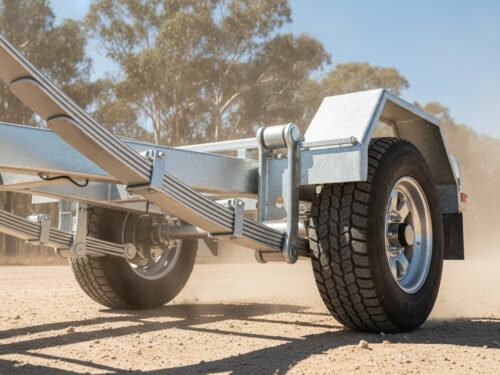
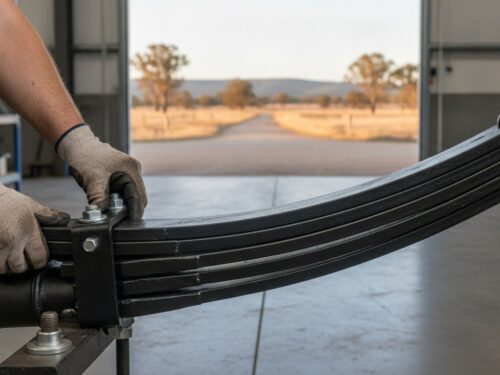
Upgrading your coupling is the perfect time to perform a full safety audit of your trailer’s running gear. Inspect your axles for signs of fatigue or bearing wear, especially if you’ve noticed uneven tyre wear. We provide 39mm round and up to 50mm square axles to suit various load capacities. You should also examine your leaf springs for cracked leaves or flattened arches. We offer slipper and eye-to-eye spring sets that are ready for immediate fitment. Our team provides nationwide shipping on all essential components, ensuring you get the parts you need to stay on the road. If you’re unsure about pattern matching or load ratings, contact our expert team for technical support.
Secure Your Trailer with Professional Hardware
We are an Australian owned and operated business committed to providing reliable hardware for the transport sector. Whether you’re performing a simple upgrade or a full trailer restoration, we offer expert technical support to help you match patterns and load ratings correctly. Shop our range of high-quality 4 hole couplings today and take advantage of our nationwide shipping. Our components are engineered to withstand harsh local conditions, ensuring your equipment stays secure over every kilometre. Get your trailer back on the road with confidence and professional-grade performance.
Frequently Asked Questions
What is the standard 4 hole coupling bolt pattern?
The most common 4 hole coupling bolt pattern in Australia is 185mm x 55mm. This measurement is taken centre-to-centre between the four mounting holes. It’s the industry standard for most override and electric couplings rated up to 3,500kg. Always verify these dimensions with digital callipers before purchase to ensure the hardware aligns with your existing mounting plate.
Can I use a 4 hole coupling on a 2 hole drawbar?
You shouldn’t attempt to fit a 4 hole coupling to a drawbar designed for only two bolts. Light-duty 2 hole plates are typically thinner and aren’t engineered for the braking forces of a heavier system. You must cut off the old plate and weld on a heavy-duty 4 hole mounting plate. This ensures the structural integrity of the A-frame remains intact under load.
What size bolts do I need for a 4 hole trailer hitch?
Most 4 hole couplings require M12 or 1/2 inch bolts for secure fitment. You must use high-tensile fasteners to ensure the connection doesn’t fail under intense shearing forces. Check the manufacturer’s specific instructions for the exact length needed for your plate thickness. Ensure the bolt is long enough to fully engage the nut with at least two threads visible.
Are all 4 hole trailer couplings the same size?
Not all 4 hole trailer couplings share identical dimensions. While 185mm x 55mm is the most frequent configuration, variations like 184mm x 54mm or 104mm x 76mm exist in the Australian market. Precise measurement is the only way to confirm fitment for your specific trailer. Never force a coupling onto a plate if the holes don’t align perfectly.
Do I need to weld or bolt my 4 hole coupling plate?
You must bolt the coupling to the mounting plate to allow for future serviceability and inspections. The mounting plate itself should be professionally welded to the trailer drawbar rails. Use continuous fillet welds to ensure a permanent, high-strength bond. This combination allows you to replace the hitch easily while maintaining a rigid connection to the trailer chassis.
What does ADR compliance mean for trailer couplings?
ADR compliance refers to the Australian Design Rules, specifically ADR 62/02 for mechanical connections. This regulation ensures that trailer components meet strict safety and performance standards for road use. Choosing hardware that meets these standards is essential for maintaining your trailer’s roadworthiness. It also ensures your insurance remains valid in the event of an accident.
How do I measure the hole spacing if my plate is damaged?
If the mounting plate is damaged or rusted, you must identify the original centre points of the holes. Clean the surface with a wire brush to expose the bare metal. Use digital callipers to find the midpoint of any wallowed-out holes to verify the 4 hole coupling bolt pattern. If the plate is severely distorted, replace the entire plate rather than trying to salvage a compromised mounting surface.
Which grade of bolt is required for trailer hitches in Australia?
Australian standards require Grade 8.8 high-tensile bolts for all trailer hitch installations. Mild steel or lower-grade bolts lack the necessary shear strength and can snap under the pressure of emergency braking. Always look for the 8.8 marking on the bolt head to verify its quality. Pair these with nyloc nuts or spring washers to prevent loosening from constant road vibrations.