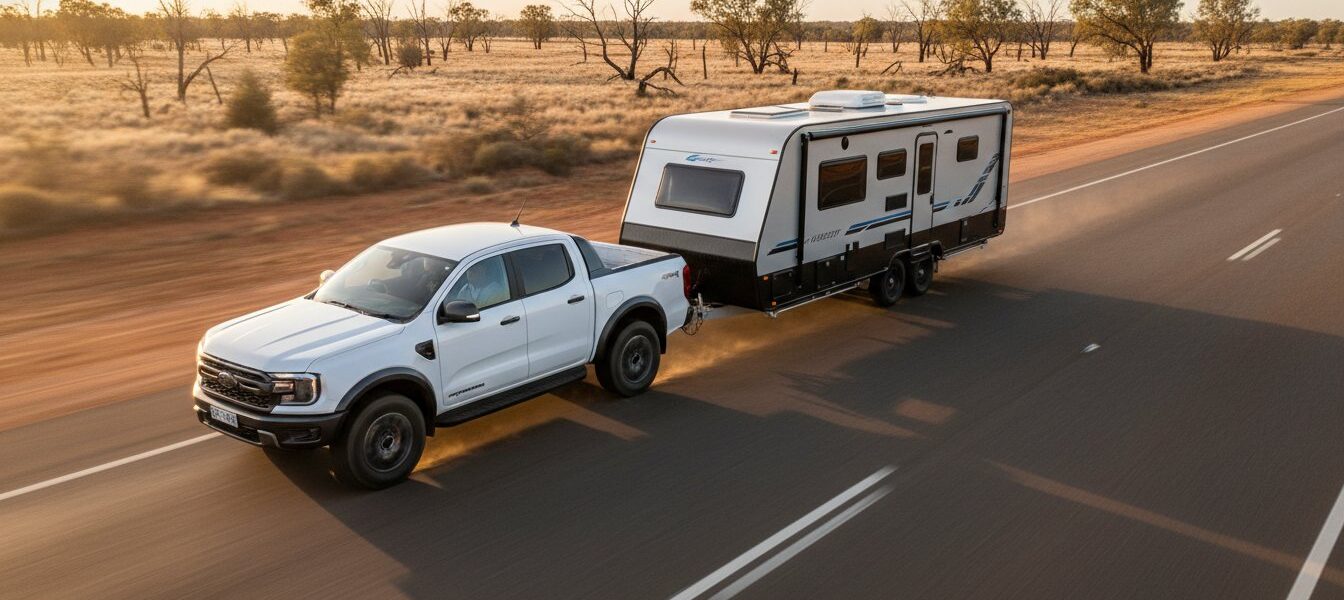
What if the unsettling wobble you feel at 100 km/h isn’t just bad luck, but a mechanical math problem you can solve before you hit the highway? Most drivers feel that surge of adrenaline when a passing B-double creates a pressure wave that makes the trailer hunt across the lane. It’s frustrating to stare at GCM and ATM figures on a compliance plate and still feel like you’re losing control during an overtake. With over 900,000 registered caravans and motorhomes sharing our roads, safety isn’t just a preference; it’s a technical requirement.
You can eliminate that risk. This article explains exactly how to prevent trailer sway Australia by mastering weight distribution and selecting the right heavy-duty hardware for your rig. We’ll break down the physics of axle placement; explain why your loading habits might be working against you; and identify which mechanical upgrades, like weight distribution hitches or 10 inch electric drum brakes, will keep your trailer tracking straight. You’ll gain the expert advice needed to ensure your tandem axle trailer or caravan remains stable across every state border, regardless of the road conditions.
Key Takeaways
- Identify the mechanical causes of lateral oscillation and the pendulum effect that leads to dangerous jack-knifing incidents.
- Apply the 10% ball weight rule to ensure correct weight distribution and maintain steering control on your tow vehicle.
- Learn how to prevent trailer sway australia by installing heavy-duty axles and weight distribution hitches designed for local conditions.
- Use the manual override on your electric brake controller to safely pull the trailer back into line during highway speed oscillations.
- Follow a professional maintenance routine for all trailer parts to ensure reliable performance on long-haul trips across the country.
What is Trailer Sway and Why Does Jack-Knifing Occur?
Trailer sway is the lateral oscillation of a trailer behind its tow vehicle. It often starts as a minor side-to-side movement but can quickly develop into a dangerous pendulum effect. During this process, the trailer’s momentum begins to dictate the direction of the tow vehicle. If the oscillation becomes too great, the trailer tries to overtake the car, pushing the rear of the vehicle out of alignment. Understanding these mechanical forces is the first step in learning how to prevent trailer sway australia and ensuring your load stays on the road.
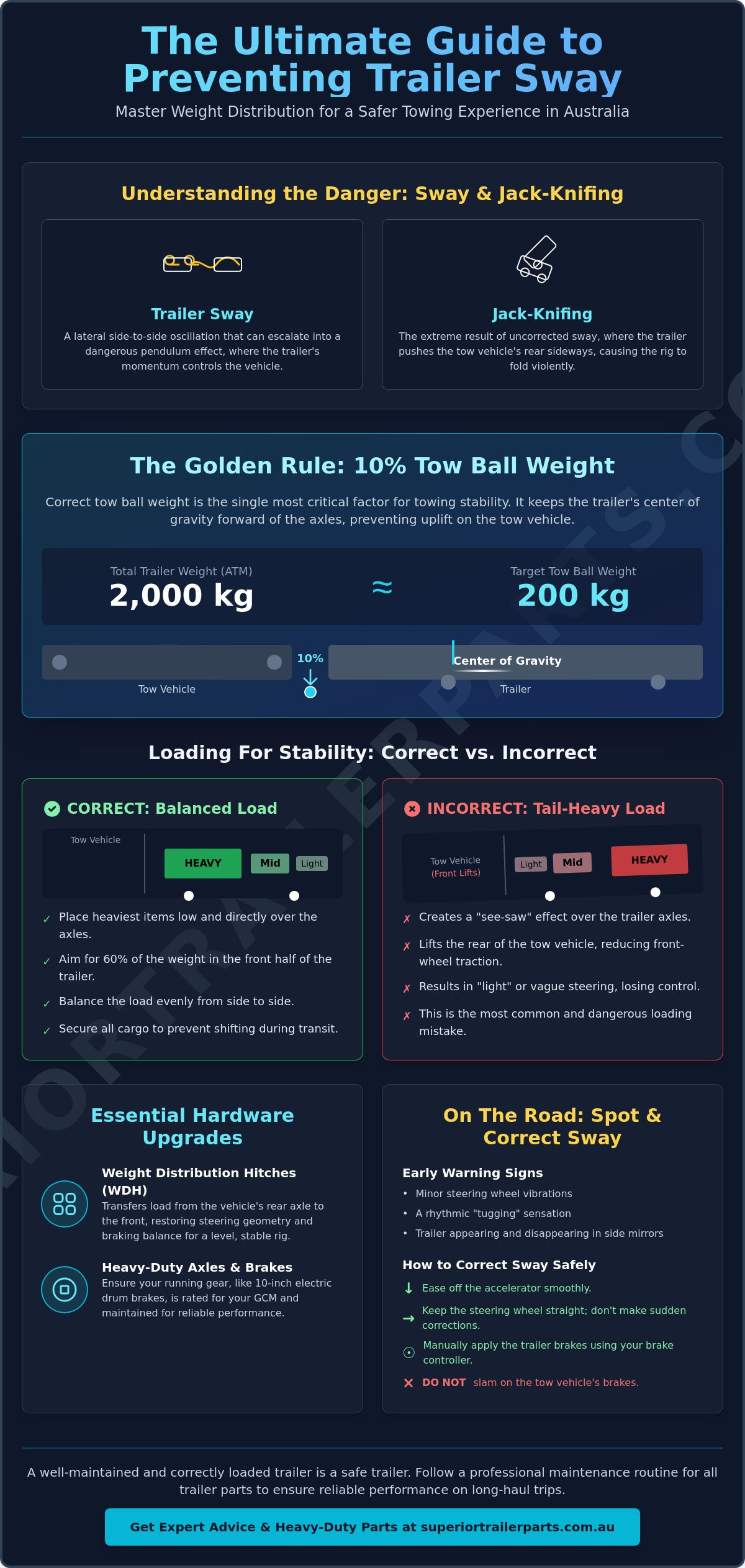
A jack-knife is the extreme conclusion of uncorrected sway. It occurs when the trailer swings so far that it pushes the tow vehicle’s rear wheels sideways, causing the vehicle and trailer to fold toward each other like a pocket knife. Primary triggers for these events include sudden steering corrections, high-speed wind gusts, or the pressure wave created by a passing B-double. While external factors start the movement, the severity is usually dictated by poor weight balance or faulty trailer parts that fail to provide the necessary resistance to lateral forces.
The Physics of Towing Stability
The hitch serves as the primary pivot point for all lateral forces acting on your rig. According to essential towing principles, the relationship between the tow vehicle’s wheelbase and the trailer’s total length is a critical safety factor. A vehicle with a longer wheelbase provides better leverage to resist the side-to-side push of an oscillating trailer. Longer trailers are naturally more susceptible to wind-induced sway because they have a larger surface area for crosswinds to catch. This creates a leverage effect that can easily overcome a light or short-wheelbase tow vehicle if the mechanical setup isn’t precise.
Recognising the Early Warning Signs
Safe towing requires constant attention to how the load feels through the chassis. You can often detect the onset of sway through minor steering wheel vibrations or a rhythmic tugging sensation. This “tugging” indicates the trailer is starting to hunt across the lane. Experienced drivers monitor their side mirrors to verify the trailer’s position. If you see the side of the trailer appearing and disappearing in your mirrors while driving straight, the oscillation has already begun. Identifying these signals within the first few seconds allows you to apply corrective measures before the pendulum effect gains enough momentum to cause a jack-knife.
Mastering Weight Distribution and Loading for Stability
Stability begins before you turn the ignition. The most effective way to manage your load is the 10% rule. This means the ball weight should be approximately 10% of the total loaded trailer weight. If your trailer weighs 2,000kg, aim for 200kg of downward pressure on the tow ball. This weight keeps the trailer’s center of gravity forward of the axles, which is a fundamental step in how to prevent trailer sway australia. A light ball weight is a recipe for disaster on the highway.
Tail-heavy loading is a frequent cause of mechanical instability. Placing heavy gear at the very rear of the trailer creates a see-saw effect over the axles. This motion lifts the front wheels of your tow vehicle, reducing the traction needed for steering and braking. You’ll feel the steering become “light” or vague. This loss of control makes the rig highly susceptible to the pressure waves of passing trucks. Always verify your setup at a public weighbridge. Guessing your Gross Combination Mass (GCM) is dangerous. If you exceed the manufacturer’s GCM, your brakes and suspension won’t perform as designed.
How to Pack Your Trailer Correctly
Position your heaviest items low and directly over the trailer axles. Keeping the center of gravity low reduces the leverage forces that cause sway. Balance the load evenly from side to side to prevent the trailer from leaning. A leaning trailer pulls the tow vehicle and creates uneven tyre wear. Secure every item with heavy-duty tie-downs. A shifting load during a sudden lane change can create enough momentum to initiate a jack-knife event.
The Role of Weight Distribution Hitches
Weight distribution hitches (WDH) use spring bars to level your rig. They don’t reduce the total weight, but they transfer the load from the vehicle’s rear axle back to the front wheels. This restores steering geometry and braking balance. You need a WDH if the rear of your vehicle sags or the front rises significantly after hitching. Adjust the hitch height so both the vehicle and trailer sit on a level plane. For those tackling heavy loads or long-distance hauls, choosing the right Weight Distribution Hitches is a practical way to ensure a stable towing experience.
Upgrading Mechanical Components to Prevent Sway
While loading is critical, the mechanical foundation of your trailer determines how it handles stress. Worn or undersized axles are a primary cause of instability. If your axle flexes under load, it alters the wheel alignment and forces the trailer to “hunt” across the road. Upgrading to high-quality trailer axles ensures the wheels track straight, even when subjected to lateral forces from wind or passing vehicles. This is a technical fundamental for anyone researching how to prevent trailer sway australia.
Selecting the Right Axle and Suspension
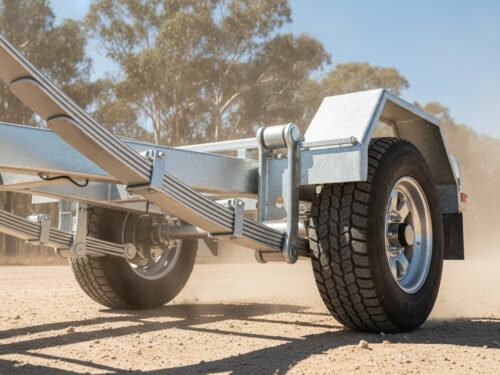
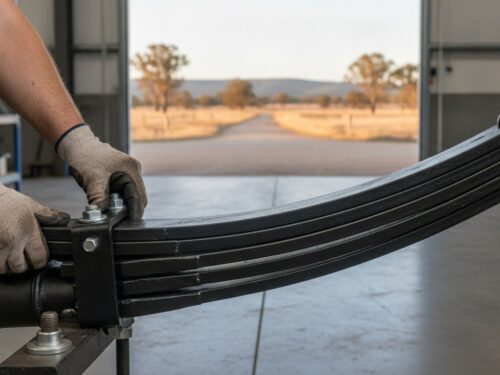
Match your axle to your Gross Trailer Mass (GTM) for maximum stability. A 39mm round axle is suitable for light loads, but tandem setups or heavy-duty trailers require 45mm or 50mm square axles to resist bending. Square axles offer greater structural rigidity under high-stress conditions. Your leaf springs work alongside the axle to dampen vibrations. If a spring leaf is cracked or the bushes are worn, the suspension can’t absorb lateral shocks. This results in a “bouncy” trailer that initiates sway. Inspect your springs every 5,000km to ensure they haven’t lost their tension or developed stress fractures.
High-Performance Couplings and Braking
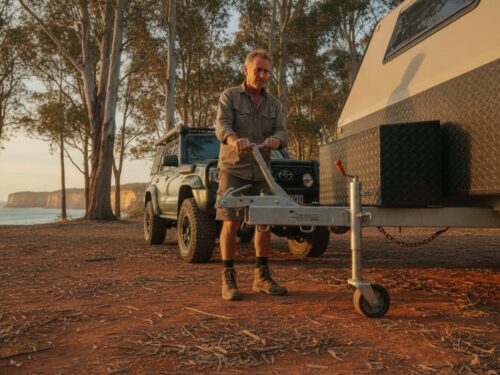
The connection between your vehicle and trailer must be rigid. Worn couplings and parts introduce “play” at the hitch point, which amplifies minor oscillations into major sway events. Whether you use a 2 hole fixed coupling or a 4 hole over-ride coupling, a secure, well-maintained connection prevents this mechanical slack. Additionally, ensure your u-bolts are tightened to specification. These small components keep the axle firmly seated against the springs; any movement here will cause the trailer to dog-track and pull the tow vehicle.
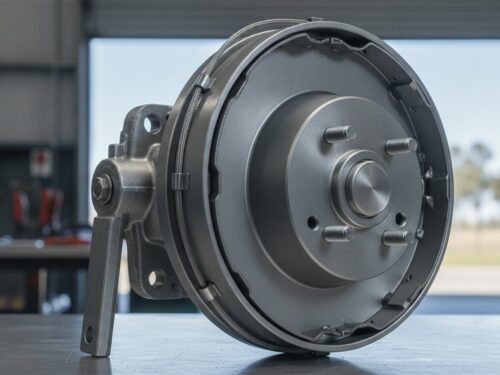
Effective braking is your last line of defense. 10 inch electric drum brakes allow you to apply the trailer brakes independently using a manual override. This tension pulls the trailer back into a straight line without slowing the tow vehicle abruptly. It’s a proven method for how to prevent trailer sway australia when external factors like crosswinds or pressure waves become unmanageable. Reliability comes down to the quality of your hardware and the frequency of your inspections.
Driving Techniques to Manage and Correct Sway
Speed is the most critical variable in towing safety. As your velocity increases, the forces required to initiate and sustain lateral oscillation grow exponentially. While some states allow towing at 110 km/h, keeping your speed to 90 or 100 km/h significantly reduces the risk of the trailer hunting across the lane. Maintaining a moderate, consistent pace is a primary method for how to prevent trailer sway australia. High speed leaves you with zero margin for error when a crosswind hits.
Overtaking large trucks requires a technical approach. As a B-double passes, it creates a bow wave of air that pushes the trailer away, followed immediately by a low-pressure vacuum that pulls it back toward the truck. Don’t fight this with aggressive steering. Grip the wheel firmly and maintain your lane position. If you feel the oscillation starting, avoid the instinct to slam on the vehicle brakes. Sudden deceleration transfers weight to the front wheels, making the rear of the car light and more likely to be pushed sideways by the trailer.
The Emergency Response Protocol
- Step 1: Stay calm and keep the steering wheel pointed straight. Do not attempt to “steer out” of the sway, as this often amplifies the movement.
- Step 2: Apply the trailer brakes independently using the manual override on your electric brake controller. This creates tension that pulls the rig straight.
- Step 3: Ease off the accelerator gradually. Do not touch the foot brake until the sway has stopped and the rig is under control.
Environmental Factors and Road Conditions
Open plains and high-wind areas require extra vigilance. A sudden side gust can act like a physical lever on a long trailer. Downhill stretches are particularly dangerous because the trailer’s momentum can begin to push the tow vehicle, a condition known as “overrunning.” In these scenarios, ensure your caravan parts and braking systems are in top condition to manage the weight. Check your tyre pressures before every trip; under-inflated tyres have soft sidewalls that allow for more lateral movement, directly contributing to instability.
Expert advice is essential for safe towing. If your rig consistently feels unstable despite correct loading, it’s time to inspect your hardware. You can find reliable components and trailer parts to upgrade your setup and restore your confidence on the road.
Maintenance Checklist for Long-Term Towing Safety
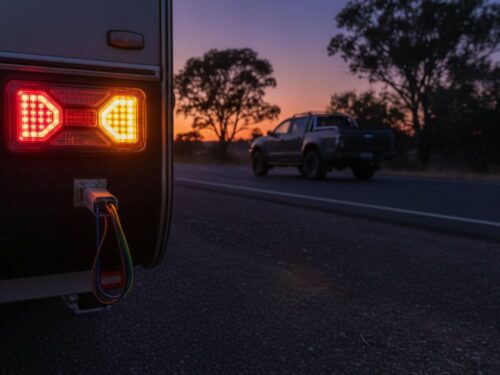
Mechanical failure often starts with neglected maintenance. A thorough pre-trip inspection of all trailer parts is your primary defense against highway incidents. Check tyre pressures on both the tow vehicle and the trailer before every departure. Under-inflated tyres overheat and lose lateral stability, which is a major factor in how to prevent trailer sway australia. Verify that your LED submersible tail lights and braking signals are functional. A non-responsive brake light prevents other drivers from reacting to your deceleration. Ensure the hitch and coupling are greased and the locking mechanism engages without resistance. A dry hitch increases friction and can cause the coupling to bind during tight maneuvers.
Routine Hardware Inspections
Check your wheel bearings after the first 100km of a long haul. Feel the hub for excessive heat. If it’s too hot to touch, the bearing needs immediate adjustment or replacement. Use a torque wrench to verify that u-bolts and wheel nuts remain tight. Vibrations from corrugated roads don’t just rattle your gear; they loosen fasteners over time. Inspect the trailer frame and drawbar for signs of rust or stress fatigue. Look closely at the welds. Hairline cracks in the paint often hide structural fatigue that can lead to a catastrophic loss of control if left unaddressed. Regular cleaning, especially after beach trips, prevents salt from corroding your galvanised components.
When to Replace vs. Repair
Components like axles and springs have a finite service life. If you notice the trailer sitting lower on one side or see “scalloping” wear patterns on the tyres, your suspension has likely reached its limit. Repairing a bent axle is rarely effective; replacement is the only way to ensure true tracking. Upgrading to heavy-duty 50mm square axles or rocker roller spring sets provides the resilience needed for harsh Australian conditions. If you’re planning an off-road trip through the red centre, consider replacing standard slipper springs with eye-to-eye sets for better shock absorption. For custom builds or complex mechanical issues, contact us for expert advice. Maintaining a rigorous service schedule is the most reliable way to understand how to prevent trailer sway australia and keep your rig safe for years of travel.
Technical Stability for Every Journey
Safe towing isn’t an accident; it’s the result of precise weight distribution and reliable mechanical components. You’ve learned that maintaining a 10% ball weight and using high-quality trailer axles are the foundations of a stable rig. Mastering how to prevent trailer sway australia also involves regular hardware inspections and using the correct driving techniques when passing heavy vehicles or descending hills. By combining these practical steps with a rigorous maintenance checklist, you can significantly reduce the risk of jack-knifing incidents.
Superior Trailer Parts is Australian Owned and Operated, providing the heavy-duty components you need to handle our unique road conditions. We offer nationwide shipping and expert technical advice to help you select the right axles, brakes, or couplings for your specific setup. Shop heavy-duty Australian trailer parts and axles today to ensure your next trip is safe and predictable. Secure your rig and hit the highway with confidence.
Frequently Asked Questions
What is the number one cause of trailer sway in Australia?
Incorrect weight distribution is the primary cause of sway. If the load is concentrated at the rear, the tow ball weight falls below the required 10% threshold. This imbalance creates a pendulum effect. External factors like wind gusts or passing trucks trigger the movement; however, the lack of forward weight allows the oscillation to grow into a dangerous situation.
Can I use my vehicle’s brakes to stop a trailer from swaying?
Don’t use the vehicle’s foot brake to correct an active sway event. Slamming on the car brakes transfers weight to the front wheels; this makes the rear wheels lose traction and increases the risk of a jack-knife. Use the manual override on your electric brake controller instead. This applies the trailer brakes independently and pulls the rig back into a straight line without upsetting the tow vehicle’s balance.
How do I know if my trailer is tail-heavy?
A tail-heavy trailer usually causes the rear of the tow vehicle to sag while the front wheels lift. You’ll feel the steering become light or unresponsive at highway speeds. The most accurate method to verify this is using a ball weight scale or visiting a public weighbridge. If your ball weight is less than 10% of the total loaded mass, you must shift heavy items forward of the axles.
Is it safe to tow a trailer that is swaying slightly at low speeds?
Slight sway at low speeds is a warning sign of a serious mechanical or loading imbalance. Never ignore it. Even minor oscillations will grow exponentially as you reach highway speeds of 100 km/h. Pull over immediately and check your load distribution. This is a vital part of learning how to prevent trailer sway australia before it becomes a high-speed emergency on the open road.
Do all trailers need a weight distribution hitch?
Not every setup requires a weight distribution hitch. You generally need one if the trailer’s ball weight significantly alters your vehicle’s level plane. If the rear suspension compresses and the front wheels lift, a hitch is necessary to restore steering geometry and braking balance. It’s a technical solution designed for heavy caravans and tandem axle box trailers that exceed the vehicle’s natural leveling capacity.
What should I do if a passing truck causes my trailer to wobble?
Maintain a firm, straight grip on the steering wheel and avoid the urge to counter-steer. Ease off the accelerator gradually and apply the trailer’s electric brakes using the manual override. This creates tension between the vehicle and the trailer; it pulls the rig straight. The air pressure wave from a B-double is temporary, so stay calm and let the mechanical tension settle the rig.
How does tyre pressure affect trailer stability?
Under-inflated tyres have soft sidewalls that allow the trailer to move laterally on the rims. This flex amplifies minor oscillations and directly contributes to instability. Always inflate your tyres to the manufacturer’s recommended cold pressure for heavy loads. Correct tyre pressure provides the structural rigidity needed for lateral stability and reduces the risk of a blowout during long-distance hauls.
Can a bent axle cause my trailer to sway?
A bent axle is a major mechanical cause of instability because it ruins wheel alignment. It forces the wheels to “dog-track,” meaning the trailer constantly pulls to one side rather than following the tow vehicle’s path. This misalignment creates a permanent lateral force that makes the trailer hunt across the lane. If you notice uneven tyre wear, inspect your trailer axles for signs of bowing or fatigue.