An incandescent bulb typically lasts about 1,000 hours. A high-quality LED can operate for up to 100,000 hours. If you’re tired of replacing blown globes after every boat ramp visit or dealing with electrical shorts in old wiring, it’s time to modernize. Installing an LED trailer light conversion kit is the most effective way to ensure your trailer remains visible and safe. You need hardware that handles vibration, dust, and total submersion without failing when you need it most.
Most owners agree that constant lighting repairs are a drain on time and money. This guide explains how to transition your trailer to a reliable, ADR-compliant system that reduces maintenance. We’ll walk through the technical requirements for different trailer widths, the importance of submersible seals, and the steps for a straightforward DIY installation. You’ll gain the knowledge to build a fit-and-forget lighting setup that meets all Australian standards for road use.
Key Takeaways
- Learn why solid-state LEDs provide superior vibration resistance compared to traditional filament bulbs.
- Identify the essential features of a robust LED trailer light conversion kit, including tinned copper wiring for corrosion resistance.
- Understand how to resolve technical issues like hyper-flash and CANbus errors during the upgrade process.
- Determine the specific marker light requirements needed to maintain ADR compliance for your trailer size.
Why Switch to an LED Trailer Light Conversion Kit?
An LED trailer light conversion kit is more than a simple bulb swap. It’s a comprehensive system overhaul. These kits typically include the lamps, pre-wired looms, and the necessary plugs to replace an entire aging incandescent setup. Traditional bulbs rely on a thin tungsten filament. This filament is the weak point of any trailer. Trailers lack the sophisticated suspension of a car, meaning every pothole and corrugated road surface sends vibrations directly to the light housing. These vibrations cause hot filaments to fatigue and snap, often at the most inconvenient times.
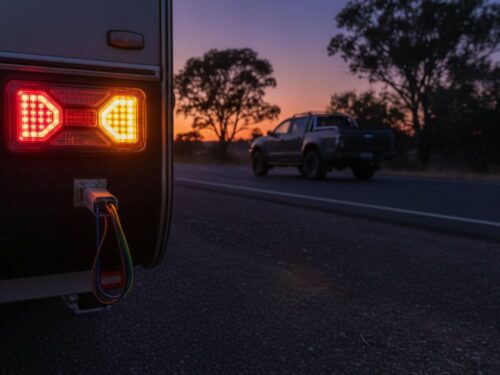
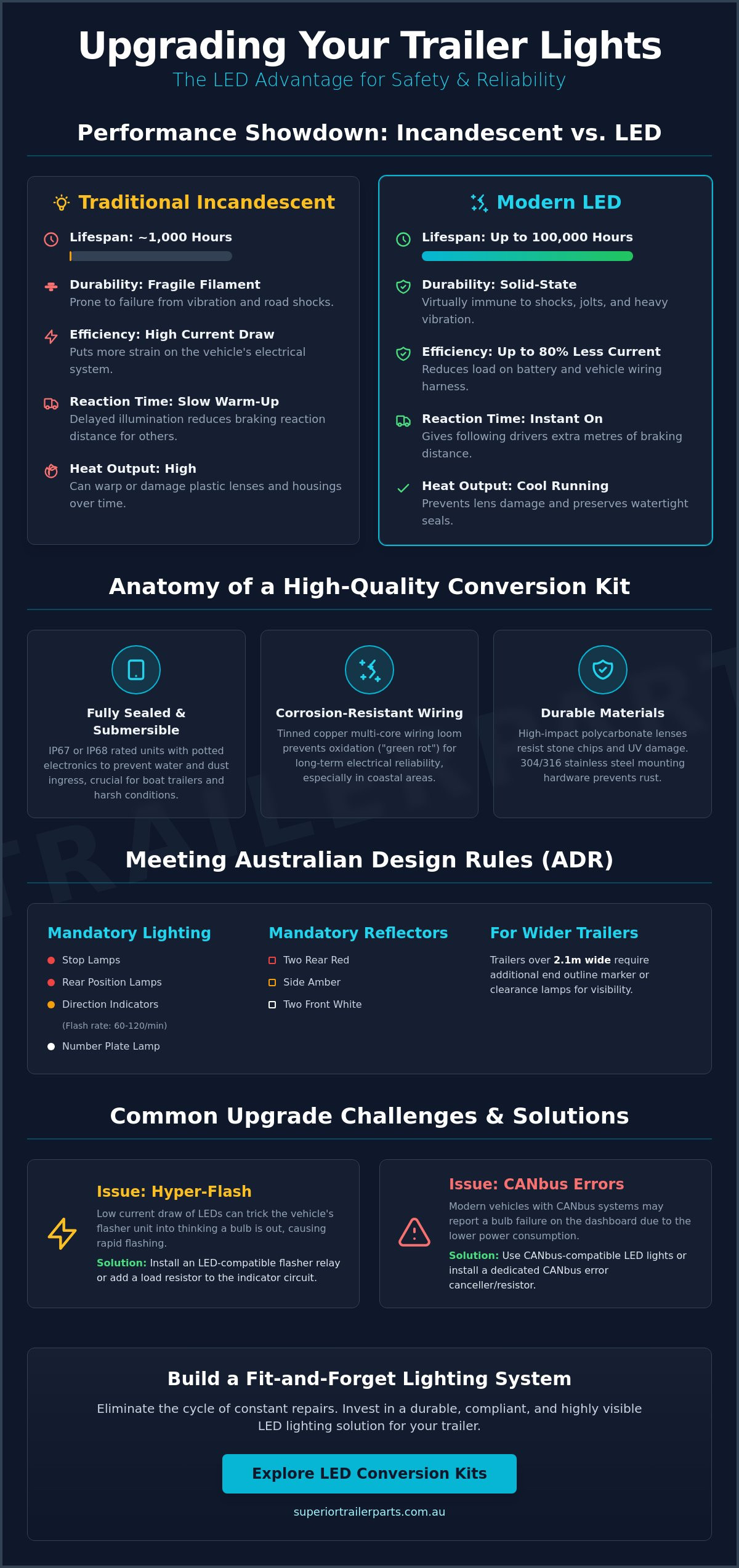
LEDs use solid-state technology. There are no moving parts or fragile wires inside the unit. This makes them virtually immune to the shocks and jolts common in heavy-duty transport. Beyond durability, the history of automotive lighting shows a clear progression toward safety through speed. LEDs reach full intensity the microsecond power is applied. Incandescent bulbs require a warm-up period to reach brightness. At highway speeds, that split-second difference gives the driver behind you several extra metres of braking distance to react to your signals.
Incandescent vs. LED Performance
Efficiency is a primary driver for the switch. LEDs draw up to 80% less current than traditional bulbs. This reduced load is easier on your vehicle’s battery and wiring. Heat management is another critical factor. Incandescent globes generate significant heat, which often warps plastic lenses or causes them to become brittle and crack. LEDs run cool. This prevents lens failure and ensures the housing remains watertight over years of use. You also get superior visibility. The light produced by LEDs is crisper and more piercing. This helps other road users see your indicators and brake lights clearly during heavy rain, fog, or dust storms.
Long-Term Reliability and Cost Savings
Corrosion is the silent killer of trailer electrics, often referred to as “green rot” in the industry. Traditional sockets are open to the air and moisture, leading to oxidized terminals and electrical failure. Modern LED units are usually potted or fully sealed. This prevents moisture from ever reaching the sensitive electrical connections. While the initial investment is higher, the total cost of ownership is lower. You aren’t paying for replacement parts or risking expensive fines for non-functioning lights. Check our range of trailer parts to find a system built for these conditions.
Essential Components of a Quality Conversion Kit
A reliable LED trailer light conversion kit must withstand the mechanical stress of Australian roads. Cheap kits often fail because they use inferior plastics and thin, untinned wiring. Look for lenses made from high-impact polycarbonate. This material resists stone chips and UV degradation better than standard acrylic. The wiring loom is equally important. It should be a multi-core cable using tinned copper. Tinned copper prevents the oxidation that leads to electrical failure, especially in coastal environments. National standards require trailer wiring to be supported at intervals of less than 600mm and insulated at all joints.
Mounting hardware should be 304 or 316-grade stainless steel. Standard zinc-plated bolts will eventually rust, leaving unsightly stains on your trailer frame. Finally, ensure the kit includes a heavy-duty 7-pin or 12-pin plug that meets Australian Standards AS 2513-1982 or AS 4177.5-2004. A secure connection at the hitch is the first line of defence against flickering lights and electrical shorts.
Understanding ADR Compliance Standards
All trailer lighting must comply with the Australian Design Rules (ADR). This is a legal requirement for road safety. Your kit must include rear position lamps, stop lamps, and direction indicators. These lights have specific mounting height and distance requirements. For example, indicators must flash between 60 and 120 times per minute. Reflectors are also mandatory. You need a pair of rear red reflectors, side amber reflectors, and front white reflectors to stay legal. If your trailer is over 2.1m wide, you must also install end outline markers or clearance lamps.
Submersible vs. Standard LED Lamps
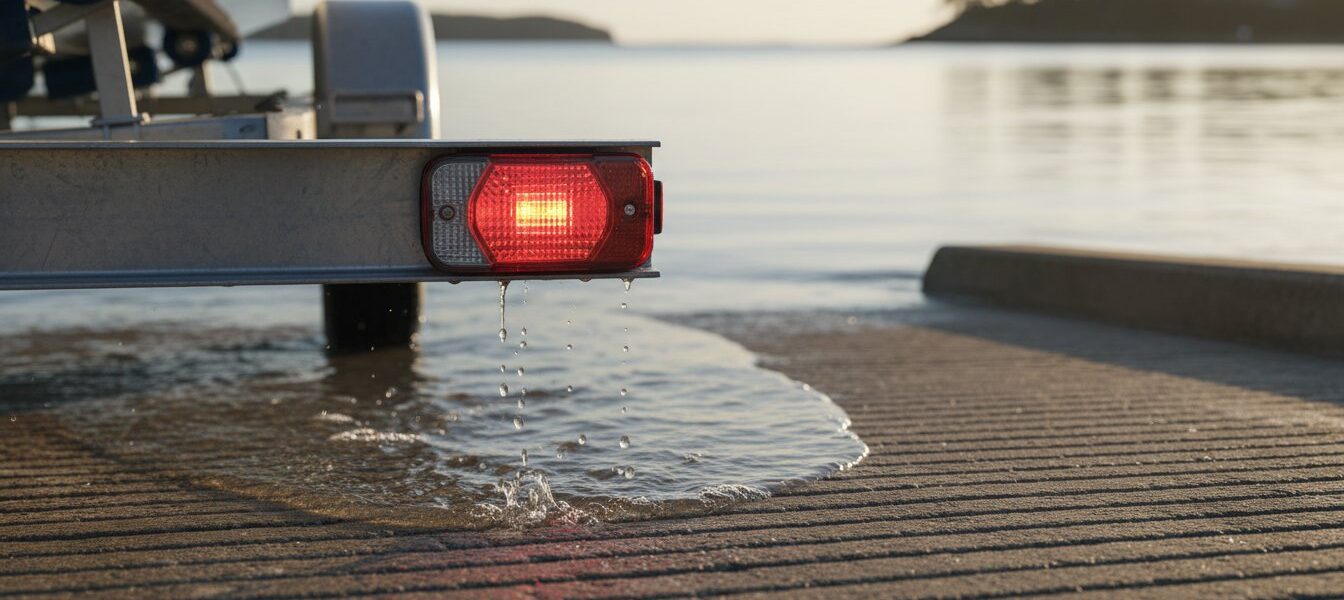
Standard LEDs don’t cut it for boat trailers. You need lamps with an IP67 or IP68 rating. An IP67 rating means the unit can survive being submerged in one metre of water for 30 minutes. High-quality boat trailer parts often feature potted electronics. This involves filling the light housing with a resin that completely encases the circuit board. It’s the only way to protect against salt water ingress. Some premium units also include breather valves. These valves allow air to move as temperatures change while keeping moisture out, which prevents internal condensation from forming during rapid cooling at the boat ramp.
Solving Common Technical Issues During Conversion
Installing an LED trailer light conversion kit is usually straightforward. However, modern vehicle electronics often introduce technical hurdles. The most frequent issue is ‘hyper-flash.’ Traditional flasher units operate on a thermal or mechanical relay that requires a specific current draw to function at the correct speed. Because LEDs use significantly less power, the relay detects a ‘blown bulb’ and flashes rapidly. You can fix this by installing an LED-compatible flasher relay in your vehicle or adding load resistors to the trailer circuit to simulate the missing load.
Modern vehicles equipped with CANbus systems present a different challenge. These onboard computers monitor the resistance of every lighting circuit. The low current draw of an LED often triggers a ‘bulb out’ warning on the dashboard. In some cases, the vehicle may cut power to the trailer plug entirely as a safety measure. Resolving this requires a kit designed for CANbus compatibility or the addition of specific dummy loads that trick the vehicle’s computer into seeing a standard incandescent load.
Managing Low Current Draw and Resistors
Load resistors are the standard solution for current draw issues. They convert the ‘missing’ energy into heat to simulate a traditional bulb. Because they generate heat, you must mount them to a metal surface on the trailer frame. Never zip-tie resistors to plastic components or wiring looms. You can choose between plug-and-play ‘inline’ resistors, which sit between the plug and the loom, or hard-wired versions that require soldering into the harness. Hard-wired solutions are more permanent but require better weatherproofing at the joints.
Wiring and Plug Configurations
Reliable lighting depends on a solid electrical foundation. Most Australian trailers use the standard 7-pin flat or round configuration. If you experience flickering or dim operation, the fault is usually a poor earth connection. Do not rely on the trailer coupling to provide a ground through the tow ball. You must run a dedicated earth wire from every lamp back to the main plug. For a full breakdown of the standard colour codes and pin assignments, refer to our guide on trailer plug wiring.
Check your wire gauge before finishing the installation. A thin common earth wire can cause ‘voltage drop’ when multiple lights are on simultaneously. If your indicators dim when you hit the brakes, your earth wire is likely too small or the connection is corroded. Ensure all joints are soldered and sealed with heat-shrink tubing to prevent moisture from entering the copper core. This prevents the ‘green rot’ mentioned in previous sections from destroying your new investment.
Selecting the Right Kit for Your Trailer Type
Not every LED trailer light conversion kit fits every application. You must measure your trailer’s total length before ordering. A standard 6×4 box trailer requires a shorter loom than an 8×5 tandem. Most kits specify the cable length provided for both the main run and the cross-members. Ensure you have at least one metre of slack to route wires safely around the suspension and chassis rails. You also need to decide on number plate light placement. Many modern LED units include an integrated number plate lamp on the bottom of the right-hand light. If your plate is mounted elsewhere, you will need a standalone lamp to remain road legal.
Width is the deciding factor for marker lights. Under Australian Design Rules, trailers over 2.1m wide must have end outline markers. These consist of two white or amber lamps at the front and two red at the rear. If your trailer is over 1.8m wide, front position side lamps are mandatory. Check your dimensions carefully. Browse our range of trailer parts to find kits that include the specific marker lamps required for your trailer’s size.
Boat and Jet Ski Trailer Requirements
Salt water is highly conductive and corrosive. For jet ski trailers and boat trailers, standard wiring will fail quickly. You must use tinned copper wiring. The tin coating prevents the copper from oxidizing and turning into ‘black wire’ which loses conductivity. Look for kits specifically designed for marine environments with fully potted electronics. These units handle total submersion during launching and retrieving. Read about essential boat trailer parts for marine maintenance to understand how to protect your electrical system from salt damage.
Heavy-Duty and Tandem Axle Setups
Large tandem trailers often face harsher operating conditions. Commercial and agricultural trailers benefit from high-intensity LEDs. These provide better light penetration through road grime, dust, and heavy rain. Ensure your chosen kit has a heavy-duty loom designed for the increased length of a dual-axle frame. Tandem setups often require extra clearance lights along the side of the trailer to indicate the vehicle’s length to other drivers at night. View our selection of LED trailer light conversion kits to upgrade your heavy-duty setup today.
Implementation and Superior Trailer Parts Solutions
Superior Trailer Parts provides hardware designed for the rigours of the Australian transport industry. We focus on providing road-legal components that meet or exceed national safety standards. When you purchase an LED trailer light conversion kit from us, you’re buying from an Australian-owned and operated specialist. We understand the local conditions because we live and work in them. Our Queensland-based hub manages national shipping to every state. This ensures you get the parts you need without unnecessary delays, whether you’re in a metro centre or a regional workshop.
We don’t just sell boxes. Our team offers expert technical support to both individual DIY installers and professional fleet managers. Whether you’re upgrading a single box trailer or maintaining a commercial transport fleet, we provide the technical knowledge to ensure your lighting system is reliable. Buying from an independent specialist means you get honest advice and durable products built for longevity. We stand behind every component we stock, prioritizing strength and fit over marketing rhetoric. This commitment to quality helps you avoid the common pitfalls of inferior aftermarket products.
Quality Components for Australian Conditions
Australian roads subject trailers to extreme temperature fluctuations, high levels of dust, and constant vibration. Our hardware is selected specifically to handle these harsh environments. We prioritize ADR compliance to ensure your trailer remains road-legal across all state borders. If you’re performing a full chassis restoration, consider pairing your new lighting with our high-quality couplings and parts. A complete rebuild using matching, heavy-duty components ensures your trailer performs safely under load. Our products are engineered to resist the “green rot” and mechanical failures described in earlier sections.
Getting Started with Your Upgrade
Begin by measuring the total length of your trailer frame from the plug to the rear light board. You need to ensure the loom length in your chosen LED trailer light conversion kit provides enough slack for clean routing through the chassis rails. Check your vehicle’s plug type to see if you need a 7-pin flat, 7-pin round, or 12-pin flat adapter. If you’re working on a custom build or a specialized application, don’t guess the requirements. Contact us today for expert advice. Our team can help you select the right components to ensure your project is completed efficiently and remains fully compliant with national regulations.
Modernise Your Trailer Lighting Today
Upgrading to an LED trailer light conversion kit is a practical decision that prioritises road safety and long-term reliability. Solid-state technology eliminates the fragility of traditional filaments, while sealed units prevent the corrosion that causes most electrical failures. You now have the technical knowledge to navigate ADR compliance and resolve common issues like hyper-flash or CANbus warnings on modern vehicles.
Superior Trailer Parts is an Australian-owned and operated specialist. We provide ADR-compliant components designed to withstand the harshest regional conditions. Our team offers nationwide shipping and expert technical support to ensure your project is completed correctly. Upgrade your trailer with quality LED lighting from Superior Trailer Parts. Take the guesswork out of your maintenance and enjoy a reliable, fit-and-forget lighting system on your next trip.
Frequently Asked Questions
Do I need a professional to install an LED trailer light conversion kit?
Most owners can install an LED trailer light conversion kit themselves using basic hand tools. These kits are designed for straightforward DIY implementation, especially when they include pre-wired looms. If your trailer features complex electric brakes or you aren’t confident with electrical soldering, seeking a professional ensures the system is safely integrated with your vehicle’s electronics.
Will converting to LED lights cause my indicators to flash too fast?
Rapid flashing, known as hyper-flash, occurs because LEDs draw significantly less current than traditional bulbs. Older flasher relays detect this low draw as a blown globe and increase the flash rate as a warning. You can resolve this by installing load resistors to simulate the draw of an incandescent bulb or by fitting an LED-compatible flasher relay to your tow vehicle.
Are all LED trailer lights waterproof for boat launching?
No, only units specifically rated as submersible are suitable for boat ramps. Standard LED lamps handle rain and road spray but will fail if the internal circuitry is exposed to salt water under pressure. For marine applications, you must verify the lamps are fully sealed or potted to prevent water ingress and corrosion of the circuit board.
Is it legal to mix LED and incandescent lights on the same trailer?
Mixing light types is legal provided every individual lamp remains ADR compliant. However, it isn’t a recommended practice for most setups. LEDs have a faster response time than incandescent bulbs, which creates a visual mismatch in your signalling. It also complicates electrical troubleshooting since the current draw will be inconsistent across the different circuits.
What does ADR compliant mean for trailer lighting?
ADR compliant means the hardware meets the Australian Design Rules, which are the national standards for vehicle safety. For lighting, these rules dictate the required brightness, colour, and visibility angles. Using non-compliant lights is illegal for road use and can result in vehicle defect notices or insurance claim rejections following an accident.
How do I know if I need a 7-pin or 12-pin trailer plug?
The choice depends on your trailer’s features and your vehicle’s socket. A 7-pin plug is the standard for most box trailers, providing power for indicators, brake lights, and tail lights. You need a 12-pin plug if your trailer requires auxiliary power for items like internal caravan lights, fridges, or specialized battery charging systems.
What is the difference between IP67 and IP68 ratings?
IP67 and IP68 ratings define the level of protection against water ingress. An IP67 rating means the light can be submerged in one metre of water for up to 30 minutes. An IP68 rating is more robust, indicating the unit is suitable for continuous submersion under conditions specified by the manufacturer, which is ideal for deep boat ramp launches.
Why are my new LED trailer lights flickering when the car is off?
Flickering is often caused by modern vehicle computers performing “pulse testing” to check for blown bulbs. These computers send tiny amounts of electricity through the circuit to test for continuity. Because LEDs are highly efficient, they can illuminate from these small pulses even when the vehicle is turned off. Installing a CANbus module or a load resistor usually eliminates this effect.