Installing a trailer axle flip kit australia involves more than just swapping parts; it is a precision suspension reconfiguration that requires heavy-duty hardware to maintain road safety. You’ve likely felt the gut-wrenching scrape when pulling your trailer into a steep driveway or navigating rugged off-road obstacles. It’s frustrating to have a trailer that sits too low for local conditions, and the technical confusion between underslung and overslung setups often stops owners from making a necessary change. You need a setup that handles harsh environments without compromising the integrity of your leaf springs.
You can safely reorient your suspension to gain significant ground clearance by using high-quality components that meet national standards. We’ll show you how to achieve this ride height increase without risking spring failure or legal issues. This article covers the essential hardware required for 39mm round or 40mm to 50mm square axles, including galvanised U-bolts and new spring seats. We’ll also explain the regulatory requirements to ensure your DIY or professional installation remains durable and roadworthy for the long haul.
Key Takeaways
- Gain significant ground clearance by reconfiguring your suspension from an underslung to an overslung position for better off-road performance.
- Identify the critical hardware needed for a safe conversion, such as high-tensile spring seats and the heavy-duty components found in a trailer axle flip kit australia.
- Evaluate how a higher ride height affects your trailer’s center of gravity and handling characteristics to maintain on-road stability.
- Learn the correct sequence for jacking the chassis and resetting the axle to ensure a secure, square fitment that meets Australian standards.
- Select the right leaf springs and galvanised U-bolts to suit your specific axle size and load rating for maximum hardware longevity.
Understanding the Trailer Axle Flip: Why Adjust Your Ride Height?
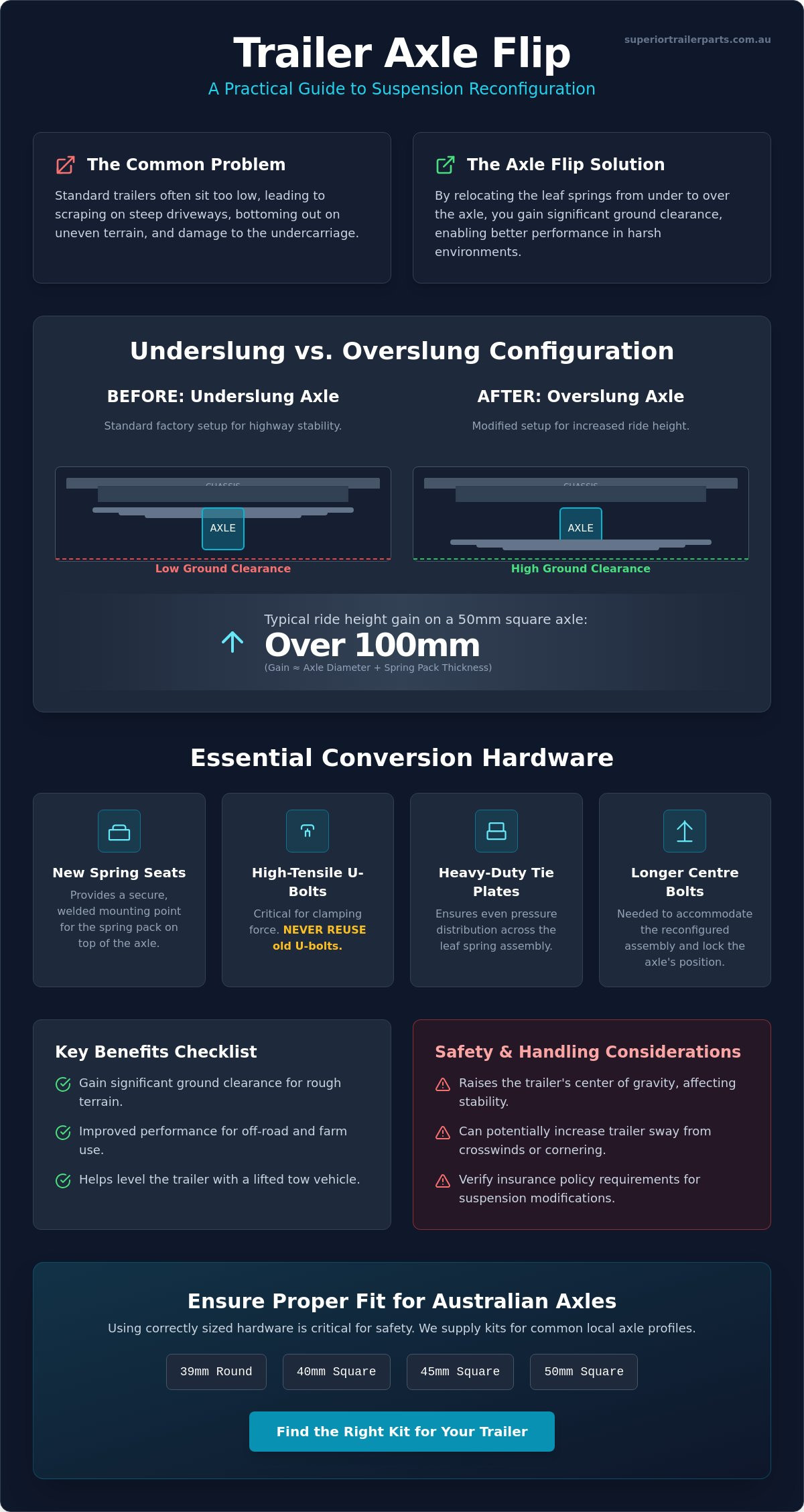
A trailer axle flip is a mechanical reconfiguration of the suspension system. Despite the common name, you aren’t actually turning the axle upside down. Flipping a cambered axle or a drop axle would ruin its alignment and compromise road safety. Instead, the process involves relocating the leaf springs from their position underneath the axle to a new position on top of it. This modification requires a specific trailer axle flip kit australia owners use to gain significant vertical clearance for better performance on varied terrain.
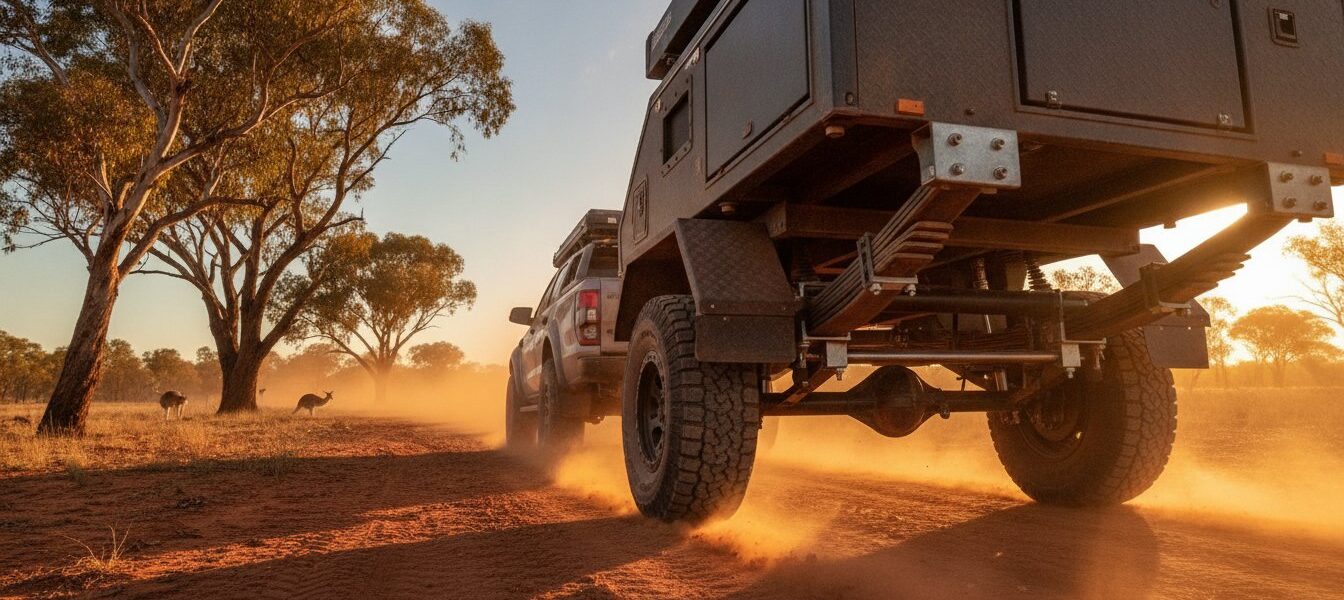
Most standard box trailers and boat trailers arrive from the factory with an underslung setup. This configuration keeps the trailer low to the ground, which is ideal for stable highway towing and easy loading. However, this low profile often leads to scraping on steep driveways or bottoming out on rugged Australian tracks. By moving the springs to an overslung position, you effectively push the trailer chassis higher. This creates the necessary room to clear rocks, ruts, and spoon drains without damaging the trailer’s undercarriage.
Underslung vs. Overslung Axles
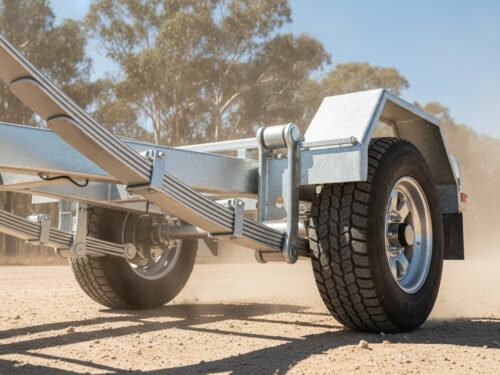
Clear terminology helps prevent errors during installation. An underslung axle is the factory standard where the axle sits on top of the leaf springs. To increase ground clearance, you move to an overslung configuration where the axle sits below the springs. Understanding Leaf Spring Suspension is vital here; the springs still support the load, but the physical mounting point changes. The height gain is generally equal to the diameter of your axles plus the thickness of the spring pack and the new spring seat. On a 50mm square axle, this often results in a lift of over 100mm.
Is an Axle Flip Right for Your Trailer?
You should assess your towing environment before starting this modification. If you frequently navigate washouts or have upgraded your tow vehicle with a lift kit, an axle flip helps level the combination. There are trade-offs to consider. Raising the ride height also raises the centre of gravity. This change can increase the leverage that side winds and cornering forces exert on your trailer, potentially leading to more sway. Always verify your insurance policy requirements before installing a trailer axle flip kit australia. Many providers require modifications to meet specific standards to maintain coverage. Ensure your leaf springs are rated for the new height and in good physical condition before proceeding.
Essential Components for an Axle Over/Under Conversion
Successful conversion requires specific heavy-duty hardware designed for local conditions. Many off-the-shelf packages from overseas don’t account for the unique dimensions of Australian axles. When you source a trailer axle flip kit australia, ensure every component is rated for your trailer’s Gross Trailer Mass (GTM). Choosing the wrong hardware grade often leads to catastrophic suspension failure on corrugated tracks or under heavy loads.
High-tensile U-bolts are the most critical part of this assembly. You must never reuse old U-bolts after a flip. These bolts are designed to stretch slightly when torqued to their specified limit, providing the necessary clamping force to hold the axle in place. Once they’ve been tensioned and exposed to road vibrations, they lose their elasticity. Reusing them significantly increases the risk of the axle shifting under load, which can snap the centre bolt and cause the axle to move out of alignment.
Heavy-duty tie plates and spring centre bolts complete the assembly. The tie plate ensures even pressure across the spring pack, preventing individual leaves from shifting or cracking. You’ll likely need longer spring centre bolts during a flip to accommodate the new orientation. The bolt head must sit securely within the hole of the spring seat to lock the axle’s position. Without this mechanical lock, the friction from the U-bolts alone isn’t enough to keep the axle from sliding during heavy braking.
Matching Hardware to Australian Axle Sizes
Australian trailers typically use 39mm round axles or square profiles in 40mm, 45mm, and 50mm sizes. Generic kits often use imperial measurements that won’t provide a secure fit on these local standards. A loose fit creates movement that eventually shears the centre bolt or snaps the U-bolts. For those operating in coastal or humid regions, galvanised hardware is a necessity. It provides the corrosion resistance required to stop rust from seizing nuts or weakening the steel. You can find the correct sizing in our range of galvanised U-bolt kits to ensure a precise fit for your specific axle diameter.
The Role of the Spring Seat
The spring seat, also known as the axle pad, acts as the primary interface between the axle tube and the leaf spring. During a flip, you’ll need new spring seats welded to the top of the axle. These seats must be perfectly aligned with the existing bottom seats to maintain the correct axle squareness. If they’re even slightly out of alignment, the trailer will dog track, leading to rapid tyre wear and poor handling. Use mild steel seats because they weld cleanly to the axle tube without creating brittle spots in the metal. If you’re unsure about which dimensions suit your setup, browse our full selection of high-quality trailer parts to find compatible components for your project.
Underslung vs. Overslung Axles: Performance and Safety Trade-offs
Switching to an overslung configuration offers immediate benefits for off-road clearance but introduces specific handling trade-offs. An underslung axle provides a low centre of gravity, which is the gold standard for highway stability. When you use a trailer axle flip kit australia to lift the chassis, you naturally increase the leverage that lateral forces exert on the suspension. This change means the trailer will react more significantly to side winds and sudden steering inputs. You must account for this shift in dynamics to prevent trailer sway from becoming unmanageable.
Ground clearance gains are the primary driver for this modification. Raising the trailer by 100mm to 150mm allows you to tackle tracks that would otherwise tear off your plumbing or damage the frame. However, this lift makes loading more difficult. If you have a high-sided box trailer, reaching the top becomes a challenge. The loading ramp angle also increases, which can make rolling heavy machinery or motorcycles onto the deck more dangerous. You should weigh these daily inconveniences against the necessity of off-road clearance before committing to the change.
Braking performance and weight distribution also shift after a flip. Because the trailer sits higher, there is a more pronounced “pendulum” effect during deceleration. This can cause the trailer to push harder against the tow vehicle’s hitch, potentially leading to instability during emergency stops. It is essential to ensure your braking system is adjusted correctly to handle the new height. Stress points on the leaf springs change too. In an overslung setup, the axle sits below the spring, meaning the U-bolts and tie plates carry the load differently. Regularly inspect these components for signs of fatigue or shifting.
Towing Dynamics and Sway Control
A lifted trailer is more sensitive to tyre pressure imbalances. Check your pressures before every trip to ensure the footprint is even. The increased height often necessitates the use of weight distribution hitches to return weight to the front wheels of the tow vehicle. Without these, the front of the car may feel light, leading to poor steering response. Slow down when entering corners. A higher centre of gravity means you have less margin for error during high-speed maneuvers.
Legal and Compliance Considerations
Australian Design Rules (ADR) and Vehicle Standards Bulletin 1 (VSB 1) govern suspension modifications. You must maintain the original axle camber. If your axle has a slight bend, it must still point upwards after the flip. Never simply rotate the axle 180 degrees. In some states, like New South Wales, significant suspension changes not covered by the manufacturer require certification by a licensed engineer. Check with your local transport authority to ensure your trailer axle flip kit australia installation remains roadworthy and legal.
Step-by-Step Guidance for a Secure Axle Flip Installation
Begin by positioning the trailer on a level, solid concrete surface. Safety is the primary concern during this process. Use a high-capacity floor jack to lift the trailer chassis, not the axle itself. Support the frame securely with heavy-duty jack stands placed behind the suspension hangers. Once the frame is stable, remove the wheels and disconnect any brake wiring or hydraulic lines that might stretch during the move. You must ensure the axle assembly is fully supported by a secondary jack before loosening any hardware.
Disassembly requires removing the existing U-bolts and tie plates. These components are often seized by road grime or rust, so use a high-quality penetrant if necessary. Lower the axle assembly carefully until it clears the leaf springs. This is the ideal time to inspect your trailer axle flip kit australia components for any shipping damage or sizing discrepancies. Clean the axle tube thoroughly where the new spring seats will sit to ensure a strong mechanical bond and a level mounting surface.
The Critical Weld: Attaching New Spring Seats
The new spring seats must be welded to the top of the axle tube to prevent axle rotation. This rotation is a common failure point if seats are only held by friction. Position the new seats so the axle remains perfectly parallel to the chassis. Measure the distance from the trailer coupling to the axle ends on both sides to verify squareness. Use a series of tack welds first, then complete the beads while monitoring for “crushing” or heat distortion on the axle tube. If you need replacement parts for a damaged assembly, browse our selection of heavy-duty trailer axles to ensure your foundation is solid.
Post-Installation Safety Checks
Reassemble the suspension by placing the axle under the leaf springs and securing the new high-tensile U-bolts. Torque the nuts in a cross pattern to industry specifications. Check the clearance of the spring centre bolt to ensure it doesn’t interfere with the axle tube. Perform a 100km re-torque after your first trip. The initial settling of the spring leaves often reduces the clamping force of the U-bolts. Verify that your brake lines and wiring harnesses have enough slack to accommodate full suspension travel at the new ride height. If the lines are too tight, they will snap when you hit a bump, leaving you without trailer brakes. For the best results, source your galvanised U-bolt kits from a trusted local supplier to guarantee they handle the increased stress of an overslung setup.
Selecting Heavy-Duty Hardware for Australian Conditions
Australian trailer manufacturing relies on specific standards that differ from overseas markets. Most generic kits found online are designed for 2-3/8 inch American axles, which don’t provide a secure fit for local 39mm, 40mm, 45mm, or 50mm axles. A loose fit in your trailer axle flip kit australia is a recipe for disaster. It leads to vibration, bolt shearing, and eventual suspension collapse. You need hardware that matches the exact physical dimensions of your axle tube to ensure the clamping force remains consistent across thousands of kilometres of travel. This precision fit is what separates a reliable modification from a dangerous one.
High-quality components must meet or exceed original equipment manufacturer standards to handle the stress of a lifted setup. When you move the axle to an overslung position, the hardware bears the load differently than in a factory configuration. Standard bolts might suffice for a light-duty trailer, but they’ll fail on a tandem axle box trailer loaded with gravel or equipment. Sourcing your gear from a specialist who understands these loads ensures your modification is a genuine upgrade. We provide national shipping and technical support to help you select the right parts for your specific Gross Trailer Mass.
Upgrading Your Suspension System
Flipping your axle is the best time to evaluate the health of your leaf springs. If your springs look flat or have lost their arch, a flip won’t fix the underlying sag. It’s often more efficient to replace worn springs during the conversion rather than doing the job twice. Slipper springs are common on single axle trailers for their simplicity, while eye-to-eye springs offer better control on tandem setups. For more technical details on choosing the right foundation, see our resource on Australian trailer axle selection.
Maintenance for Long-Term Reliability
A flipped suspension requires a more rigorous inspection schedule than a factory setup. The increased ride height puts more leverage on the spring seats and U-bolts. Check for any signs of silver metal around the U-bolt nuts, which indicates movement. Inspect the welds on your new spring seats for cracks or stress fractures. If you notice the trailer pulling to one side, the axle may have shifted on the spring centre bolt. This usually happens if the U-bolts weren’t torqued correctly. For expert advice on your specific configuration or to source heavy-duty hardware, contact the team at Superior Trailer Parts today.
Secure Your Trailer for Off-Road Performance
You now have the technical knowledge to lift your trailer safely. Moving to an overslung configuration provides the clearance needed for rugged Australian tracks. This modification requires specific heavy-duty hardware and precision installation. Success depends on using new high-tensile U-bolts and ensuring your spring seats are welded to prevent axle rotation. Always adjust your driving style to account for the higher centre of gravity and maintain routine torque checks on all fasteners.
Selecting the right trailer axle flip kit australia for your specific axle size ensures the modification remains durable under heavy loads. We are Australian-owned and operated, providing components engineered for harsh Australian conditions. Our team offers nationwide shipping on all axles and suspension hardware to get your project moving quickly. Don’t settle for generic kits that compromise safety on corrugated terrain. It’s vital to use parts that match local 39mm to 50mm standards.
View our range of heavy-duty trailer axles and hardware to find the exact fit for your round or square axle setup. Upgrade your trailer today for reliable off-road performance and peace of mind on every trip.
Frequently Asked Questions
Is a trailer axle flip kit legal in Australia?
Yes, performing an axle flip is legal across Australia as long as the trailer remains compliant with Vehicle Standards Bulletin 1 (VSB 1) and relevant Australian Design Rules. You must ensure the modification doesn’t exceed the 4.3 metre maximum height limit or reduce ground clearance below 100mm. In jurisdictions like New South Wales, any modification not specified by the original manufacturer may require an inspection by a licensed certifier to remain roadworthy.
How much height will I gain from an axle flip?
You will typically gain a ride height increase equal to the diameter of your axle plus the thickness of your leaf spring pack and the height of the new spring seat. For a standard 50mm square axle with a four-leaf spring pack, this often results in a total lift exceeding 100mm. Using a high-quality trailer axle flip kit australia ensures you have the correct components to manage this height change safely while maintaining suspension geometry.
Can I flip the axle on a trailer with brakes?
You can flip the axle on trailers equipped with 9 inch mechanical drums, 10 inch electric brakes, or hydraulic disc systems. The primary concern is ensuring the brake lines or wiring harnesses have enough slack to accommodate the increased distance between the chassis and the axle. If the lines are too short, they’ll snap during suspension travel. You’ll likely need to extend your wiring or install longer flexible brake hoses to maintain full functionality.
Do I need to weld the new spring seats to the axle?
Welding the new spring seats to the axle tube is a mandatory step for a secure installation. Friction from the U-bolts isn’t enough to prevent the axle from rotating under heavy braking or when hitting large obstacles. You must tack weld the seats in place while the axle is squared to the frame, then complete the beads. This mechanical bond ensures the axle remains in its designated position and prevents the centre bolt from shearing under stress.
Can I reuse my old U-bolts for an axle flip?
You must never reuse old U-bolts when installing a trailer axle flip kit australia. U-bolts are designed to stretch slightly when torqued to provide a permanent clamping force. Once they’ve been tensioned and then removed, they lose their structural integrity and won’t hold the same tension a second time. Always install new, high-tensile galvanised U-bolts to ensure the axle remains securely attached to the leaf springs during transit.
Will flipping my axle void my trailer insurance?
Modifying your suspension can void your insurance policy if you don’t notify your provider of the changes. Most Australian insurers require you to disclose any modifications that alter the vehicle’s performance or ride height. Failure to report an axle flip could lead to a denied claim in the event of an accident. It’s best to contact your insurer beforehand and provide details about the hardware used and the professional nature of the installation.
Does an axle flip affect trailer sway?
Raising the ride height increases the trailer’s centre of gravity, which naturally increases the potential for sway. The trailer will react more to side winds and the air pressure from passing heavy vehicles. You’ll need to pay closer attention to weight distribution and ensure you have adequate ball weight. Using a weight distribution hitch can help manage these dynamics, but you should also reduce your speed in high-wind conditions or on winding roads.
What is the difference between underslung and overslung?
The difference lies in where the axle sits in relation to the leaf springs. An underslung setup is the factory standard where the axle sits on top of the springs. An overslung setup moves the axle underneath the springs to push the chassis higher. While “flipping the axle” is the common term, you’re actually flipping the position of the springs to achieve the desired ground clearance for off-road or high-clearance applications.