A single mismatched axle or unrated coupling doesn’t just fail under load; it makes your entire project illegal for Australian roads. Building your own trailer is a serious engineering task that requires more than just good welding skills. You need a precise DIY trailer build parts list that accounts for every kilogram of Aggregate Trailer Mass. Most builders struggle with the transition from old state-based rules to the current federal ROVER system. It’s easy to feel overwhelmed by the technical specifications required for ADR compliance and safety.
We understand the need for hardware that stands up to harsh conditions and strict inspections. This article identifies the essential components and weight ratings you need for a successful build. You’ll learn how to select the right 45mm square axles, electric drum brakes, or slipper springs to match your specific load requirements. We also provide a clear breakdown of Australian braking laws and VSB 1 standards to ensure your trailer is road-ready and compliant from day one.
Key Takeaways
- Learn why selecting a pre-coordinated trailer kit prevents component mismatch and ensures all hardware ratings align with your intended load.
- Identify every essential component for your DIY trailer build parts list, from 45mm square axles to ADR-compliant LED submersible tail lights.
- Evaluate the performance differences between single and tandem axle setups to determine the best configuration for stability and weight distribution.
- Understand Australian braking requirements, including the mandatory 750kg GTM threshold and the use of 10-inch electric drum brakes for heavier builds.
- Source hardware designed for Australian conditions by prioritising galvanised U-bolts and high-tensile steel components that resist wear and corrosion.
Understanding Trailer Kits and Essential Hardware Systems
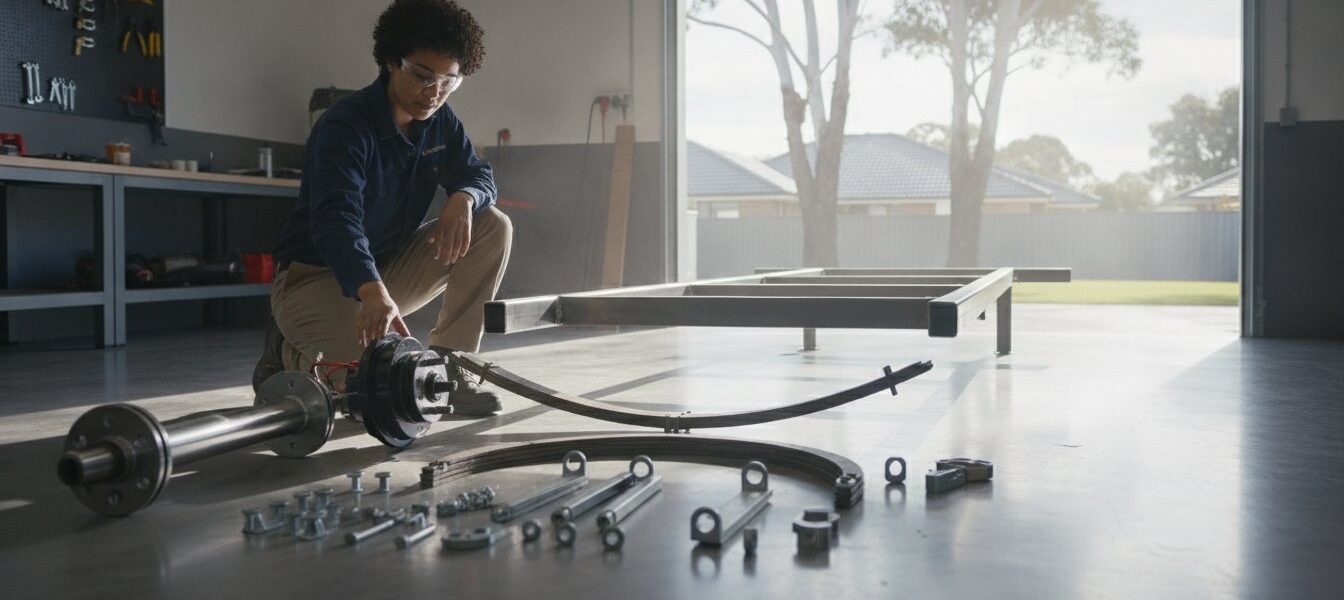
A trailer is more than a steel frame welded together; it’s a Trailer (vehicle) engineered as a coordinated mechanical system. Every component must work in unison to handle the stresses of Australian roads. A pre-configured trailer kit functions as a technical solution that ensures every part is rated for the same maximum load. Using a kit simplifies your DIY trailer build parts list because it removes the risk of mismatched hub and axle ratings. When you source parts individually, you might accidentally pair a 1400kg axle with bearings only rated for 1000kg. A kit eliminates this dangerous mechanical discrepancy.
In Australia, all trailer hardware must comply with the Vehicle Standards Bulletin 1 (VSB 1). These standards dictate the strength and performance requirements for everything from safety chains to braking systems. Choosing ADR-compliant hardware is mandatory for passing the federal ROVER approval process. High-quality kits focus on mechanical synergy, ensuring the coupling, suspension, and axles are all engineered to meet the same Gross Trailer Mass (GTM) specifications.
The Core Mechanical Checklist
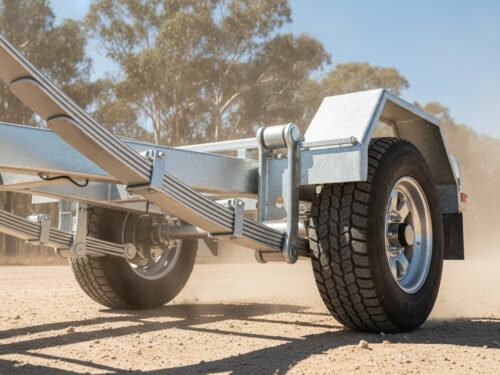
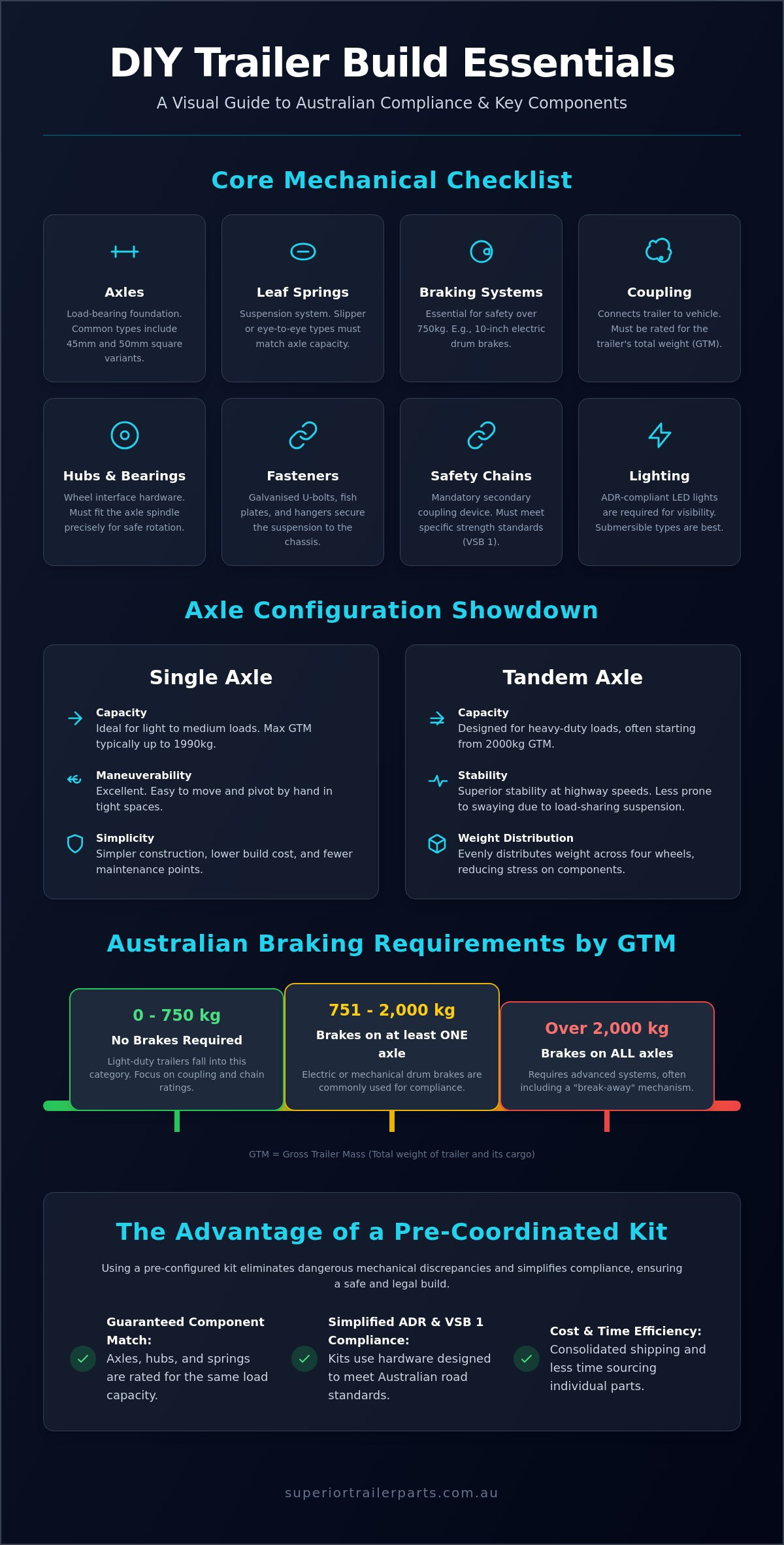
At the center of every build are the load-bearing components. This includes axles, such as 45mm square or 50mm square variants, and the corresponding leaf springs. Whether you choose 4 leaf slipper springs or 5 leaf eye-to-eye springs, the suspension must match the axle’s capacity. Wheel interface hardware is equally critical. You need hubs, high-quality bearings, and grease seals that fit the spindle precisely. Fastening systems like galvanised U-bolts, fish plates, and spring hangers secure these systems to your chassis. Don’t overlook the coupling, which must be rated for the total weight of the trailer and its cargo.
Advantages of the Kit Approach
The primary benefit of a kit is guaranteed weight capacity alignment. When you buy a 2000kg tandem kit, you know the rocker roller spring sets and the 10-inch electric drum brakes are designed to work together. This technical certainty is vital for safety. Bundled kits also provide cost-efficiency through consolidated shipping. Axles and leaf springs are bulky items; receiving them in a single shipment reduces logistical hurdles and costs. For small-scale manufacturers and DIYers, this approach streamlines project management. You can focus on the fabrication of the frame while knowing your DIY trailer build parts list is technically sound and ready for assembly.
Comparing Single Axle and Tandem Axle Configurations
Choosing between a single or tandem axle configuration is the most significant decision for your DIY trailer build parts list. This choice dictates the chassis design, the suspension type, and the legal weight capacity of the finished build. While a single axle setup is simpler to construct, a tandem axle configuration offers mechanical advantages for heavier loads that a single axle cannot match. It’s the difference between a light utility trailer and a heavy-duty transport tool.
Weight distribution remains the primary benefit of a dual axle system. Tandem trailers use load-sharing suspension, such as rocker roller spring sets, to distribute the weight evenly across all four wheels. This prevents one axle from being overloaded when traversing uneven terrain or speed bumps. In contrast, a single axle trailer places the entire burden on two tyres and one set of bearings. This makes the single axle configuration more sensitive to how you position the cargo within the trailer bed.
Manoeuvrability is where the single axle shines. You can easily pivot a 6×4 box trailer by hand in a tight driveway. Tandem trailers are more difficult to turn manually because the tyres scrub against the pavement during tight rotations. However, this resistance translates to superior stability at highway speeds. Tandem trailers are less prone to swaying or snaking when passing large vehicles. Choosing the right configuration for your DIY trailer build parts list ensures the vehicle handles predictably on rural Australian roads.
Single Axle Kits: Versatility for Light Loads
Single axle kits are the standard for heavy duty single axle box trailers. For trailers with a GTM under 750kg, no braking system is required. This keeps the build cost low. Once you exceed 750kg, you must add at least one braked axle. These builds are limited to a maximum GTM of 1990kg. They are preferred for lower maintenance costs, as you don’t have as many bearings and tyres to monitor for wear.
Tandem Axle Kits: Capacity and Safety
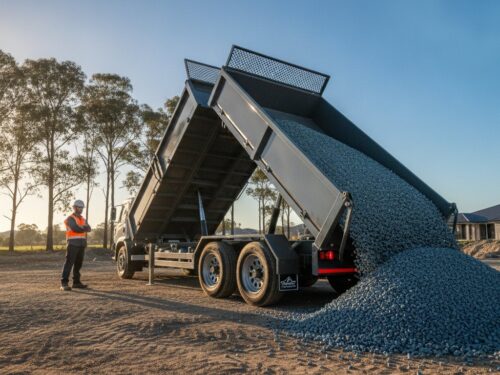
When your build requirements exceed 2000kg, a tandem axle configuration is mandatory. This is the standard for car haulers and large tippers. A dual-axle system provides a massive increase in braking capacity. You can install 10-inch electric drum brakes on all four wheels. This setup is essential for safely stopping heavy plant equipment. While the investment in a tandem axle trailer is higher, the safety margins are significantly better for high-capacity applications.
Suspension and Braking Systems for Custom Builds
The suspension and braking systems determine how your trailer handles under pressure. These are not just individual components; they are safety-critical systems that must be matched to your Gross Trailer Mass (GTM). A poor choice here leads to frame fatigue or dangerous stopping distances. When refining your DIY trailer build parts list, you must prioritise hardware that meets Australian Design Rules (ADR) for both reliability and legal compliance. These systems work together to ensure the trailer remains stable during sudden manoeuvres or heavy braking.
Leaf Spring Variations: Slipper vs Rocker Roller
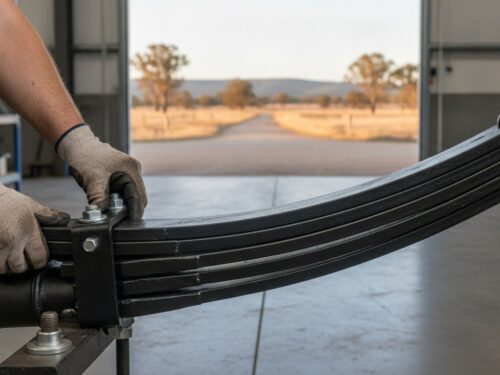
Slipper springs are the standard choice for light-duty, single-axle builds. They use a fixed front eye and a rear tail that slides through a keeper. This simple design is cost-effective and keeps maintenance requirements low. For tandem trailers, rocker roller spring sets are the industry benchmark. They feature a central pivoting arm that shares the load between axles when driving over uneven ground. Correctly rated leaf springs reduce road vibrations and prevent stress fractures in the trailer frame over time.
Braking Technology: Mechanical, Electric, and Hydraulic
Australian regulations specify clear thresholds for braking systems. Trailers with a GTM up to 750kg require no brakes. Between 751kg and 2000kg, you must install brakes on at least one axle. Over-run or override brakes are permitted in this weight range. Once you exceed 2000kg, brakes are mandatory on all wheels. You must also include an emergency breakaway system that remains applied for at least 15 minutes if the trailer disconnects.
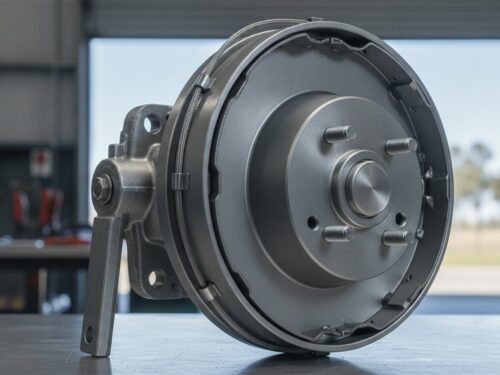
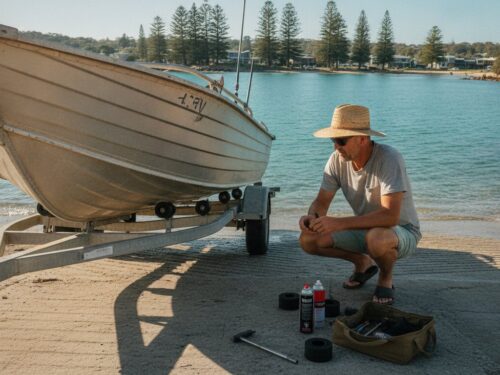
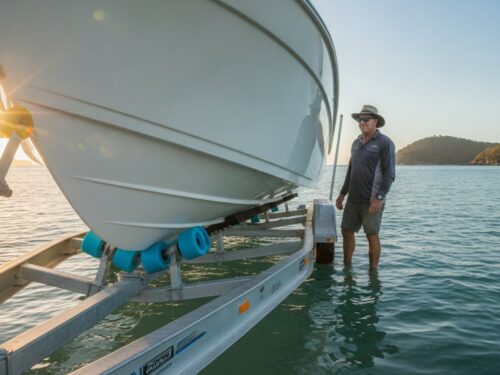
9-inch mechanical drum brakes provide a reliable solution for trailers in the 751kg to 1990kg bracket. If your project is a heavy-duty car hauler or plant trailer, 10-inch electric drum brakes are the preferred choice. They allow the driver to adjust braking force from the cab. For marine applications, hydraulic disc brake kits are essential. They offer better resistance to saltwater corrosion compared to standard drum systems. Your DIY trailer build parts list should reflect the specific environment where the trailer will operate.
Selecting the right coupling completes the system. A 2-hole or 3-hole fixed coupling is sufficient for unbraked trailers. If your build requires brakes, you will need a 4-hole over-ride coupling or a specialised poly block off-road coupling. Always ensure the couplings and parts you select meet or exceed the total GTM of your build. This ensures the connection to your tow vehicle remains secure under maximum load conditions.
Matching Hardware to Gross Vehicle Mass (GVM) Requirements
Gross Vehicle Mass (GVM) is the total weight the trailer axles can legally support. This figure includes the weight of the trailer itself plus the maximum payload. Your DIY trailer build parts list must be engineered from the ground up to support this weight. A common error is assuming the axle rating alone determines the capacity. The lowest-rated component in your assembly dictates the entire trailer’s legal limit. If you pair a 1450kg axle with 1000kg springs, the trailer is legally capped at 1000kg. Safety and compliance depend on matching every fastener, hub, and spring to the intended load tier.
Engineering for a margin of safety is standard practice in the transport sector. You shouldn’t operate a trailer at 100% of its rated capacity constantly. Selecting hardware that exceeds your expected maximum load ensures longevity and reduces component fatigue. This is particularly important for trailers used on corrugated rural roads or in industrial environments where loads are often unevenly distributed.
The 750kg GVM Tier: Unbraked Solutions
Light builds under 750kg are the most common DIY projects. For a standard heavy duty single axle box trailer, unbraked hubs and slipper springs are sufficient. These builds typically use 39mm round axles or 40mm square axles. These profiles are lightweight and cost-effective for utility trailers. You don’t need complex braking systems here; this simplifies the fabrication process and reduces the number of electrical connections required. Ensure you use galvanised U-bolts that match these specific axle diameters to prevent movement under load.
2000kg to 3500kg: Heavy-Duty Braked Tiers
Heavy-duty tiers require a shift in engineering logic. For trailers between 2000kg and 3500kg, you must move to 45mm or 50mm square axles. These thicker profiles handle the increased shear forces and bending moments of heavy loads. Any trailer exceeding a GVM of 2000kg must also have a breakaway system installed. This safety feature applies the brakes automatically if the trailer detaches from the tow vehicle. Tandem kits with 10-inch electric brakes are the standard for these weight classes; they provide the necessary stopping power for car haulers and plant trailers.
Selecting the right foundation is the first step in any project. You can find the correct axles for your specific weight requirements in our range to ensure your build is both safe and compliant.
Sourcing Quality Hardware for Australian Conditions
Australian road conditions are among the most demanding in the world. Corrugated outback tracks and salt-heavy coastal air quickly expose weaknesses in inferior hardware. When you finalise your DIY trailer build parts list, you must prioritise materials engineered for these extremes. Structural failure on a remote highway isn’t just a mechanical problem; it’s a significant safety risk. Sourcing high-tensile steel and corrosion-resistant coatings is the only way to ensure your build lasts. We see many projects fail because the builder prioritised initial cost over material durability.
Reliability also depends on the precision of the moving parts. High-quality bearings and grease seals are essential to prevent hub overheating during long hauls in high ambient temperatures. You need a supplier that understands the specific stresses placed on a trailer’s undercarriage. Logistics also play a vital role in your build timeline. Moving heavy components like 50mm square axles or rocker roller sets requires a reliable national shipping network. You don’t want your project stalled because a supplier cannot deliver bulky items to your regional workshop or fleet depot.
Durability Features: Galvanisation and Material Strength
Corrosion is the primary enemy of trailer longevity. Protecting the chassis and sub-frame requires more than just a coat of paint. You should use galvanised U-bolts and hardware kits to prevent rust from seizing your fasteners. This is especially critical for boat trailers or utility trailers stored outdoors. Identifying trailer parts built for industrial use ensures that your suspension hangers and fish plates won’t buckle under maximum GVM. These components are the foundation of a resilient build that can withstand years of heavy use without structural fatigue.
Technical Guidance for Your Project
Building a trailer is a technical undertaking that leaves no room for guesswork. Accessing expert advice to verify your component list before purchase saves you from expensive mistakes. A supplier that understands national compliance standards, including VSB 1 and the ROVER approval process, is a valuable ally for any builder. They can help you confirm that your 10-inch electric drum brakes and couplings are correctly rated for your specific application. Contact Superior Trailer Parts for technical support to ensure your DIY project meets every safety and legal requirement before you hit the road. We stand behind the hardware we provide because we know the conditions it must endure.
Build Your Trailer with Technical Confidence
Finalising your project requires more than just fabrication skills; it demands a precise alignment of hardware with GVM requirements and ADR standards. The integrity of your DIY trailer build parts list determines the safety and longevity of the vehicle on Australian roads. You don’t want to risk structural failure by using mismatched components. Whether you are assembling a light utility trailer with 39mm round axles or a heavy-duty tandem build with 10-inch electric brakes, every component must be rated for the task. Selecting high-tensile, galvanised hardware ensures your trailer resists fatigue and corrosion in harsh conditions.
We are an Australian-owned and operated specialist dedicated to providing the industrial-grade components you need. Our team offers national shipping on all trailer and caravan components to keep your project moving. We also provide expert technical support for DIY and trade builders who need to verify their specifications before assembly begins. Browse our range of DIY Trailer Kits to find a coordinated system that matches your load requirements. Start your build with the right foundation and create a trailer that performs reliably for years to come.
Frequently Asked Questions
What is typically included in a complete trailer kit?
A complete trailer kit contains all the mechanical hardware needed to get a chassis rolling. This includes axles, leaf springs, hubs, bearings, and grease seals. It also features the coupling, galvanised U-bolts, fish plates, and spring hangers required for mounting. These kits ensure every part in your DIY trailer build parts list is rated for the same weight capacity, eliminating the risk of component mismatch.
Are brakes legally required for a 750kg trailer build?
No, trailers with a Gross Trailer Mass (GTM) of 750kg or less don’t legally require a braking system in Australia. You can use unbraked hubs and a standard fixed coupling for these light utility builds. However, if the GTM exceeds 750kg, you must install brakes on at least one axle. Maintaining compliance with these weight thresholds is essential for passing federal ROVER approval and ensuring road legality.
What is the difference between slipper and rocker roller suspension?
Slipper springs are a simple, cost-effective suspension type where the rear of the spring slides through a keeper. They’re ideal for single-axle trailers and light-duty applications. Rocker roller sets are more complex systems designed for tandem axles. They feature a central pivot point that shares the load between both axles. This load-sharing capability is essential for maintaining stability and preventing axle overload on uneven ground.
Can I use a single axle kit for a trailer rated at 2000kg GVM?
No, you can’t use a single axle for a trailer with a 2000kg GVM in Australia. National regulations mandate that trailers exceeding 1990kg GTM must use a tandem axle configuration. Additionally, trailers over 2000kg require brakes on all wheels and a mandatory emergency breakaway system. For these heavy-duty applications, you must use a tandem kit with 45mm or 50mm square axles to handle the load.
How do I determine the correct axle size for my trailer parts list?
Axle size is determined by the maximum load the trailer will carry. A 39mm round or 40mm square axle is generally sufficient for unbraked trailers up to 750kg. For builds approaching 1400kg, a 45mm square axle is the industry standard. If your DIY trailer build parts list targets a 2000kg to 3500kg rating, you must use 50mm square axles to handle the increased shear forces and bending moments.
Do these trailer kits comply with Australian Design Rules (ADR)?
Yes, all components within our kits are engineered to meet or exceed relevant Australian Design Rules. This includes couplings, safety chains, and LED submersible tail lights. Using ADR-compliant hardware is a mandatory requirement for the federal ROVER approval process. We source high-tensile steel and galvanised components to ensure your build passes inspection and remains safe for long-term road use across Australia.
Can I customise the components within a pre-packaged trailer kit?
You can customise your kit to suit specific project needs. While pre-packaged kits offer coordinated weight ratings, you might need to swap 4 leaf slipper springs for 5 leaf eye-to-eye springs or change a fixed coupling for an over-ride version. We provide technical support to help you adjust your hardware selection while ensuring all parts remain compatible and correctly rated for your intended Gross Vehicle Mass.
Is national shipping available for heavy items like axles and springs?
We provide national shipping across Australia for all heavy trailer and caravan components. Axles, leaf springs, and drum brake kits are bulky items that require reliable logistics. Our distribution network ensures these parts reach your workshop or depot efficiently. We prioritise secure packaging to prevent damage to threads or machined surfaces during transit, ensuring your hardware arrives ready for immediate assembly and installation.