A single miscalculation of your 5 leaf eye to eye springs capacity could be the difference between a successful haul and a snapped suspension on a remote corrugated track. Many trailer owners struggle to distinguish between single and pair ratings, which often leads to dangerous overloading. It’s a common point of confusion that puts both your cargo and your roadworthiness at risk. Under the *Road Vehicle Standards Act 2018*, ensuring your suspension meets specific safety requirements is now a legal necessity for all Australian trailers.
You probably want to confirm your trailer’s legal load limit and identify the correct leaf thickness for your specific application. This article explains how to accurately calculate these ratings to ensure your trailer remains safe and compliant with current VSB1 guidelines. We’ll cover the technical details of measuring eye centres and matching your springs to the right axle, whether you’re using 45mm square or 50mm square hardware. This overview provides the technical clarity needed to maintain a reliable, roadworthy trailer.
Key Takeaways
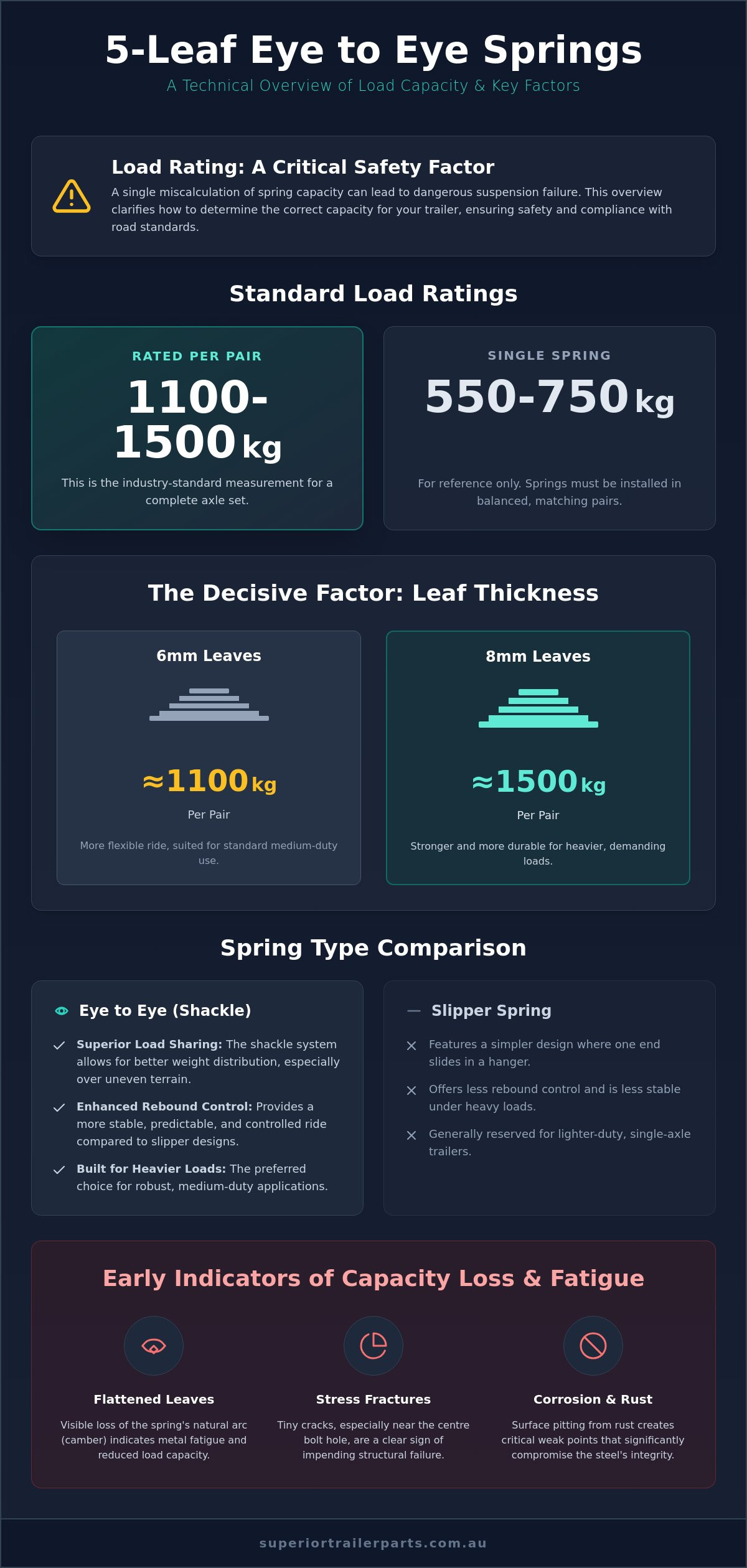
- Confirm that standard 5 leaf eye to eye springs capacity generally falls between 1100kg and 1500kg per pair for medium-duty use.
- Determine how leaf thickness variations between 6mm and 8mm dictate the overall strength and durability of the suspension stack.
- Calculate your Aggregate Trailer Mass (ATM) requirements to ensure your springs correctly match your axle and coupling ratings.
- Spot early indicators of capacity loss including flattened leaves and stress fractures near the centre bolt.
- Measure eye-to-eye centres accurately before purchase to guarantee a proper fit and maintain correct trailer geometry.
Load Ratings for 5 Leaf Eye to Eye Springs
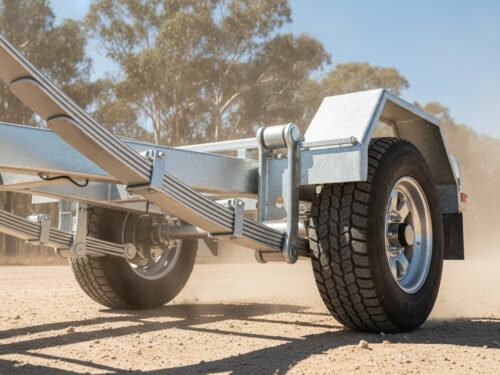
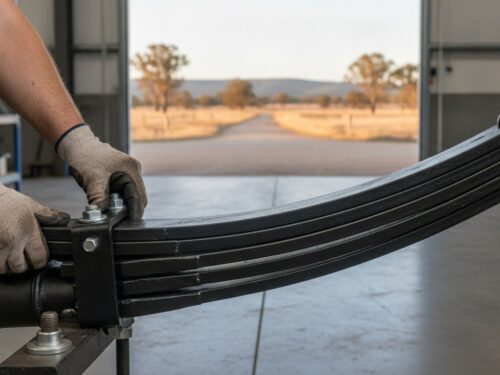
The fundamental design relies on a Leaf spring stack that flexes under load to absorb road energy. However, leaf count alone isn’t a definitive measure of weight capacity. A common mistake is assuming all 5 leaf sets are equal. The actual strength is determined by the width of the steel and the thickness of each individual leaf. Using five leaves of 6mm steel results in a much lower capacity than a stack using 8mm steel. Always verify the steel gauge before assuming a spring is fit for your Aggregate Trailer Mass (ATM).
Single Spring vs. Pair Capacity
In the Australian transport industry, suspension is almost always rated by the pair. This matches how trailer axles are categorised. While a single 5 leaf spring is typically rated between 550kg and 750kg, you must install them as a balanced set. If you mix and match different ratings on the same axle, the trailer will pull to one side. This also causes uneven tyre wear and poor braking performance. The industry-standard 1500kg rating is specifically reserved for 45mm wide by 8mm thick leaf sets.
Eye to Eye vs. Slipper Spring Capacity
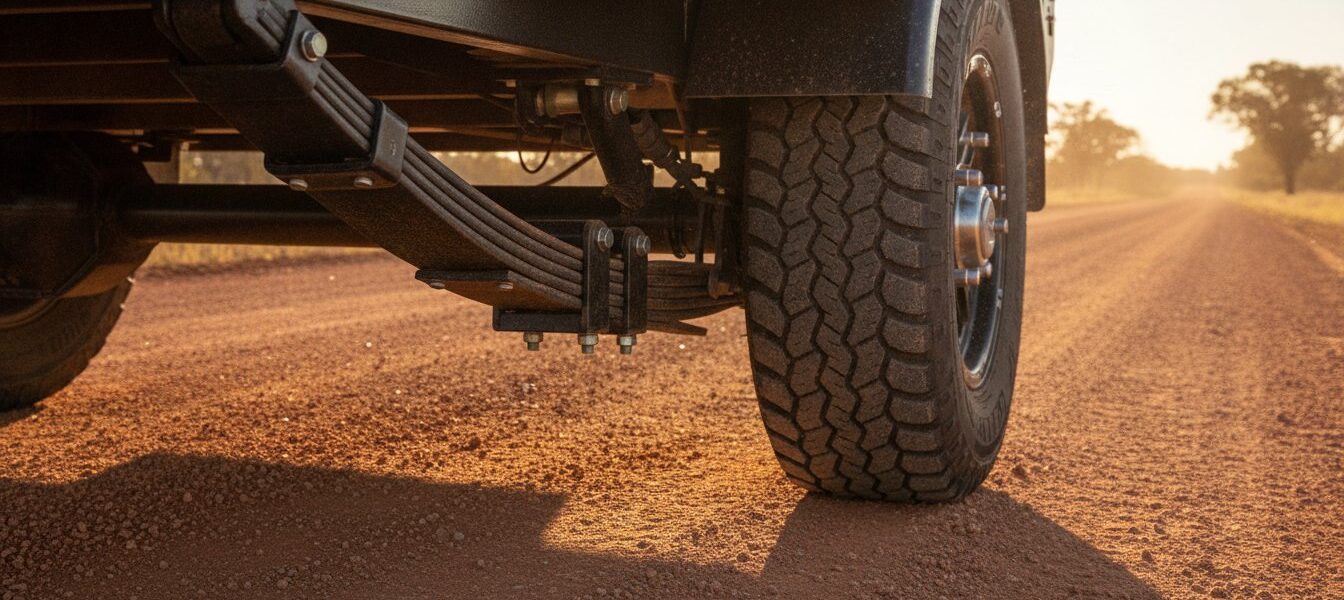
Eye-to-eye springs offer superior load-sharing capabilities compared to slipper springs. While slipper springs simply slide in a rear hanger, the shackle system in an eye-to-eye setup allows for better rebound control. This is a critical factor when hauling heavier loads over uneven terrain or corrugated roads. The shackle angle at the rear of the spring also plays a role in performance. A shackle angled at approximately 45 degrees provides the best balance between flexibility and support. If the angle is too flat, the effective spring rate increases. This makes the ride harsh and can lead to stress fractures in the trailer frame.
Factors Influencing 5 Leaf Spring Strength
Steel quality and dimensions dictate the final performance of your suspension system. While 45mm is the industry standard width for most Australian trailers, the thickness of each individual leaf is the primary variable. A 5 leaf set using 6mm steel will typically carry roughly 1100kg per pair. In contrast, upgrading to 8mm steel increases the 5 leaf eye to eye springs capacity to a reliable 1500kg. High-tensile spring steel is essential for Australian roads to prevent the leaves from sagging or snapping under heavy vibration. The 45mm width provides the lateral stability needed to prevent the trailer from swaying during cornering.
Corrosion is a silent killer of spring capacity. Standard black paint offers basic protection for dry-land box trailers, but it wears off quickly. For coastal areas or salt-water exposure, galvanised or Dacromet coatings are necessary. Rust creates pitting on the steel surface. These pits act as stress points where cracks eventually develop. A rusted spring loses its structural integrity long before it physically breaks. If you’re building a marine setup, browse our range of boat trailer parts to find corrosion-resistant options that maintain their rating over time.
Leaf Thickness and Stack Height
A 5-leaf stack works progressively. Under light loads, the primary leaves provide flex to absorb small bumps. As the weight increases, the shorter lower leaves provide the necessary resistance to keep the trailer level. A 6mm leaf offers more flex for a smoother ride but lacks the heavy-duty support of an 8mm leaf. This thickness also determines your total stack height. A thicker stack requires longer galvanised U-bolts to securely clamp the spring to the axle. Always measure your total stack height before ordering hardware to ensure you have enough thread for the nuts to engage fully.
Length and Camber Specifications
Most Australian eye-to-eye springs measure between 630mm and 710mm from centre to centre. Shorter springs are generally stiffer and suited for compact trailers. Longer springs offer a softer ride because they have more room to flex under pressure. Free camber refers to the height of the arc when the spring is uncompressed. A higher camber usually indicates a higher load-bearing potential, but it also raises the trailer’s centre of gravity. You must balance the arc height with your desired deck height to maintain stability. If the camber is too low, the spring may invert under a full load, which drastically reduces its effective lifespan.
Calculating Trailer GVM with 5 Leaf Suspension
To build a roadworthy trailer in Australia, you must understand the difference between Aggregate Trailer Mass (ATM) and Gross Vehicle Mass (GVM). The ATM is the total weight of the trailer and cargo when uncoupled. The GVM is the weight on the tyres when hitched. Your 5 leaf eye to eye springs capacity must support the full ATM to ensure legal compliance. If your springs are underrated, the trailer will sag, causing the axle to bottom out against the chassis rail. This leads to frame damage and potential tyre blowouts. Always match spring capacity to your trailer axles rating to ensure the entire assembly can handle the load.
Don’t push your suspension to its absolute limit. Follow the 10% safety rule. If your trailer has a 1400kg ATM, don’t use 1400kg springs. Opt for a 1500kg set instead. This buffer accounts for uneven weight distribution and the dynamic forces of hitting potholes at highway speeds. Remember that tare weight (the empty trailer) consumes a portion of your capacity. If your box trailer weighs 400kg and you have 1500kg springs, your actual payload is 1100kg. Overlooking this calculation is a primary cause of roadside suspension failure on Australian highways.
Matching Springs to Axle Ratings
Match your components for a balanced system. Pairing 1500kg springs with 45mm square axles is a standard configuration for heavy-duty single-axle builds. Your couplings must also share this rating. A 2000kg coupling is suitable for a 1500kg suspension, but a 750kg coupling creates a dangerous legal mismatch. Avoid over-springing light trailers. Putting 1500kg springs on a 6×4 garden trailer causes the trailer to bounce violently when empty. This reduces tyre contact with the road and can lead to loss of control during emergency braking.
Tandem Axle Capacity Calculation
For dual axle tandem trailers, you use four springs to distribute the load. In a 2000kg GVM setup, four springs rated at 550kg each provide 2200kg of total capacity. For a 3000kg GVM trailer, you need four 800kg springs. Tandem setups require load-sharing rocker arms. These ensure that when one axle hits a bump, the load is distributed to the other axle. Without rockers, one pair of springs can momentarily take the entire trailer weight. This exceeds the 5 leaf eye to eye springs capacity for that specific pair, leading to immediate leaf failure or shackle bolt shearing.
Signs of Fatigue and Capacity Loss
Suspension systems don’t always fail with a loud snap. Most capacity loss happens gradually as the steel loses its elastic memory. A healthy 5 leaf spring should maintain a clear upward arc, known as positive camber. If you notice your trailer sitting lower than usual or the leaves appearing flat under a standard load, the 5 leaf eye to eye springs capacity is likely compromised. In extreme cases, the leaves may even invert, curving downward toward the road. This negative camber indicates the steel is fatigued and can no longer support its rated ATM.
Visual inspections are your first line of defence against roadside failure. Look for stress fractures around the centre bolt and the eyes where the shackle bolts pass through. If you see “bleeding” rust-orange streaks coming from between the leaves-it’s a sign of internal friction and metal-on-metal wear. This friction thins the leaves over time. As established earlier, leaf thickness is the primary driver of strength. If rust scales off 1mm of steel from an 8mm leaf, the spring’s legal and physical capacity drops significantly. You can also measure for “axle walk” by checking the distance from the hitch to the axle ends. If the measurements aren’t identical, the springs have likely stretched or the mounting hardware has shifted.
If your trailer is bottoming out or showing signs of sag, replace your suspension before the next haul. Browse our range of 5 leaf eye to eye springs to restore your trailer’s original load rating.
Bush and Shackle Bolt Inspection
The eye-to-eye system relies on shackle bolts and bushes to function. Nylon bushes often wear into an oval shape, creating “slop” in the suspension. Brass bushes are more durable but can seize if not lubricated. Inspect your shackle bolts for “notching,” which are grooves worn into the bolt by the bush. These notches prevent the spring from lengthening as it compresses. This restriction makes the suspension feel rigid and transfers all road shock directly to the chassis, which can lead to frame cracking.
When to Replace Your Leaf Springs
Always replace leaf springs in pairs. If you only replace one side, the trailer will lean toward the older, softer spring. This imbalance affects braking performance and causes uneven tyre wear. Avoid the temptation to add a “helper leaf” to a fatigued stack. Adding new steel to a tired 5-leaf set doesn’t fix the metal fatigue in the original leaves; it simply creates a pivot point that can cause the old leaves to snap. For detailed service intervals and maintenance schedules, refer to Essential Trailer Parts: A Resource for Maintenance and Repair.
Selecting the Right 5 Leaf Springs for Your Trailer
Accuracy is everything when ordering replacements. Before purchasing, measure your eye-to-eye centres while the trailer is jacked up and the suspension is hanging free. Common Australian lengths like 630mm or 710mm aren’t interchangeable. If you select the wrong length, the shackle plates won’t sit at the correct 45-degree angle. This misalignment compromises the 5 leaf eye to eye springs capacity by preventing the stack from flexing properly under load. It’s a technical detail that many builders overlook, leading to a harsh ride and premature wear.
Match the finish to your operating environment. For standard box trailers used for general cartage or trades, a painted finish is sufficient. However, if you’re building or repairing a marine trailer, you must use galvanised springs. Saltwater trapped between the leaves causes rapid oxidation and structural failure. Sourcing specific boat trailer parts ensures your suspension withstands harsh Australian coastal conditions. Technical compatibility also extends to your mounting hardware. Most Australian eye-to-eye springs are designed for 9/16 inch shackle bolts. Don’t try to force metric bolts into these eyes. The resulting play causes vibration that eventually elongates the spring eye and reduces the stability of your trailer.
Why Quality Spring Steel Matters
Low-grade imports often use recycled steel that lacks consistent carbon content. This leads to “memory loss” where the spring stays flat after the first heavy load. Professional-grade springs use heat-treated high-tensile steel that meets Australian Design Rules (ADR). This ensures the suspension maintains its 5 leaf eye to eye springs capacity through thousands of compression cycles. High-quality suspension is the foundation of trailer safety. Sourcing from an Australian-owned specialist provides the technical support needed to ensure your components are fit for purpose.
Final Checklist Before Ordering
Run through these technical specifications before confirming your order to avoid installation delays:
- Verify your axle diameter (39mm, 40mm, 45mm, or 50mm) to select the correct u-bolt kit.
- Confirm your hanger width; while 45mm is the industry standard, some heavy-duty setups require 50mm hangers.
- Check that your shackle plates are in good condition and aren’t bent or rusted thin.
- Ensure your bushes are seated firmly and lubricated with the appropriate grease if using brass.
For nationwide shipping or technical help with your selection, contact Superior Trailer Parts. Our team provides expert advice to ensure your trailer remains roadworthy and reliable under the toughest Australian conditions.
Restore Your Trailer’s Roadworthiness
Maintaining a safe trailer requires a precise understanding of your suspension’s limits. We’ve established that 5 leaf eye to eye springs capacity depends heavily on leaf thickness and accurate eye-to-eye measurements. Matching these components to your trailer’s ATM and axle rating is the only way to ensure legal compliance on Australian roads. Regular inspections of shackle bolts and bushes will prevent minor wear from turning into a major failure. Choosing high-tensile steel over low-grade alternatives protects your investment and your safety.
Superior Trailer Parts is proudly Australian owned and operated. We provide nationwide shipping across Australia to ensure you get the hardware you need without delay. Our technical experts are available to assist both trade professionals and DIY builders with specific mechanical queries. Don’t risk your cargo on fatigued or underrated suspension. Shop our range of high-performance 5 leaf eye to eye springs to get your trailer back in peak condition. You’ve got the knowledge to make the right choice for your next build.
Frequently Asked Questions
What is the weight rating of a 5 leaf eye to eye spring?
A standard set of 5 leaf springs is typically rated between 1100kg and 1500kg per pair. The exact capacity depends on the leaf thickness and width. Most Australian medium-duty trailers use 45mm wide springs. Always check the manufacturer’s specification for the single spring rating, which is usually half the pair capacity. Ensure your total Aggregate Trailer Mass doesn’t exceed this combined rating to maintain roadworthiness.
Can I use 5 leaf eye to eye springs on a boat trailer?
You can use these springs on boat trailers provided they have a galvanised or Dacromet finish. Saltwater environments cause rapid corrosion on standard painted springs, which leads to pitting and structural failure. Using corrosion-resistant hardware is essential for marine applications to ensure the 5 leaf eye to eye springs capacity isn’t compromised by rust. Match them with galvanised U-bolts for a complete saltwater-ready suspension setup.
How do I measure eye to eye springs for replacement?
Measure the distance from the centre of one eye to the centre of the other while the spring is uncompressed. It’s best to do this with the trailer jacked up so the suspension hangs free. Common Australian sizes include 630mm and 710mm centres. Don’t measure along the curve of the steel. Use a straight line between the bolt holes to ensure you order the correct replacement size for your hangers.
What is the difference between 6mm and 8mm leaf thickness?
The primary difference is the load-bearing capacity and ride stiffness. A 6mm leaf is more flexible and suited for lighter loads, typically providing a 1100kg rating per pair. An 8mm leaf is more rigid and increases the rating to 1500kg per pair. Thicker leaves handle heavy-duty hauling better but can result in a bouncy ride if the trailer is empty. Choose your thickness based on your primary payload requirements.
Do 5 leaf springs come with bushes included?
Most 5 leaf springs come with nylon bushes pre-installed in the eyes. These are standard for general-purpose trailers and provide a quiet, maintenance-free ride. Some heavy-duty or off-road variants might offer brass bushes instead, which require regular greasing. Always verify with your supplier if the shackle bolts and hangers are included, as these are often sold separately as part of a complete suspension kit.
What happens if I overload my 5 leaf springs?
Overloading causes the leaves to lose their camber and eventually invert. This puts excessive stress on the centre bolt and shackle eyes, which can lead to the steel snapping under vibration. Your axle may also bottom out against the chassis, damaging the frame and blowing out tyres. Operating beyond the rated 5 leaf eye to eye springs capacity is illegal in Australia and significantly increases the risk of a high-speed accident.
Are eye to eye springs better than slipper springs for heavy loads?
How many leaves do I need for a 1500kg trailer?
For a 1500kg ATM trailer, you need a 5-leaf set with 8mm thick leaves. While a 6-leaf or 7-leaf set could also reach this capacity, the 5-leaf 8mm configuration is the industry standard for 45mm wide suspension. Ensure your axle, hubs, and tyres are also rated for 1500kg to create a balanced system. Using a 5-leaf 6mm set for this weight would result in dangerous sagging and suspension failure.